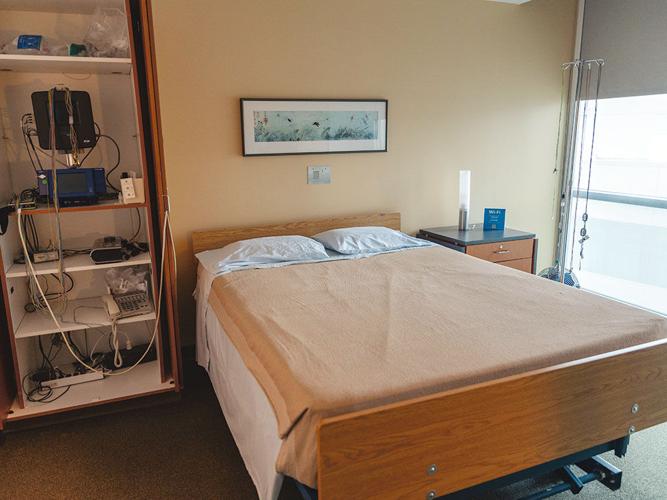


At CHOMP’s Sleep Disorders Center, clinicians split in-house sleep studies – in the first half they monitor the patient and during the second half they provide CPAP (a machine that uses pressure to keep airways open).
THERE MIGHT BE A FEW HABITS THAT FIRST COME TO MIND WHEN YOU THINK ABOUT MAINTAINING A HEALTHY BODY – a balanced diet, drinking water, regular exercise. But there is another activity, even if it feels like a state of inactivity, that fuels a healthy body and mind: sleep.
During sleep, the body and mind reset. The body releases hormones and proteins, nerve cells reorganize and our brain stores information. “Sleep is not an inactive phenomenon,” says Mazhar Javaid, a sleep medicine specialist at Salinas Valley Health.
Quality of sleep is directly proportional to quality of life, and it goes beyond crankiness or tiredness, Javaid says. It can affect short-term memory, learning, sex life, growth in children and chronic health problems including heart disease, obesity, depression and anxiety.
“Sleep deprivation on a regular basis also impairs our immune system,” says Richard Kanak, medical director for Community Hospital of the Monterey Peninsula’s Sleep Disorders Center, highlighting that without sufficient sleep, our bodies are less likely to be equipped to fight illnesses, including some as serious as cancer.
Good sleep among teens and children can affect their behavior, concentration and learning. During sleep is also when the body releases growth hormone. “If you talk to a teenager nowadays, they will say sleep is a waste of time,” Javaid says, but research shows the opposite. According to the American Physiological Association, adolescents need about 9.25 hours of sleep every night. During the 2022-2023 school year, California became the first state to implement late start in schools with an 8:30am start time so students can get more sleep, the result of a 2019 state law.
“[Parents] have no idea that a 10-year-old child needs about 10 to 11 hours of sleep at night,” Javaid adds.
The National Sleep Foundation recommends a minimum of seven hours of sleep per night for adults. However, in 2020 the U.S. Centers for Disease Control reported that one-third of American adults sleep less than seven hours.
Some of those adults – some 200 patients are referred per month to SVH and 160 to CHOMP – become sleep center patients, seeking a solution to sleeplessness.
KANAK SAYS IT IS A MISCONCEPTION PEOPLE SHOULD FALL ASLEEP AS SOON AS THEIR HEAD TOUCHES THE PILLOW. Falling asleep instantly is a sign of sleep deprivation; for someone with good sleep habits, it can take between 10 and 20 minutes to fall asleep.
Despite sleep being essential to wellness, most people with sleep deprivation never see a sleep specialist.
But specialists say the stigma around sleep disorders has changed over the past few decades. Doctors and patients are more aware of how important sleep is, and people are more willing to seek professional help if they snore, suffer from insomnia or suspect they have sleep apnea.

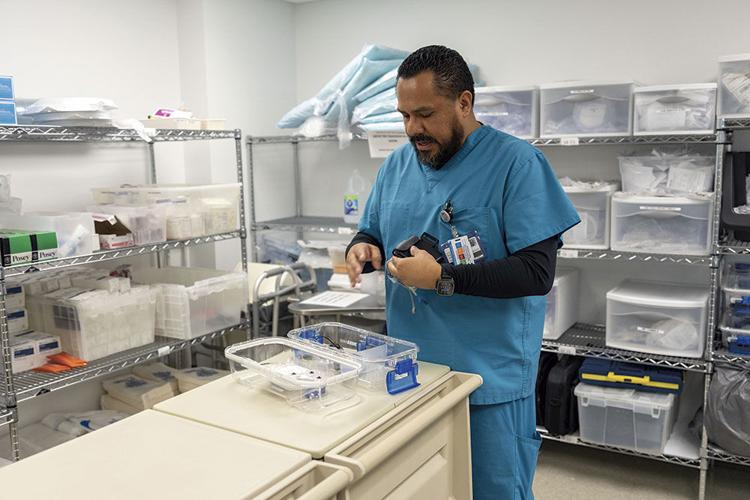
Jesus Cazares, a supervisor, shows a kit patients take for at-home sleep apnea studies.
Some common sleep disorders include sleep apnea (ceasing breathing during sleep) – accounting for some 90 percent of patients referred to a sleep specialist – as well as insomnia and restless leg syndrome. Snoring, feeling sleepy, and waking up with headaches may be common symptoms of sleep apnea; people with narrow faces, high-arched roofs of their mouths, and small lower jaws are more prone to the condition.
Sleep medicine is a relatively new field that was born in the second half of the 20th century to promote good sleep habits and treat people with sleep disorders. Thanks to computers and sleep monitors, the field has rapidly developed and specialists can collect information from sleep phases based on brain activity, body movements and breathing.
Sleep studies (not all health insurance covers them) can give specialists a way to discover the patient’s sleep quality. They gather an array of information including how long the patient took to fall asleep, if they woke up during the night, if they stopped breathing or moved during their sleep, and more.
The study entails attaching a number of devices to your body before falling asleep, and some kits are designed for patients to use at home in their own bed.
For example, a sleep apnea test kit comes with two belts, a nasal cannula to monitor breathing and a pulse oximeter to measure oxygen levels. There are cables to connect those devices to a recorder. At bedtime, the oximeter goes on a patient’s index finger, the cannula is affixed to their face and the belt around their chest. Next, it’s time to go to sleep and let the data come in.
If patients conduct their sleep study at the center, “we always recommend that if they have a favorite pillow to bring that, as well as a favorite blanket,” says Jesus Cazares, a supervisor at the CHOMP Sleep Disorders Center.
Cazares notes a home study provides a more comfortable environment for sleeping, but one at the center provides more detailed information including monitoring the stages of sleep from light to deep and REM sleep (the stage of sleep where people have dreams). There, the team can also conduct other analyses including for narcolepsy (a sleep disorder that causes drowsiness during the day) and sleep-related breathing disorders.
Some patients get a diagnosis of a sleep disorder that can be treated by changing sleep habits, medication, surgery or wearing a device. (In case of sleep apnea, a continuous positive airway pressure or CPAP device is often prescribed.)
Some habits can contribute to good sleep for everyone, whether or not you struggle with sleep. Kanak recommends things like minimizing light exposure (including TV and phone screens); using the bedroom for sleep and sex only; and avoiding caffeine, alcohol and nicotine at night.
Kanak notes that good sleepers can break all these rules and still sleep well. “It’s not something everybody needs to do compulsively, but more so when you have trouble falling asleep at night,” he says.
Exercising and eating a light dinner are two other factors that experts say aid a better night’s sleep. For people who can’t sleep their seven hours at night (because of work, for example), Kanak recommends taking 20-30 minutes naps.
Of course, doctors can give advice, but they run up against culture. “The most common sleep problem in America is people, through their own choices, burning the candle at both ends,” Kanak says. “[They] just frequently don’t get enough sleep.”
Correction:
The most common sleep disorder referral is sleep apnea and not insomnia. Dr. Kanak recommended 20-30 minutes naps (one to two hour naps are indication of sleep dipravation).
Sleep Tight
According to the U.S. Centers for Disease Control and Prevention, the amounts of sleep recommended by age group are below – it might be more than you think:
| AGE GROUP | RECOMMENDED HOURS OF SLEEP PER DAY | |
| 0-3 months | 14-17 hours (National Sleep Foundation) | |
| 4-12 months | 12-16 hours/24 hrs. (including naps) | |
| 1-2 years | 11-14 hours/24 hrs. (including naps) | |
| 3-5 years | 10-13 hours/24 hrs. (including naps) | |
| 6-12 years | 9-12 hours/24 hrs. | |
| 13-18 years | 8-10 hours/24hrs. | |
| 18-60 years | 7 or more hours per night | |
| 61-64 years | 7-9 hours per night | |
| 65+ years | 7-8 hours per night |


(1) comment
I agree. Sleep is absolutely essential. It's tricky, in old age, the metabolic rate decreases, and sleep becomes defective. A key to repair sleep is to repair metabolism. A trick for good sleep can be a bit of salt (as salt keeps adrenaline at bay) and some sort of saturated fat-- ice cream or milk, for example. Good article!
Welcome to the discussion.
Log In
Keep it Clean. Please avoid obscene, vulgar, lewd, racist or sexually-oriented language.
PLEASE TURN OFF YOUR CAPS LOCK.
Don't Threaten. Threats of harming another person will not be tolerated.
Be Truthful. Don't knowingly lie about anyone or anything.
Be Nice. No racism, sexism or any sort of -ism that is degrading to another person.
Be Proactive. Use the 'Report' link on each comment to let us know of abusive posts.
Share with Us. We'd love to hear eyewitness accounts, the history behind an article.