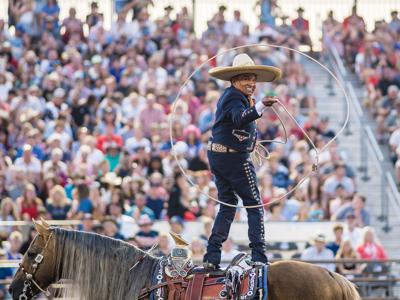

Some people say one must climb the ladder to reach the top. But Tomás Garcilazo started there.
From an early age, the third-generation charro dreamed of performing at rodeos. Raised in the tradition of La Charrería horsemanship and disciplined in floreo de reata – the Mexican art of trick roping – the Mexico City native was a veteran of parade and event performances even before his teenage years.
But rodeo was a calling, and in 1997, he gave his first specialty act at a rodeo – the Wrangler National Finals in Las Vegas.
Garcilazo has been back to the biggest of all rodeos every year since. But he returns this year to the California Rodeo Salinas for the first time since before the pandemic. And despite the accolades – he is a member of the Texas Cowboy Hall of Fame, has performed for Mexican presidents and been invited to the White House – Garcilazo’s excitement is evident as he speaks about his appearance.
“I like the interaction,” he says. “When I was a kid, I said I wanted to share this all over the world. I had a mission to share these skills and call it a job.”
A charro is a cowboy, but so much more. There is a look – tailor-made outfits, groomed horses – and a style of riding that is refined to the point where horse and cowboy act as one. Moreover, the rope work (floreo de reata) is demanding. Garcilazo selects the lariat, or lasso, for a particular show with respect to heat, humidity, time of day and the setting. Some ropes are better suited for an indoor event.
Garcilazo does not perform mere tricks with the rope. He and his horse are artists in the arena. There is an elegance to the movement, and the charro uses the rope as a form of expression.
His performance is authentic to tradition. But his career path was rather unusual.
For years, Garcilazo competed in Mexican roping events. So he was already an accomplished charro when Linda Ronstadt discovered a talent for mariachi. Her 1987 album Canciones de Mi Padre earned a Grammy. In 1992, he joined her tour supporting a follow-up album, Frenesí, performing onstage while Ronstadt sang. That led to a part in the Tony Award-winning Broadway musical The Will Rogers Follies.
“I had two lines,” Garcilazo recalls. “That was a challenge for me – and with my accent. But people loved it.”
He toured with the play for three years and credits the experience for improving his presence with audiences, as well as honing his sense of performance. A 1994 review in the Hartford Courant singles out Garcilazo’s roping display in the second act as “hypnotic,” adding that the horseman “seems as modest as [star Mac] Davis pretends to be.”
Garcilazo admits to being shy at the time. After taking a bow following his first show, he quickly left the stage. The director turned him back with a reminder that actors should share the appreciation.
“You have to connect with the crowd – the music and the excitement,” he says. “It’s learning how to present yourself.”
Following the success of The Will Rogers Follies, Garcilazo took his charro act to Europe. He traveled with the Buffalo Bill Wild West Show and was one of the stars of Disney’s Wild West Show during a two-year run in Paris.
While in France, Garcilazo met his wife, Justine, who shares his respect for animals and now manages the family business. He would perform at horse shows in his spare time and noticed her at one event. The next time he spotted her on horseback, Garcilazo’s rope missed its target – “accidentally” – catching her instead.
But he also got the break he had always wanted.
One evening a visiting American saw the show and was so taken by Garcilazo’s skills that he asked if the charro would be interested in a gig. Shawn Davis happened to be general manager of the National Finals Rodeo.
“And here I am,” Garcilazo says with a chuckle.
The family spends a lot of time on the road. Justine joins Garcilazo in the arena and their 11-year-old son Louis has already played to the Las Vegas crowd three times.
For the Salinas appearance, 3-year-old Ulysse also has a role – although it’s not his first rodeo. “He steals the show,” Garcilazo says. “People love it.”
Their involvement is important. When he toured with the musical, Garcilazo was on stage for up to eight shows a week. And he has remained on the road ever since, becoming an American citizen, moving first to California and then to Texas, but has always been called to rodeos.
That means homeschooling for Louis and his 5-year-old brother Gaspar. But, Garcilazo explains, “This way I don’t miss them growing up.”
Now almost 60, Garcilazo admits he is aging. But he says La Charrería and the dirt of the arena never gets old. So when he rides before the Salinas crowd, it’s where he always wanted to be – even when he was in the Broadway spotlight.
“I never quit thinking about it,” Garcilazo says of rodeos. “But it didn’t happen that way. The road took me elsewhere.”



(0) comments
Welcome to the discussion.
Log In
Keep it Clean. Please avoid obscene, vulgar, lewd, racist or sexually-oriented language.
PLEASE TURN OFF YOUR CAPS LOCK.
Don't Threaten. Threats of harming another person will not be tolerated.
Be Truthful. Don't knowingly lie about anyone or anything.
Be Nice. No racism, sexism or any sort of -ism that is degrading to another person.
Be Proactive. Use the 'Report' link on each comment to let us know of abusive posts.
Share with Us. We'd love to hear eyewitness accounts, the history behind an article.