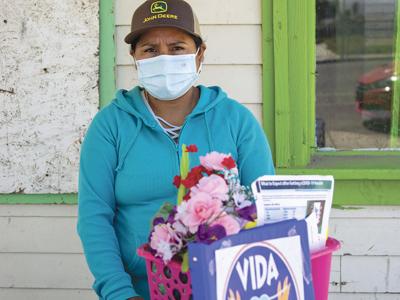
FOR MARCIANA LAZARO, WORK DURING COVID WAS A LOT LIKE WORK ANY OTHER TIME. During harvest season she would start her days at 3am preparing lunch and getting ready for her day, then wait for a ride (she doesn’t know how to drive) and get to an eight-hour shift working in the fields usually six days a week. She adds that it was difficult to maintain six feet of distance between workers, except during lunch.
She isn’t surprised that information on Covid-19 and resources might have been slower to penetrate in the farmworker community, because often farmworkers are too tired or too focused on everyday survival to tune into additional outreach.
But starting in January, Lazaro left the fields and became an outreach worker herself, employed as a community health worker through Monterey County’s VIDA Project, designed to help vulnerable residents navigate Covid-19 resources such as testing, paid sick leave and, more recently, vaccinations. On a recent afternoon, she and two fellow farmworkers are sitting at a table in Greenfield distributing flyers about local programs.
Lazaro, a petite woman with a shy smile, says promoting vaccinations is one of her primary topics of conversation these days. “I encourage them to get vaccinated because there are many who don’t want to get vaccinated,” she says. Some cite fears about developing a more serious illness from the vaccine (unfounded fears, which Lazaro talks through with them) or about developing flu-like symptoms and missing work.
Lazaro tells them they can get supplemental sick leave if they attend a Covid-19 vaccine appointment or experience symptoms after getting the vaccine – all regardless of immigration status. “I tell them not to be afraid because even though we don’t have papers, we have rights,” she says.
Lazaro is also an immigrant. She moved with her husband from Oaxaca, Mexico to Greenfield in 2003 seeking a better life. Back in their hometown, they barely earned enough money to feed themselves. They have three sons – Ulises, 16, Egu, 11, and Santiago Jr., 2. Her eldest son is deaf, and Lazaro learned sign language to communicate with him.
It’s her third language, in addition to her native Mixteco and Spanish. “It’s easier to talk with my fellow citizens who speak Mixteco,” she says.
While her focus in the VIDA Project is communicating to Monterey County’s thousands of Indigenous Mexican residents, some of whom don’t speak Spanish or speak Spanish as a second language, her fluency in sign language has also been useful. One time, when she was at Mee Memorial Hospital for a Johnson & Johnson vaccination clinic, a deaf couple showed up hoping get their second dose of the Pfizer vaccine. She signed to them to communicate that they were at the wrong clinic, and sent them on to the right place.
Audelia Garcia Cervantes, board president of Lideres Campesinas, says having Indigenous language speakers like Lazaro in their organization and in county programs helps them to reach more people among the farmworker community. “They help us to build trust,” Cervantes says. “It’s an achievement to have her [Lazaro] in our group.”


(0) comments
Welcome to the discussion.
Log In
Keep it Clean. Please avoid obscene, vulgar, lewd, racist or sexually-oriented language.
PLEASE TURN OFF YOUR CAPS LOCK.
Don't Threaten. Threats of harming another person will not be tolerated.
Be Truthful. Don't knowingly lie about anyone or anything.
Be Nice. No racism, sexism or any sort of -ism that is degrading to another person.
Be Proactive. Use the 'Report' link on each comment to let us know of abusive posts.
Share with Us. We'd love to hear eyewitness accounts, the history behind an article.