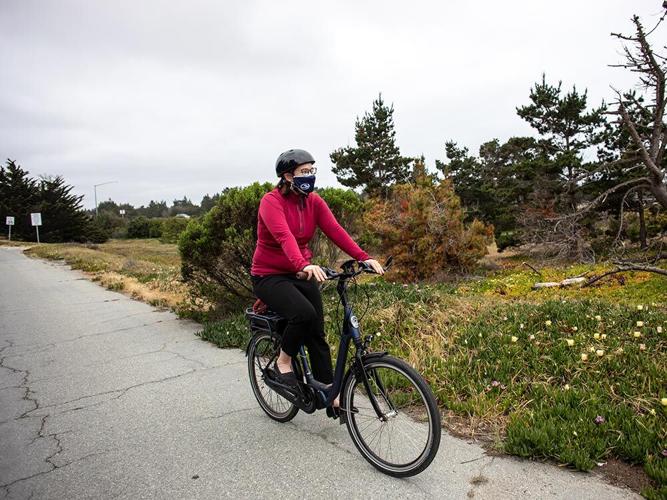

Wendy Root Askew never would have imagined buying an electric bike. But now that she has one, she’s incredibly enthusiastic about it. “I absolutely love it,” she says. “I use it all the time.”
It happened like this – Askew’s mother, who is in her 70s, bought an electric bike in order to take rides with her grandson, Askew’s son. Unfortunately, on her very first ride, she took a fall off the bike. She wasn’t hurt, but hasn’t wanted to get back on it. “So in the meantime, I’ve got this new electric bike in my garage,” Askew says, “and I’m like ‘I’ll try that.’ So I hopped on it and thought ‘oh my gosh, this is a gamechanger.’”
By her own assessment, Askew was “not a bike person” before that fateful ride. Now, she’s even been known to commute by bike into her Marina office (a distance of less than five miles). “I found myself like ‘oh, I’ve got to run to the store to get milk – I’ll just hop on the bike. Oh, I’m going to go over to a friend’s house to say hi, to wave at the kids – I’ll just hop on the bike!’”
Askew isn’t alone. E-bike sales in the United States, already rising before the pandemic, grew by 145 percent between 2019 and 2020, according to the market research company The NPD Group. That compares to 65 percent growth in all bike sales, NPD says. Analysts imagine that e-bikes will be able to extend the overall boom in bike interest because, as Askew has discovered, they fit easily into many people’s lives regardless of pandemic status, providing an easy option for quick trips to the grocery store or a commute to an in-town office.
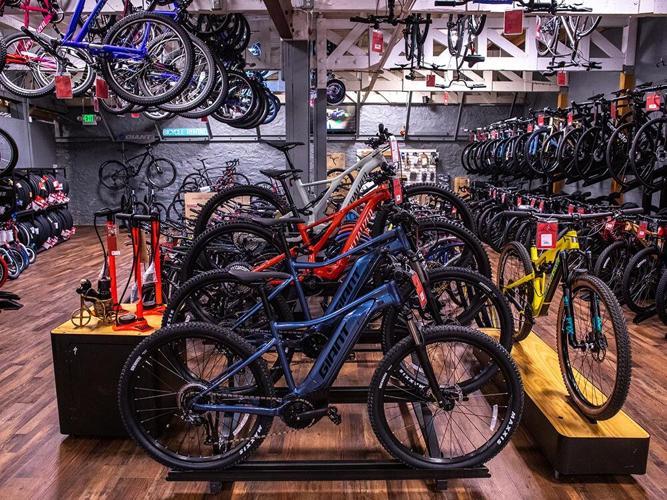
Locally, at Epicenter Cycling in Monterey, e-bike sales are strong. The Monterey outpost of this Santa Cruz-based Trek dealer sells a wide range of mountain bikes and road bikes as well as Class I and Class III electric pedal-assist bikes. (Class II e-bikes have a throttle and are street legal, not legal for riding on trails. The other two classes are legal wherever bikes are ridden.) “We sell e-bikes every day,” salesperson Angie Scarlett says. “Plural.” And buyers seem to have all kinds of motivations – “everything from someone knowing exactly what they want, or someone just having heard about them, or a friend has one and they can’t keep up with their friend. It’s also been getting more people on bikes because it’s so fun.”
Over at Work Horse Bicycles in Monterey, owner Frank Pinto agrees with this assessment. “E-bikes are on a rocket ship going straight up,” he says. A couple of years ago they’d sell one a month, last year it was one a week and by this year sales are up to almost one per day. He attributes the rise in popularity to the press attention that e-bikes get (guilty) as well as the kind of word-of-mouth sales that Scarlett alludes to – a friend gets one, likes it, and won’t stop talking about it.
Both Scarlett and Pinto agree that e-bikes are a great option for a range of different kinds of customers. “It’s not just for someone who’s old or someone who’s got limitations,” Scarlett says. “It’s also for riders who want to open their world to more possibilities – to go further in the same time frame or take longer rides. You can adjust the assistance so you can still work for your workout, or if you’re running late, or you don’t want to sweat in your commute, you can turn up the assistance to get to where you’re going more efficiently.”
Pinto adds that two of the things that made e-bikes less accessible in the early years – they were heavy and they were expensive – are beginning to change. The bikes are getting lighter with new battery technology, and, at the starting end, you can get a good-quality e-bike for around $1,500.
Still, this price point is prohibitive for many. And this is what a new bill introduced in the House of Representatives by Rep. Jimmy Panetta, D-Carmel Valley, is aiming to address. The Electric Bicycle Incentive Kickstart for the Environment Act (E-BIKE Act) would create a tax credit incentive for the purchase of an electric bicycle, reimbursing 30 percent of the cost, or up to $1,500. The credit would apply to all classes of e-bikes. “We don’t want e-bikes to be just a fad for the well-off,” Panetta says.

Bikes in general, including e-bikes in particular, have been popular at Work Horse Bicycles in Monterey. “E-bikes are on a rocket ship going straight up,” says owner Frank Pinto.
Askew also sees the value to creating incentives for e-bikes, along the lines of what exists for electric cars. Those subsidies, she says, just aren’t within the realm of possibility for so many people. But an e-bike, not to replace a car but to supplement it for short trips around town, could be a reality. There’s a climate component here, both for Panetta and Askew, who works as a county supervisor representing District 4 – the more people we can get out of their cars by offering another realistic option, the better.
“If we really care about addressing climate change and want to create a community that is healthy and safe and resilient for everybody, electric bikes offer us a really fantastic option to pursue,” Askew says. “This e-bike opened up a whole new realm of transportation options for me.”


(0) comments
Welcome to the discussion.
Log In
Keep it Clean. Please avoid obscene, vulgar, lewd, racist or sexually-oriented language.
PLEASE TURN OFF YOUR CAPS LOCK.
Don't Threaten. Threats of harming another person will not be tolerated.
Be Truthful. Don't knowingly lie about anyone or anything.
Be Nice. No racism, sexism or any sort of -ism that is degrading to another person.
Be Proactive. Use the 'Report' link on each comment to let us know of abusive posts.
Share with Us. We'd love to hear eyewitness accounts, the history behind an article.