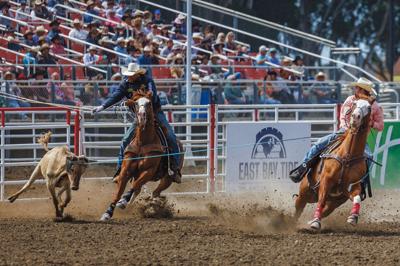

AS THE UNITED STATES CELEBRATED 250 YEARS of independence on July 4, the California Rodeo Salinas gears up to celebrate its 116th anniversary from July 15-19 with a theme of “America Salutes Red, White & Boots.”
During Big Week, people unite in watching saddle bronc, bull riding, barrel racing and other events while connecting through music, dance, food and attire. What began as a local rodeo attracting approximately 4,000 spectators in 1911 has grown into the largest professional rodeo in California and one of the top 15 in the U.S., drawing nearly 90,000 attendees annually.
It’s a local attraction, certainly. “We attend every year,” says Andrew Sandoval, a member of Salinas City Council. “This year my wife got tickets to the bull riding.”
But 40 percent of people catching rodeo action come from outside the county, which is a reason local elected officials appreciate the action. According to the rodeo’s 2025 economic, fiscal and social impact report, conducted by the Los Angeles-based consulting firm Beacon Economics, these visitors spend on average $160 per person throughout the rodeo.
“The rodeo brings revenue to the entire city and I think overall it brings good to our city,” says Tony Barrera, another member of Salinas City Council who also serves on the city’s rodeo oversight committee.
In 2025, $14.6 million in spending was directly attributed to the rodeo, with almost half of that amount coming from off-site attendee spending, according to the report, presented to the oversight committee on Wednesday, June 17. The event also supported 83 full- and part-time jobs locally, in sectors such as hospitality, retail, construction and event services, bringing its economic impact to $18.7 million.
The rodeo’s base – its venue, the Salinas Sports Complex, and the California Rodeo Association – is also part of the equation. The facility, located on City-owned land at Sherwood Park, is leased for a 50-year term to the California Rodeo Association, Inc. (The current grandstands were built in 1997, replacing 1924 structures that were condemned.)
The Sports Complex hosts more than 550 events during a typical year, ranging from concerts and tournaments to festivals and government presentations. The Beacon Economics analysis found that the Sports Complex generated $3.1 million in direct and indirect spending – as well as supporting 10 positions – due to the rodeo and another $2.4 million from other events.
Combined, that amounts to $21.8 million in total economic output, as well as an estimated $2.4 million in local, state and federal tax revenues.
There are, of course, costs to hosting an event of this size. Salinas police officers staff the event and regularly receive overtime to work events at the rodeo. City documents put police department staff time at $159,000 during Big Week.
“We, the city, are paying several thousand dollars, even though the rodeo also pays money toward the in-kind services,” Barrera adds.
Under its lease agreement with the City, the California Rodeo Association pays a per-ticket surcharge to help offset the costs, based on the total number of tickets sold for events over the 10-day period of the rodeo as well as events hosted by the Professional Bull Riders Association. Mandy Linquist, marketing director for California Rodeo Salinas, puts this amount at $1 per ticket during Big Week events and $2.50 per ticket for outside events held throughout the year.
Complementing its economic footprint, the California Rodeo Association’s role extends to other social and community benefits. The rodeo rides on more than 1,400 volunteers, including 350 students contributing over 5,500 hours annually to event setup, guest assistance and operations support. Local dignitaries are regularly seen taking tickets or managing the flow of people during busy times.
“I volunteered for the rodeo two years ago,” Sandoval notes. Of the California Rodeo Association, he says, “They do a lot of good stuff for the community.”
In 2025 alone, the association donated more than $850,000 to 39 local nonprofits, schools and civic organizations, also awarding $30,000 in scholarships to six recipients to help cover college expenses. The association has given more than $200,000 in scholarships since the 1980s, according to Barbara Causley, general manager of the rodeo.
The main attractions of California Rodeo Salinas are the competitors, the performers, the vendors and the rides. But the sum total also includes jobs and spending, making for a big week indeed.

(0) comments
Welcome to the discussion.
Log In
Keep it Clean. Please avoid obscene, vulgar, lewd, racist or sexually-oriented language.
PLEASE TURN OFF YOUR CAPS LOCK.
Don't Threaten. Threats of harming another person will not be tolerated.
Be Truthful. Don't knowingly lie about anyone or anything.
Be Nice. No racism, sexism or any sort of -ism that is degrading to another person.
Be Proactive. Use the 'Report' link on each comment to let us know of abusive posts.
Share with Us. We'd love to hear eyewitness accounts, the history behind an article.