


GOLF IS A NUMBERS GAME. Golfers consider the number of yards to the pin before selecting a club, which is often distinguished by a number – 6-iron, 9-iron, 3-wood. They play 18 holes and keep score by tracking strokes per hole.
But those aren’t the sort of numbers that concern those responsible for overseeing the game.
First, there are the number of people who play rounds of golf on a traditional course. In 2018 the National Golf Foundation tallied 24.2 million, but participation has been relatively flat for a decade. There were some 31 million golfers in the U.S. in 2003, the peak year in terms of on-course population. Research by Joseph F. Beditz, who serves as president and CEO of the foundation, and James R. Kass found the game lost 5 million players and 35 million rounds of golf since 2008 – falling to 1995 levels. Meanwhile, since 2006 more courses have closed than opened. And just 9 percent of Americans in their 20s bother to play a traditional round.
And all that, in the sport’s vernacular, represents a pretty difficult lie.
The data caused some hand-wringing in the offices of the game’s organizing bodies. Media reports of course closures around the U.S. have not brightened the mood. But just as there are numbers to define golf, there are also anecdotes and analysis of said numbers, and the two give a clearer – and more optimistic – account of the game’s status.
Since the “Tiger Boom” of the late 1990s and early 2000s when golf experienced an annual growth rate of 3 percent or better – a phenomenon credited in large part to the ascent of Tiger Woods to stardom – the tale took a turn for the worse.
The recession drove participation levels down, courses began to suffer, with country club and golf course revenue inching along at a 1-percent annual growth rate from 2011 to 2016, according to a report by IBISWorld, an industry research firm. Yet programs like Youth on Course took off. There was a gain in shorter 9-hole rounds and amateur talent taking part in USGA championships improved.
“We do not believe things to be dire at all – quite the opposite,” reports Beth Major, the USGA’s director of public affairs. “From a variety of perspectives, the game is doing very well.”
Major cites the NGF report of 2.6 million people playing for the first time, both in 2017 and 2018. A total of 456 million rounds of golf were played in the U.S. two years ago (a 4.8-percent drop in 2018 is blamed on weather, the third-wettest year on record). And, she adds, “there are other indicators beyond the number of golfers and rounds played – television ratings, digital media numbers, attendance at championships, equipment sales – all of which tell a very positive story about the state of the game in the U.S.”
That positive story is mostly about a younger generation of prospective golfers – a generation that doesn’t look (or act) like the sport’s past.

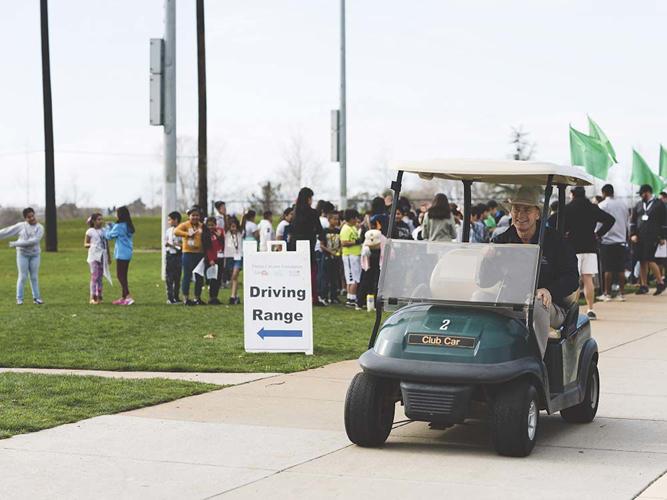
Nick Nelson (in cart) heads up the First Tee program in Salinas, where some 9,000 local children learn both the game of golf and character traits that lead to success.
THE NATIONAL GOLF FOUNDATION ESTIMATES THAT 107 MILLION AMERICANS PLAYED ON OR OFF COURSE, watched tournaments on television or otherwise got involved in the game last year. That’s 1 in 3 residents over the age of 6.
Despite reports that Dick’s Sporting Goods planned to reduce the space devoted to golf items and Nike’s decision to stop producing equipment, consumer purchases have not only rebounded, but also passed 2005 levels. According to calculations by TEConomy Partners and SRI International, spending on equipment and apparel in the U.S. reached almost $5.5 billion in 2016, compared to $5.2 billion a decade earlier.
To find positives, the NGF and USGA took to collating data related to off-course participation and what they refer to as “near golf experiences.” But the 2.6 million first-timers counted in the annual NGF report is a significant bit of hard data. It represents the largest number of beginning golfers ever recorded in a single year, easily surpassing the previous mark – 2.4 million in 2000, Woods’ heyday – and an increase of some 14 percent since 2015.
Some of this is a reflection of outreach efforts toward children. A program started by the Northern California Golf Association operating out of Poppy Hills Golf Course in Pebble Beach contributes significantly to the strength of youth participation and first-time figures. Youth on Course allows children and young adults through age 18 to join the program for a $20 fee. This gets them into select courses, where they pay just $5 per round.
“Youth on Course – that’s pretty much a game changer,” says Michael Spiller, assistant golf pro at Bayonet & Black Horse in Seaside. “That program is one that will help retain players. It keeps them engaged.”

Bayonet & Black Horse pro Michael Spiller says that basic instruction, whether as a child or an adult, is “where the game gets its hooks in you.” The Seaside course runs programs such as Get Golf Ready to teach fundamentals.
YOUTH ON COURSE STARTED IN 2006 WITH A HANDFUL OF NORTHERN CALIFORNIA COURSES INVOLVED. Now the program enlists over 1,300 courses nationwide and includes 70,000 young golfers. Youth on Course CEO Adam Heieck points out that 85 percent of participants in the NCGA junior tour are involved in the program. And in 2018 U.S. Amateur Championship match play rounds – played at Pebble Beach Golf Links and featuring the world’s top amateurs – 10 percent of the field had Youth on Course credentials. Yealimi Noh, winner of the 2018 U.S. Junior Girls Amateur held at Poppy Hills, is a Youth on Course graduate and credits the program for her start.
“We fundraise to support these efforts,” Heieck explains. “We’re doing that every day. There’s a very generous community out there.”
The funds allow Youth on Course to subsidize the rounds. While members pay $5 for green fees, the program makes up some of the difference.
“It’s not a revenue generator,” Spiller says. “But it makes it more attractive for courses to take part.”
A national program with an outpost in Salinas – First Tee – is also credited for the strong state of youth golf. Through their National Schools Program they have introduced the game to approximately 10 million children around the country. In Salinas, First Tee engages 9,000 students ages 7-17, 96 percent of them minorities.
“Golf isn’t for everyone, but if you offer them the opportunity, they can choose whether they want to play or not,” says Nick Nelson, executive director of First Tee Salinas. “We find they need to be exposed to ways of life, to see that it’s a big wide world out there.”
On a national level, youth participation figures are encouraging. In 2011, there were 2.4 million golfers ages 6-17 involved in various programs and leagues. In 2017 the number was 2.7 million. The growth is even more apparent when it comes to young women. LPGA-USGA Girls Golf grew by 1,400 percent over a seven-year span. Over the course of the last year more than 80,000 girls learned golf through the program. Between the 2005-06 school year and the one ending in 2017, the number of high schools around the country offering girls golf jumped from 8,816 to 10,016.
Despite the contention that the sport is not flailing for life, few in the industry are complacent. Bayonet & Black Horse created a basic instructional course called Get Golf Ready. It involves six weekly clinics for adult beginners for $125, who can bring their kids along for free.
The first series of classes offered by Bayonet &Black Horse had a waiting list.
“That’s where the game gets its hooks in you, when you have the hope – often a false hope, but a hope – that you can make that ball do what you want it to do,” Spiller says. “It takes more instruction.”

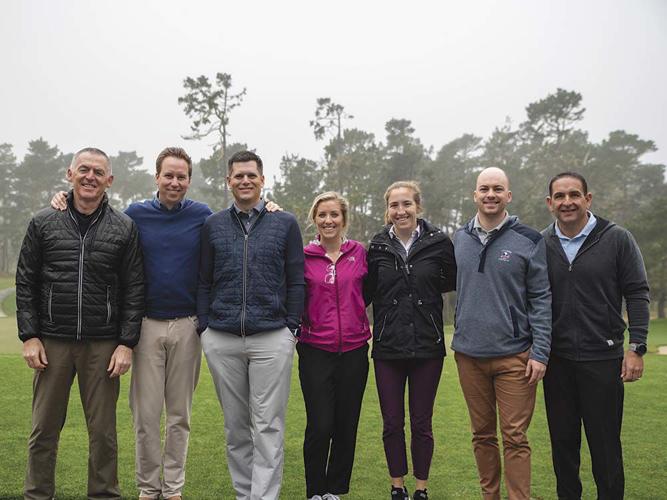
Adam Heieck of Youth on Course, with his staff, has seen the program explode in popularity, from 42,000 participants two years ago to more than 70,000 today. Youth on Course operates out of Poppy Hills Golf Course in Pebble Beach.
THERE ARE, HOWEVER, TWO NUMBERS THAT NAG THE SPORT. According to an NGF report entitled “U.S. Golf Facilities, 2012-2017,” 737 courses closed over the span of the study, with both private and public segments experiencing declines. In addition, participation by those in the 18-34 age group plummeted, dropping by 36 percent compared to the early 1990s.
The consensus is that developers overbuilt, planning suburban communities around new courses that were set too close to existing facilities. The problem was particularly noticeable in the 1990s, when many developers were keen to take advantage of the Tiger effect.
An NGF breakdown shows the extent of overdevelopment. From the 1960s through the 1980s, construction of new courses generally kept pace with the growth of the game. After an initial boom – 3,803 new facilities and 7 million additional golfers in the ’60s – building slowed to a more manageable rate. In the ’70s and ’80s, the game added 12.5 million golfers and 2,658 courses.
Then came the ’90s. Developers sunk funds into another 2,641 new locations. Yet just 4.4 million people were added to the golfing rolls. Kevin Williams, former general manager at Pacific Grove Golf Links, remembers waiting in line to play courses around Sacramento. But after the building boom, he says, no place was fully booked.
“Let’s do that simple equation: How many people play and how many holes are there?” Williams says.
Industry observers refer to the series of highly publicized course closures as a simple market correction – one that is still underway. Williams points out that because of the investment behind a club or public facility, corrections take longer in golf than other industries. Once the market returns to equilibrium, the issue will be largely resolved. Furthermore, Williams notes that the percentage of the population that participates in traditional on-course golf has remained relatively steady over the long term.
Heieck is unconvinced the pessimistic reports truly reflect the future of golf. “It doesn’t really tell the growth story,” he says. “There was a dramatic increase in the number of golf courses built. Now you read ‘another golf course closes,’ but it’s not bad to have a correction. You’ll continue to see a correction.”
In 2018 only 12 new courses opened. Instead, money is flowing into renovation – to the tune of $3.5 billion since 2006.
Like almost everything marketed to the public these days, the biggest concern is the numbers involving millennials. Although 6.4 million millennials play golf – amounting to 26 percent of all golfers – only 9 percent of the 18-34 population take to the course. And that figure sinks to 5 percent in some studies when accounting for those under 30.
Those in the golf industry blame a number of factors, from money to that most comprehensive of reasons – everyday life. “There are all kinds of junior programs,” Spiller says. “But there’s that gap between 18 and 40, when you have a life and kids. Life gets in the way.”
GOLF STRUGGLES AGAINST THE PERCEPTION THAT IT IS AN OLD MAN’S SPORT – and a stuffy one at that, with dress codes and guidelines covering how one conducts themselves both on course and in the clubhouse. But over the last 30-plus years, we’ve become more casual in general. Fine dining restaurants that once required men to wear jackets are now welcoming jeans and a polo shirt. Offices where suits and ties were the norm went first to casual Friday then to relaxed standards the rest of the week.
Yet the sport is loosening its rules only grudgingly. There is a respect for the game’s traditions that permeates golf, and many consider it part of the appeal. The youth program First Tee teaches the skills embedded in golf’s code of dress and behavior – which they label as communication, self-management, goal setting and resilience – as necessary tools for children to acquire core life values.
“People who play golf, there’s no referee,” Nelson explains. “You’re out there on your own. They have to monitor themselves.”
There is lodged somewhere in the sport’s collective mindset that dress codes provide that sense of decorum so important to conduct. Still, the codes are starting to change.
“We have a policy of no denim and you have to wear a polo shirt,” Spiller says of Bayonet & Black Horse. “But we’re not going to grow the game by being strict. We have to maintain the honor of the game, but also realize the world is changing.”
Dress code is a secondary matter, however. USGA surveys consistently find that time and the costs related to the game drive more people away from the course. Rates vary, but to play the legendary Pebble Beach Golf Links sets you back $575 a round during the season, although that’s an anomaly – a bucket list course. To play Poppy Hills Golf Course is $250. Bayonet & Black Horse run $155 each. Del Monte, $110. And the average membership at a private club nationwide is over $6,000 a year, according to MarketWatch. No wonder more than a quarter of all golfers in the U.S. claim a household income over $125,000.
“Kids get to play for next to nothing, then they turn 18 – and they pay $100 a round,” Nelson says. “They drop off the face of the earth.”
USGA’s Major acknowledges the perception of golf as a rich person’s sport, but points out that such a view is not entirely accurate. The NGF determined that the average charge for an 18-hole round across the U.S. was just $34 in 2017 – a figure that drops to $19 for a quick nine.
While it may cost $395 for a round at Spyglass Hill, green fees at Laguna Seca fall into the $70 range. Monterey Pines and Salinas Fairways charge around $40.
“The expense is more of a myth,” Spiller notes. He adds that one can shell out quite a bit to play, but “there are a lot of courses here competing for golfers.”
In the fall of 2019, Youth on Course and the NCGA began rolling out an alumni program for YOC members. It will involve a small annual fee and $15 per round at participating courses. Initially the program will concentrate on courses in urban areas and near college campuses, like Fresno and San Jose.
“If you’re going to have a program like Youth on Course and when they turn 19 expect them to suddenly pay $50 or $100 a round, you’re going to have a severe disconnect,” Heieck says. “Let’s keep the barriers to entry low.”
Yet the absence of millennial participation continues to trouble those concerned for the welfare of golf, even when statistics show that many people return to the course once incomes improve and family life settles. The NGF report provides a profile of the average golfer: 43 years old, playing 20 rounds in a year.

Topgolf re-creates golf as a form of nightlife, with cocktails, food and a casual atmosphere. Entertainment venues featuring virtual forms of the game are growing in popularity, especially among millennials.
SO WHERE DO MILLENNIALS DISAPPEAR TO? Part of the answer is reflected in research devoted to the “near golf experience,” “off-course participation” and “latent demand” – inventive phrases that allow numbers from driving ranges and golf-related entertainment to be included in reports on the game’s health.
Within the past decade, sports entertainment venues operated by Topgolf, Drive Shack BigShots and others opened. These are indoor-outdoor franchises combining full-service restaurants, bars, music, televisions and a technology-driven form of golf where participants swing clubs, but shots are tracked digitally and courses are often virtual. It’s nightlife, with a set of clubs. Topgolf reports that 70 percent of their customers are 34 or younger, compared to just 16 percent in the more typical over-45 golf crowd.
According to NGF figures, such simulated golf ventures are wildly popular, driving off-course participation growth close to 10 percent annually. As a result, almost the same number of people take part in the game off course as on. Tiger Woods and his TGR Design announced in the fall of 2019 they were starting PopStroke, an entertainment venture combining a party atmosphere with a putting course.
Golf professionals see this as a boon to the game, particularly as Topgolf claims that more than half of its clientele are non-golfers, while another 27 percent say they are occasional green-grass players.
“It’s getting people with a club in their hands,” Spiller points out. “We have to figure out how to get them from Topgolf to the course, to real grass.”
That’s where latent demand comes into play. In a summary released in November of 2019, NGF reported that 14.7 million non-golfers in the U.S. are now “very interested” in a real, on-course round. That’s up from 12.8 million the previous year and double the figure reported early in the decade. Millennials were the largest group in the survey to declare their interest.
But to Williams, this is all much ado about nothing. “How many studies have been done on millennials?” he says. “Who has time to play golf? The Boomers. Once you have time to play again, you are back. We see a lot of that.”



(0) comments
Welcome to the discussion.
Log In
Keep it Clean. Please avoid obscene, vulgar, lewd, racist or sexually-oriented language.
PLEASE TURN OFF YOUR CAPS LOCK.
Don't Threaten. Threats of harming another person will not be tolerated.
Be Truthful. Don't knowingly lie about anyone or anything.
Be Nice. No racism, sexism or any sort of -ism that is degrading to another person.
Be Proactive. Use the 'Report' link on each comment to let us know of abusive posts.
Share with Us. We'd love to hear eyewitness accounts, the history behind an article.