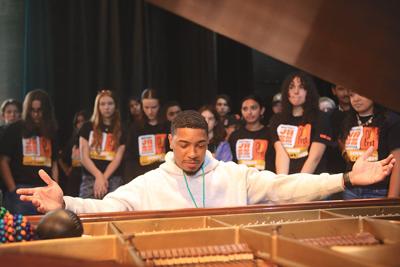

TEN YEARS AGO, THE MONTEREY JAZZ FESTIVAL AUDIENCE WAS INTRODUCED TO 26-YEAR-OLD CHRISTIAN SANDS when he joined a trio of pianists on the Main Stage – including Jason Moran and Russell Malone – to perform a celebratory rendition of Errol Garner’s best-selling album Concert by the Sea (recorded at the Sunset Center in Carmel in 1955).
Sands has continued his development as an innovative jazz pianist, touring worldwide and performing with many of the jazz greats. He earned a Grammy Award nomination for 2020 Best Instrumental Composition for his piece “Be Water II.”
In 2020 he was named the Monterey Jazz Festival’s Artist-in-Residence; in 2023 he became the musical director for the MJF star-studded All-Star Ensemble, touring across the United States and performing 25 gigs. This year, Sands was named the 2025 Commission Artist and asked to create an original piece of music for the festival – a tradition that originated in 1959 and returned in 1994.
Sands will perform “Reflections from the Shore: A Monterey Suite” at 1:30pm on Sunday, Sept. 28 on the Main Stage. It turns out he wrote six original songs as the Commission Artist, not just one. He spoke with the Weekly about his musical journey.
Weekly: You were born and raised in New Haven, Connecticut and began playing very early – at age 1. Really?
Sands: Yes. I started lessons later, around age 3 or 4. No one really wanted to teach a 1- or 2-year-old how to play piano, so it took a while to find the teacher. But I had an upright piano at my house. And the story goes that I wouldn’t kind of bang on the piano, I would actually try to use my fingers to play. That is the story I was told. I don’t remember, because I was 1.
In hindsight, did you feel special to be so focused on music, so young?
I grew up in a really creative household. My parents were 9-5ers but they were super creative. My mom loved storytelling. My dad would do photography, and he also played a little music. He also was an illustrator. So creation and expression was definitely in the house, all the time.
What did your folks do for work? Were they big jazz fans?
My dad was a jazz fan. My mom, she became a jazz fan from just bringing me around when I started playing professionally, as I was young—she had to bring me. But my dad, he's had so many different jobs over the years when I was a child, I think he might have been the manager of the local CVS back then. And later was the manager of Lenders Bagels.
Did you ever go play with the other kids and not play music?
Absolutely. I played football, basketball. I wasn’t on any teams because I was playing gigs. So I couldn’t really do that. Although the coaches wanted me to try out, I had rehearsals and I had gigs.
I also did martial arts as a kid, but I stopped that early on. I was really good but when we started doing more physical things my mom got a little more worried and told me, “You can’t break boards and go play a gig, too. So one’s going to have to give.”
Who was introducing you or exposing you to the different jazz music?
It was definitely the jazz community in New Haven, Connecticut and Jesse Hameen II. He’s a wonderful drummer who used to play with Dr. Lonnie Smith, Lou Donaldson, a lot of those amazing cats in New York at a time. Also, the bassist Jeff Fuller.
Rex Cadwallader, who was a jazz fan and a composer more than a player, was the one who first taught me, I guess. My father, too. While we were driving he’d put something on, and he’d ask me, “Do you know who that is?” And he’d say, “Oh, that’s Herbie Hancock, or this is Oscar Peterson.” He would play those records; I’d bring them to my teachers and ask them about them.
The community was really wonderful. And the more I progressed in it, the more I got to meet other elder musicians, like Rufus Reed or the Heath Brothers. New Haven was a beautiful community because it also had a lot of jazz education.
I was struck that you recorded your first album Footprints at age 13. Looking back, does that seem young to you? Were you ready?
Well, I was actually 12 when I recorded it. It was one of those things where my teacher at the time, Rex, he recommended that I recorded. And it wasn't for profit. It wasn't anything like that. It was just to hear myself in the progress that I was making. It was a beautiful way of a teacher just telling a student, hey, I think you got something—I think you should document this for yourself. So it started there. And then, we made a few copies, gave them to some friends and family, and then those friends and family gave them away and other people who wanted more of them and so then we made some more.
If you were to listen to that recording today, what would you think?
I remember it was my safe place. And so I think listening back to it, I probably remember those moments like I had learned “that” chord three weeks prior. Or I recorded this tune and used the second take because during the first take the drummer told us to stop. He said, “I recommend that you cut your nails so you don't get this ticky-sound, right?” So it's these things that you learn.
I learned, OK, we should probably play this slower because the drummer said that this would make this feel better or the bassist was like, oh, this baseline that you wrote is really, really nice. And I like playing it. So can I play this through the whole song? And, you know, what I loved about it was also making that record with the musicians, although older than me, they still asked me for my leadership, which was really beautiful.
Now you’re 36. And you’re a recording artist on Mack Avenue Records, where the jazz great Christian McBride also records. He’s referred to you as an old soul. What does that mean to you and does it resonate?
It does. I’ve always been told that my entire life. I think it just means that they feel like I’ve been here before. Or I’ve been able to channel certain things that are beyond my age, but I think that literally for myself is just because I pay so much attention to the elders and what came before.
When you’re sitting and talking to Dave Brubeck and he’s talking about Earl Hines, you gotta pay attention to that, right? Or talking to Dr. Billy Taylor and he’s talking about Teddy Wilson, or talking to Jason Moran and hearing the stories about studying with Jaki Byard, right? Maybe being a part of the lineage of not just jazz piano, but jazz as a whole, I think I’ve always realized that I am carrying this information that was passed down from Jelly Roll [Morton], from all those cats into me now, and in my job is to pass it to the next generation.
Have you spent much time recently listening to Errol Garner’s Concert by the Sea recorded at the Sunset Center in Carmel, to get inspired for playing Monterey?
It's funny because I listened to it the other day. I was talking to a student about it because we were talking about Errol Garner and the brilliance of Errol, right? And not just as a pianist, but an entertainer, as a magician. He would set things up, you know, his introductions, how adventurous they were, and then how swingy he was, and then how much of an orchestrator and an arranger that he was either on the spot or prerehearsed, or a combination of all of it. We were actually just talking about that yesterday.
You’ve spoken about how martial arts influences your music, particularly the 2020 album Be Water. I’m curious if you have a martial arts practice today?
I don’t necessarily have a practice today – other than meditation. That’s really it. But growing up, I tried many different styles of martial arts. My father was also an instructor when he was younger, we both just had a love of martial arts, especially Bruce Lee. And that style is very unique and it’s very specific.
What I loved about it, it is very much like jazz, where you have these fundamental ideas that are there, but everything is about the individual, and everything is about creation and everything’s about just being aware and being present in the moment – all the time. I think that the best way to approach the music of jazz is that it’s being present all the time, whether you’re playing it or whether you’re listening to it.
When you're off balance, or not being present, what do you do to bring yourself to the moment?
It's a number of different things. It might be a conversation with a friend, visiting and talking to my mother, talking to my father, I think it's about who you have around you. My bandmates, sometimes it happens where we're just in a different place on the road and, if you are so in tune yourself that you forget that there's other things going on.
I tell my students this, if you're soloing and you're so concentrated on you, on your solo, you're not really being present. You know, because there's a lot of information going on that you actually aren't in charge of, which is beautiful because it can take you out of that. So if you can remove yourself from you sometimes and open and embrace everything that's going on around you, that can reset and recenter you as well.
Whether it's music or everyday situations, I think that if we don't try to control it all, we just try to be the example of what we want it to be. Like Bruce Lee, be like water, right? Be present consistently. I think that is a way that we can navigate through these treacherous terrains and waters that we go through. And not drown.
What’s your routine on any given day?
Since I’ve been home and I’ve been preparing for this MJF commission piece, my routine has been wake up, meditate, maybe make a cup of coffee or matcha. That’s kind of been my new thing is creating that, which I really love to do with the whisk in the bowl and the whole thing. It’s really meditative in itself, right?
And then I will go from my apartment to my parents’ home, I don’t have my piano here. I left it there because I sort of like going to the office. I kind of like the idea of traveling to work.
And on my drive, I listen to some music, just something to get my day started. It might be the new record that just came out, like lately I’ve been listening to Immanuel Wilkins’ new record, which sounds phenomenal. And then I’ll go and I’ll practice, and I’ll warm up, and then I’ll start writing for the commission piece.
Are you more of a coffee or a tea drinker?
I grew up being a tea drinker. And then I became a coffee drinker the more I went to Italy. My girlfriend bought me an espresso machine for my birthday last year, and so now, literally, that’s what I create – I make these different types of drinks that I’m loving, whether it’s a caramel cold foam, a cappuccino or a cortado.
When it comes to the music you listen to, is it mostly jazz?
It’s absolutely everything. There’s times where my alarm wakes me up to an Indian raga because I just love how meditative it is, and I love how it begins the day, right? I love listening to music from Mali, I love listening to Toumani Diabate – I love listening to him.
I also listen to birds and bird songs. Sometimes in my meditation, I’ll just either open the window or I’ll find birds on YouTube and just play them.
I do have quite a big library of bird sounds on my phone from my travels. Birds and frogs – I absolutely love how they sound. I tell my students to listen to everything. Don’t shut yourself off to one style of music and disregard the other one. You might have a favorite and you can listen to that, sure. But there’s information everywhere.
Where do you think creativity comes from? Where do you primarily get inspiration from?
I get it from living life. And that goes with the dreams when I go to sleep, that goes from the things I've experienced, or even the things that I’m worried about, or the things that are on my mind. Lately it's more apparent. Or I think I'm just able to articulate the story better being older now. They all are stories, everything that I've recorded, there's a story that goes with every song.
You've served as the artistic director for the MJF on tour. And now you're curating the original commission piece for this year's festival. Is it daunting?
No, but I asked a lot of questions—they can tell you. With anything I do, it's stories and the stories that I've experienced, that's where I always start. So I started with my experience with Monterey Jazz Festival—what's my experience of Monterey? And then, what are people's experiences with Monterey or Monterey Jazz? And then I write from there. which has led to six pieces that I'm pretty excited to bring to the musicians and to actually play for the people.
Despite a commitment to fostering younger musicians, jazz accounts for just about 1 percent of music sales last year, down from 3 percent 20 years ago. It’s always been a niche genre, but if you could wave your magic wand, what might you do to help broaden its appeal?
Oh, man. There’s so many things.
I find it interesting that sometimes the creators or the patrons get stuck in the old. And when I say stuck in the old, it’s not just that it has to swing, for example. I think it’s how it’s presented – especially in the day of social media, I think jazz is behind on that.
I will say the older generation needs to make room for the newer generation and they need to be championed, because they are going to continue to do better and the encouragement helps.
How is all that what's happening in the world influencing your music right now?
I think today, with the political climate or the actual climate, it all informs how we maneuver as human beings, how we interact as human beings, and I just continue to be honest, continue to be grateful, continue to just challenge myself to get better.
What's going on in the world and what I can do to not necessarily fix it but to give a space where you can go—if you need refuge, or if you want to have a dialogue about it. I think I can create, either through sound or through a space, where we can talk about it, right? Again, I have students, if students want to talk about it, we can talk about it. I think whatever you go through in your life informs your music.
How has streaming impacted your career, your income?
Unless you are a pop star you (won’t) see the needle move. So I really don't pay attention to it a lot. As long as you could share your music on every platform, I think that's a very important thing.
Whenever I get a check from Spotify or Apple Music, what I do love is that it does show me that people are loving the music and they're listening to the music. And so that is the takeaway. It's not even about the financial side of it, it's the sharing of your music side of it. I think it's a wonderful thing because people are looking for you. It's good for jazz.
If you really want to support an artist, you buy the music from them directly. Here’s a shout out to Jason Moran, who sells it himself and he has a platform that he's created to sell his own music.
Who’s somebody you would love to have dinner with, living or not?
I would have loved to have dinner with Wayne Shorter. I never got the opportunity to. I met him once in a hotel lobby in Umbria. He was leaving, and I was checking in, and it was like 6 in the morning, something like that. There were no words exchanged because everyone is tired. But I would have loved to have had dinner with him – and just talk about the universe with him.
And, if I can add another person, like him and Neil deGrasse Tyson, I feel like the two of them would just be really interesting to talk to. At the same time.
So you’d like to have dinner for three?
Yeah, yeah. I would do that. You know. If I could add another person for four, I’d say John Williams. Dinner for four now. Yeah, John Williams, Wayne Shorter and Neil deGrasse Tyson. I feel like that would be a really interesting conversation.
If we can keep building, add Picasso. Actually, a really interesting dinner now: Wayne Shorter, Neil deGrasse Tyson, John Williams, Pablo Picasso. And add Salvador Dalí.

(0) comments
Welcome to the discussion.
Log In
Keep it Clean. Please avoid obscene, vulgar, lewd, racist or sexually-oriented language.
PLEASE TURN OFF YOUR CAPS LOCK.
Don't Threaten. Threats of harming another person will not be tolerated.
Be Truthful. Don't knowingly lie about anyone or anything.
Be Nice. No racism, sexism or any sort of -ism that is degrading to another person.
Be Proactive. Use the 'Report' link on each comment to let us know of abusive posts.
Share with Us. We'd love to hear eyewitness accounts, the history behind an article.