
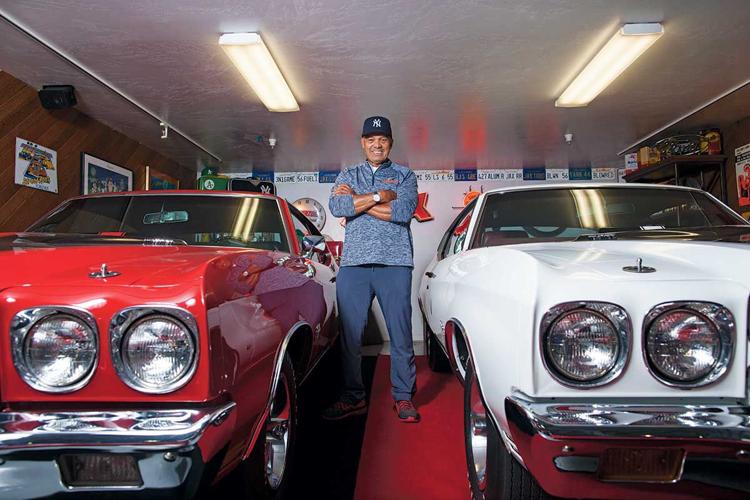


All sorts of things catch your eye at Reggie Jackson’s 16,000-square-foot climate-controlled garage near the border of Sand City and Seaside. There’s the pearl-white 1965 Corvette Sting Ray with just 9,600 miles on it, which spends much of its time at the Bloomington Hall of Fame Gold Museum. There’s the 1955 Chevy Bel Air he bought in 1970, painted his favorite color, maroon. There are the 20 gleaming motorcycles and a signed boxing glove from Muhammed Ali. There are the 30 or so wooden baseball bats signed by the likes of Willie Mays and Derek Jeter – he keeps the Babe Ruth bat worth $500,000 elsewhere – and one with Jackson’s face carved into it.
Amid all the stuff – from the B-52 Bomber model dangling from the ceiling (“Just something I thought was cool,” Jackson says) to the cutout of him dressed like an Old West gunslinger – two things stand out: A pair of big, heavy, shiny, golden trophies, awarded to the winning team of the Major League World Series.
There are less than 30 aluminum-engine 1969 Chevrolet Camaro ZL1s (like the one Jackson keeps here in Seaside) on the entire planet. But these Commissioner’s Trophies are a tougher get. You can’t buy them at any price. You earn them beating the best baseball players in the world. By definition they don’t belong to any individual player – even if a player, say, hits three home runs on three consecutive World Series pitches.
“How did you get those trophies?!” I blurt.
Jackson looks at me like I just keyed the door on his 1955 black-on-red GTO. Then he leans in.
“I was a big star. You forget that?” he says.
“Reg-gie, Reg-gie, Reg-gie,” he adds rhythmically, pumping his fist with a certain smoothness and understatement, echoing the stadium-shaking chants he heard across a career that included five world championships and 563 home runs. “That’s Reggie power.”
≈ ≈ ≈
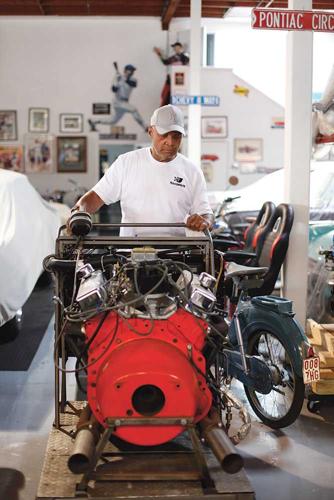
Reggie Jackson’s got his motor running. The garage fills with noise. Exhaust thickens the air. The heavy and throaty rumble wins a big smile of approval from Jackson; when he gives it gas, the roar makes the memorabilia on the walls tremble.
More power on display.
The 352-cubic-inch, 550-horsepower Chevy engine sits on its own roll cart, not destined for any of the rehab projects at play, just moments like this. “It’s put where it is, just for show,” he says. “What it did with you is what it does.”
As a player, he was famous for his own brand of noise, and a motor that had him swinging from his heels (at one point smacking a 650-foot HR) and shooting from the hip (“Fans don’t boo nobodies”).

Jackson, pictured here revving his favorite Chevy engine “just for giggles,” offers this: “How’d I get successful? You get the job done, get it figured out, or we sent the wrong man.”
At the garage, he has a team that’s constantly working on his fleet as he zips to New York to fulfill his responsibilities as a New York Yankees special consultant on everything from hitting to training regimens to how to follow the Yankees’ winning way, or dips to his second home in Newport Beach.
Gary James reports to the garage after an early-morning shift as supervisor of Monterey Bay Aquarium’s paint shop.
“Reggie’s very knowledgeable and works on the cars himself,” James says. “He cleans ’em just as well as I can. He’s the one who taught me about cleaning.”
Jackson says nothing makes him feel better than rebuilding a vehicle. “I feel most alive when I get a car started for the first time,” he says. “I do it for the joy of building a beautiful bitching car.”
Rebuilding is a theme of Jackson’s life that doesn’t get as much attention as it might. His parents divorced when he was young. When he cracked five vertebrae playing football as a high school junior, he was told he wouldn’t walk again. He faced racism – and rosters devoid of minorities – in the college recruiting process and when he was passed over for the number-one pick in 1966. He followed his most tormented and turbulent season in New York – spiked with rifts between teammates and his manager that almost came to very public blows – by winning the World Series MVP. In 1988, a Berkeley fire claimed 35 of his classic cars that, as he told reporters, “all had a reason. They all stood for something.”
That provided perspective when he took the podium in Cooperstown in 2003 to be inducted into the Major League Hall of Fame.
“I struck out more than anybody in the history of baseball,” he said. “Even though I tasted failure, I stuck with it.”
≈ ≈ ≈
Jackson doesn’t like crowds. That presents one of his paradoxes: That Reg-gie chant he carries in his head doesn’t happen without one.
His form of agoraphobia is one of the reasons he settled on the Monterey Peninsula full-time in the early ’90s. “It’s nice,” he says. “Most people just wave and keep going by.”
But he does like an audience, especially when he’s got something to show them. At his Seaside garage, the show-and-tell opportunities are endless.
It starts with the cars, many of them classic American muscle from the ’50s and ’60s, all running well, all of them so clean you could serve sushi on them.
They number more than 50 all told; he keeps another 25 in a Monterey airport hangar, six at his Carmel home and 25 at his place in Southern California.
“Just say I got too many,” he says.
He leads the way into an additional room stocked with shelf after shelf of exhaust manifolds, alternators, shocks, headlights, coolant hoses, car polish and water pumps, across the room from a phalanx of vintage American engines, each as spotless as a doctor’s office. On one peg hang 40 Corvette steering wheels he knows weekend hobbyists hunger for. He pauses to inspect a dipstick, pointing out how you can tell it’s for a 1966 Camaro. In the adjacent office he ticks off the signatures on 50 baseballs he keeps beneath a sheet of glass in a vintage yellow Radio Flyer wagon: Yogi Berra, Dennis Eckersley, Rollie Fingers, Catfish Hunter, Charlie Finley, Duke Snider, Willie Mays, Hank Aaron, Whitey Ford, Juan Marichal, George Brett, Willie McCovey, Pete Rose, Tony Gwynn.
As the tour continues he flips through old-school license plates, citing which lead letters respond to which year of production, and calls a collector he sold a 1963 split-window Corvette to tell him he found the original hubcaps and will put them in the mail. (“Your son’s name is Aiden, right? Not bad for an old guy.”)
He keeps a three-ring binder for every single car he has owned, past and present, ordered chronologically by purchase date, from #1 (the maroon Chevy Bel Air) to somewhere in the hundreds (a yellow 1973 Ferrari Daytona Coupe). When he produces one to look at, he is visibly gleeful at the memories the original documents conjure. He runs his finger down the build sheet for a cranberry red Chevelle convertible (#156), admiring all the stereo, power antennae and duct-hood options. “All the gingerbread,” he says.
Along the tour, he deploys a reflective fluency for history and practicality, a playful sense of humor, and a tendency to use your name to cut through inattention. It strikes me that this man isn’t nearly so much ego as he is massive car nerd.
“I got too many cars,” he repeats. “But I enjoy them.”
Hence his plan to sell off a few dozen, starting with a Car Week party of sorts. He’ll throw open the door to his garage 10am-6pm through Saturday, Aug. 19, sharing his cars, parts and memorabilia with whoever’s interested.
“It becomes a place where people come and hang out,” he says.
Visitors will see a large painting, a gift from a friend, immortalizing the moment during Game 6 in Oct. 18, 1977, that third straight World Series swing that resulted in a Reggie Jackson home run and a championship, his first in New York after three in a row in Oakland 1972-74.
When the real-world accomplishments take on mythic proportions, the “Mr. October” nickname feels like an understatement, and it’s not hard to believe those trophies were a gift made possible because he did the impossible.
The actual story, though, is that he worked for the same company that crafted them for the World Series winners, and he had his own exacting copies made.
So the tale is more real and more practical than it appears at first.
The same can be said for Reggie Jackson.
(0) comments
Welcome to the discussion.
Log In
Keep it Clean. Please avoid obscene, vulgar, lewd, racist or sexually-oriented language.
PLEASE TURN OFF YOUR CAPS LOCK.
Don't Threaten. Threats of harming another person will not be tolerated.
Be Truthful. Don't knowingly lie about anyone or anything.
Be Nice. No racism, sexism or any sort of -ism that is degrading to another person.
Be Proactive. Use the 'Report' link on each comment to let us know of abusive posts.
Share with Us. We'd love to hear eyewitness accounts, the history behind an article.