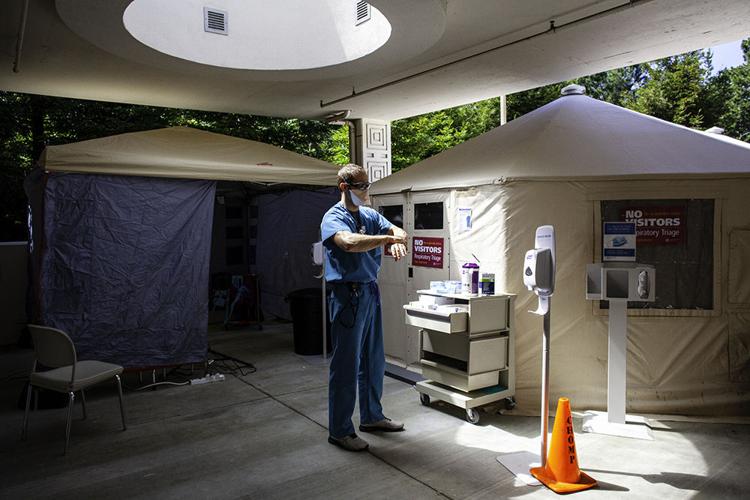
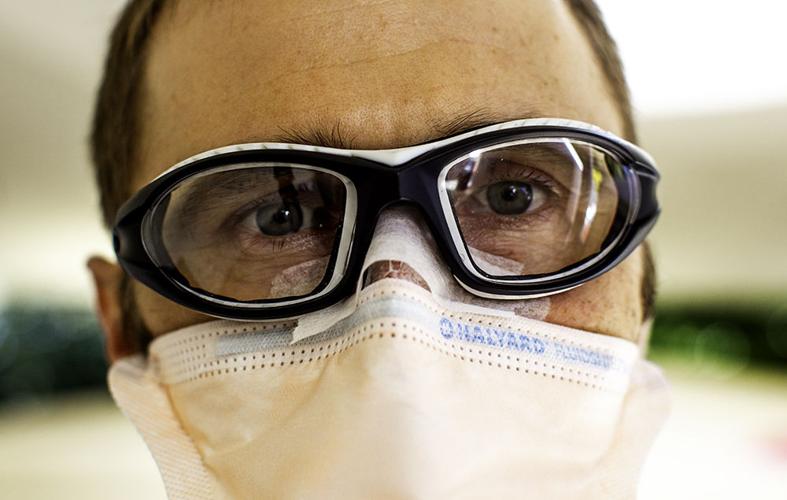
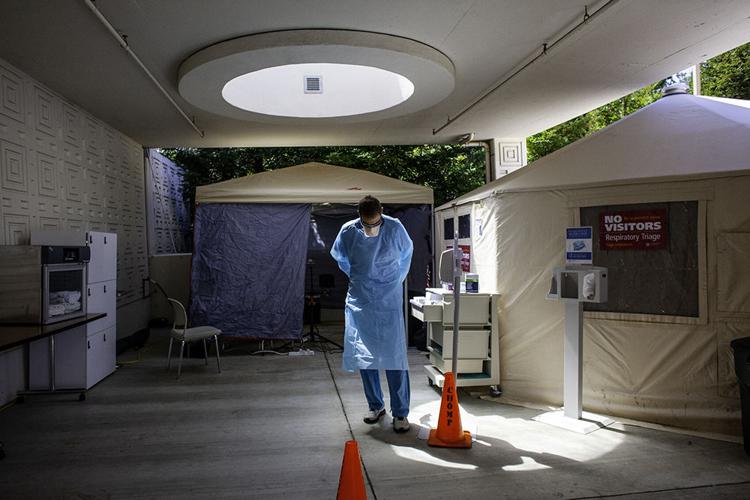

The sun shines through an opening in the ceiling, casting a spotlight on Dr. Casey Grover as he ties a baby blue plastic gown around his waist, pulls gloves over the wrists of the gown and spreads hand sanitizer over the plastic and latex surfaces before walking into one of the negative pressure respiratory triage tents outside of Community Hospital of the Monterey Peninsula. “Protective equipment is not an infinite resource, so how do you make it last and how do you protect patients and staff?” he says.
It’s something he thinks about a lot. His life used to be filled with administrative shifts, clinical shifts and projects as the medical director of the emergency room at CHOMP. Now his life consists of three things: his shifts, his family and coronavirus preparations.
Since the start of the Covid-19 pandemic, Grover has spent a lot of his time making sure the ER is clean and ready for a surge in Covid-19 cases. As the number of confirmed cases in Monterey County continues to rise, regulations change and new information and science are released, Grover and his staff adjust their protocols. “We started working on this in February and here we are in April still refining everything,” he says.
Both in the hospital and outside of it, Grover has become much more aware of sanitation. At work, he is more careful as he takes off his scrubs, he washes his hands even more frequently, wipes down his stethoscope, phone and badge regularly. On every shift he worked in March, he was in one of the respiratory triage tents, treating patients who had symptoms of Covid-19 or had tested positive for the virus.
“When I take care of a patient with coronavirus I have to take a pause and make sure I’m not rushing and that I have mine and my patients health in mind,” he says. “I have a family and a daughter and I have to be as sensible as I can.”
Grover finds the constant need to read new information, sanitize surfaces, plus the worry that he or his wife – also a doctor at CHOMP – could bring the virus home to their 10-year-old daughter to be emotionally and mentally draining. The ritual at the end of a shift has become to immediately remove his work clothing and put it in the laundry, then take a shower.
Grover is aware that this will be the “new normal” for the foreseeable future, but he focuses his energy on trying to stay positive. “The other day my daughter was moping about it and I told her that wishing it away doesn’t help,” he says. “We all have to work on keeping things as positive as we can and supporting each other no matter who we are or where we are. This is a tough time for everyone.”



(0) comments
Welcome to the discussion.
Log In
Keep it Clean. Please avoid obscene, vulgar, lewd, racist or sexually-oriented language.
PLEASE TURN OFF YOUR CAPS LOCK.
Don't Threaten. Threats of harming another person will not be tolerated.
Be Truthful. Don't knowingly lie about anyone or anything.
Be Nice. No racism, sexism or any sort of -ism that is degrading to another person.
Be Proactive. Use the 'Report' link on each comment to let us know of abusive posts.
Share with Us. We'd love to hear eyewitness accounts, the history behind an article.