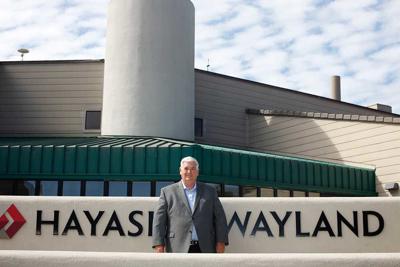

In the early 1970s, accountants Doug Hayashi and Warren Wayland had worked together at a local accounting firm for about three years. But when their company merged with a national firm, they suddenly realized they didn’t like the way things were being done.
So in 1976, they started a firm of their own in Salinas: Hayashi Wayland.
In the early years, it was just the two of them, and because they both had experience working with clients in agriculture – and Wayland had a degree in ag management – that industry became a key focus, and remains one today.
“This became a natural thing for us to go into,” Wayland says, “and ag is the largest industry in the county, so it made sense.”
In time, the firm grew, and grew more. It now has about 80 employees and satellite offices in Carmel, King City and Paso Robles. It’s also gained a foothold serving other industries, including hospitality and nonprofits.
As for why they’ve been so successful, Wayland says, “We’ve tried to provide excellent service to our clients. That was our first rule: Provide timely, accurate products at a reasonable fee.”
It’s also because of the people.
“We’ve been very selective in the type of staff we’ve hired over the years, and tried as much as possible to hire people who live within the area, so they appreciate it more,” Wayland says.
That first rule was also integral the firm’s guiding principles that, in Managing Partner Mike Briley’s estimation, are fundamental to the company’s success today: “Care. Excellence. Gratitude. Humility. Integrity. Respect. Stewardship.”
“We’ve kept together a core group of people, we’ve integrated into the community, and that’s part of our mission,” Briley says.
Part of that integration is developing expertise in local niches, like understanding, from an accounting perspective, how to value grapevines, calculate yields and appropriately apply tax deductions. (That niche is why the firm opened an office in Paso Robles.)
With hospitality, it’s understanding the cost of labor, filling seats and tables, and food costs. And then there are nonprofits, most of which don’t pay taxes, but have to file public financial documents, as well as government agencies.
“When you start with just [Hayashi and I], and look at what it is today, there is a great amount of pride in that,” Wayland says.


(0) comments
Welcome to the discussion.
Log In
Keep it Clean. Please avoid obscene, vulgar, lewd, racist or sexually-oriented language.
PLEASE TURN OFF YOUR CAPS LOCK.
Don't Threaten. Threats of harming another person will not be tolerated.
Be Truthful. Don't knowingly lie about anyone or anything.
Be Nice. No racism, sexism or any sort of -ism that is degrading to another person.
Be Proactive. Use the 'Report' link on each comment to let us know of abusive posts.
Share with Us. We'd love to hear eyewitness accounts, the history behind an article.