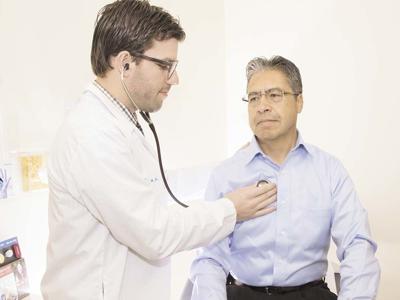

Salinas husband and father Jose Serrano, 55, didn’t pay much attention when his doctor diagnosed him with Type 2 diabetes in 2017. He didn’t feel any symptoms so he ignored the warning. He kept drinking three sodas a day, eating tortillas and enjoying sugary treats.
Then last September the warning bells started loudly ringing when chest pains landed him in the hospital. The pains weren’t directly related to his diabetes – although people with diabetes are at greater risk for heart disease – but his doctor made it clear that his blood sugar levels were dangerous: Well over 200 milligrams per deciliter, double what’s considered normal. The doctor encouraged Serrano to take classes at the Natividad Diabetes Education Center.
This time Serrano heeded the warning. He started learning which foods to avoid and which ones to add to his diet, portion control and exercise. He also learned that diabetes can lead to blindness, amputations, kidney damage and other serious health effects. He gave up soda, tortillas and candy and started eating more fish and vegetables.
“Mostly what I’ve done is dedicate 20 minutes daily to exercise where I walk on a treadmill,” Serrano says through a Natividad translator. “I’ve gotten really good results.”
Since his hospital visit he’s lost about 15 pounds and surprised his doctor when a recent blood test revealed a glucose level so low it’s as if he never had the disease, Serrano says. He feels less sluggish than before. And there’s a ripple effect on his wife and three kids with the change in diet and a ban on soda inside the home.
Serrano is one of approximately 38,000 Monterey County adults with Type 1 or Type 2 diabetes – Type 2 is a whopping 95 percent – according to Dana Armstrong, a certified diabetes educator and director of Diabetes Services at Salinas Valley Memorial Healthcare System.
In Monterey County, 1 in 8 people has diabetes, while nationwide it’s 1 in 11. Another 140,000 local residents are estimated to have prediabetes, or 1 in 2 people, compared to 1 in 3 nationally. The Latino population is especially vulnerable. One estimate is that 13.8 percent of Latinos in Monterey County have diabetes, compared to 4.8 percent whites and 4.4 percent Asians.
Armstrong has had a front-row seat since 1985 to what she calls a growing “tsunami” of diabetes in Monterey County. When she started working with Type 2 diabetes patients 34 years ago, they were mostly in their late 70s and early 80s. Today, she sees people in their 20s and even children with Type 2 diabetes.
“It’s a pretty scary situation,” Armstrong says.
It was scary enough that in 2014, the SVMHS board decided to invest $4 million in building the Diabetes & Endocrine Center, a 10,000-square-foot “one-stop shop” that opened in August 2017. Last year, the center entered into a partnership with UC San Francisco to address pediatric diabetes, making it the first facility in the county that has both pediatric and adult diabetes centers, according to Director Dr. Nicholas Kissell.
Calling diabetes an “epidemic,” particularly in the Latino community, Kissell says they have a bilingual staff and provide education in both English and Spanish. Other benefits for patients include vouchers for produce at a weekly farmers market on site and free educational classes. All insurance plans are accepted and no one is turned away.
Since launching the center, Kissell says they’ve seen an average 2.1-percent drop in patients’ A1C levels. (The A1C test measures the amount of hemoglobin in the blood that has glucose attached to it. A normal level of glycinated hemoglobin is 5.6 or below.) He’s glad about the drop, but says there is still a long way to go – 30 percent of patients never reach their goals.
Recognizing that no one organization can fight the rising tide in the county alone, a partnership of SVMHS, Community Hospital of the Monterey Peninsula and the Monterey Independent Physicians Association formed in 2016 as the Monterey-Salinas Healthcare Collaborative Diabetes Initiative, through the nonprofit Community Health Innovations. The partners combined resources to offer a Pediatric Diabetes Wellness program.
Prevention has also become a focus for all of Monterey County’s hospitals and health organizations, which has led to classes and other opportunities for screening and education throughout the county. (See resource list, left.)
The nonprofit Natividad Foundation, which supports the county hospital, Natividad, offers a program it developed seven years ago called 5 Steps to Prevent Diabetes. The program was tailored specifically to the local community, says Dr. Dana Kent, the foundation’s medical director of health promotion and education. About 1,000 people have taken the 10-hour, five-week course at various locations from King City to Pajaro. Kent says progress has been made – last year they saw more than a 20-percent increase in patients who attained goals associated with lowering their risk for diabetes.
The 5 Steps program, like other diabetes education programs, stresses small, sustainable changes that an individual can stick with. But it’s tough, especially in a society where unhealthy food choices bombard people; fast food is cheap and readily available and lifestyles have increasingly become more sedentary.
With all that people are up against, how can they stick to healthy changes long term?
“You’ve raised the million-dollar question,” Kent says. “It really is a matter of what works for the individual. The educators work closely with patients to find out what is meaningful for that person and will work for them.
“The main thing is we all know someone who has diabetes or has someone in the family with it,” she adds. “It’s alarming, but small steps can make a difference.”


(0) comments
Welcome to the discussion.
Log In
Keep it Clean. Please avoid obscene, vulgar, lewd, racist or sexually-oriented language.
PLEASE TURN OFF YOUR CAPS LOCK.
Don't Threaten. Threats of harming another person will not be tolerated.
Be Truthful. Don't knowingly lie about anyone or anything.
Be Nice. No racism, sexism or any sort of -ism that is degrading to another person.
Be Proactive. Use the 'Report' link on each comment to let us know of abusive posts.
Share with Us. We'd love to hear eyewitness accounts, the history behind an article.