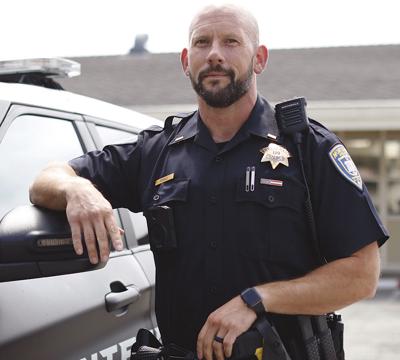

IN MARCH 2023, CSU MONTEREY BAY POLICE OFFICERS RESPONDED TO A MARINA HOME ON A REPORT OF A MAN ACTING ERRATICALLY. The 38-year-old who resided at the house was well known to police, who had responded to the home at least seven times over the past four years, one time arresting him for firearms violations.
According to court records, the man, who had three firearms registered to him, said he wanted to pull a gun out on the officers, with the hopes that they would shoot and kill him. He was taken into custody without incident.
A few weeks later, CSUMB Police filed for a gun violence restraining order, known as a “red flag law,” against the man. A GVRO, if approved by a judge, requires an individual to turn in their firearms and prevents them from owning a gun for up to five years.
“It is my opinion that a Gun Violence Restraining Order is necessary to prevent personal injury to [him] and/or others because less restrictive alternatives are ineffective, inadequate and/or inappropriate for the circumstances at issue in this matter,” Sgt. Stacie Russo wrote in the filing.
A Monterey County Superior Court judge agreed, and in April 2023 ordered the man to surrender his weapons and be prohibited from owning guns for three years.
In mid-2022, a Salinas man posted on Instagram photos of multiple AR-15-style rifles, a local hospital and an elementary school in Uvalde, Texas, the site of a 2022 mass shooting, with a post that ended with: “You will die like everyone else. One day or the next.” The court agreed with a request from Salinas Police, and signed an order banning him from possessing weapons for three years.
However, most of the time, these cases are dropped before they ever get to a judge, for various reasons – a suspect might agree to a mental health evaluation, or turn in their guns voluntarily, for example. Other times, there just isn’t enough evidence to convince a judge that the person is inherently dangerous.
In 2022, a King City man, who claimed that, while he didn’t own a gun, he had access to them, threatened to shoot two people and make police officers kill him, according to court records. After being placed on a mental health hold, he later reportedly said he was drunk when making those statements. Monterey Police Department dropped its request for a restraining order.
In 2022, the Salinas Police Department filed for a GVRO against a Salinas man arrested for domestic abuse. Court records state the man turned in one of his guns willingly, but he claimed that the other two were stolen sometime over the past two years, which he never reported. The city dropped its request.
It’s been nearly a decade since the red flag law went into effect, hailed as a way to possibly stem the rising tide of mass shootings. But it’s not being utilized to the full extent that lawmakers had hoped for. That is especially true in Monterey County.
• • •
IN 2014, A 22-YEAR-OLD MAN KILLED SIX PEOPLE AND INJURED 14 OTHERS by using semi-automatic pistols, knives and his car in Isla Vista. Prior to the rampage, he posted videos online vowing to kill people.
His family reportedly alerted police a month earlier, but as outlined in a 2015 report by the Santa Barbara County Sheriff’s Office, deputies had no legal right to search his apartment, where he kept his stockpile of weapons, nor did they believe he was a danger to himself or others.
In response to the killings, State Sen. Nancy Skinner, D-Berkeley, authored Assembly Bill 1014, known as the “red flag law.” Once signed by Gov. Jerry Brown later in 2014 and taking effect in 2016, the law authorized gun violence restraining orders.
A GVRO prohibits a person from buying or possessing a gun, ammunition or magazines. Only law enforcement, the person’s immediate family members, employer, co-worker or teacher can request such an order from the court. Unlike other types of restraining orders that may require a person to stay away from specific individuals or places (in addition to requiring them to relinquish firearms), GVROs focus exclusively on removing weapons from a potentially dangerous person.
Once the necessary paperwork is submitted to the court, a judge will review it and can issue a temporary GVRO until a scheduled hearing three weeks later. At the hearing, a judge can issue a GVRO for up to five years, or throw it out. If the court grants the request, the person is required to turn in their weapons to the police or sell them to a gun dealer within 24 hours.
In a March 2024 newsletter, nearly 10 years after she introduced the bill, Skinner wrote that while there is much more to be done on gun violence, GVROs have been “proven to be effective, but have been underutilized.
“A good place to start is to fully use the gun violence prevention tools we already have in place, especially GVROs,” she wrote. “They’ll make our communities safer. We know they work.”
• • •
LOOK NO FURTHER THAN MONTEREY COUNTY when examining Skinner’s claim that GVROs have been underutilized.
In June, the California Department of Justice’s Office of Gun Violence Prevention released a report on the state’s nine different types of protection orders that prevent people from owning firearms, such as for domestic violence and civil harassment.
From 2020 to 2023, the number of GVROs issued per year in California increased by 118 percent, according to the report. But of the 8,988 GVROs issued statewide from 2016 to 2023, 44 percent were issued in just two of the state’s 58 counties, San Diego and Santa Clara. Of the total amount issued, only 2,071 were final orders that lasted between one to five years, while the rest were temporary, generally for three weeks.
For the final GVROs issued per capita, or those that last for multiple years, Monterey County is listed at below the state average. (Neighboring counties of Santa Cruz and San Luis Obispo were ranked in the top 10.)
For Monterey County, 57 GVROs were filed from 2016-2023. Only 16 of those were final orders.
A review of Monterey County Superior Court records shows Monterey and Salinas police departments are the top two local agencies that have filed the most GVROs, with Monterey at nearly a dozen and Salinas close on its heels.
• • •
MONTEREY POLICE LT. JAKE PINKAS says getting a final GVRO granted depends on the situation.
He points to one example of a case Monterey Police filed that wasn’t granted – during a conversation between two people, one of them threatened to shoot the other. The man being accused denied the claims, and a judge agreed there wasn’t enough evidence to grant the GVRO.
Is it just an empty threat during a drunken fight at the bar, or are these threats part of a pattern of altercations between the same people? The latter case could be more persuasive for a judge, Pinkas says, especially if police can prove the accused are in possession of firearms in the first place.
Pinkas believes that even if a final order is not granted, a temporary one, which is easier to obtain, is beneficial, even though it’s “not an end-all, be-all,” he says. “You could get a gun illegally tomorrow.”
But “tomorrow” might be meaningful. “For us, it’s a valuable tool even if it is just those 10 days before the court proceeding,” he says. “Maybe that has changed the person’s mind. Anytime that we have a tool that we can use to potentially prevent violence, I think it makes it valuable.”
A 2022 study from the Violence Prevention Research Program at UC Davis examined 201 cases from the first three years since the GVRO law went into effect.
Fifty-eight cases involved threats of mass shootings, and almost 30 percent of all individuals subject to the restraining order had assault-type weapons.
The study suggests that GVROs have been effective in preventing self-harm. Threats of suicide accounted for about 40 percent of the cases, and none were reported among the people subject to the orders.
Opponents of red flag laws, meanwhile, question the effectiveness of the laws, pointing to think tank RAND Corporation’s survey that found inconclusive evidence to support claims that they have been successful in reducing violent crime.
Some also say the laws are constitutionally suspect, and infringe on residents’ Second and 14th amendments rights of owning firearms and due process, respectively.
In 2022, the conservative majority of the U.S. Supreme Court ruled that gun laws must align with “history and tradition.” That set off a flurry of lawsuits challenging the constitutionality of firearms restrictions, including red flag laws.
But in June 2024, a Supreme Court ruling upheld a law that prevents domestic abusers from being in possession of guns, and by doing so, gun control advocates say red flag laws are safe.



(0) comments
Welcome to the discussion.
Log In
Keep it Clean. Please avoid obscene, vulgar, lewd, racist or sexually-oriented language.
PLEASE TURN OFF YOUR CAPS LOCK.
Don't Threaten. Threats of harming another person will not be tolerated.
Be Truthful. Don't knowingly lie about anyone or anything.
Be Nice. No racism, sexism or any sort of -ism that is degrading to another person.
Be Proactive. Use the 'Report' link on each comment to let us know of abusive posts.
Share with Us. We'd love to hear eyewitness accounts, the history behind an article.