
IN THE ARC OF HUMAN HISTORY, 30 YEARS IS A FRACTION OF A FRACTION OF A FRACTION (repeat ad infinitum) of a second. But 30 years in the history of a local, independently owned business is no mere blink of an eye. It’s a day-in, day-out grind, a slog uphill, a daring feat to stay on mission, adapt to changing times and still meet the balancing act of taking care of customers, employees, staff and even yourself.
For the Weekly, 30 years in business has involved a lot of great storytelling, and a lot of great storytellers. We invite you to take a look at this list – and keep in mind, it’s by no means comprehensive; instead it’s a year-by-year compendium of some of our favorite pieces and moments of the past 30 years.
2018:
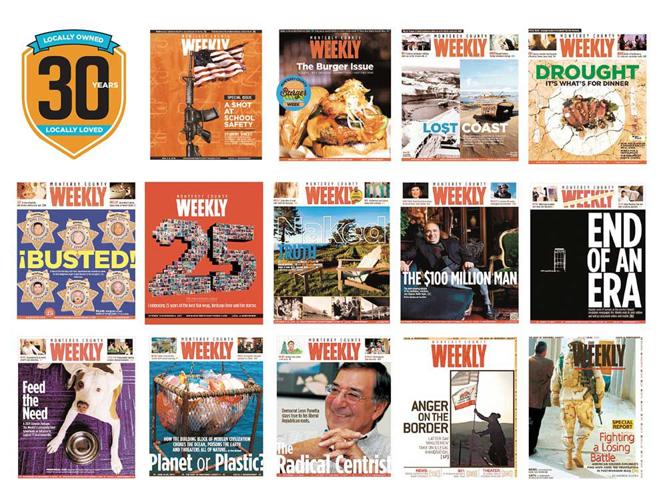
How many more times will we let it happen before politicians find the will to put a stop to it? That was the focus of a unique package we published in May. In their own words, and with their own artwork, high school students from around Monterey County weighed in on gun violence, as the Weekly examined how the horrific mass killing at Marjory Stoneman Douglas High School in Florida has reshaped how students consider school safety.
2017:
Tourists, amirite? We love the dollars they bring, but the traffic and litter they generate, not so much. In this November story, the Weekly looked at how tourism, something Carmel residents love to hate, helps pay the bills but tests their patience, and why a new wave of marketing targeted at bringing Chinese tourists to Carmel had been especially trying for residents.
2016:
The Cemex sand mine in Marina is the last remaining coastal sand mine in the country, responsible for one of the highest coastal erosion rates in California. The mine, owned by a Monterrey, Mexico-based giant, pumps thousands of truckloads of sand from the lagoon every year, and does it without much oversight, lacking a coastal development permit from the California Coastal Commission, or a permit from the city of Marina. This January cover storytook a deep look at mine operations, and the fight – ultimately a successful one – to get it shut down.
2015:
In April, the Weekly turned the concept of food writing on its ear, featuring the drought on the cover of its annual food and drink issue. The arresting cover image – a perfectly rare sliced steak served over greens, placed on a cracked plate that was placed on drought-cracked earth – led to stories about how much water it takes to produce an average Salinas Valley meal and what clever grape growers were doing to make great wine in the midst of sustained drought.
2014:
Law enforcement teams made up of Monterey County District Attorney’s investigators, FBI agents, Salinas police and Monterey County sheriff’s deputies in February simultaneously served arrest warrants on three current or former King City police officers and a towing company owner; the acting police chief was arrested at the police station and two other officers later turned themselves in. The Weekly broke the story the day of the arrests, and this story was the first long look at the wholesale corruption involving a towing-for-dollars scam that targeted immigrants and enveloped tiny King City.
2013:
In September, the Weekly filed a motion to intervene in a civil suit brought by John “RJ” Doe against the Diocese of Monterey, Bishop Richard Garcia and Father Edward Fitz-Henry. Doe claimed that Fitz-Henry molested him, and the Weekly sought to unseal depositions the paper believed could prove those allegations. In 2015, after a years-long and expensive court battle, the Weekly won its case, obtained the documents it sought and wrote a multi-part package about the grim details those documents revealed.
2012:
The Esalen Institute attracts travelers from around the globe, especially ones interested in getting in touch with their inner selves – the “genuine seekers,” as they are known. This October piece, arriving as Esalen celebrated its 50th year in existence, looked not only at the land of hippie harmony, but also at the friction created by an identity crisis as the institute tried to determine how to stay grounded in the modern world, and how guests and staff alike felt isolated by Esalen management’s tactics.
2011:
Businessman, real estate developer, self-made mogul and frequent litigant: Syrian-born Nader Agha is one of the wealthiest men in Monterey County, and one of the most controversial. He arrived to the country in 1965 with $27 in his pocket, did field work, waited tables and cleaned houses – then slowly and methodically cobbled together an empire. (Did we mention the litigation? There are so many lawsuits that when we put together this story, we had to make a separate list of them.)
2010:
We couldn’t resist. April 1 of this year fell on a Thursday – the Weekly’s publication date – and so we published a cover story with the following subhead: “Despite years of success as the county’s largest circulation newspaper, the Weekly ends its print edition and will go exclusively online and mobile.” Chaos ensued. Rage-mail poured in. The phone rang off the hooks. April Fool’s.
2009:
The brothers Roger and Basil Mills were legends in the Salinas Valley agriculture industry. But a foray into real estate development with their tony Monterra Monterey project off of Highway 68 spiraled out of control and piece by piece, their empire was destroyed as business partners, banks and other creditors came to collect. This January story was a cautionary tale ne plus ultraabout the perils of biting off more than you can (or should) chew.
2008:
It was a harbinger of far worse fires to come. The Basin Complex Fire started on June 21 when lightning struck Big Sur. The conflagration raged for weeks, forcing evacuations and burning most of the Ventana Wilderness. At the time, it was the most expensive fire to fight in California history. Our continuous coverage culminated in the July 31 cover “Afterburn: The long, slow road to recovery in Big Sur.”
2007:
In October, the Weekly ran a news story outlining the ingredients in a spray manufactured by Suterra and used to combat the light brown apple moth. Then-Gov. Arnold Schwazenegger ordered the California Department of Food and Agriculture to release the complete list of ingredients in the spray and when the paper ran its piece, Suterra sued us – and we sued them back. After a Los Angeles judge rejected the company’s motion to gag us and keep the ingredient list private, Suterra dropped its suit, and we dropped ours. It was a big win for the First Amendment.
2006:
The smiling visage of hometown hero Leon Panetta makes our Nov. 2 cover, carrying the headline, “The Radical Centrist: Democrat Leon Panetta stays true to his liberal Republican roots.” It was still three years before President Barack Obama would tag him to be the director of Central Intelligence (and lead the ultimately successful hunt for Osama bin Laden), and five years before Obama named him as the country’s Secretary of Defense. The great thing about Leon: He always comes home.
2005:
Not before and not since has the paper devoted as much space to the subject of immigration. On June 16, the cover featured “Anger at the Border: Latter Day ‘Minutemen’ Take on Illegal Immigration.” On Dec. 1, the cover featured “The Real Immigration Crisis: Not Enough Mexicans,” which looked at how the lack of a rational immigration policy created a severe labor shortage. And on Dec. 8, the cover story was “More and More Illegals: Looking for a Home,” which covered how undocumented immigrants sought to become citizens of the U.S. The three-part cover series won a state investigative reporting award.
2004:
There’s nothing like an election year to shape our headlines. 2004 saw a trio of stories that made waves on the local political scene. First, a cover about Jerry Smith chronicled why powerful special interests wanted him to be on the County Board of Supervisors. (Maybe they knew something nobody else did?) Then a cover meant to look like a wanted poster featured then-Supervisors Lou Calcagno, Edith Johnson, Butch Lindley and Fernando Armenta and listed their crimes as wasting taxpayer money, ignoring the public’s well-being, disregarding environmental law and selling out to special interests. And a third cover detailed then activist/businesswoman Jane Parker, as she sought to become the District 4 supervisor.
2003:
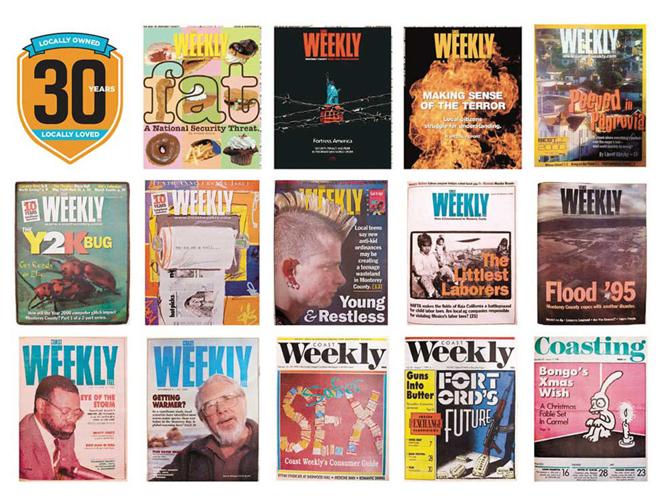
Weekly reporter Andrew Scutro spent Christmas in Baghdad, making him the only local reporter in Monterey County sent to cover the Iraq War, and making the Weekly the only paper in the Association of Alternative Newsmedia to send a reporter to do it. Scutro’s coverage included an early 2004 cover story on how American soldier-diplomats tried to create democracy amid the chaos – more than 14 years later, it still makes for a heart-wrenching read.
2002:
As the nation prepared for war, we examined changes that occurred nationally and locally in the year since the 9/11 terror attacks. That run-up to war included a look at activism around the county, and how the main Salinas post office and Monterey’s Window on the Bay became gathering spots for protesters and signs to come and be seen and heard. And 16 years later, some of those same activists are still on the scene in those same places, and still waging a fight for peace.
2001:
It was months before the 9/11 terror attacks and it galvanized the Monterey Peninsula: In May, a 5-year-old, 268-pound black bear was treed after Carmel police followed it through town. When California Department of Fish and Game officers showed up and shot it with a tranquilizer dart, it climbed a few branches, then grew woozy and fell, missing the cushions game wardens had laid out. It hit a garage roof and died about 20 minutes later from a ruptured liver and punctured lung. The act spawned a wave of grief and public outrage, with signs that included one tacked to that same tree that read: “Save the bears, dart the game warden.”
2000:
It was as jaw-dropping then as it is now. Dedicated land-use watchdog Pat Bernardi, a retired schoolteacher, sensed something funny was going on at the Monterey County Planning Department. Some planning staffers seemed to rely too heavily on information from developers and neglecting doing their own due diligence. Turned out, her instincts were right. Along with attorneys Jane Haines and Michael Stamp, they discovered attorneys working for powerful land use attorney Tony Lombardo were ghostwriting the very documents that county officials depended on to make decisions about projects. The scope was breathtaking, and involved hundreds of county planning, environmental health and water agency documents used on multiple projects, including September Ranch, Canada Woods and the Bernardus Lodge “remodel.”

1999:
In 1999, methamphetamine was still an underreported problem in Monterey County. Home labs were popping up, use was on the rise and people were just beginning to understand how dangerous a drug meth is – both to use it and manufacture it. And law enforcement officials stated Monterey County was one of the leading counties in the state for production. “Meth is the worst drug… because the violence that is associated with it is unbelievable,” one official told theWeekly. This story was our first deep dive into a burgeoning epidemic that would sweep the nation.
1998:
Bill and Al: Remember them? In June of ’98, Bill (or President Clinton, as he was known) and Al (or Vice President Gore, as everyone called him) came to the Naval Postgraduate School for the National Ocean Conference. But we wondered: Was the conference merely a media event with the Monterey Bay as a great photo backdrop, or an opportunity to kick around great ideas that could lead to meaningful change?
1997:
And introducing Squid, the gender-neutral, misanthropic (yet eternally optimistic) cephalopod columnist who takes on all the county’s sacred cows, with Squid’s trusty companion, the snuffling mess of a bulldog known as Rosco P. Coltrane, at Squid’s side. Squid made Squid’s first appearance this year, and more than 20 years later remains one of the Weekly’s most popular features. “Who is Squid?” reporters frequently get asked while out and about. The answer now, as ever, remains the same: “We’ll never, ever tell.”
1996:
The small, wide-eyed faces on the Aug. 29 cover told a story of their own: They belonged to children under the age of 10 who were working in a field alongside their parents. And in the story, titled “The Littlest Laborers,” we looked at how the North American Free Trade Agreement had turned the fields of Baja California into a battleground for labor laws, and whether or not local ag companies were responsible for violating Mexico’s labor laws.
1995:
Water, water everywhere. Flooding in March cut off the Monterey Peninsula from the rest of the county and rendered it an island. Police drove through South Salinas neighborhoods, using loudspeakers to warn residents about what could happen and urging them to take precautions. Thousands of people were forced from their homes in the middle of the night as the Pajaro and Salinas rivers overspilled their banks; one man was swept to his death. Carr Lake once again became an actual lake. At its peak, the Salinas River flood tide was recorded at 30.2 feet, the highest level ever recorded.
1994:
Our special investigative report on the tenure of Interim Seaside City Manager Sam Head leads to his ouster by the city council. Seaside Mayor Lance McLair rages in front of our building the day the story breaks but can’t identify a single error. Meanwhile, Seaside’s former city attorney Elaine Cass filed a claim against the city, alleging she had been sexually harassed by Head and then threatened with the loss of her job when she complained to councilmembers about the harassment.
1993:
Consider that we all knew what many to this day are still trying to deny. A story about Monterey Bay’s warming trend is one of the first to show the impact of global warming on the oceans – we published three months before Science reported it. And climate-change deniers still walk among us.
1992:
We published our “Safer Sex Guide” – and handed out free condoms as well to focus attention on the issue of HIV/AIDS. Over 300 people from a church in Pacific Grove signed a petition to boycott our advertisers and sent that petition to every advertiser. In a brave and stunning show of loyalty, not a single one of them cancelled.
1991:
The big move! We relocated our offices from Carmel to our current, and dare-we-say, permanent headquarters, designed by renowned architect Charles Moore, at the corner of Fremont Street and Williams Avenue in Seaside. On our very first day in this office, a neighbor punched the window of the then-crack house across the street, severed an artery and ran into our office bleeding, asking for help and ripped the cords out of a stereo system to make an improvised tourniquet. Our brand new receptionist quit.
1990:
It was a harbinger for hard times to come. Then-U.S. Secretary of Defense Dick Cheney proposed that 35 military bases be closed, including Fort Ord. A year later, a new university for Fort Ord was proposed. And three years later, as the local economy suffered due to Fort Ord’s closure and the California recession, we published California’s Guide to Monterey Bay, with a circulation of 1.2 million, inserted into alt-weeklies all over the West Coast.
1989:
A converted bathroom in our office (then located in Carmel), functioned as a darkroom when, on Oct. 17, the Loma Prieta earthquake hit at 5:04pm. We completed the paper on a manual typewriter (with corrections taped in) and went to press on time with our original cover story on the Aquarium’s fifth anniversary – and a paragraph about the earthquake. Expansive coverage of the earthquake, and the damage it wrought throughout the county and beyond, would come in the weeks and months that followed.
1988:
The Monterey Bay Aquarium turned 4, Fort Ord had 37,000 soldiers, dependents and civilian employees and a paper is born. Coasting, and its companion classified shopper The Exchange, were nearly bankrupt when the printer, one of the five owners, called his note and forced the papers’ sale. Bradley Zeve created Milestone Communications Inc. and bought the paper on Sept. 1.





(0) comments
Welcome to the discussion.
Log In
Keep it Clean. Please avoid obscene, vulgar, lewd, racist or sexually-oriented language.
PLEASE TURN OFF YOUR CAPS LOCK.
Don't Threaten. Threats of harming another person will not be tolerated.
Be Truthful. Don't knowingly lie about anyone or anything.
Be Nice. No racism, sexism or any sort of -ism that is degrading to another person.
Be Proactive. Use the 'Report' link on each comment to let us know of abusive posts.
Share with Us. We'd love to hear eyewitness accounts, the history behind an article.