
By any standard, the 2024 AT&T Pebble Beach Pro-Am was unusual.
For the first time, there was no Bill Murray, no celebrity antics. Instead the field was populated with the world’s top professionals – also a first for the tournament. The PGA Tour named it a designated event, so the purse jumped from $9 million to $20 million. Meanwhile the weather took a brutal turn, putting the area under shelter-in-place orders and canceling the final round. Seven years had passed since the previous 54-hole finish on the tour.
What truly stood apart, however, started with a guy named Mike.
“Sorry, don’t know his last name, just met him this week,” Wyndham Clark said after Saturday’s third round in 2024. “I flew in early Sunday, spent about three, four hours with him.”

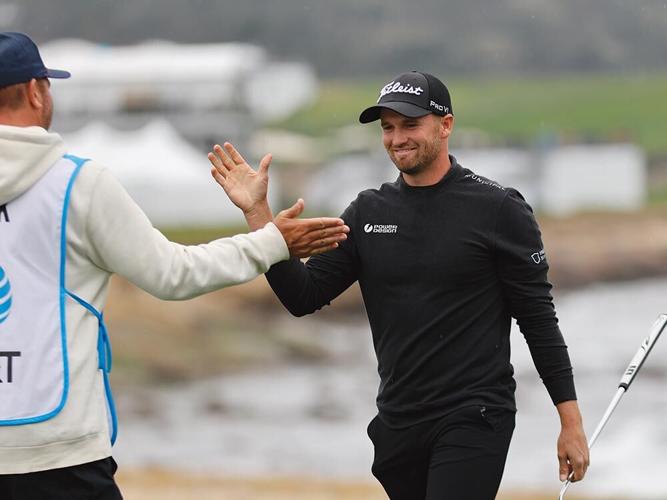
Wyndham Clark and caddie John Ellis celebrate after finishing the record round.
Golf coach Mike Kanski is the Mike in question. Clark had been struggling with his putter for several months and Kanski worked on a solution.
The results were not obvious at first. Clark managed par – 72 at Spyglass Hill – on Thursday and wrapped up Friday with a round of 67 at Pebble Beach Golf Links. He began Saturday on the very fringe of contention, six strokes back in a tie for 23rd.
By the end of the day, Clark had made course history.
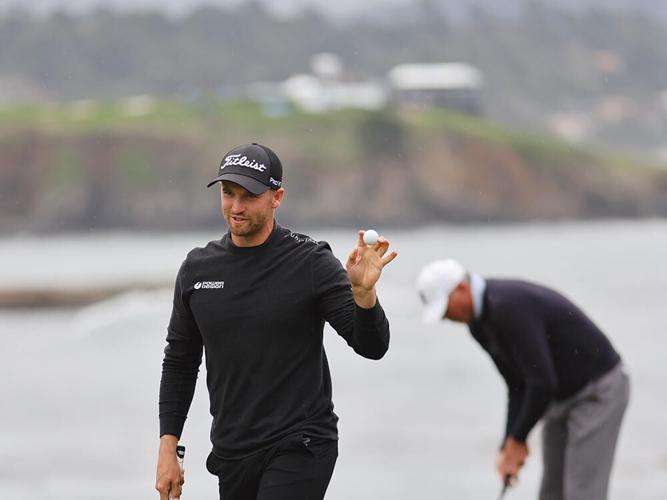
He was an unstoppable force, especially on the greens. Clark drained 189 feet of putts on the day, besting the previous course mark by a whopping 73 feet. Five were from 25 feet or further.
“It was the best putting day of my life,” Clark says. “Everything just went in.”
But there’s more. The Colorado native with two previous tour wins scorched the field, claiming the tournament crown by firing a course record 60, a full 12 strokes under par.
Below, we recount his memorable day.
Holes 1-5
After one hole, there was nothing to foreshadow what was to come. Clark’s drive nestled in the right rough. Although he still made the green in two and had a chance at birdie, he settled for par.
The first indication that fortune might be on Clark’s side came on number two. An errant approach shot smacked the edge of a bunker guarding the right. Instead of toppling into the sand, however, the ball kicked sharply to the left and bounded onto the green. He took advantage of the opportunity by sinking a 40-foot putt for an eagle – 2-under on the par 5.
Yet holes three, four and five saw a return to competent but uneventful play. A gentle tap on three rolled to a stop inches short of the cup. On five he measured a long putt nicely, but missed to the right. Clark went par, birdie, par.
“Pebble is tough on putting,” he explains, citing the time of year – rain slows the greens and exaggerates the bumps of poa annua, the type of grass. While the grass is not exclusive to Pebble Beach, players do not get much experience on such surfaces. And poa tends to throw otherwise easy taps off kilter. “But I had a good look at birdie on one and made a 40-footer.”
Holes 6-9
The sixth hole is where the iconic course begins to show its callous beauty. The fairway is guarded by a series of bunkers on the left and a cliff and ocean on the right – all leading to a daunting climb that obscures the flag.
For Clark, it also promised little – at first. His drive hugged the left fairway, but his approach shot from 196 yards out fell more than 40 feet from the flag.
Now, however, the hours spent on putting technique earlier in the week began to tell.
Under Kanski’s tutelage, Clark switched to a cross-handed grip – a significant change just days before a signature tournament. A confident pendulum stroke sent the ball on a line to the center of the cup – Clark’s second eagle on the front nine.
“The eagle putt on 6 – I thought ‘hey, that’s nice,’” he recalls.
Suddenly at 5-under after just six holes, Clark was beginning to realize that he was now in contention for the win. The thought of a record round had not yet entered his plans.
Following a birdie on the postage stamp par 3 seventh, the group – Clark played that day with Matt Kuchar and Nicolai Højgaard – headed to the trio of menacing par-4s, known colloquially as the “Cliffs of Doom.”
The fairway on number eight is split by the first ominous chasm. Hitting too long off the tee puts a golfer in difficulty. Two years earlier, Jordan Spieth had risked death, dangling over a 70-foot precipice rather than trade a penalty stroke for a safe lie. Clark parked his drive without such drama and landed his second shot in the front third of the green. He was looking at 30 feet from ball to pin.
No problem. He sank an arrow-straight putt to chop another stroke.
“When it got crazy is when I made the putt on eight,” he observes. “Whoa. I thought, ‘This could be a special round.’”
A golf adage assures that one bashes the driver for show. A deft touch on the green is what puts a player in the money.

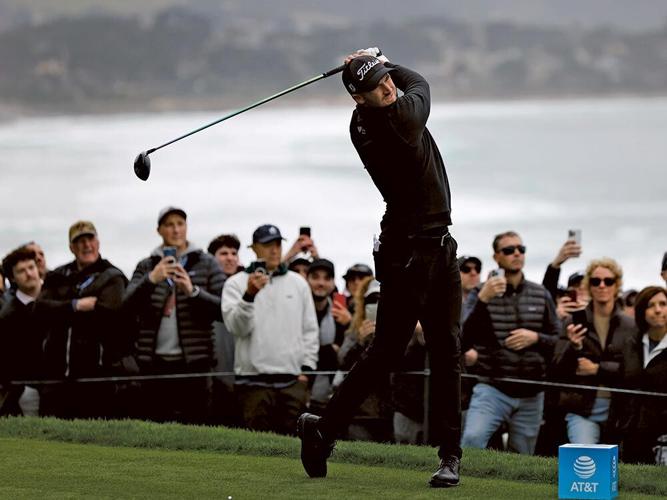
Clark often found a little trouble off the tee, but he kept recovering throughout the day.
Poa annua can consign old sayings to the bin, however. One study found that from between 4 to 8 feet, golfers make more than 68 percent of their attempts. On the sturdy bluegrass, that figure drops to 66 percent – a small number that adds up as a round goes on.
On nine Clark stood over the ball, studied the contours of the green and recognized a dip. From 25 feet, he sent the ball slightly to the right. As it closed on the hole, the ball curled a few inches to the left and dropped in for a birdie.
A few dozen fans applauded in approval. There still was not a large gallery following the group. That would change.
Holes 10-12
“I started feeling the nerves kind of on 10,” Clark admitted after the round. “I think in the past I would have kind of coasted in and shot a nice 8-, 9-under. To keep the pedal down and to stay aggressive mentally was the most impressive thing to myself.”
From the tee, he chose to challenge the fairway bunkers on the right. The drive found the choppy rough surrounding a trap.
Yet this is how his round was shaping up. Clark’s was not a flawless effort. But for every shot that spelled potential trouble, he countered with an improbable recovery.
So while his drive on 10 went astray, Clark’s approach shot, on the other hand, was remarkable – a three-quarter swing, lofting the ball for a soft landing, less than four feet from the stick. Clark tapped in for another birdie.
The 11th followed suit. Nerves flared on the tee and Clark’s drive again got tangled in the rough. His second shot faced threats from bunkers and a treeline. Again, though, he rallied for a birdie.
That made five consecutive birdies, preceded by an eagle. Clark was now playing at 10-under.
An amateur held the male course record at Pebble Beach. During the 2017 collegiate Carmel Cup, Hurley Long of Texas Tech fired a 61. Now Clark was threatening the mark.
But the legendary course was not willing to concede just yet.
While the 204-yard par 3 12th may not be one of the course’s signature holes, the fairway narrows suddenly in front of the green. Clark’s 6-iron shot ended up badly, the ball buried in the right front bunker. His attempt to blast it from the sand also went awry. This time the ball hung on a narrow strip of rough on the fringe of another greenside trap – a particularly deep one, at that.
He considered his options, none of which were promising. For the right-handed golfer to hit a conventional wedge, he would need to take his stance in the bunker. The ball would be almost at waist level.
Professional golf is a numbers game. On the fairway, for example, a player and his or her caddie know just how far they can carry each club, as well as where the ball will land if they decide to take 10 percent off the swing. “What’s my number?” is a question often tossed from golfer to caddie.
Percentages also come into play on and around the green. In his mind, Clark considered the chance of clipping the ball with the club’s heel or socket too high for comfort. Fail to strike it cleanly and the ball would careen who knows where. And he was already in a desperate situation.
So he turned around and lined up left-handed.
“I didn’t know what to do,” Clark admits. “Everyone thought it was a bad play.”
Striking the ball left-handed not only required him to turn around. It also meant holding the club awkwardly, the toe of the clubface pointing down. If caddie John Ellis protested the idea, Clark gave no indication at the time. He just went about sizing up the shot.
Once the round was over and he could assess the situation calmly, another thought occurred: “Now that I think about it, I maybe could have got a 3-wood or a putter and just tried to put it on the green.”
Instead, swinging lefty with a right-handed iron, Clark popped the ball to the fringe on the far side, 25 feet from the pin. He was certain to lose one stroke and probably more.
Clark later told reporters that he had accepted the double bogey in his mind and was just trying to nudge the putt that followed somewhere close. But his ball bounded toward the hole, caught the very edge of the cup, teetered and fell in.
For all his trouble on 12, Clark had avoided catastrophe, dropping just one stroke. The bogey – the only mark on his scorecard above par – may have been the signature hole of the round.
“For that to go in, it was like, ‘All right, man, I’m hot,” he said.
Holes 13-15
When a pitcher is tossing a no-hitter in baseball, his teammates generally remain silent. As Clark’s round progressed, Kuchar, Højgaard and their caddies began to keep their distance. Kuchar rarely spoke, other than to Brian Reed, his man on the bag.
“It’s a gentleman’s thing to get out of the way,” Clark says, explaining Kuchar’s reticence. “He didn’t want to jinx it.”

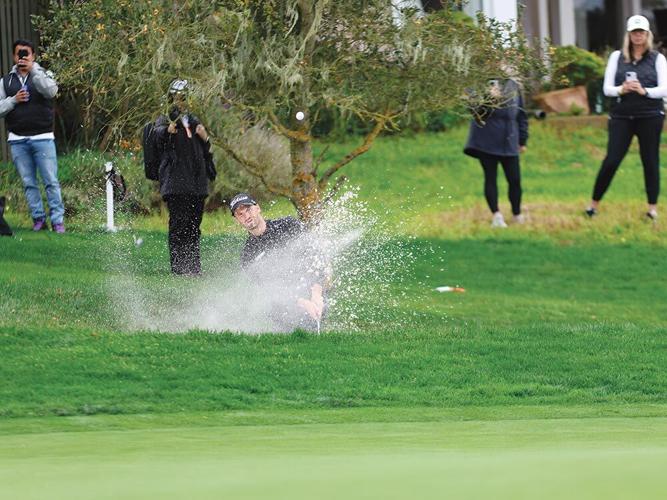
Clark blasts out of a bunker on 14.
Superstitions matter in sports. They are part of the mental game. Perhaps rattled by mishaps on the previous hole, Clark sailed his drive left, into the rough between a fairway bunker and the cart path.
The gallery had to make way as he lined up his second shot, which carried enough speed that the ball almost rolled off the back of the green – almost. Clark gathered himself and knocked in a 12-footer to birdie the par 4 13th.
While he birdied 14, as well, it required yet another improbable save. Clark’s second shot found the greenside bunker on the right. But he popped a beauty of a wedge that ended up four feet from the pin.
“I still don’t know how I did it,” he says. Adding, with poa annua in mind, “the three- to four-footers at Pebble are tough.”
He didn’t need to worry on the par 4 15, as a pitch from the rough left him just 20 inches away. But he did record par for the hole.
Clark now stood 11-under, on track to at least tie the course record. Another string of birdies, however, would put him in an exclusive group.
In the PGA Tour’s history, only 13 golfers carded rounds of 59 or lower. On top-level professional tours, there have been just four rounds as low as 58. Two of these – by Ryo Ishikawa and Kim Seong-Hyeon – were recorded on the Japan Golf Tour. Another occurred on the LIV tour, on a course where rounds of 20-under are the norm. None took place on a par 72 layout.
Jim Furyk’s 58 at the 2016 Travelers Championship played on the par 70 River Highlands course in Cromwell, Connecticut remains the only such score on the PGA Tour.
Over the final three holes, Clark would flirt with that number.
Holes 16-18
Throughout the day, he had consistently found ways to work out of trouble. If 12 was the only blot on the scorecard, 16 will be remembered for its teasing possibility.
Clark’s drive carried over the managed playing area into scruffy native ground. It rested in deep grass on the edge of a hole scoured out by a burrowing animal – a bit of luck, in this case, because officials granted him relief, allowing the golfer to drop the ball in a new location. But he still had to contend with a tree covering his approach.
On this day, though, obstacles faded for Clark. He lofted an iron over the tree, having to squat to see where the ball ended up, just over 10 feet away. On a day when great saves had followed errant shots, it was seemingly deja vu all over again.
After draining five putts of 25 feet or more, a mere 10-footer seemed certain. On 16, however, Clark’s touch betrayed him. The ball stopped short and he had to tap in for par.
He suffered more flatstick frustration on the par 3 17th, when his putt hung on the lip of the hole, but did not fall in.
“The only two shots I’d like to have back are the putts on 16 and 17,” he says. “They were dead center, I just left them short.”
On the short stroll to the tee on 18, Clark realized the significance of those two near-misses. He had been closing in on a 59 or 58, perhaps even a 57.
“I thought, oh my gosh, it would have been really nice to have one of those last two,” he told reporters later. “Because then I only have to birdie 18.”
With his mind now set on the possibility of a record, Clark decided to attack the final hole, the iconic par 5 with its tempting and dangerous options. The ledge that runs along the bay narrows the course before it curves slightly to broaden the fairway. Many golfers have watched helplessly as their effort to cut the corner kicks up ocean spray instead.
Clark cracked a drive on a line over the bay. It fell in the clean, 224 yards to the flag – a perfect lie that took both of 18’s notorious trees out of play.
His second shot – a 4-iron – dropped softly onto the green, stopping within 26 feet of the ultimate target.

On the 16th and 17th greens, Clark left putts agonizingly close. In a remarkable round with a number of small miscues, it is those two strokes he would like to have back.
Although he put together a record round, it is equally memorable for its almosts. And there was one more. For the third time in a row, he was too careful on the green. Clark’s attempt at an eagle – and a 59 – slowed to a stop, online but still 7 inches from the cup.
“We almost had it,” he rues.
• • •
Clark recalls the round for the Weekly while on the road, ahead of The American Express Event held at La Quinta, part of the PGA Tour’s California swing earlier in January. The sport’s fickle nature flared and he failed to make the cut.
As his return to the AT&T Pebble Beach Pro-Am as defending champion nears, Clark admits that the record was on his mind “a little” – from his car he could cite each hole in some detail. He credits his team, which includes caddie Ellis and performance psychologist Julie Elion. There was also that guy named Mike.
“It’s tough to defend, so you just have to have fun,” Clark notes.
After Clark wrapped up his record round, rain began to pelt Pebble Beach. The wind whipped through, pummeling the temporary structures around the course. Officials wisely decided to cap play at 54 holes, making Clark the champion.
February at Pebble Beach can offer up beauty. It can also turn the game into a chore.
“It’s one of my favorite courses,” Clark says. “There’s no better walk in golf than Pebble Beach – in good weather.”🏌
(0) comments
Welcome to the discussion.
Log In
Keep it Clean. Please avoid obscene, vulgar, lewd, racist or sexually-oriented language.
PLEASE TURN OFF YOUR CAPS LOCK.
Don't Threaten. Threats of harming another person will not be tolerated.
Be Truthful. Don't knowingly lie about anyone or anything.
Be Nice. No racism, sexism or any sort of -ism that is degrading to another person.
Be Proactive. Use the 'Report' link on each comment to let us know of abusive posts.
Share with Us. We'd love to hear eyewitness accounts, the history behind an article.