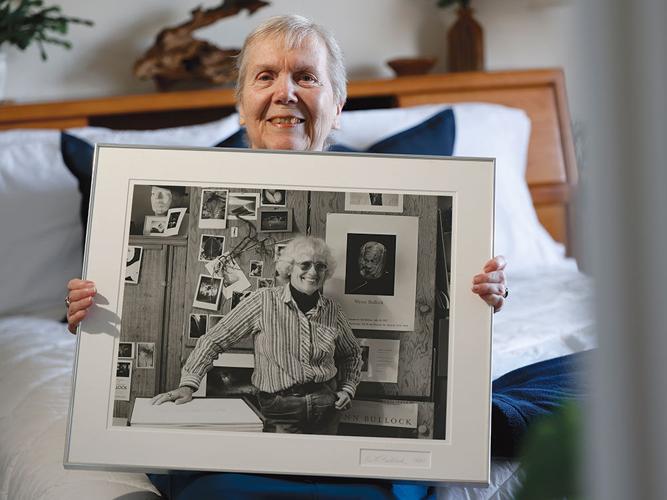


Barbara Bullock-Wilson holding an image of her mother, photographer Edna Bullock.
WYNN BULLOCK, ONE OF THE ICONS OF AMERICAN MODERNISM IN PHOTOGRAPHY AND A LONGTIME MONTEREY RESIDENT, DIED IN 1975. A year later, at the age of 61, his wife, Edna Bullock, knocked on the door of the Monterey Peninsula College photography department, where instructor Henry Gilpin was teaching a Photography 1 class.
“What in the world are you doing here, Edna?” he asked. He had known her photographer husband and he knew her as a former dancer and physical trainer, and in later years a teacher of home economics.
“What do you think, Henry?” she retorted. “I’m here to learn!”
This is how Barbara Bullock-Wilson, writer and curator of her parents’ photographic legacy, tells the story of how her mother, recently widowed, started her career. Edna was a practical woman; her husband gave her a camera, and he left behind a darkroom and equipment, so taking photos herself seemed like a practical thing to do. Edna picked up the camera her husband gave her as a memento, the Nikon F, and she started photographing her family, including her mother-in-law, Lillie. “I can do this!” she decided. Moreover, “I want to do this!”
“Edna and Wynn were, in my mind, such partners that I assumed Edna knew all there was to know about photography,” Gilpin recalled in the 1995 book, Edna’s Nudes, by Bullock-Wilson. “To find her enrolled in my basic photography class at MPC was a shock.”
The portrait of Lillie was the first photo Edna Bullock was recognized for, before she became a legend herself, a white-haired grandma who specialized in male nudes and was not above getting naked herself (when a model didn’t show up), standing on the other side of the camera during one of her workshops in Yosemite National Park.
“With the MPC photo department’s support, Edna’s 20-year career as a fine art photographer and popular workshop leader was launched,” Bullock-Wilson wrote in her book. Several of Edna’s photographs are on permanent display in the MPC Library. During her lifetime, her work was included in exhibitions at the MPC Art and she was invited periodically to speak about Wynn’s and her work to MPC photography classes.
Half a century later, Bullock-Wilson, now a historian of the local photography scene, started to hear good things about the MPC photography department. In late 2025, she visited the campus and met the new head of the department, Becky Brister. She was pleased with what she saw – a clean new darkroom, adequate space for students, everything in order.
“As a community, we could do so much more to make the photography heritage of our area a vibrant, living legacy that can enrich practice and foster future creativity,” she wrote to Brister shortly after her visit. “It feels like you have the vision, Becky, for MPC to become a key player in that.”
It’s worth pointing the lens today on MPC’s art photography department, founded in the mid-1950s, but more specifically its spectacular revival in the last couple of years. Fruits of this program, past and current, will be on display in the MPC Art in an exhibit titled Through a Community Lens, as part of PhotoCarmel 2026, a six-week-long celebration of local photography that kicks off on March 27 in venues across the Central Coast.
The story of photography in Monterey County is one of brilliant female photographers, from Ruth Bernhard (1905-2006) through longtime MPC instructor Martha Casanave to contemporary photographers Cara Weston and Debra Achen. (Achen will be giving a talk about her pieces from the Landscape ReEnvisioned show at the Monterey Museum of Art as part of PhotoCarmel 2026.)
Bullock-Wilson and Casanave are enthusiastic about the current renaissance of the department under Brister’s leadership. “It took a woman to do it,” Casanave says. “Photography at MPC is thriving. There is a lot to be excited about.”
THINGS WERE NOT ALWAYS ROSY AT THE MPC PHOTOGRAPHY DEPARTMENT.
Around the time when Edna Bullock started taking classes at MPC, Casanave, a now-Pacific Grove-based photographer known for black-and-white portraits with natural light, took a studio lighting class there. Back then, there was no photography by women around, she recalls.

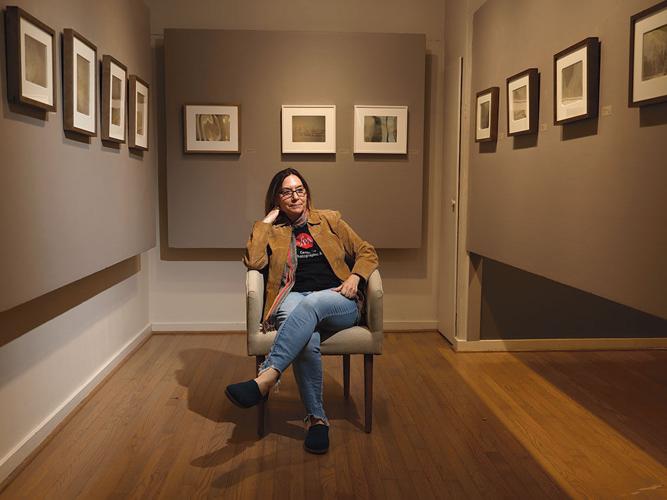
Photographer and longtime MPC Photography department educator Martha Casanave in her apartment in Pacific Grove.
Later, in 1991, Casanave became a part-time photography teacher at MPC, where she remained until 2019. Having experience teaching at a well-equipped photo department at Cabrillo College where she started seven years earlier, she found the MPC photography department disorganized, dirty and without proper ventilation, which often resulted in headaches. There was no funding; the department was not noticed by the administration, she says.
Casanave recalls efforts by Ansel Adams himself, with whom Casanave was friends with, who tried to intervene, but Adams left with the impression the department couldn’t be helped.
“The MPC photo department never got off the ground,” Casanave says. “It has been limping along all these years and very nearly closed altogether. There were horrendous safety and health issues that never got addressed.”
What Brister has done since 2024 Casanave thought was impossible to achieve. “Nothing short of a revolution,” Casanave says. “Becky has been able to access funding to expand the physical premises – opening up a whole new room with new computers and digital printers, creating a new classroom, which she also made into a camera obscura. She knows digital and she is bringing the department up to date.”
According to Casanave and Bullock, MPC was always meant to be the place for local photography, being located geographically in the heart of the photography legacy that has been attracting photographers for decades.
“MPC rises from the ashes, at last,” Casanave says. “Under Brister, it finally has a chance.”
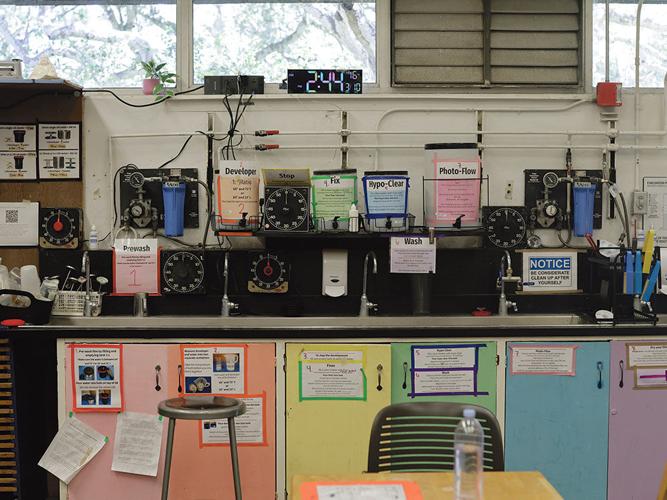
THE PHOTOGRAPHY DEPARTMENT IN BUILDING 36 ON THE MPC CAMPUS looks very different today than it did just a couple of years ago. The huge, 23-person darkroom is clean and organized; it has a new stainless steel sink the instructors and students can’t stop talking about. (The original sink was wood, and no longer sealed, and was too high for most people.)
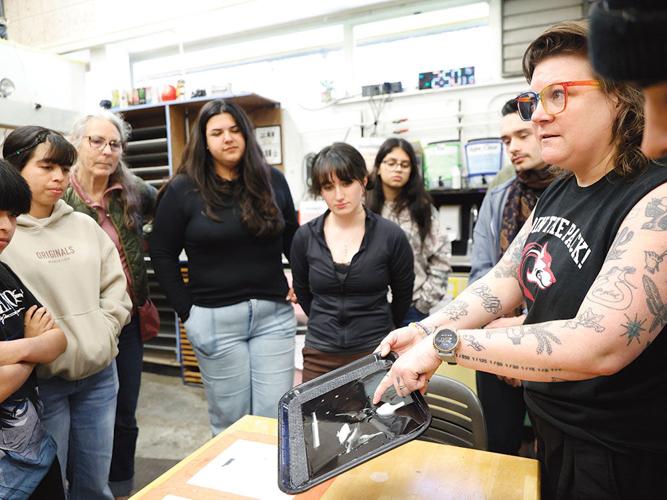
On a Tuesday afternoon in March, a group of students is working in the darkroom. Among them, dressed in a black T-shirt and with many tattoos walks Brister, who in 2025 received MPC’s IDEAA Impact Award in recognition of her commitment to advancing Inclusivity, Diversity, Equity, Anti-Racism and Accessibility.
Brister has been teaching photography at the community college level since 2006. She was one of those California kids who experienced equity barriers shared by a lot of students to get into a UC system. Education was not a big subject in her family and she wasn’t sure what career to pursue.

The current head of the MPC Photography Department, Becky Brister, right, teaching a photography class.
“I had found the photo program at the community college and incredible mentors and teachers who really helped me,” she says.
Quickly, she realized she wanted to do the same: help others. After grad school (the fine art program at UCLA), her conviction that community college is special solidified when it comes to supporting the students, whatever life phase they are in.
“It’s the diversity of students,” she says. “You have people out of high school, like I was, but then students who have returned to school later in life.” In her current MPC classes, she teaches students as young as 12, and as old as 82. Some drive from as far as Gilroy. “It’s a pretty wide range of ages and experiences. Anybody can sign up.”
Brister started teaching at MPC in early 2024, becoming the first full-time photography since the pandemic, when enrollment had dropped. When Brister arrived, she immediately saw the photo department needed to be cleaned and repainted. Getting rid of things that were built in and putting in more accessible features was essential.
The enrollment rate for the photography program is now at over 90 percent.
MPC offers photography students an Associate of Arts degree or a certificate of achievement. In addition to Brister, there are four part-time instructors. One can take 13 different photo classes at MPC, from introduction to photography to narrative photography and alternative processes. The school is also working to build a video program to offer a video production course in fall 2026.
According to Brister, there’s strong interest in fine art photography. It is an outlet for creativity and a way to explore identity. Commercial photographers also use the skills learned in fine art photography. Students want to learn analog photography not only to do fine art.
“Commercial photographers are once again leaning toward the aesthetic qualities of film,” Brister says. “Culturally, there seems to be a shift back to film and analog processes; digital fatigue exists across generations.”
Finally, there is a matter of AI in digital photography. It has been part of photography since the early 2000s, with Photoshop’s healing brush, noise reduction, etc. “Earlier, AI was assistive,” Brister says. “Now, AI can be generative. An artist needs to be intentional in working with AI for it to work with them.”
MPC also offers several classes through continuing education – a lot of older students that just want to take photography classes for fun. Marigee Bacolod is a professor of economics at MPC, who enrolled in the MPC photo program in 2025. Brister was her first teacher; she first helped her to find a camera. Bacolod has been interested in analog photography since high school, but while working full-time and raising a family, she had no time to pursue it.
“I’m your traditional community college student,” Bacolod says. “I always wanted to know how to use the darkroom and develop photography, and found that here through the MPC community. I learned not just from Becky and the other instructors, but also from the other students.”

The refurbished MPC Photography Department includes the film development station (left) and a darkroom.

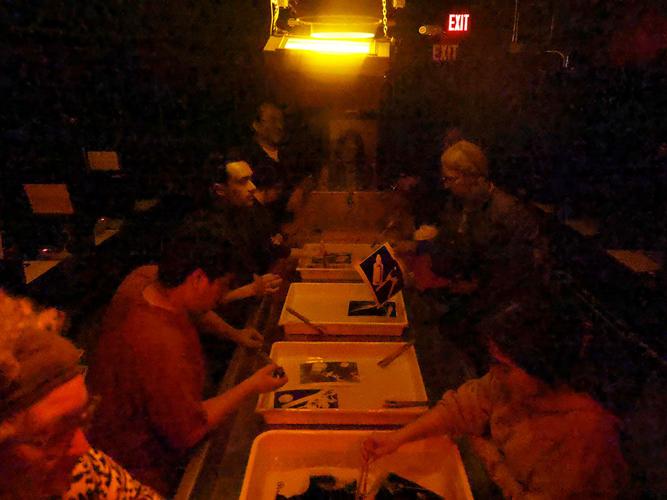
Students develop film in the darkroom, in addition to learning digital techniques.
Photography students often run into a barrier for purchasing materials. “The administration at MPC has helped purchase instructional supplies like film and paper,” Brister says. “There is no cost to students, material-wise.” The MPC Foundation is also helping, raising money for photography supplies, which can be costly.
Dianne Yost enrolled in the program in the spring of 2022, before Brister arrived, and is a witness to the big changes. “The program was taught by part-timers, with no leadership and students had to pay for everything out of pocket,” she says. “When Becky came, she made everything equitable. If you are on a fixed income like me and need materials, paper and chemicals – she made it accessible to everyone.”
Yost does both digital and analog photography. A vice president of the MPC photo club, which Brister resurrected, she already got her degree in 2025 and this is her last semester. She says that she stays because her heart is in it – the photography itself but also the community she found.
The MPC photography department was invited to participate in the inaugural PhotoCarmel, held in 2025. They went for it. Brister and Arts Division Chair Jamie Dagdigian spent spring break in 2025 sanding and cleaning and patching the MPC Art , which had been inactive since the pandemic. This year, the is opening again for PhotoCarmel, with a show, Through a Community Lens, starting April 10, composed of works by former and current students – about 40 photographers in total. Among the pieces are works by Wynn and Edna Bullock, Martha Casanave, Jane Olin, Ryuijie and Cathy Jaeger.
Among contemporary local female photographers, many went through the MPC photo program, from the arts teacher at Santa Catalina School, Celia Lara, to photographer and educator at The Weston Collective, Nadia Gutierrez. The voices of female photographers currently enrolled, like Dianne Yost and Marigee Bacolod, are also part of the exhibit.
Brister marvels over the support she found in the local photo community, including the group Salon Jane (to which Casanave also belongs). “Especially women in this community are some of the most amazing people I’ve ever met in my life,” she says. “The entire group has been so incredible.”
FROM THE EARLY 21ST CENTURY, THANKS TO ANSEL ADAMS AND EDWARD WESTON, Monterey County became associated with American modernism in photography. The forever seductive Big Sur coastline and the natural kingdom of Point Lobos play a key role in this story as well, inspiring both black-and-white landscape and alternative process photography. Local photographic groups have always been at the core of this story, from the 1967-founded Friends of Photography to its already mature in years successor, the Center for Photographic Art (CfPA), the organizer of PhotoCarmel.

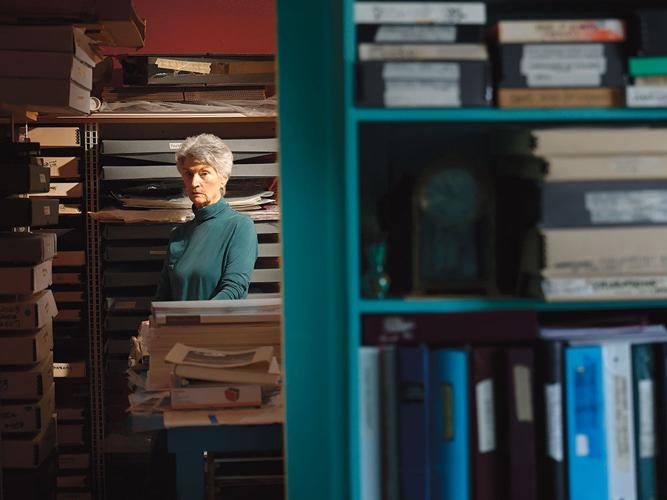
Center for Photographic Art Executive Director Ann Jastrab in the nonprofit’s gallery in the Sunset Center in Carmel.
The upcoming month-and-a-half is the perfect time to explore photography in Monterey County, filled with workshops, lectures and countless photo shows that comprise PhotoCarmel 2026.
The festival grew from an afternoon when a few Carmel galleries opened their doors to a larger crowd, staying open late and serving wine.
In 2025, PhotoCarmel lasted five weeks, with 42 events in 36 venues. This year, it lasts for six weeks, with 67 events in 54 venues – a regional celebration of the medium in dozens and dozens of different places, offering much more than just photo exhibits. There are also photography workshops, lectures and reviews of portfolios of local artists (see event highlights, right).
This year, PhotoCarmel is spreading its tentacles beyond Monterey County to Santa Cruz and as far as Oakland (with East Bay Photo Collective and Gray Loft ) and San Francisco, where Barbara Ramos will show her works at the Harvey Milk Photo Center (on display until May 16).
“The big thing about PhotoCarmel is that it’s community-led,” CfPA Executive Director Ann Jastrab says. Then she quotes her colleague and the visionary for PhotoCarmel, Nancy Sevier: “Photography should be everywhere.” That means in galleries, bakeries and libraries, be it the Meals on Wheels in P.G. or Chamisal Tennis & Fitness Club in Corral de Tierra, venues that are participating in the festival.
“Nancy engages with places where you wouldn’t necessarily see photography,” Jastrab says. “She stops by venues and asks if they have space for photography. And then she picks local artists to go into those spaces. ‘Like, hi, would you like to show photography here?’”
(Sevier curates a show at the Hartnell College Art , A Photographic Odyssey to The Salton Sea, opening April 14. Ten participants’ images come from a CfPA workshop led by Ted Orland and Brian Taylor.)
Some participating galleries, such as the Nancy Dodds in Carmel, are opening their walls to photography for the first time; there will also be – another premiere – a book fair because presses that specialize in printing photography books are plentiful.
This way, PhotoCarmel 2026 has exhibits and events at the CfPA, where the annual Members’ Juried Exhibition opens on March 28, as well as the by-the-wall neighbor Marjorie Evans , Sunset Center (A Light Exists in Spring opens May 7), ArtWorks @Salinas, Weston College in Seaside and the Monterey Museum of Art (which hosts its annual Block Party during PhotoCarmel). “We have a booth there,” Jastrab notes. “And a VW Photo Booth bus from ’69 that’s been converted into a mobile photo booth. So you actually get into the bus, and have your picture taken.”
The appetite for photography today – pursuing it or admiring it – is big and it seems to be growing. The renewed hunger is being addressed by the existing photo community, for example via scholarships given out by the CfPA.
“[Monterey County] has always been a supportive community for photographers,” Bullock-Wilson says. “And today’s scene is also vibrant.”
Casanave adds, “The local photographic community is bigger than ever.”
In addition to showing her pieces at the MPC Art and the Carl Cherry Center for the Arts in Carmel, Casanave this year gives a talk on April 22 at the Carmel Foundation titled, “Who’s a Good Girl? Little Known Stories of Women in Photography and the Men in Their Lives.”
“More diversity, more women,” she adds. “It’s contemporary photography now, but certain things haven’t changed, such as the strong flavor for landscapes.”
Bullock-Wilson and Casanave both agree that there’s a resurgence in interest in photography among young people, who are picking up analog photography.
“There’s strong respect for legacy,” Bullock-Wilson says. “PhotoCarmel reflects this excitement.”

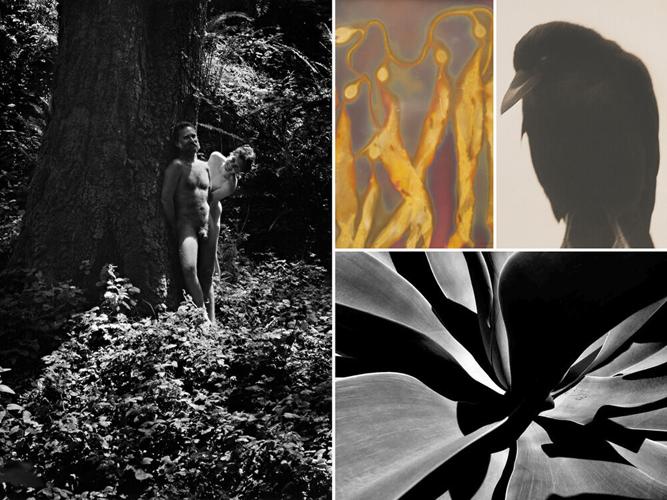
(left) Edna Bullock’s 1988 photo, “Jane and Marc”; (top left) “Untitled” by Martha Casanave; (top right) “Crow 1” by Jane Olin; (bottom) “Leaves and Shadows” by Jeanne Marino. These photos will be displayed at the MPC Art Gallery during PhotoCarmel.
PhotoCarmel 2026: A Celebration of Photography on the Central Coast takes place from Friday, March 27-Sunday, May 10. See full schedule at tinyurl.com/2026PhotoCarmel.
(0) comments
Welcome to the discussion.
Log In
Keep it Clean. Please avoid obscene, vulgar, lewd, racist or sexually-oriented language.
PLEASE TURN OFF YOUR CAPS LOCK.
Don't Threaten. Threats of harming another person will not be tolerated.
Be Truthful. Don't knowingly lie about anyone or anything.
Be Nice. No racism, sexism or any sort of -ism that is degrading to another person.
Be Proactive. Use the 'Report' link on each comment to let us know of abusive posts.
Share with Us. We'd love to hear eyewitness accounts, the history behind an article.