


Nader Agha walks down a weedy access road between Moss Landing Harbor and Highway 1, picking his way through wild fennel and broom growing up through the cracks in the asphalt.
“The whole thing started here,” he says, gesturing toward an old seawater pumping station out over the harbor.
The smell of salt hangs in the air, and Agha steps onto a cement platform at the base of two giant pipes. He looks down at his feet, and stops.
“What’s this?” he says.
He crouches down and examines a small blown glass pipe with coiled ribbons of greens, browns and blues wrapping down its stem. Its bowl is packed tight with something that looks like tobacco, but is probably marijuana gone brown – it’s clearly not the kind of pipe grandpa used to puff.
But Agha, the man whose net worth the Weekly estimated at about $200 million in a 2013 cover story, acts astonished. It’s hard to believe he doesn’t know what pot – or a pipe you smoke it in – looks like. There is, after all, an industrial marijuana growing operation happening on his property, the existence of which slipped out a few months ago in court.
He leaves the pipe where it is, and quickly stands up and pivots toward the other pipes, the ones that may help make him far wealthier than he is and bring water to a Peninsula that is teetering on the brink of drought-induced disaster. He points to their entry under the highway.
“This will never happen again in history, to put the pipes under Highway 1,” he says.
His gaze then follows the pipes southwest, to the pumping station over the water that, from the 1940s to the early 2000s, brought seawater into the Moss Landing Commercial Park for industrial purposes. This sliver of land he’s standing on, just west of Highway 1 and south of Dolan Road, is just a small piece of the 200-acre property Agha bought out of foreclosure in 2003 for $7.5 million.
Agha tells me the pipes were long used by Henry Kaiser, the mid-20th century industrialist known as the father of modern shipbuilding, to draw in seawater to extract magnesium.
“This is our backup intake,” he says. “All desal needs a backup.”
Agha wants to show off the other pipes on the property. While he walks back up the road toward his Mercedes s550 sedan – he insisted we arrive in the same car, to save fuel – he debates pulling his car back on to the highway and heading south, or driving through cypress trees and ice plant sloping down to the water.
He decides on the latter.
“We’re going to put a 10,000-square-foot restaurant here,” Agha says, as dead cypress branches snap under his tires and scrape across the undercarriage of his luxury car.
As the slope to the harbor increases, Agha decides to turn back to the road. Heading uphill, his tires lose traction and start spinning on the ice plant, which bleeds water and becomes slick under the weight of his car.
“See if there’s a berm,” he instructs me.
I get out of the car and inform him that yes, there is a curb between the car and road.
Agha accepts the news stoically, and sets to navigating the car through a tight maze of cypress trees, the tires spinning repeatedly as he maneuvers. A few times it appears he is stuck, and watching from the outside, it makes for an only-with-Agha scene: One of the richest people in Monterey County driving a Mercedes through a sloping forest blanketed with ice plant, as if it’s perfectly normal.
I can’t keep from laughing, but he is less amused.
“Get in the car,” he says.
As we continue over ice plant, I tell him it’s the most fun I’ve had all day, all week even.
“You need to add excitement in your life,” he says. “You need to have humor, fun and laughter. Without them, you’re nothing.”
Agha drives across a bridge toward the west end of the harbor and stops in front of a small gated fence. Behind it, pipes run through a narrow passage on the northern edge of Moss Landing Marine Laboratories. The pipes, which Agha owns, are the preferred intake source for The People’s Moss Landing Water Desalination Project, his proposed plant that is one of three competing desal projects vying to supply the Peninsula with water.
“The site is famous for processing water, and that’s what we’re doing,” he says. “We’re not doing anything ingenious.”

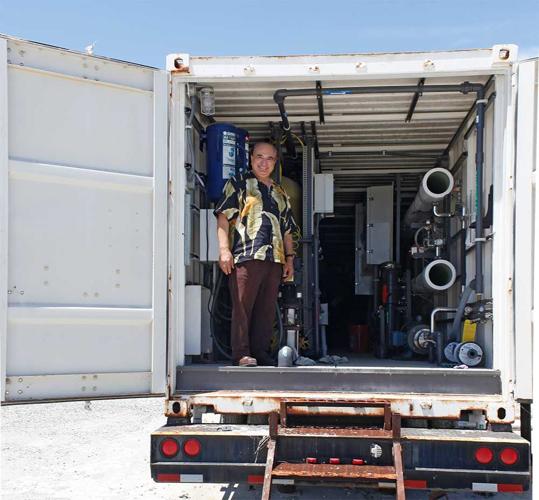
Nader Agha stands in a portable desalination plant at his Moss Landing property, which he says can process 50,000 gallons of seawater per day.
We then see his project’s proposed outfall pipe – the one that will discharge brine into the Monterey Bay – on the northeastern bank of the bridge.
It’s not much to look at.
Agha crosses Highway 1, and a minute later, we’re inside the Moss Landing Commercial Park, where he hopes to build his desal plant. He pulls to a stop next to two dusty old Land Rovers parked alongside a warehouse, and informs me we are switching vehicles.
“I always get a flat tire when I drive my Mercedes around here.”
The commercial park has several buildings, a handful of tenants and a few rows of storage units. As Agha drives past some of those units, the smell of pot plants wafts into the Land Rover’s passenger-side window.
“Is this where they’re growing marijuana?” I ask.
“No, that’s on the other side of the property,” Agha says curtly. “And it’s medical marijuana.”
I ask if I can see the grow.
“It’s a private business,” he says.
Agha is not interested in that story, and appears irritated that I am. He just wants to show me where his proposed desal plant will rise from the ground, a dream he’s had since he acquired the property in 2003.
“It will be water to supply the entire Peninsula and North County,” he says. “If the Peninsula doesn’t want it, we will send it to Salinas and the Salinas Valley.”
Agha then repeats something he’s said over several conversations about his project.
“I’m not interested in making money on the deal,” he says. “I’m interested in providing service to my community, which has been extremely good to me.”
Yet he does stand to make a good deal of money if he succeeds.
“The infrastructure of the property has been appraised for $120 million,” he says later. “We are willing to sell it to any public agency for the best interest of the public for a 75-percent discount.”
The biggest catch of that idea – and there are more than a few head scratchers in this topsy turvy tale – is that the property is scheduled for a foreclosure sale July 27.
If you’ve lived in Monterey County long enough and read the news now and then, you’ve probably heard of Nader Agha.
As a 22-year-old with only $17 in his pocket, Agha traveled from Syria to Monterey in 1965, and in the past five decades, he’s risen from a fieldworker to a grocery store bagger to a polarizing real estate mogul. Capitalizing on an instinct for sniffing a good deal, Agha has amassed a real estate portfolio hard to hang a dollar sign on. His properties extend to Salinas and as far south as Soledad, and he recently sold one of his assets, the Holman Building in Pacific Grove, for $5.9 million.
But one property he owns stands apart from the rest, and is the muse of his dream: the Moss Landing Commercial Park. He’s been trying to gain momentum for a desal project on the site for the last dozen years, with little luck.
It’s not because his proposal lacks merit: In 2002, a California Public Utilities Commission report called it the region’s optimal site for a desal project.
In August 2012, the Technical Advisory Committee of Monterey Peninsula Regional Water Authority compared three desal proposals on a variety of metrics: cost, litigation risk, infrastructure, etc.
The other two projects, California American Water’s Monterey Peninsula Water Supply Project in Marina, and DeepWater Desal nearby in Moss Landing, scored just below Agha’s People’s Project, which ranked highest.
But the TAC report was written off as an amateur assessment, according to TAC member George Riley, who has long been an outspoken critic of Cal Am and an advocate for public water ownership. The Monterey Peninsula Water Management District selected Cal Am’s slant well proposal as its project of choice, and DeepWater Desal – which calls for an open ocean intake pipe deep in the Monterey Bay Canyon and a data center, situated behind the Dynegy power plant, to help heat the seawater and reduce energy costs – as Plan B.
Agha’s project finally became an official contender last August, when the Moss Landing Harbor District agreed to be the lead agency for The People’s Project, and oversee, in a neutral capacity, the environmental review process. (Any project requiring an environmental review needs a public agency to lead it.)
Not long after, on Aug. 28, 2014, Bank of the Sierra, the lead bank for Agha’s loan on the property, sued to recoup an overdue and unpaid debt of about $7.5 million. In less than a year, the ensuing litigation has produced a case file nearly a foot thick, and those papers, along with hearings over the last few months, have provided a window into an asset that is far more complex than meets the eye.
There is the threat of foreclosure, which was first reported by the Weekly April 24, two days after the sale was legally noticed in the Salinas Californian’s “Salinas Life” section. The deed description was so complex, outlining so many parcels, pipes and easements, that it took up the section’s entire back page.
But there is also the medical pot growing operation in the mix, as well as the nagging issue of Chromium 6 contamination, which are too intriguing to ignore.
On the financing side, there have been so many different entities trading debt on the property that it’s difficult to understand without being an accountant.
What’s become most intriguing about the case is that Agha – whose People’s Project began its environmental review June 26 – is suddenly right back in the desal race. The environmental review process for California American Water’s proposed desal project in Marina has been delayed three months as the CPUC investigates allegations of conflict of interest by Cal Am’s environmental contractor. Meanwhile, the environmental review for the other competing project, DeepWater Desal in Moss Landing, has yet to formally begin.
Agha’s Moss Landing Commercial Park, which carries decades-old entitlements and easements that give the property grandfathered-in permits for already-existing pipes in a marine sanctuary, couldn’t be more ripe for development.
It’s quite possibly the most interesting piece of real estate in the county.
Agha’s foreclosure litigation began last August and first came to a head this May, when it was staved off for at least two months. Agha’s attorneys, and an attorney for Monterey County Bank, convinced the court that the majority of the debt holders, 58 percent, could be caused “irreparable harm” in the event of a foreclosure sale scheduled for May 12.
The sale was cancelled, and the next hearing was set for this Friday, July 24.
For the layperson, sorting out all the parties involved in the property’s debt – and tracking who owes who, and why – is enough to cause a migraine. Simplifying the tangle of affairs is tricky, but here are the basics:
One of Agha’s companies, HMBY LP, bought the property out of foreclosure for $7.5 million in 2003. Another of his companies, REVX-173 LLC, took out a $15 million loan with Monterey County Bank on the property in 2005, and increased that amount to $18 million in 2008.
REVX eventually changed its name to Moss Landing Commercial Park LLC, and renegotiated the loan in 2010. After that, Monterey County Bank began selling off the debt, with some going to Bank of the Orient, some to Golden State Bank and some to Bank of the Sierra.
The Most Interesting Property in Monterey County
It’s not pretty, but Moss Landing Commercial Park commands a pretty penny, and is a singular property for several reasons.
- Up to 5 million tons of magnesium hydroxide, valued at $75 million in 2013, is deposited on the site.
- The site has grandfathered-in pipes and easements that predate the establishment of the Monterey Bay National Marine Sanctuary in 1992.
- There is currently an industrial medical marijuana growing operation in one of the property’s warehouses.
- Two separate plumes of Chromium 6 – the carcinogen made famous by Erin Brockovich – are beneath the ground. Reports with the state show they have been partially remediated.
- Nader Agha bought the property out of foreclosure for $7.5 million in 2003. A dozen years later, he is in litigation to stave off his own foreclosure.
Through a complex set of negotiations that followed, Bank of the Sierra took over “lead” status of the loan in 2013, shortly before the debt was due that December.
Agha paid off some of the other debtors, another bought in, and Agha now owns some of the debt himself. (Two subsequent loans that amount to $16 million, from other banks, have been paid off.)But Agha still owes Bank of the Sierra about $7.5 million on the original loan, and they sued him last August to foreclose.
Just over a month after the May hearings, June 18, a new name enters the suit, one of the guarantors to Agha’s collateral: the mysteriously-named Trustee of the Molasses Trust.
Before digging into the latest court filings, I ask Agha, “What’s up with the Trustee of the Molasses Trust?”
“I have no idea what is,” he says. “I wouldn’t worry about it.”
As it turns out, according to court records, Agha is the trustee of the Molasses Trust.
The Bank of the Sierra, the lead bank on the property’s debt of about $12.5 million, filed the writ to have power to seize ownership of Agha’s more liquid assets: minerals, vehicles, safe deposit box, etc.
Complicated as the property’s financial affairs can be, it’s hard to imagine that Agha, an astute businessman, wasn’t aware of the Molasses Trust. He certainly knew about it July 17, because he sat in the courtroom for the writ of attachment hearing.
“This is a very convoluted case with many different facets to it,” said Monterey County Superior Court Judge Susan Matcham.
She decided against making a ruling on the writ, as Andrew Swartz, one of Agha’s attorneys, made it clear that there was a scheduled court hearing on the foreclosure July 24.
After Matcham continued the item for another week, Swartz said in the courtroom hallway, “Judges hate to make a ruling. Especially in this county.”
But it was during the May hearings the most fascinating tidbits slipped out.
On May 8, just after the court ruled to delay a foreclosure, the Bank of the Sierra’s attorney, Don Pool, asked the court for a moratorium on a cannabis growing operation in warehouses on the property, arguing his federally licensed bank couldn’t allow an operation to continue that’s in violation of federal law.
David Balch, one of Agha’s attorneys, cringed when Pool made the request.
Balch argued that the medicinal pot business is licensed, and legal in California. Judge Matcham allowed it to carry on in its business, for now.
Agha doesn’t want to talk about his medical pot tenant, and Balch, when asked how long it’s been in operation, only allows for what came out in court.
“It’s recent,” he says.
Another wrinkle argued in court is that the property has an unknown environmental contamination liability, and foreclosure would present an unknown risk to the debtors.
Studying reports filed with the Central Coast Regional Water Quality Control Board over the past dozen years, it’s revealed that Chromium 6 contamination on the site spiked in 2003, just before Agha bought it.
Chromium 6, a chemical byproduct of industrial processing, was made famous by the film Erin Brockovich; the chemical got into the water supply and led to a cancer cluster in Hinkley, California. After Brockovich brought a class action suit against Pacific Gas & Electric Co., which was responsible for the pollution, the company ultimately settled the suit for $333 million.
When Agha took over ownership of the property from the bankrupt National Refractories, he was ordered by the state to remediate the contamination. In large part, it appears he has succeeded. A few questions, though, still remain.
A 2012 report from the water control board noted two Chromium 6 plumes on the site appear to be spreading. The most recent data from Agha’s July 2014 report to the state shows that Chromium 6 levels are down to nil at some wells, but since 2011, rising at others.
The levels at the most contaminated well, monitoring well 11, is 27 parts per billion, more than 50 times the federal “maximum contaminant level” for drinking.
Don Eley, an engineering geologist for the Central Coast Regional Water Quality Control Board, says the numbers aren’t necessarily a red flag unless the site’s wells are supplying drinking water. But he does understand why a bank would be wary of bearing the cleanup liability.
“Some banks have been burnt so many times that they’re cautious,” he says. “They’re probably weighing that.”
When I ask Agha how much he’s spent on the cleanup so far, he’s vague.
“A lot,” he says. “$10 to $15 million.”
Agha says he’s up to date on his required twice-a-year report with the CCRWQCB, and is surprised when he hears otherwise.
The last document on file with the state is a May 27 email from Bob Barminski of Caprock Geology, Inc., Agha’s contractor, in which Barminski writes, “There have been some delays in the sampling due to problems refinancing the property. We sampled the wells in January 2015 and we will complete the report once we get our finances worked out with the client.”
In a July 21 email, after our initial conversation, Barminski says a report would be completed shortly.

“Whoever builds the first desal plant is going to get the water contract agreements,” says David Balch, one of Agha’s attorneys. “People will be lining up.”
The environmental contamination at the site, accumulated over decades of industrial activity, might be costly to completely remediate. But the land also has a huge upside: The court filings include an assessment of the value of his property, which was conducted by Landmark Realty Analysts, Inc. in January 2013. That assessment pegged its worth at $202,575,000, a number based on land, buildings and improvements such as pipes and entitlements that will allow for a desal project. The assessment also says that “the already low level of contamination will disappear or at least be reduced to an irrelevant level over time,” then says, “the appraiser was not supplied with a geotechnical or environmental report to substantiate this information.”
The Landmark assessment was done at the behest of Concord-based investor Donald Lew, who had announced at a December 2012 Pacific Grove City Council meeting that he had purchased the property from Agha, and was assembling a desal team.
Two weeks after the assessment was completed, Agha sent out a press release indicating the sale had not gone through.
Paul Hart, another of Agha’s attorneys, said at the time that Lew’s company failed to produce the $52 million in capital infusion it had stipulated in a contract.
What the land is worth now is an open question: For 60 years, the property was used to extract magnesium from seawater to make metal, fire bricks and for other industrial applications. Landmark’s valuation assumes much of that magnesium wealth remained on site.
Based on information provided by Agha (but not verified by Landmark), the assessment states that 5 million tons of magnesium hydroxide is deposited on the site, which Landmark values at $75 million.
Agha declines to discuss whether he’s sold any of that magnesium.
“Why are you asking about this?” he says. “We should be talking about desal.”
The first public meeting for environmental review of the People’s Project was held July 8 at the Moose Lodge in Del Rey Oaks, and a few dozen people – mostly those steeped in local water politics – came to learn more.
Steve Brown, who was hired two years ago by Agha to compile a draft environmental impact report (EIR) of the project, presented the plan: The intake would extend 50 feet southwest into the ocean, and sit 15 feet below sea level. Three screens on the pipe would attempt to reduce the intake of marine life.
“I’ve tried for two years to make subsurface [intake] work, and we have yet to find a way to make it feasible,” Brown says to the group. “We’ve looked at the harbor, we looked at the beach by the ocean, but in order produce 12 million gallons of freshwater per day, we need to pull in 28 million gallons of seawater.”
Brown says the project would need up to 15 slant wells on the beach in order to achieve that, something not possible with the land Agha owns.
“We just don’t have the space, and that’s why we’ve opted, reluctantly, to go to ocean intake,” Brown says. “I still have hope somebody can prove us wrong.”
Given the current state of Cal Am’s test wells, which were recently shut down by the California Coastal Commission after they appeared to affect the groundwater levels of the Salinas Valley Groundwater Basin, it’s hard to imagine Brown will be proven wrong anytime soon.
Add to that, the California Public Utilities Commission extended the comment period on the Cal Am project’s environmental review until Sept. 30 (from July 13) due to potential conflicts of interest in the well-monitoring team.
But state regulations explicitly favor subsurface intake over open ocean. That’s why, according to MPWMD General Manager Dave Stoldt, the district chose Cal Am’s project as its top choice.
“The preferred methodology is wells,” he says. “You need to exhaust the evaluation of wells.”
As to why the district chose DeepWater – which was founded by scientist and entrepreneur Brent Constantz in 2011, who founded the “green” cement company Calera in 2007 – over Agha’s People’s Project, Stoldt has a short list.
“I’m very concerned that it’s an uphill battle,” he says of Agha’s project. “An open water intake near the surface is a very challenging permitting hurdle.”
Stoldt also says two and a half years ago, when the district made its decision, People’s was behind DeepWater in terms of progress. But that’s not all.
“To get things done you need a high-powered team,” he says. “I don’t see that surrounding this project.”
But presently, Cal Am’s project is stalled, and People’s and DeepWater are neck and neck. One might say People’s is even ahead. Brown’s draft EIR will soon be submitted for review to Susan Lee, the environmental consultant hired by the harbor district to conduct the EIR process. Lee estimates Agha’s draft EIR will become public this fall or winter, and that the final draft will be ready within a year.
DeepWater partner David Armanasco estimates a similar timeline for his project’s EIR process, but says an EIR consultant has yet to be hired.
On a conference call with Lee and Moss Landing Harbormaster Linda McIntyre, McIntyre says the People’s Project is now progressing rapidly.
“We’re off and running.”
Spending time with Nader Agha often means listening to him talk on the phone. It rings constantly, and he’s a master code-switcher – he talks adoringly to a friend one minute, pure business to a lawyer the next.
He exudes a warmth and energy that draws many in, but he is a man with powerful enemies. In February, he sued local PR icon Armanasco – a partner in DeepWater – for breach of contract, seeking $10 million in damages. Agha hired Armanasco in 2010 to promote the People’s Project, but shortly after the contract ended in 2011, Armanasco joined forces with Brent Constantz.
Constantz also worked for Agha on desal, and he and Armanasco formed their own competing project in 2011, which heats up Agha’s voice when he talks about it.
“Before me, they didn’t know anything about desal,” he says.
Armanasco declined to speak about the litigation. Constantz, when talking about Agha’s project, does not mince words. “It’s a paper project,” he says. “There’s no possibility of it being operational.”
He talks about a cease-and-desist letter he received from the Coastal Commission when working at Calera regarding ocean intake, but before he can elaborate, or speak to Agha’s accusations, he warns me he’s hanging up because he has another call.
And that’s what he does. He hangs up.
I wanted to ask him, among other things, about the pipe DeepWater plans to use for intake, because many say it’s owned by the Moss Landing Harbor District, not Dynegy. (Armanasco maintains it’s still owned by Dynegy.)
A subsequent message to Constantz has gone unreturned.
But Constantz, lack of manners aside, does speak to the biggest question about Agha’s project: Is it real?
It might be easy to write off, as many have, because it’s so unsophisticated. But it’s the simplicity of the project, says Balch, that makes it the best.
Agha owns the land, the pipes, the entitlements, and he just wants to use the property in the way it was designed, back when Henry Kaiser drew in seawater in the 1940s to extract magnesium.
“Keep it simple,” Balch says. “The less moving parts, the easier it is to get approved.”
“We have the location, we have the land, we have a portion of the harbor, we have the pipes to the deep sea,” Agha says. “We have all our ducks in place.”
Yet hopes for People’s, Balch says, might hinge on the Cal Am slant wells failing.
“Let’s say Cal Am’s slant wells work perfectly and the test data comes back perfect,” Balch says. “If they find subsurface feasible, we’re not going to get approved. The gatekeeper issue is going to be feasibility of intake sources.”
That obviously remains to be seen, and Balch – like Agha – also stresses that the Moss Landing location, when it comes to desal, is singular.
“Can you name for me another property between L.A. and S.F., that’s on the coast and zoned industrial?” Balch says. “It’s been historically used for industrial operations, and it’s sitting there waiting to be repurposed.”
There are also facets of Agha’s desal dreams that are not formally part of his proposal. One is that he hopes to line the property with solar panels in order to reduce the cost of water from his plant, which he estimates between $1,340-$1,600 per acre-foot, depending on if solar pans out. (The estimate on The People’s Project website pins the range at $1,900-$2,000, which includes the cost of building pipelines for delivery. DeepWater Desal’s website boasts that their project’s water will be delivered at $1,100-$2,000 per acre foot, depending on one’s distance from the plant.)
Another of Agha’s ambitions is to turn the salt – which kills marine life when piped back into the sea as brine – into an asset. In 2011, he formed the company De-Salt America, LLC, for that purpose, and says he has people actively working to make the dream a reality.
“Why should we throw the salt away?” he says. “We have the places to store it, and we will process it.”
At the end of my recent tour with Agha, out of the Land Rover and back into his Mercedes, he beams with pride as he drives off his land and onto Dolan Road.
“I love this property, it’s just beautiful,” he says. “The location, the size, the versatility, and its unlimited potential opens the door for me.”
That door may – or may not – close soon: The next hearing in the property’s litigation is July 24, where Balch and other attorneys will try halt to a foreclosure sale scheduled for 10 am July 27 in front of the county administration building in Salinas.
That sale probably won’t happen: Agha has a sharp team of attorneys, and a strong case. And with an arbitration set for September, it seems reasonable the court would find that the process will grant Bank of the Sierra an appropriate remedy at that time.
As for Agha’s desal plans, that’s a tougher read. Some of the smartest water minds in the county think open ocean intake is dead on arrival with the Coastal Commission.
Yet others say that subsurface intake has never been successfully carried out on a large scale, which is true, and doubt that it can succeed when adjacent to the hotly contested, overdrafted Salinas Valley Groundwater Basin.
So far, the big money, and about 60 percent of the voters, have lined up behind Cal Am.
But remember: Agha came to America with $17 in his pocket.
Place your bets.
(0) comments
Welcome to the discussion.
Log In
Keep it Clean. Please avoid obscene, vulgar, lewd, racist or sexually-oriented language.
PLEASE TURN OFF YOUR CAPS LOCK.
Don't Threaten. Threats of harming another person will not be tolerated.
Be Truthful. Don't knowingly lie about anyone or anything.
Be Nice. No racism, sexism or any sort of -ism that is degrading to another person.
Be Proactive. Use the 'Report' link on each comment to let us know of abusive posts.
Share with Us. We'd love to hear eyewitness accounts, the history behind an article.