




When reporters and community members gathered on the lawn outside of King City City Hall on the afternoon of Feb. 25, 2014, a handwritten sign was still taped up on the front door of the Police Department: “Office is closed for today.”
The sign had gone up after about one-third of the members of the police department – including the acting chief and recently retired chief – had been arrested in the predawn hours. They were arrested for a range of charges, including illegal storage of a firearm and making criminal threats to a suspected car thief rather than filing a proper police report. Most egregiously, three defendants – Acting Chief Bruce Miller, his brother Brian Miller, who owned a car towing business, and Officer Bobby Carrillo – were accused of running an illegal car-towing scheme that included impounding hundreds of cars, mostly from poor, Mexican immigrants who were afraid to call authorities. (It was, after all, the authorities who were pulling them over.) Carrillo then called Miller’s company for 87 percent of the tows, and they kept and sold vehicles that owners couldn’t afford to claim.
Within hours, all six cops and one civilian (Brian Miller) had bailed out.
That afternoon, an angry crowd assembled alongside reporters for the press conference at City Hall, seeking answers.

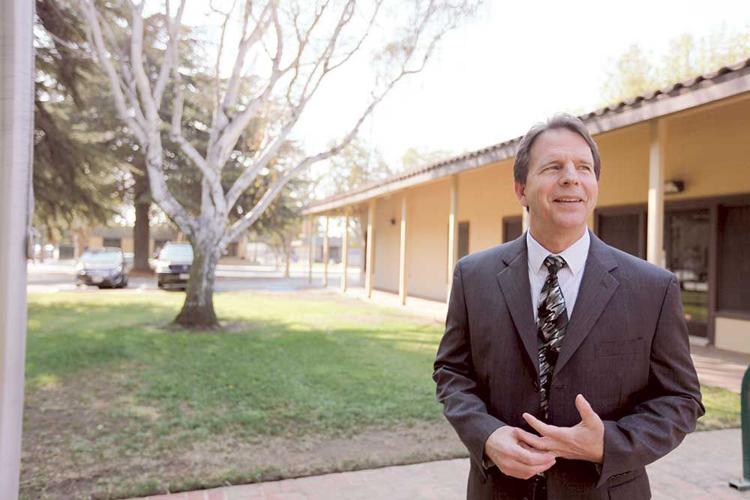
City Councilmember and former mayor Robert Cullen is bullish on King City overall, and specifically the cannabis industry, which he courted. “Five to 10 years from now, this town is going to be a different place,” he says.
One person asked how they could help, and then-mayor Robert Cullen urged them to pray: “It starts with prayers. We can all pray for each other, our police department, our community.”
Prayers or not, the trouble for King City had just begun.
Fast forward three years to today, though, and efforts to rebuild King City appear to be working – and they’re built on more than a prayer. The city of 14,000 is rebounding with a fully staffed police department, a meaningful plan to curb youth violence and streetscape improvements underway. City officials have a plan to pay down the city’s debt.
The reduction of city debt is banked partly on cannabis, and an infusion of cash – to the tune of $100 million – from investors who are looking to cash in on the so-called Green Rush.
If it works, King City is positioned to become the cannabis capital of Monterey County, and the thriving center of South County.
~ ∆ ~
City Hall is quiet these days, a far cry from the relentless press conferences out front in 2014.

City Manager Steve Adams conducted a citywide survey when he first started, and plans to use that as a baseline for follow-up surveys every two years.
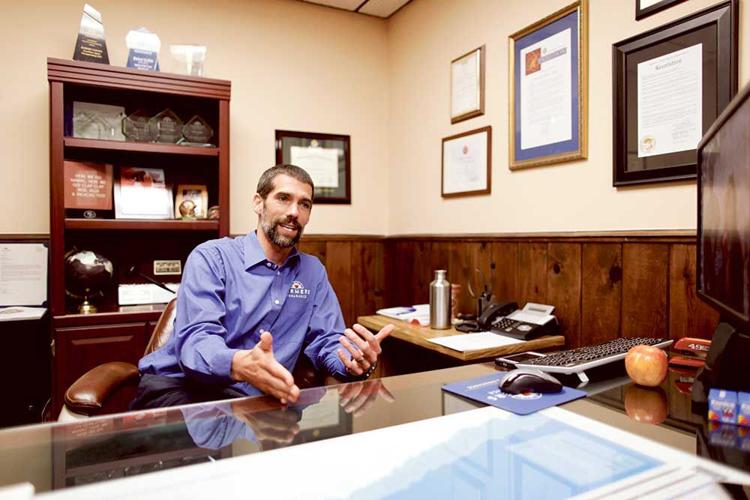
City Manager Steve Adams, who came on in late 2015, has a sparse office with lots of empty shelves, even after a year and a half on the job. He’s the kind of administrator who remembers, off the top of his head, which date City Council voted on a particular ordinance, and he’s applied that kind of attention to detail to city business. He undertook a project to revamp the city’s website, improving public access to city records, and reopened City Hall on Fridays as part of an effort to improve customer service. He laid out plans to revitalize downtown and pay down the city’s $5 million debt by 2021, no small feat considering the city’s entire annual budget is $7.4 million. He encouraged City Council to sell off land to do that, including an unpaved 4.8-acre lot to Monterey-Salinas Transit for $470,500, where MST is building a new garage and maintenance yard. Five residential blocks near downtown are freshly paved, Monterey County’s first completed project utilizing funding from Measure X, a transportation tax approved by voters in 2016.
Most importantly, Adams started listening to people. He developed a community task force that created what they call a “comprehensive plan to end youth violence.” Each City Council member now holds an open house for residents of their district, twice a year; the first batch of district meetings happened in March, and drew more than 200 members of the public.
After a large turnout at a forum on immigration in April, City Council decided to bring Catholic Charities back to continue offering immigration information. In June, Adams announced the city had signed a $15,000 contract for six months, inviting immigration experts to set up shop every Friday at St. John the Baptist Church to give free advice. It was, he said, “an effort to effectively serve the needs of everyone in the community.”
Meeting these needs requires cash.
If the cannabis boom goes as expected, according to Adams’ calculations, it will generate some $2.8 million a year in taxes, increasing the city’s budget by more than 35 percent. For jobs that will include everyone from farm workers to chemists, the salary range is anticipated to be $35,000-$100,000 annually.
As for the number of jobs, Adams does some quick math in his head. “It could easily generate 750 jobs,” he says. “That’s significant.”
~ ∆ ~
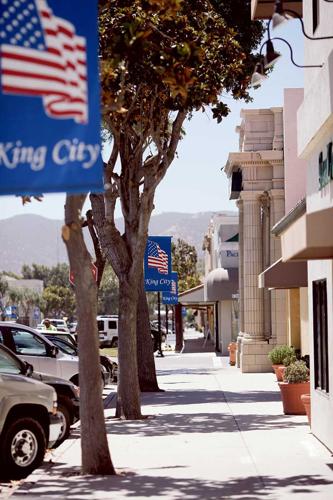
Broadway Street has new streetlights and trees have been cut back to let more light in and reduce sidewalk debris. Two new sidewalk planters have been purchased, and a newly formed community group, King City in Bloom, is maintaining them. Council approved a new public art program, encouraging the installation of wind sculptures. King City Cinemas is playing War for the Planet of the Apes and other new releases. City Council has dusted off old plans to build out the existing train station to create a transit center. The Cork & Plough sells inventive $10 cocktails and locally sourced menu items. King City feels like a classic walkable downtown.
That’s by design. Adams sees the city’s core economic development opportunity as downtown, alongside pot in the neighboring industrial area. His primary target is the 300 block of Broadway, with businesses like Huarache King and El Pueblo Market. It’s the most run-down stretch of Broadway, he says, but boasts the most historic buildings. The city budgeted $75,000 for facade improvements there, and the city is also in the process of buying an old gas station property to convert it into a public plaza.
“Over the next year, we will see [downtown] transform,” Adams says.
There are a couple of old businesses that have newly relocated to downtown: A Lil Bit Country Antiques and Kasey’s Gym. Both were previously located in warehouses, in the industrial neighborhood northeast of downtown.
They were forced out because their new landlord, King City Cultivation, is planning to transform King City’s industrial area into a pot-growing and manufacturing capital.
To do it, they’ve had to move fast, as cannabis cultivation kicks into high gear all over the state with recreational legalization coming Jan. 1 and jurisdictions permitting medical production in the meantime.

Mayor Mike LeBarre compares things King City today to when he was first elected in 2014: “Night and day.”
King City has hired a planner to deal with cannabis-related permits, and voters last fall approved Measure J with 79 percent of the vote, setting King City’s cannabis tax rate at $25/square foot for the first 5,000 square feet of plant canopy, then $10/square foot of canopy beyond that. That’s lower than the county’s rate of $25/square foot (starting in 2020), an effort make King City competitive.
“We will see an actual benefit because we are small,” Mayor Mike LeBarre says. “There’s only so many miles of road, only so many feet of sidewalk.”
The priority, rather than big tax revenues, is to encourage innovators. “You’re going to find we’re going to have the best of the best,” LeBarre says. “Our goal is to really be the Silicon Valley of the cannabis industry.”
~ ∆ ~
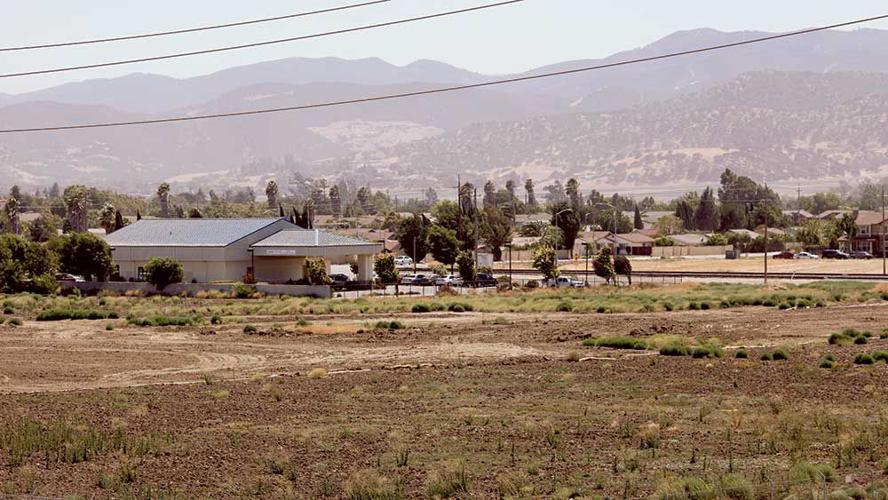
Just across the tracks from downtown King City, restaurants and hair salons in quaint buildings give way to welding and propane sale businesses. They’re in warehouses scattered around a dusty, weed-covered field – a 6.1-acre property the city previously owned and had on the market for 12 years before King City Cultivation came along and bought it for $800,000. (The city has sold another 5.7 acres of land for $750,000 to King City Cultivation.)
This property is set to become the site of 10 buildings, each 22,000 square feet, nearly double an Olympic-sized swimming pool. And that’s just a fraction of what investors anticipate will be a $100 million investment in this 3.8-square-mile town.
City Councilmember Robert Cullen looks past a rumbling power plant at the vast field. “Almost all of this will be medical cannabis,” he says.
There’s no cannabis growing here yet, but with 12 permits issued on June 30, there will be within a couple of months.
King City Cultivation has spent about $7 million to date, mostly purchasing industrial real estate. The company then acts as a landlord, contracting out property to various operators like Golden State Sciences, at work on improving extracted cannabis oil technology. These 10 22,000-square-foot warehouses will be operated by the Ginsburg Group, owned by Scott Ginsburg, a high-end auto sales magnate based in Dallas, Texas.
To date, King City Cultivation plans on eight large indoor cultivation greenhouses, six greenhouses with artificial light, two nurseries and four manufacturing operators. CEO Rob Baruck expects the investment, at full buildout, will approach $100 million.
“King City is a really great success story,” Baruck says. “Well, I guess it’s not successful yet, but it’s in the process of turning things around.”
Baruck, who lives, in Ventura, is new to cannabis. His globe-trotting career history covers spas and health clubs and golf courses, most recently as CEO of Nizhny Fitness Group in Nizhny, Russia, from 2012-13. He shares a 23-page resume by email that includes news clippings collected over years. One magazine article is in Russian; another details his efforts to persuade Princess Diana to join his UK health club.
He teamed up with a pot grower, Ron Glantz of Los Angeles.
In one failed venture, Glantz formerly operated a pool company that closed down and left jobs unfinished. Faced with five related lawsuits, he and his wife filed for Chapter 13 bankruptcy during the economic downturn in 2008; a bankruptcy court approved a plan for them to pay off about $18,700 in debt, in monthly installments of $519.40 over 36 months. After they failed to make those payments, the Glantzes filed for Chapter 7 bankruptcy, liquidating assets to pay off debt.
Their third partner is Carmel Republican political strategist Brandon Gesicki, who led them to King City. That’s where, Baruck says, the idea of a large-scale industrial cannabis operation was met with unparalleled enthusiasm.
~ ∆ ~
King City Cultivation circulates a business plan to prospective investors that concludes with a statement about the city’s buy-in: “Our strategic approach mitigates risk for investors due to the fact that we are located in King City, California. The local municipalities including the mayor, City Council, Planning Commission, police chief, and local businesses have offered us their total support.”
That support, however, stops at retail sales. While King City hopes to be the cannabis capital of the region when it comes to growing and extracting, retail dispensaries are still banned. (Neighboring Greenfield, meanwhile, is also going all-in on pot, including legalizing dispensaries.)
Prohibiting retail was the way to keep it acceptable to Cullen, who was mayor when the city first passed a cannabis ordinance in January 2016. It was also the way to get the Catholic church to stop organizing members to show up and voice opposition at City Council. As soon as the dispensary prohibition was added, Cullen says, opponents went quiet.
Part of the reason City Council banned dispensaries in its pot ordinance was because of fears the cash business would be a magnet for crime. (The volume of marijuana plants at wholesale operations, they say, was not a concern. Meanwhile, a study published in the July issue of Journal of Urban Economics reports marijuana dispensaries, “contrary to popular wisdom,” are not correlated to an uptick in crime.)
“At the time we were first looking at this, we were still in a time when our police department wasn’t stable,” Cullen says. Now that it is, he says it’s worth reconsidering that hardline prohibition.
Cullen, who’s largely credited for welcoming the cannabis industry, watched as the state Legislature passed laws paving the way to regulate cannabis in 2015, and saw an opportunity: “I looked at that and a lightbulb went off,” he says. “For years, people have come to me and said, ‘Rob we need more jobs.’
“There has to be some sort of catalyst; you can’t just create jobs and businesses out of thin air.
“I was like, that’s the catalyst! We need to roll out the red carpet for these companies to come here. We’ve got lots of land. We’ve got great access to power and water, and a ready and willing labor force. I thought, we need to jump on this.”
To City Council, creating jobs is part of a different goal: Economic growth is part of the city’s new strategy to end youth violence.
Aug. 5, 2016 was already a somber day. A 16-year-old girl and her friend were leaving a memorial for another friend who’d been murdered. As they drove off around 6:30pm, a brown pick-up began following them through King City. As they turned onto an on-ramp to Highway 101 at Canal Street, someone fired a gun from the pickup, striking the 16-year-old girl in the head.
She survived, but lost sight in her left eye.
Shootings are all too common in King City. King City earned the dubious distinction in 2013 of having California’s highest per-capita murder rate, and in 2013 and 2015, the highest youth murder rate. (In each of those years, there were five homicides, and in 2015, another 23 shootings.)
Also common: having zero suspects. The small city counts 33 unsolved homicides since 1999. But the Aug. 5 case was different. Within an hour of the shooting, a resident called police to report two suspicious men lurking in the neighborhood. She also snapped photos of them with her smartphone.
Police came to investigate, and arrested 29-year-old Victor Manuel Reyes and 20-year-old Placido Omar Casas. They pleaded guilty on June 21, and were set to be sentenced to prison for 23 years and 15 years, respectively, on July 26, after the Weekly’s deadline.

Police Chief Robert Masterson is not enthusiastic about cannabis, but he’s agreed to go along with the city’s plan: “I’m sworn to uphold the law, I’m not sworn to agree with it,” he says.
The tip that led to their arrest, Police Chief Robert Masterson says, marks a new normal.
“We didn’t see things like that in King City two years ago,” he says. “Now that people are calling us and providing information – we’re definitely seeing a change. We have a lot of unsolved shootings because no one will call the police. A citizen calling in led to a break in the case.”
Masterson started his job about a year ago. He was greeted by a gutted police department where only four officers stayed through the corruption scandal and arrests. His first order of business was staffing up, and a year in, he’s been successful; there is just one vacancy.
Masterson makes regular recruiting trips to police in the Central Valley, looking for young cadets. As the lowest-paying law enforcement agency in Monterey County, with a starting salary of $55,971, Masterson says his pitch is best aimed at people early in their career.
Besides, when hiring for a police department coming back from a corruption scandal, he says his standards were so high, he was better off with rookies. “Frankly, anybody I looked at could not have any blemish in their background at all,” he says. “We’re not going to attract them for money or prestige. Who we’re really looking for: officers who want to make a difference.”
And with good reason: In 2015, after the arrests, the city hired a new chief, then fired him four months later. Victims of the towing scheme filed a federal class-action lawsuit against the city, which in 2016, agreed to pay $1.2 million. The city ordered an extensive search of the phone system at City Hall when former city manager Michael Powers was accused by an interim police chief of eavesdropping on confidential conversations. All of the arrested cops eventually agreed to plea deals. (Former chief Nick Baldiviez was the only one who went to trial, and after facing a hung jury, also took a plea deal.)
More recently, to tackle the gun-violence problems, the city convened a task force that developed the city’s “comprehensive plan to end youth violence.”
That plan, adopted in January, includes spending $450,000 on surveillance cameras and $350,000 on an after-school program launching this fall. (The city signed a contract with nonprofit ProYouth to work with students in grades K-5, and raised $100,000 toward the program from private donations, including about $10,000 from King City Cultivation.)
The plan calls for a dedicated gang-focused police officer and better street lighting. The city is working with PG&E on adding 100 street lights to town, which they’ll pay for using the savings from converting existing street lights to LEDs.
Margarita Lopez, a former councilmember who was a critic of the previous city administration, served on the task force that developed the plan. She remains skeptical of its implementation: “I just didn’t want it to become another program that gets a check on the box,” she says. “Who is going to sustain it?”
But the plan itself, she says, is “great,” and was guided by a city manager who she believes is buying into the community and listening.
“At one time, we were the cream of the crop here in South County,” Lopez says. “It’s starting to look up. But it’s not what King City used to be.”
When County Supervisor Luis Alejo was a state assemblyman, his district included King City. He was a staunch critic of city governance after the towing scandal broke, and went so far as to request the Attorney General investigate. Now he thinks the city has turned a corner. “The willingness of the City Council and police chief to implement best practices is truly making a difference,” Alejo says. “So far, there is a sense of vindication.”
For Adams, the violence prevention plan is a great success already, because of its bottom-up approach. “When we all make up our mind to take back the community – if we can make people feel safe, and people get out and become active – that’s going to be a deterrent in itself,” he says.
The plan is Adams’ effort to make King City not only shed its reputation for the highest youth homicide rate, but also serve as a laboratory for other cities to replicate what it does.
It’s also time to test how the pot industry can transform a small community. It’s a risk; as every farmer will tell you, not every experiment works.
(0) comments
Welcome to the discussion.
Log In
Keep it Clean. Please avoid obscene, vulgar, lewd, racist or sexually-oriented language.
PLEASE TURN OFF YOUR CAPS LOCK.
Don't Threaten. Threats of harming another person will not be tolerated.
Be Truthful. Don't knowingly lie about anyone or anything.
Be Nice. No racism, sexism or any sort of -ism that is degrading to another person.
Be Proactive. Use the 'Report' link on each comment to let us know of abusive posts.
Share with Us. We'd love to hear eyewitness accounts, the history behind an article.