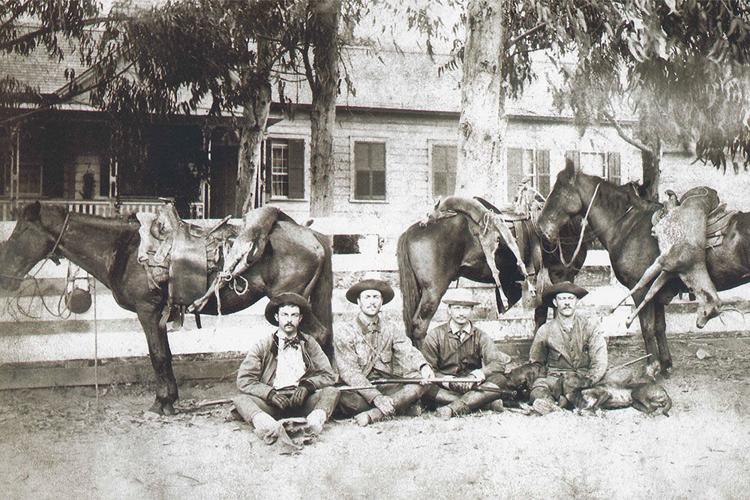

Back from a hunt, men pose for a photo in Carmel Valley, circa 1875.
El Pescadero. Tuesday Evening, June 4
WE WERE READY EARLY Tuesday morning, May 28, for a start. Up at daylight – Averill, Peter, and a buccaro for a guide – saddlebags packed, and two pack-mules: Sleepy with blankets and some meat, coffeepots and bread; Stupid with more blankets, frying pan and more provisions. We followed a trail about three miles, then struck the road up the Carmelo Valley.
We stopped at a house half an hour to wait for Charley, the buccaro, to overtake us. He had been to town for bread for the trip. Mrs. McDougal, where we stopped, insisted on our drinking a pan of milk, which we did, then struck up the valley.
We followed the road about 20 miles. Five ranches were passed; some barley fields along the river, and wild oats in abundance on the hills, supporting many cattle. We lunched at a stream, saddled, and were again off.
Here we left the road, and for 15 miles followed trails, now winding along a steep hillside – steep as a Gothic roof, the stones from the path bounding into a canyon hundreds of feet below – now through a wide stretch of wild oats, now through a deep canyon.
We passed two more ranches, where cattle are raised among the hills, and at last struck through a rocky canyon, in which flowed a fine stream, with some glorious old trees. Before dark we arrived at a small ranch owned by a man named Finch, with whom Charley was acquainted.
We camped near, and slept well, for we had been 10-and-a-half hours in the saddle in 13 hours. We frightened up four fine deer just as we went into camp.
Peter and Averill had each bought a “Sharp” for hunting, so on Wednesday they tried for deer. I climbed the mountain for “geology.”
First I passed through a wild canyon, then over hills covered with oats, with here and there trees – oaks and pines. Some of these oaks were noble ones indeed. How I wish one stood in our yard at home.
One species, called encina (coast live oak), with dark green foliage, was not extra fine, but another, el roble (valley oak), was very fine. I measured one of the latter, with wide spreading and cragged branches, that was 26-and-a-half feet in circumference. Another had a diameter of over 6 feet, and the branches spread over 75 feet each way.
I lay beneath its shade a little while before going on. Two half-grown deer sprang up close to me, but got out of pistol shot before I, in my flurry, had the pistol ready. Up, still up, I toiled, got above the grass and oats and trees into the chaparral that covers the high peaks.
I struck for the highest peak, but backed out before quite reaching it, for the traces of grizzlies and lions became entirely too thick for anything like safety. Both are very numerous here. Finch killed three a few days before we arrived.
But what a magnificent view I had! A range of hills 2,000 to 3,000 feet high extends from Monterey to Soledad. It is a part of the mountains, yet there is a system of valleys behind, up which we had passed.
The Carmelo River follows this a part of the way. I was higher than these hills. Over them, to the northwest, lay the Bay of Monterey, calm, blue and beautiful.
Beyond were blue mountains, dim in the haze; to the east was the great Salinas plain, with the mountains beyond, dim in the blue distance.
In the immediate foreground was the range of hills alluded to, the Palo Scrito (Sierra de Salinas), in some places covered with oats, now yellow and nearly ripe, in others black with chaparral. Behind lay a wilderness of mountains, rugged, covered with chaparral, forbidding, and desolate. They are nearly inaccessible, and a large region in there has never been explored by white men.
I returned by the same way I had come up. There is a most beautiful tree I had not seen before, with foliage something like but even richer than the magnolia – it is a kind of manzanita. It would be splendid in cultivation in a mild climate.
Averill and Peter returned without any venison, but Averill brought in an enormous rattlesnake, by far the biggest we have yet seen. He was huge, and, Averill says, decidedly savage when wounded.
He was 4-and-a-half feet long, as thick as one’s arm, and had 12 rattles. His head was over an inch and three-quarters broad, with mouth corresponding. I cut out one of his fangs as a specimen.
WE SPENT AN HOUR IN MR. FINCH’S HOUSE THAT EVENING. Two brothers, Americans, have a ranch, and are raising horses. Mrs. Finch seemed a meek, sad woman, with more culture arid sensibility than her husband, and evidently pining for other lands and other scenes here in this lonely place, away from the world, almost away from the “rest of mankind.”
The house was of sticks plastered with mud, the floor, the earth. Two pretty little girls were playing upon a grizzly skin before the fire. It is a lonely life they lead there.
Thursday we took a young man for guide and pushed on, over hills, through canyons, winding, climbing, toiling; our road, cattle trails; our landmarks, mountains. I saw many pretty flowers, some new to me.
We struck a fine stream of water that flows toward the Salinas plain at Soledad, 14 miles distant, but it sinks long before that in the arroyo seco, or dry canyon. It was a swift clear stream, and good water on that trip was one of our luxuries. It has been long since I have tasted good water.
Here we found a little ranch, Hitchcock’s. The owner was talkative, asked for papers, showed us some fine quicksilver ore, but was too shy to tell us where he found it. He only said it was back in the mountains – “A hell of a place to get to” – which I can easily imagine, if it is six miles farther in than we were, as he said it was.
Here we struck up the canyon into the heart of the mountains a few miles, now over a table for a mile, now down a steep bank and crossing the stream, up on the other side, steep as a house roof. But our mules were trusty; Old Sleepy, with his pack, proved himself equal to the occasion, and my old white mule won fresh laurels.
Up this canyon the strata are bent, twisted, contorted and broken. I never before saw finer examples of bent strata. They were less grand than the noted ones on Lake Lucerne, but more beautiful. We saw some deer and got a shot – one was wounded, but we did not get him. All had rifles but me; my botanical box and hammer were enough for me.
Soon more deer were seen. Peter and the guide started after them. We missed the trail, and in attempting to cross the stream and climb the bank came near having an accident.
The bank had a slope of 45 degrees; the path wound up it at 29 degrees – I measured it. Averill’s mule trod on loose stones and went down. A mule never slips, but here the path slipped. Averill got off and saved himself, but the mule went down slowly and got away. An hour and a half were spent in finding and getting her.
At last all were ready again, and we took our way up the canyon as far as mules could get – and that is saying a good deal – and struck a very narrow, wild canyon leading to a little lake. It was a lovely spot, but a poor place to camp, so we turned back a mile, and camped on the banks of the main stream.
I wish I could describe the spot. A deep rocky canyon, with rugged, almost perpendicular sides, but green, grassy bottom, opens into the main canyon, where there is a swift stream of water of crystal clearness, grass and oats abundant for our mules, fine trees scattered around for effect and all around rise high, rugged, rocky mountains.
We are now beyond all traces of human homes, but in the abodes of grizzlies and deer.
A fire is built, supper (as well as dinner) got, and then we go out to hunt. In 10 minutes Averill is back with a deer, and an hour later the others come in with another, I know not how many deer we saw on that trip.
I took a swim in the cool stream – it was refreshing enough after riding on dusty trails and through hot canyons.
I wish you could look on such a camp at night. Scattered around are pack-saddles, saddles, bread – and oh, such bread as we had after 60 miles’ travel on a mule’s back in a bag! It needed sifting to get pieces large enough for mouthfuls. The mules are picketed near and around us. They will give the alarm if grizzlies become too familiar.
Scattered on the grass around, we lie rolled in our blankets. A rifle peeps out from beneath the blankets here and there – loaded too, for, although grizzlies never molest persons asleep, it is best to have the weapons handy.
The bright campfire throws a ruddy glare on the green foliage, which shows black shadows and grim recesses back, and stately trunks and gnarled limbs shine out brighter here and there.
But brighter than all, and more beautiful to me, are the stars in the deep, clear, blue sky. One is just trembling over the brow of that rugged mountain, it seems almost to touch it – others are slowly moving behind the trees, or the hills, in their majestic march to the west. The only sound to break the silence of this solitude is the murmur of the streams by us.
And thus we sleep – such glorious sleep – sound and refreshing; no bad air, no close smell of feathers, no musty, ill-aired beds from which one rises in the morning with gummy eyes and heavy brain and mouth tasting as if half filled with Glauber’s salts and clay.

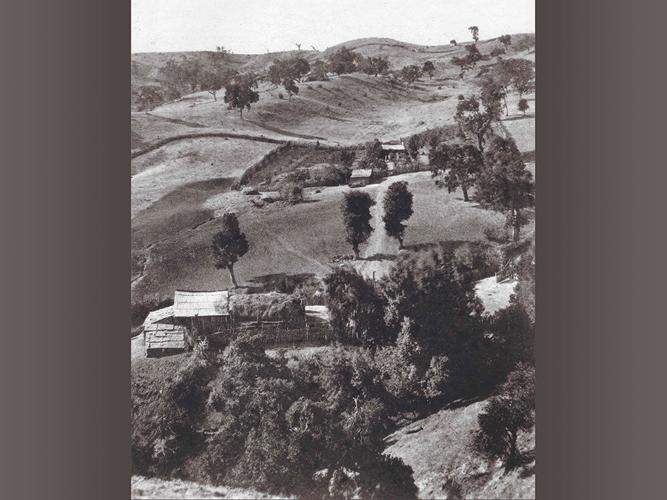
Ranch homes in Carmel Valley at an unknown location, circa 1880.
THE SHADOWS WERE DARK IN THE CANYON as we rose, and some choice cuts of venison roasted on the coals were partaken of with a relish that many a hothouse millionaire might well envy. Ah, it was good!
We lingered around some; I botanized an hour – and then we took our way back, following nearly our same trail.
In one place the trail led along the very brink of a precipice 250 to 300 feet high; one could look down, unobstructed, almost perpendicularly (tourists would say quite so), to the rocks and water so far below. It was as steep as the north bank of Taughannock Falls, by the house, and two-thirds as high, the path scarcely a foot wide.
But the mules did not hesitate – they know their own powers – and with loose rein we let them take their way, slowly, surely, now looking steadily at the path, but often swinging their heads over and looking at the abyss below.
Where the path ascended a steep slope I got off, not for greater safety so much as to ease my mule, which is most too light for me. But most of them rode here, nor spoke of danger.
We got back to Finch’s that night. We found some fossil bones on our way – the backbone of a large fish, not so large as a whale, yet very large. Thousands of acres of these lower hills are covered with wild oats, as thick as a poor oat field at home.
These are the “live oats” or “animated oats,” sometimes cultivated at home, and were introduced here from Spain by the old padres.
We got back safely on Saturday, June 1, after a pleasant trip, no mishaps, and much of botanical and geological interest, but well tired from the hard riding.
Tuesday, July 9
Last night Professor Whitney arrived, bringing with him a topographer, so today our company is quite lively again.
I have returned from a trip on the Gabilan hills – quite a ride. Tomorrow the Professor and I will go to Monterey to be gone three or four days.
San Juan. July 14
It is a quiet Sunday, and, although the wind blows, it is too hot to write in the tent, so I write in the shade of a fine oak by our camp. My last was sent the first of last week, by express.
Well, Professor Whitney arrived on Monday night. Tuesday was spent in arranging some small matters, and Wednesday, July 10, we started for Monterey – Professor Whitney, Averill, and I.
We were up at dawn, had our breakfast, and by half past 5 were in our saddles. I took one of the team mules to ride, being stronger than my little one. The early morn was clear, but soon the fog rolled in from the sea, enveloping the hills.
It was 39 miles to Monterey, but a mountain trail shortened the distance some five miles, so we took that, although neither of us had ever traveled it. First up a canyon, then across the ridge about a thousand feet high, by a steep winding trail, then down on the other side.
Our trail was often obscure, mingling with cattle paths, and the dense fog obscured all landmarks, but in about seven miles we emerged on the Salinas plain, where we took the stage road and crossed the plain. There was some wind, and it was cool, but the fog did not entirely obscure the hills.
We stopped at Salinas, and fed both ourselves and our mules, then rode on. On striking the valley that leads up to Monterey for about 16 miles we had hotter air, but not much dust.
We arrived before night, and found the town (city, I should say – a city of 600 or 800 population!) in much excitement over a recent discovery of silver mines in the vicinity, but which I don’t think will ever prove of any value.
The next morning we went on to Pescadero Ranch, found no one at home, so climbed in by the window, opened the back door, and “took possession.” This was the place where we had encamped so long, you recollect.
I had found the geology too much for me, and I wanted Professor Whitney to see it; hence our visit to Monterey, for it was a matter of some importance to settle.
Mr. Tompkins, the owner of the ranch, had tendered us its hospitalities, but his buccaro, Charley, was gone – all the dishes dirty on the table, and no provisions to be found, no candles, no wood cut.
We spent the day looking up the objects we had come to see. Averill went into town, four miles, and got supplies, we washed up the dishes, got our dinner and supper, and made ourselves comfortable.
Professor Whitney was as much interested as I had been, both in the geology and in the abundant life in the sea.

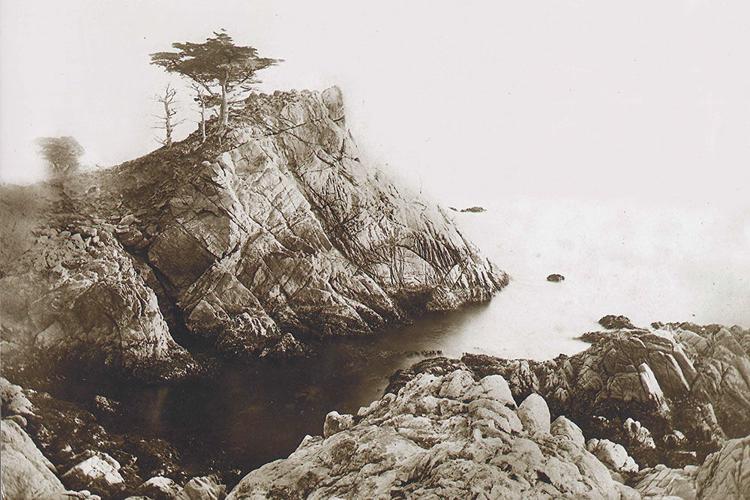
Midway Point at what is now Pebble Beach, circa 1870. James Perry, executive director of the Monterey County Historical Society, says the cypress tree atop the point was struck and killed by lightning in 1924, and one or more trees were subsequently planted to replace it.
I WISH I COULD DESCRIBE THE COAST THERE, the rocks jutting into the sea, teeming with life to an extent you, who have only seen other coasts, cannot appreciate.
Shellfish of innumerable forms, from the great and brilliant abalone to the smallest limpet – every rock matted with them, stuck into crevices, clinging to stones – millions of them. Crustaceans (crabs, etc.) of strange forms and brilliant colors, scampered into every nook at our approach. Zoöphytes of brilliant hue, whole rocks covered closely with sea anemones so closely that the rock could not be seen – each with its hundred arms extended to catch the passing prey.
Some forms of these “sea flowers,” as they are called because of their shape, were as large as a dinner plate, or from 6 to 12 inches in diameter! Every pool of water left in the rugged rocks by the receding tide was the most populous aquarium to be imagined.
More species could be collected in one mile of that coast than in a hundred miles of the Atlantic coast.
Birds scream in the air – gulls, pelicans, birds large and birds small, in flocks like clouds. Seals and sea lions bask on the rocky islands close to the shore; their voices can be heard night and day.
Buzzards strive for offal on the beach, crows and ravens “caw” from the trees, while hawks, eagles, owls, vultures, etc., abound.
These last are enormous birds, like a condor, and nearly as large. We have seen some that would probably weigh 50 or 60 pounds, and I have frequently picked up their quills over two feet long – one 30 inches – and I have seen them 32 inches long. They are called condors by the Americans.
A whale was stranded on the beach, and tracks of grizzlies were thick about it. The air was cool, and at times fog rolled in from the Pacific, as it often does there.
WE FOUND BEDS AND BLANKETS, and after breakfast the next day rode to Point Lobos, then over some high hills back of Carmelo Mission, but the fog obscured the fine views I wanted Professor Whitney to see.
We descended into the valley, and called at Judge Haight’s, where we had visited before. Professor Whitney soon returned to Pescadero, but the young ladies pressed us so cordially to stay to tea that Averill and I did, and had a most pleasant visit. It is a very intelligent and pleasant family indeed. Our tea, and a walk we took with the ladies, detained us so that we had to ride home after dark.
This would be a light matter at home, but not so here, where for three or four miles the trail led through a woods or dense chaparral as high as our heads or higher, where grizzlies sometimes dispute the right of way, and across a dark gulch with almost perpendicular sides, where none of you would trust yourselves to ride by broad daylight.
Saturday morning we had intended to start back, but were detained on our way, in Monterey, until noon, so we only reached Salinas, 20 miles from Pescadero.
An excitement in the dull monotony of the little town was occasioned by the arrival of an English brig, of only 180 tons, six months out from London. She had not seen land during all that time. She was in a terrible condition, and had put in in distress.
Provisions and water very scant and bad all the way, now exhausted, men sick of the scurvy, captain dead of the same disease, second mate and boatswain lost in a storm, sailors decidedly used up – their story was a pitiful one.
As I said, we stopped last night at Salinas. This morning we were up early, and were off, crossing the plain, then over the mountain trail again, and by 10 o’clock were at camp, where we found all well.
We had our blankets washed during our absence. We are resting quietly this lovely afternoon after our long ride.
(1) comment
So. Cool. Thank you so much for posting this. This brought me so much joy.
Welcome to the discussion.
Log In
Keep it Clean. Please avoid obscene, vulgar, lewd, racist or sexually-oriented language.
PLEASE TURN OFF YOUR CAPS LOCK.
Don't Threaten. Threats of harming another person will not be tolerated.
Be Truthful. Don't knowingly lie about anyone or anything.
Be Nice. No racism, sexism or any sort of -ism that is degrading to another person.
Be Proactive. Use the 'Report' link on each comment to let us know of abusive posts.
Share with Us. We'd love to hear eyewitness accounts, the history behind an article.