
In the collision between art and commerce, few places in the county experience a more generous and gregarious fallout than Sand City’s annual art and music showcase, West End Celebration.
This year’s WEC, the city’s eighth, docks again at the courtyard of the Design Center, but this time the emphasis lies more on the city’s burgeoning art scene than last year’s push to sell condos.
The festival jumps off Friday, Aug. 21, with a pre-party at (only in Sand City) the old, abandoned cannery warehouse of the Monterey Bay Fish Company, with Santa Cruz’s Beatles tribute band The White Album Ensemble.
A decorated “Magical Mystery Tent” will be erected inside the confines of the “urbanesque” warehouse, stocked with beer, wine, food and “surprise visuals,” with the graceful sand dunes and twinkling stars above greeting arrivals. That party benefits the nonprofit Guitars Not Guns, a youth outreach program.
Saturday’s main event, on Aug. 22, will spill forth onto Ortiz Avenue with about 20 artists, day-long music and food galore, and will fan out over surrounding streets like candy from a piñata, struck at noon with the intoxicating Brazilian samba clamor of the Sambahemians; after their set, they will jump in back of a flatbed truck and cruise the festival streets while performing (which beats any subwoofer).
They will be followed by a roster of bands, lined up by longtime WEC music coordinator Steve Vagnini, including the funky, slinky, urban hip-hop-electro-rock of local comers Alex Lee & Le Vice – hard to define, harder to resist. They’re followed by the Maverick Award-winning Champagne Sunday; Les Dudek, whose guitarist has played with the Steve Miller Band, the Allman Brothers on “Rambling Man” and written for Stevie Nicks; and rising Canadian roots-rock band The Duhks, 2007 Grammy nominees for Best Country Performance, currently driving a biodiesel bus on The Duhks Sustainability Project tour, patronizing local organic farmers, and recycling as they go – no TVs getting thrown out of hotel balconies for these guys.
The celebration also features legions of artists, craftspeople and performers showing and selling their goods from numerous booths that will line the streets. It adds up to a block(s) party/outdoor art opening not seen elsewhere in the area.
Last year, tours of the hip, fully appointed lofts delighted visitors, but with its pre-recession prices, buyers were hesitant. Even so, the bash was at once cohesive and diverse, organized and loose – a surprisingly big affair for such a small city.
In addition to bringing Sand City’s normally hermetic working artists out into the sunshine, WEC also showcases the city’s ongoing metamorphosis.
Is Sand City ready to step forward as the refuge and gathering place for Monterey County’s boho community?
Its business and civic leaders, and the City Council – many of whom share allegiance with the WEC Committee and are, themselves, artists – seem to believe it is. They would like to see it evolve (and are actively pushing that evolution) into “SoHo West,’’ according to the city’s website. The vision is of a community with lofts, galleries and restaurants similar to New York’s SoHo – on a smaller scale, of course.
But some folks, including Elizabeth O’Malley, co-owner of Sand City contemporary art gallery, called fine art base, thinks that model is flawed.
“To have developers pushing it [is] not authentic,” she says. “If it were like SoHo, it would have to be underground.’’
Scott Grover, who owns Seaside’s Alternative Café, knows, first-hand, of another flaw: Developers may be more interested in profit than art.
“[The] original spot we rented was in Sand City, on Redwood Street, about four years ago,’’ he says. “[Artist] Andrew Jackson and his wife Sunshine were upstairs. Dan Cort owned the building, but sold it to a new buyer who didn’t want to renew our leases.’’
Faced with uncertain tenancy, the Sand City version of the Alternative Café never opened – Grover never even put out a sign. Instead, he used it as a working studio/office, stockpiled material for a relaunch elsewhere (hello, Seaside) and waited out the lease. This happened, if you’ll remember, at a time when people were flipping soon-to-be-hot properties like flapjacks.
Another problem with the model is the model itself. The anticipation of SoHo-like real estate appreciation has kept prices of studios and mixed-use spaces in Sand City artificially high. So while artists and studios still move in (fine art base set up shop in February, and Todd McClaire, son of the former Seaside mayor, and photographer Kodiak Greenwood are said to be scoping spaces), it’s offset by artists and studios who are priced out.
Before the real estate boom went bust, developers and city planners seemed to work under the creed: “If you build it, they will come.” But the hulking and largely empty Design Center building is a giant reminder that the best laid plans of mice and men don’t always favor gentrification.
Nevertheless, Sand City residents are loyal to their promising community.
Last year’s WEC introduced a former New York resident to Sand City; he liked the place so much he moved here. “I liked its urban, bohemian feel,” says the transplant, who preferred anonymity, “and the organic art movement. It’s cutting edge. Carmel doesn’t have that. Big Sur once did.”
Jerry Lomax feels the same way. He’s the famed architect of the modern building across from Ol’ Factory Café – variously called the Lomax or Hawthorne (developer Greg Hawthorne) Building – that many see as a harbinger of Sand City’s mixed-use shape to come. “I love it here,” he says. “It’s got such potential, and I would like to be involved in its evolution.”
Deirdre Duncan-Bascou, this year’s West End Celebration coordinator, and her husband have lived in Sand City for 12 years.
“Living in Sand City is awesome,” she says. “We embrace the industrial. It’s a secret city. Behind the industrial façade, there’s stuff going on. Suzka [avant-garde artist Susan “Suzka” Collins] lives in a warehouse. Outside you would never suspect, but [inside] it’s a magical palace. Young people get the industrial thing.”
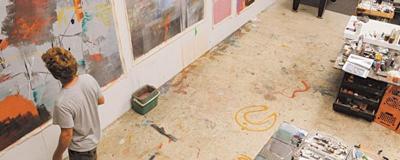
“Johnny Apodaca’s studio is gorgeous,” O’Malley adds. But from the outside, it’s anonymous. One of the goals of the West End Celebration is to unveil the city’s secret stash of working artists toiling behind windowless doors and garage bays – Apodaca, John Chappell, Stefani Esta, Susan Giacometti, Fred Saunders, et al – to merge the public with the private.
More than one artist, including French stone carver Jean-Luc Preti, expressed the appeal of Sand City this way: “You can get dirty.”
Taylor Hawthorne, son of WEC founder and artist/gallerist Greg Hawthorne, echoes that sentiment. He’s a metal and glass sculptor whose studio sits atop a metal shop and serves as an informal HQ for the band of artists known as the Octopi Collective.
“[Making art] is not always nice and shiny,” he says. “It can be loud and dirty. But the cops are cool and [people] understand. If you’re throwing a loud party, they’ll come over.”
But even Sand City’s tolerant residents have their limits, as Morgan Christopher of Ol’ Factory Café discovered in June when he attempted to segue the shuttered Monterey Live bookings to his art studded, eco-friendly venue.
“The first night it was four death metal bands,” he says. “I did not like the bands. My neighbors didn’t like the bands. They complained.” The shocked proprietor let them all finish their sets, but vowed to stick with live music of a less apocalyptic nature – jazz, bluegrass, Celtic, folk.
Adam Giudici hangs out at Ol’ Factory. In the late ‘90s, he says, his family built a skate park called Skate Station, next to Sanctuary Rock Gym.
“Kids loved it,” says the 28-year-old. “There were skaters, rollerbladers, BMXers – even razorscooters. But it flatlined after four years.”
When asked what he does now for fun in Sand City, he points at the grounds of the Ol’ Factory Café: “This is it.”
But there is more. Nearby mechanics and metalworkers have long gorged on the quiches, baguettes, sandwiches and pastries amidst original art at Sweet Elena’s Café and Gallery. And, on occasion, the French eatery goes more ambitious.
“Elena will do, like, these big dinners, huge menus, from different regions,” says O’Malley. “Four – or five-course meals with wine. You pay some nominal amount for this amazing home cooked meal. A lot of artists show up.” (Elena fires up those dinners during WEC.)
Sand City holds other diversions. The Redemption hip-hop breakdance tournaments have filled Fit Athletics Gym on Tioga Avenue with multitudes of the young and gregarious. Some of the most scenic stretches of the Bicycle Rec Trail, a few spots of which harbor 360-degree views of the Peninsula, run through the tiny town. The southern point of its beach, by the Best Western Beach Resort Monterey, is a magnet for kite flyers, and its northern dunes a paragliding favorite. And, apparently, after artists put down their paintbrushes and blowtorches, impromptu visits to one another turn into beer and wine-laced gatherings full of conversation and merriment. As for surfing, it’s a mixed bag, according to brothers Phil and Aqua Padick, who last week were scoping the surf where Tioga Avenue drops into the sea, which gives the spot its name – Tioga break.
“This is an alternative spot,” Phil says. “Not many people surf here because it’s not that good unless a low tide exposes the sand bar. And there’s substantial rip currents.”
“And sharks,” says Aqua.
“It’s the nicest dump yard on the Pacific Coast,” Phil continues, referring to the construction material, trucks and concrete poured right over the dunes from years past to form a rip-rap wall. That doesn’t stop Cotton Raph, 37, from fishing the spot, though. He stands at the crest of the concrete “dunes,” fishing pole in hand, looking for signs of striped bass. He says a group of about eight fisherman fish here regularly.
“The wind pushes the bait here,” he says, referring to sardines and squid, “and the bass follow. Usually, flocks of cormorants will tell you where the action is.”
The action on the arts scene, aside from WEC, is slated to ramp up. The Seaside and Sand City joint SeaSand Chamber of Commerce is in talks on a number of events, including a Seaside/Sand City art walk complete with walking map; an art bus that starts in Salinas and winds its way south; an extension of their recent food and wine-appointed Sand City Salon Series, hosted by various artists; and an ethnic farmers’ market talked about by the chamber’s president, Patrick Orosco.
In addition to the lectures and performances O’Malley’s fine art base is planning, she points to another type of activity that seems to define Sand City’s openness and otherness: “Lately we’ve notice people like to go exploring all the cool abandoned lots and walk across the tops of rooftops.”
Maybe illegal, definitely dangerous. Now that sounds more like SoHo West.
(0) comments
Welcome to the discussion.
Log In
Keep it Clean. Please avoid obscene, vulgar, lewd, racist or sexually-oriented language.
PLEASE TURN OFF YOUR CAPS LOCK.
Don't Threaten. Threats of harming another person will not be tolerated.
Be Truthful. Don't knowingly lie about anyone or anything.
Be Nice. No racism, sexism or any sort of -ism that is degrading to another person.
Be Proactive. Use the 'Report' link on each comment to let us know of abusive posts.
Share with Us. We'd love to hear eyewitness accounts, the history behind an article.