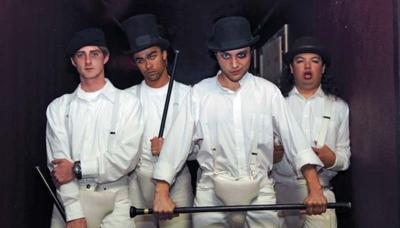

In October 2009, audiences showed up in droves to a chilly, tiny space in New Monterey to see a performance that melded avante garde theater, multi-media visuals, and a four-piece rock band performing the music of Pink Floyd. The show was The Wall: A Live Tribute, and the space was Paper Wing Theatre Company.
In the first scene, when Paper Wing co-owner Lloyd “Lj” Brewer, as Pink, bellowed “In the Flesh” – “So ya, thought ya, might like to, go to the show/ To feel the warm thrill of confusion, that space cadet glow/ Tell me is something eluding you sunshine? Is this not what you’d expected to see?” – it sounded like a dare, an invitation to open wide and brace yourself.
Paper Wing can have that effect. The company corrals misfits and geeks and yearning performers, and jumps into risky ventures with guerrilla tenacity. And they’re not afraid to get dirty, violent, profane, sexual or mean. For years, first at the Fox Theater in Salinas and now at their permanent home on Hoffman Street, they’ve put on shows that burrow a rich vein of material that their fellow theater companies won’t touch: The violence prone Killer Joe; the queasy suspense of Stephen King’s Misery; the sacrilegious The Eight: Reindeer Monologues; the wrenching catharsis of Bill W. and Dr. Bob; the bloody REPO! The Genetic Opera; the defiantly deviant The Rocky Horror Show.
It’s an alternate universe of local theater that drapes emotion, reflection, and social critique in outlandish garb. Sometimes it doesn’t work. Killer Joe on one evening was only able to rustle up an audience of two (the show went on anyway). More often, though, their audience, attuned to Paper Wing’s skewed channel, finds them. They found them for a nearly sold-out run of their adaptation Tribute to Oh Brother Where Art Thou? And their audience found them, if last week’s opening weekend is any indication, for the current production, a hybrid of the nihilistic Anthony Burgess novel and the Stanley Kubrick film version of A Clockwork Orange.
Jan. 20. Oh Brother Rehearsal – Don’t embarrass me.
“You’re just in time for the Klan scene,” says director and company co-owner Koly McBride, standing in the center of the black-painted theater, a compact 35-feet-by-15-feet space. She’s directing the rehearsals – usually closed to outsiders – for their adaptation of the Coen Brothers’ Oh Brother, and tells the assembled actors sitting in the stadium riser chairs, “Not to be like your mother or anything, but don’t embarrass me.”
During one scene, an actor playing a Ku Klux Klan member stands on the elevated riser stage tucked into a corner and rails about “darkies, Jews and papists.” Moments later a chorus of actors sings a sweet, sullen hymn as McBride interjects commands. A lot of easy laughter and wisecracks accompany the proceedings. To a point.
“Who’s that talking back there!?” McBride yells toward the hallway. “Stay in character! Stop the playing, stop the playing!”
McBride’s earned the right to say what goes down in Paper Wing. She founded the company 20 years ago at age 19 in Southern California, spurred by experienced theater friends who were not getting choice roles because they didn’t have the “right” face or body. McBride, who today wields a Rubenesque frame, was tired of being cast as the funny friend.
“I toyed with naming the group Short Fat Theater Company,” she says. But the name Paper Wing seemed more providential. “A paper airplane could go ‘phhtt’ when you throw it. Or it could just go and go and go.”
McBride moved to Monterey in 1993, then folded up the company until 2001 – that’s when, after the theater itch compelled her, the owners of Salinas’ Fox Theater agreed to let her use the space so her fledgling company could take flight again.
Picnic, by William Inge, didn’t make any money; it opened in the wake of 9/11. But buoyant musical comedy Nunsense was a jackpot. In 2004, she decided to put on The Best Little Whorehouse in Texas, a show that would bring in someone who would change everything. That someone was Lloyd Brewer.
Feb. 4. Oh Brother opening night – The highwire act.
It’s Friday night. Hours earlier, Brewer attended the memorial “life celebration” for his mother, Frances Brewer, who died “quite suddenly” on Jan. 31. At 8pm, he’s performing in the lead role of Everett in Paper Wing’s opening night of bluegrass musical Tribute to Oh Brother, Where Art Thou?
The house is packed. Many know of his fresh loss. It’s hard to not imagine the grief intruding as Brewer performs. But instead what happens is a show as boisterous and warm as campfire songs with friends. It gallops along without a hitch, with the audience laughing, clapping and singing bright tunes like “You Are My Sunshine.” Just as the cast lines up to take their well-earned bows, Brewer lets out a nearly imperceptible “whew.” He had made it. And would again for the rest of the well-attended, nine-show run.
Maybe he’s able to do so because he has had to before. On Oct. 25, 2008, his father, Jim Brewer, also died suddenly. Four days later, Paper Wing opened their big, rollicking Halloween staple, The Rocky Horror Show, with Lloyd in the lead as the cross-dressing Dr. Frank N. Furter. The day after that show closed, Brewer says he drove his father’s body to L.A. to bury him.
Yet another reason Brewer made it through could be what he calls “tunnel vision.”
Before he first walked into the Fox Theater to audition for the first time, Brewer was a drug addict. He started early and was so dedicated to getting high that Natividad Boy’s Ranch, the courts, multiple jail sentences and his family couldn’t intercede.
“Once I started smoking crack,” he says, “I ended up sleeping underneath parked cars in Seaside.” Even the birth of his son, now 14, couldn’t restrain him. But a final arrest marked a turnaround.
“June 3, 1996,” he recalls. “That’s my sobriety date. I went to jail for four months. [Then] I went into the courtroom, orange jumpsuit, shackled, and stood in front of the judge and he gave me five years in state prison. I almost shit myself.”
But the judge said he would suspend that sentence if Brewer completed a program in San Jose. He pounced on it. And held on with both hands.
The next few years were one of rebuilding a sober life and raising his son by himself. In 2004 he saw an ad in the Weekly, he says, inviting actors to audition for Best Little Whorehouse in Texas.
“Koly walked up to me [in the Fox Theater] and asked me to sing ‘Happy Birthday,’” he says. “I did, and she said, ‘We’ll get you onstage right away.’”
“I had a really good time during rehearsals,” he says. “Opening night I was pretty scared.”
It was the first time he had done theater, but he was a natural. His performance earned a mention in an otherwise “not too kind” review from the Pajaronian: “auspicious debut.”
“I had to look it up,” Brewer says.
Rocky Horror came next, and Brewer “nailed” the audition for the lead. That show was a big hit for Paper Wing and a revelation for Brewer.
“I finally found it,” he says. “It’s extremely cathartic for me to be on stage and have nothing else in my mind except what I’m doing that exact moment – tunnel vision.”
It’s something that crack used to do for him. But drugs had only taken away from him. It couldn’t give him the platform, the creative community, the recognition – he was voted Best Actor by Weekly readers in 2005 and 2007 – that theater was giving him.
Feb. 23. Rehearsal for Clockwork – Here we go.
Auditions for Oh Brother and Clockwork took place Jan. 9. Rehearsals for Clockwork started a week ago, with actors leafing clean new scripts in their laps. Today those scripts are marked with highlighter and notes scribbled in the margins. The rustic backwoods set of Oh Brother, which closes in three days, is still up. Brewer tells Tyler Vocelka, the actor who plays Alex, to slow down his delivery.
“I know, I’m really speeding through,” Vocelka says. “I’m trying to remember my lines.”
“Jeff, can you burp on command?” Brewer asks Jeff Collenberg, playing the droog character Pete.
“Probably,” Collenberg says. “If I drink soda.”
“You can’t suck in air on stage and burp?”
Brewer asks a guy named Tony, who plays a sympathetic priest, “How are you going to react?
“It depends on if the priest is actually gay,” Tony says.
“That’s on you. That’s your backstory.”
Tony doesn’t want to give his last name. He doesn’t want his boss to know he’s in the show.
Brewer gives “notes” to a young Alyssa Stone, whose hair is dyed electric red: “I want you to Google ‘Romper Room’ and watch Miss Mary Anne.” Tony, who is older, laughs.
Vocelka queries his director: “Are we using the prop from the Christmas show?”
“The dildo?” Lloyd replies. “Yeah.”
“Cool.”
Behind the illusory facade of the stage, the gears and guts of a theater sit and wait. Paper Wing moved from the Fox Theater into their New Monterey space off Lighthouse in 2007, cleared out “waist-high” detritus, inherited much gear from previous tenant Monarch Theater (Paper Wing is the fourth theater company to occupy the space) and settled in.
Hidden behind the interior walls lie a gauntlet of Paper Wing’s accumulated history, the props and equipment stacked up, encroaching on walking space, like the lair of an unrepentant hoarder: hubcaps, hula hoops, a 4-foot crucifix, empty bottles, rugs, pillows, trophies, enough flatware for five families, lumber, two Bibles still wrapped in plastic, cranberry juice, boxes, that prop Vocelka mentioned. And costumes, racks of them, like booty from vintage store heists, line the wall and share a high-ceilinged space with dressing rooms and a dozen conjoined make-up/mirror stations.
“We screw everything together so we can reuse it,” says set builder Rob Adams. “Paint it six times. Koly and Lloyd collect everything because you never know when you’ll need… a kitchen sink.”
As he says that, walking through the back rooms, he taps on an honest-to-God kitchen sink. Except for posters of past shows and political sloganeering, the décor is utilitarian as a garage.
To the right of the entrance is a room being converted into another theater space called the Gallerie Theatre. McBride says they’ve invited Breakthrough H’Art, a nonprofit that helps mentally ill people adjust to life, to put on a show there – Paper Wing’s music director, Eric Johnson, is a member of the Breakthrough program. The Gallerie’s first performance is slated to be Tracy Letts’ disturbing Bug, directed by Kirstin Clapp, who has directed shows at MPC, but wants to graduate to riskier adult stuff. And for that, one comes to Paper Wing.
March 16. Clockwork rehearsal – Mise en scene.
Progress is evident. Brewer walks out of the theater while a scene is playing out and the actors continue the scene without pause. During another, the dozen or so actors following the action from the seats turn the page on their scripts at the same time. When doing their scenes, most don’t hold onto their now-weathered scripts anymore.
Though McBride and Brewer remind their cast to sell tickets to the show, it’s not all business. McBride patters about in bunny slippers. When Jay DeVine, as Deltoid, tells Vocelka, aka Alex, “You are now a murderer, little Alex,” both men start laughing. Drew Davis-Wheeler works his fingers on his twist hairstyle, which he hopes works for his character.
Allen Aston, walking stiffly with a cane due to an injured neck, smashes the tip of the cane onto a stair, startling everyone in general but one guy, Richard Sanchez, in particular.
“This one’s new,” Brewer warns Aston. “Let him get used to you.” To which the cast knowingly laughs.
From the outside, Paper Wing looks like just a provocative performance troupe. But within its confines, as reiterated by its all-volunteer actors and crew, at its heart, it’s a family. A family of creatively bent misfits, but family nonetheless.
“The comaraderie is probably the best I’ve ever seen in theater,” says Aston, a self-described “theater rat” who’s spent decades building sets and rigging lighting at companies all over the region. “[The company] greets the audience on the way out… to bond and take pictures.”
Christina Kulvicki, 22, has been cast as a rape victim, a daunting prospect alleviated by her dedication to theater as an artistic reflection of reality, but also by the “weird family” she has in Paper Wing.
“People are not cast as individual actors, but as a unit,” is how Vocelka puts it. And he’s the lead.
Though the cast and crew come from a scattered array of background, age and ambitions, once in, they seem to give and receive healthy doses of respect and support with a cohesion that comes with embarking, together, on something worthy.
As Brewer’s new love for theater grew, so did the feelings between him and McBride, especially when they starred in the two-person Frankie and Johnny, at times, literally and figuratively, naked. Brewer became a partner to McBride as well as Paper Wing.
“We started to push the envelope,” Brewer says. “There’s got to be others, working class people, who want to see this [fringe stuff]. It’s young, it’s alive.”
McBride had doubts at first, but when she was convinced, she says, “We got as gritty as we could.” That meant Nabokov’s Lolita; 2007’s first production of Clockwork; or Six Women with Brain Death, with one female character played by a transgendered actor.
“The response was ‘you are so brave; nobody else is doing this.’ After that, it became our battle cry. Is this moving, adult, quirky, edgy?”
That shared ethic wove its way into Paper Wing’s identity as the “only independent theater company in the county,” as well as McBride’s early reservations about sharing the company she had given birth to.
“The final say had to stay with me and Lloyd,” she says.
March 24. Clockwork final rehearsal – hit your marks.
It’s 8pm on the day before Clockwork opens. The week leading up to this is dubbed Hell Week, on account of its intensity and the complexity of bringing all the elements – character, story, cues, set changes, props, lights, narration, music – together. But the atmosphere from the crew and cast, now in full costume and makeup, is giddy. Like they know they’re ready.
Backstage is a jumble of movement by crew and actors in surreal costume juxtapositions touching up makeup or reading or talking or warming up their vocal cords chanting “buh-duh-guh-guh-duh-buh,” all illuminated by the bright make-up station lights.
“Some people have rituals, read lines, listen to music,” says actor Nick Kelly. “I’m a pacer.” Actor Shane M. Dallmann, a medical billing specialist by day who also produces AMP public access TV show Manor of Mayhem, does puzzle problems.
Prop assistant and actress Allison Smith takes a wicked-looking hypodermic needle and casually jabs it in the palm of her hand. The needle retracts inside the chamber.
Someone yells “Halftime!” which means five minutes until showtime. A few minutes later, “Places!” to signal it is beginning. From here on, people talk in hushed voices and move with measured quickness and care. There is red tape on the floor called the “red zone,” kind of a fast lane for actors and crew to get to costumes and props without obstacle.
“The play goes faster than you think [from back here],” says stage manager Kelly Hutchison Machado.
Music seeps into the backstage room. It’s the arch synth score of “The Funeral of Queen Mary” by transgendered composer Wendy/Walter Carlos. Vocelka’s pre-recorded narration rises up, and Beethoven follows.
Then, minus an audience, as if doing it just for themselves and each other, the show starts.
(0) comments
Welcome to the discussion.
Log In
Keep it Clean. Please avoid obscene, vulgar, lewd, racist or sexually-oriented language.
PLEASE TURN OFF YOUR CAPS LOCK.
Don't Threaten. Threats of harming another person will not be tolerated.
Be Truthful. Don't knowingly lie about anyone or anything.
Be Nice. No racism, sexism or any sort of -ism that is degrading to another person.
Be Proactive. Use the 'Report' link on each comment to let us know of abusive posts.
Share with Us. We'd love to hear eyewitness accounts, the history behind an article.