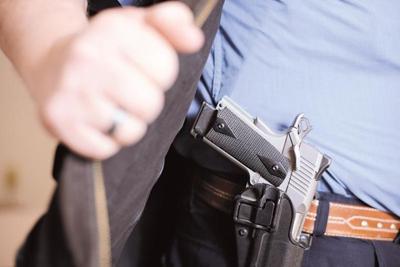
“I wish he had never pulled a gun.”
That’s the only thing Phil Nash would change about the evening he shot a man in self-defense.
In April 2001, Nash, then an officer with Carmel Police Department, was off-duty and having dinner at a friend’s house in South Salinas. They heard a car crash into another vehicle and ran outside to see what happened.
A man later identified as Adrian Castro was attempting to run from the accident, which happened just down the block from the home of Nash’s friend. Nash planned to detain Castro until police arrived, but in the blink of an eye, everything changed.
“He reached into his waistband and produced a 9mm handgun,” Nash says, “and pointed it at me.”
Nash was carrying a 40-caliber HK USP handgun as a matter of routine. He says what he did next was a matter of survival.
The bullet he fired hit Castro in the center of his body. The 29-year-old man dropped immediately.
“There was nothing else for me to do to come out alive,” Nash says. “In those few seconds you have to make a decision.”
Castro died two weeks later at Salinas Valley Memorial Hospital.
“I made my choice and I have to live with it,” says Nash. “It turns into who is going to go home and if I have a choice, I’m going to pick myself. I can live with my choice.”
Nash – now an FBI-certified instructor in firearm safety – says pulling a gun in self-defense needs to be the absolute last resort. It’s the same philosophy Marina-based firearms instructor David Wasson teaches in his classes. Wasson carries a .45-caliber Kimber Ultra Carry II, but as concealed-weapons permit-holder, he can carry up to three concealed weapons wherever he goes.
Wasson compares carrying a gun to using a seatbelt.
“How often do you use it? It’s a trick question, because you only use it in a crash. You wear it everyday, but you never want to actually use it,” Wasson says. “If you don’t plan on using it and you’re a good driver, why wear it? It’s better to have it and never need it, than not have it and need it. You can’t put the seatbelt on when you’re crashing.”
Wasson is a National Rifle Association-certified instructor, a range safety officer, and an approved instructor for the conceal-carry weapon certification.
He is also one of only 209 people in Monterey County who have permits to carry concealed weapons wherever they go.
“Just because you’re a concealed carry holder does not mean you go looking for an armed confrontation,” Wasson says. “You’re going to do everything you can possibly do to avoid them. It has to be the worst-case scenario, but you need to be comforted that it is there.”
Some people might not find it all that comforting to know their friends and neighbors are walking around locked and loaded; there are enough people in Monterey County doing it illegally as it is.
But here’s one thing they can take comfort in: Those who go through the process of doing it legally are going through possibly the most rigorous permitting process in the state.
• • •
In Monterey County, the Sheriff’s Department handles all applications for concealed-carry weapons (or CCW, as the permits are more commonly called). Apply and you will be fingerprinted. You will have sheriff’s investigators perform a background check. Your family, neighbors and coworkers will be interviewed.
And then you will undergo a mandatory psychological evaluation.
From the time the process starts, it might take more than a year before an applicant receives an answer. Right now, the sheriff’s office isn’t even scheduling personal interviews with applicants until January 2014.
And when applicants jump through all of those hoops, a surprising number of them find the answer from the sheriff’s office is “no.” From 2012 to 2013, 23 of the 152 people who applied were rejected – some because they didn’t pass the psych exam, some because the investigator doing the personal interview or background check found something hinkey.
If an applicant flunks the psych exam, the Sheriff’s Department keeps it confidential from everyone, including the applicant. But the end of the rejection letter contains a clue: If it says the application is finished and cannot be re-submitted for two years, a failed psych exam is probably the reason. Applicants rejected for other reasons can appeal immediately.
Monterey County Sheriff Scott Miller has a contradictory reputation as one of the most tight-fisted sheriffs in the state when it comes to giving out CCW permits, even as he strives to make the process more open than it had been under previous administrations.
“We are looking for reliable, responsible adults. We’re not handing these out like candy,” Miller says. “If my standard was going to be that personal protection alone was good cause, then our screening process was going to be much more robust than it had been.”
Than it had been – that’s a key phrase. Miller alleges that before he took office, anyone who wanted a CCW permit had to either know the sheriff, donate to his campaign or be a personal friend or someone of influence to get it.
“If you were ‘Joe Citizen,’ you had to establish good cause, and that’s completely ambiguous,” he says.
The application process, developed for counties by the state Department of Justice, is lengthy and detailed. But it’s even more so in Monterey County, one of only three counties in the state that requires applicants to undergo the psych evaluation.
But Miller believes any citizen who hasn’t been convicted of a crime and who can make it through the rigorous application process and pass the background check has the right to personal protection.
“We made it a process with substance, and a process that’s more strenuous,” he says, “but we also made the commitment that any citizen should be able to access it if they were of good character.”
One of the more in-depth sections is the background investigation. Aside from a standard DOJ check for criminal convictions and a personal interview with the applicant, Miller says, an applicant’s neighbors, coworkers and family are also interviewed to get a sense of the person’s character.
“The interviews are about seeing if there are any immediate red flags. It is not comprehensive, but we do hope to know the applicant better,” says Miller. “We want to know if they make their neighbors or coworkers uneasy.”
Malcolm Gray is a 25-year veteran of the Monterey County Sheriff’s Department, including many years in investigations. Since last September, he has been part of the background team for the concealed-carry permits. He says he can tell a lot about an applicant by a quick look at how they live.
“If a person takes care of their life, they are typically pretty diligent about being responsible with their firearms,” Gray says.
He checks to ensure any current firearms are properly secured, safely kept away from children. Gray says some applicants try to underplay the interviews, despite having clean criminal backgrounds, but the investigators want to get to know them.
“We dig, and our investigators are good at seeing through the bullshit,” Gray says.
• • •
If you make it through the interviews, the background checks and the chats with the neighbors and co-workers, next comes the drive to Los Gatos, where applicants pay $150 to undergo psychological exams done by a company called Law Enforcement Psychological Services.
While the evaluation is not as comprehensive as, say, what someone seeking a job in law enforcement goes through, Law Enforcement Psychological Services owner and president Michael D. Roberts, Ph.D., says the process is necessary.
“Our bias is the public interest as our first priority,” says Roberts, a clinical psychologist for 30 years. “We want to do an individualized assessment to understand if they have basic emotional stability and self-regulation in tense situations.”
He argues the three-part background check done by Monterey County is like a stool: All three legs have to work. The psych exam balances against the background check and interviews with neighbors and co-workers to provide a thorough picture.
“The psych exam is a risk assessment,” Roberts says. “We don’t say someone fails it, we say they’re high risk for using deadly force.”
Wasson says he applied three years ago through former Sheriff Mike Kanalakis, whose office initially denied him a permit. (He doesn’t know why.) He successfully appealed the denial and then went through a local, four-hour safety class – the minimum time required by the state – which includes time spent on a range to show proficiency.
Wasson feels the class wasn’t in-depth enough. He didn’t feel mentally ready.
“The first time I carried was the worst lunch I ever had. I definitely didn’t feel comfortable even though I had received my permit the day before,” Wasson says. “The minimum [training class in California] should be eight hours.”
So Wasson went to a 40-hour self-defense training in Nevada. Some permit holders feel the current minimum is sufficient, but others say it infringes on their rights.
“It’s a hell of a process and very costly,” says one current permit holder, who asked not to be quoted by name. “I have a real problem with how stringent it is, because your right is circumvented by opinion. Let’s make it uniform and stick to the spirit of the Second Amendment.”

That’s what Monterey County’s law enforcement neighbor to the south, Kern County Sheriff Donny Youngblood, believes in.
“I will fight tooth and nail to give CCW permits,” he says.
Kern County borders Monterey County’s southeast corner. With a population of around 850,000 residents – about twice that of Monterey County – about 6,000 people there currently have the legal permission to carry concealed weapons.
“Six thousand permit holders in Kern County and no psych exam required,” Miller says with a slight chuckle. “But then again there are places, Florida comes to mind, where you can mail in an application and they issue one to everyone.”
Despite Youngblood wanting more people to carry, he generally agrees with Miller’s stance on requiring a process to control who gets that privilege.
“My gut says regardless of their potential clean backgrounds, you look at each one at face value and make sure they’re not going to hurt anyone,” Youngblood says.
But unlike Miller, Youngblood doesn’t see the need for a psychological exam. He argues his process runs smoothly enough. Though, he admits, applicants needs to be smart and honest.
When there’s a problem in the background check, “the common argument we hear is, ‘Oh, something happened 30 years ago,’ and the applicant took a liberty in thinking it went off their record after a while,” Youngblood says.
Miller and Youngblood agree some form of standardization would be nice, but neither has an answer what that looks like, with 58 counties and 58 sheriffs in the state.
“The biggest issue with standardizing laws in California is the different cultures of the different counties,” Youngblood says. “And not all the sheriffs can agree on gun issues.”
Miller agrees the process is backwards. While an approved CCW permit holder can lawfully carry a concealed gun across the state of California, he says, a person applying for one has to jump through the hoops required by his or her county of residence.
Another hurdle for some is the price of the entire process. The nearest location for psychological exam is Roberts’ place ($150) in Los Gatos. Another $213 covers county fees, fingerprinting and state DOJ fees. Add $50 for the classroom and range time at Markley’s – or $195 for the eight-hour class at Wasson’s – and an applicant is looking at more than $500 for a permit.
In Kern County, a denied applicant has to wait one year to reapply for a permit. In Monterey County, it’s two years. Applications, as well as renewals of existing permits, are all a matter of public record. The fact that someone is denied also is public, but the reason for the denial might not be disclosed.
One man wondering about his denial is Steven Ponsi, a former U.S. Army Green Beret who served in Vietnam. The 67-year-old former Salinas resident now lives off of River Road. He found out last October that his CCW application was denied, but says the Sheriff’s Office won’t tell him why.
He thinks he deserves to know.
“I have been diagnosed with post-traumatic stress disorder. But I don’t think that’s a good reason to deny me. It’s doesn’t make me more or less violent,” Ponsi says. “I’ve personally owned weapons since 1973, and I’m well-trained. I have a respect for actually needing to use it.”
He wants to be able to legally carry a weapon, he says, because the gang problem in Salinas makes him to feel unsafe. And he worries about being car-jacked when he drives through the city.
“My concern is that with cuts to law enforcement, I won’t be able to get the help I need if necessary,” Ponsi says. “I’m disappointed I was denied. To me, it’s an insurance policy. You want to have it, but you never want to use it.”
• • •
Even as Miller seeks a way to make the CCW permitting process more open, he says he’s not interested in flooding Monterey County with concealed weapons. But based on a recent gun control vote in the U.S. Senate, Monterey County might not end up having a choice.
The Senate failed on April 17 to pass a measure expanding background checks for people buying weapons online or at gun shows. (The vote was 54-46, with 60 being required to pass). But an amendment to the bill that would allow people with concealed weapons permits in their own states to carry the weapons into other states (even where concealed weapons aren’t legal) received 57 votes. It went down with the bill, but the numbers speak volumes.
It’s a huge responsibility to carry a concealed weapon, and it’s an even bigger decision to ultimately pull the trigger on another person. Miller wants ensure that it is the right decision made by the right person.
“I will not go to the mat and make sure every person in the county has a CCW permit,” he says.
“Every good and upstanding citizen in Monterey County who wants to apply, I support their ability to apply and if they are upstanding citizens, be successful in the process,” he adds. “We’ve tried to establish a policy that’s fair and open and to keep it even-keeled.”
(2) comments
You can buy guns online too. The system is made so well that no child or person without a gun permit can not buy a gun. I usually restock my gun store from the ClarkeArms.com. If you have another supplier we should discuss and exchange information.
I'm visiting from Idaho for several months. I have an Idaho Concealed Weapons License, and of course wish that California honored it with reciprocity. But I understand and agree with Sheriff Miller; it is a HUGE responsibility carrying a concealed weapon. It is for your personal defense as a last resort, so if you can hand your wallet over and walk away, that is the correct decision, rather than blow away the thief. Carrying a concealed weapon does not make a person a law enforcement officer, or a special deputy. You are not to interfer with a man and a woman arguing on the street, produce your gun, and tell the guy to back off.
I took the required CCW course at the Ada County Sheriff's Office. Yes, they give the course, and at no charge! Several places in the state have classes, $75, but the Sheriff gives them at no cost. Emphasis is placed on the use of deadly force and all of it's consequences. Several hours on that alone, along with the responsibility of carrying a gun and instances where you would actually use it. If you pull your gun out it is to shoot a person because you fear for your life, not to scare them away.
I agree that the fees are prohibitive in California, and believe they are meant to discourage many from applying. Idaho fees for the CCW are $20 plus fingerprint fees of $15.
Live range shooting should be required in California but an 8 hour class should be suficient.
Welcome to the discussion.
Log In
Keep it Clean. Please avoid obscene, vulgar, lewd, racist or sexually-oriented language.
PLEASE TURN OFF YOUR CAPS LOCK.
Don't Threaten. Threats of harming another person will not be tolerated.
Be Truthful. Don't knowingly lie about anyone or anything.
Be Nice. No racism, sexism or any sort of -ism that is degrading to another person.
Be Proactive. Use the 'Report' link on each comment to let us know of abusive posts.
Share with Us. We'd love to hear eyewitness accounts, the history behind an article.