
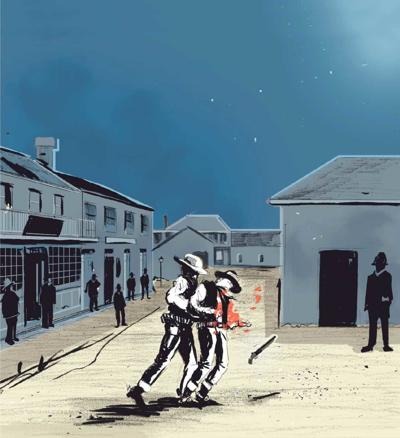


THE CONFRONTATION HAPPENS AT NIGHT, in downtown Monterey, right in front of the Union Saloon. It’s September 1871.
A young man, having just left the saloon after a night on the town, is heckled by another man, who has just emerged from a dark alley.
Curses are exchanged, the young man lunges at the other, three shots are fired and the two men wrestle to the ground.
The sheriff, who’d been just across the street, runs over and pulls the young man off the heckler, whose chest is bleeding with multiple stab wounds. In the young man’s hand is a bloodied knife, which the sheriff takes from him.
The wounded man crawls toward the saloon door, but he does not make it.
His wounds are mortal.
To understand why this killing happened – why it seemed almost fated – one must go back more than 20 years before that fateful night.

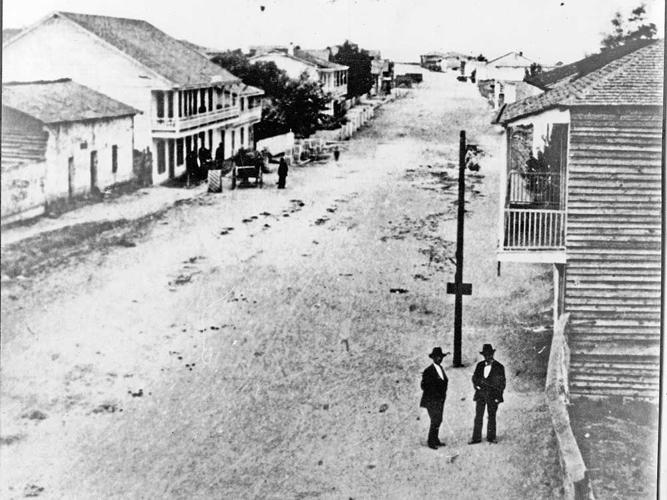
Alvarado Street in downtown Monterey in 1867.
IN THE EARLY SPRING OF 1848 21-year-old James Lynch, of the 1st New York Volunteers, left Santa Barbara with five fellow soldiers and headed north toward gold country.
The regiment, which was under the command of Col. Jonathan D. Stevenson, had arrived to California by ship in 1847 to fight in the Mexican-American War. When the war ended in February 1848, the regiment disbanded, and the men dispersed to fulfill the second part of their mission: settle California for the United States.
On the way north, Lynch and the five soldiers he was traveling with camped at Pleyto Rancho on the San Antonio River, an area deep in South Monterey County that is near what is now the northwestern shore of Lake San Antonio. Over a campfire one evening, a local Californio told the men of a gorgeous valley six miles to the south at the foot of a mountain called Tierra Redonda, named for the round hills in the valley below.

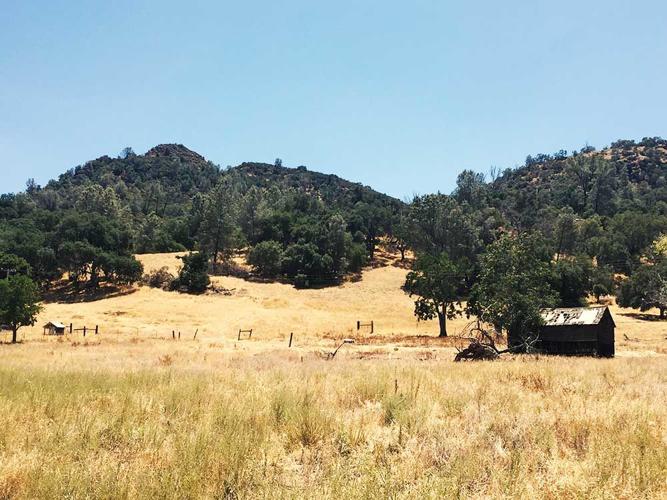
This land by the foot of Tierra Redonda, just south of Lynch Canyon Road, is near where James Lynch built his family's home.
Intrigued, Lynch left the other men the next day to see it for himself, and was enchanted. He met a German doctor, who went by Dr. Friend, who had built a small cabin at the base of the mountain near a spring that formed a stream on the valley floor. Lynch spent the day with the doctor, who told Lynch he gave care to anyone who came to him, and that the only other inhabitants in the valley were indigenous.
The memory of the valley stuck with Lynch in his years mining for gold, and later, as a merchant in Stockton and San Francisco. He revisited it a decade later and found it even more beautiful than he remembered. He decided to build a home there and raise sheep and cattle.
But Lynch also saw a harbinger of what was to come: The doctor’s house was by then a heap of burnt timbers, and nearby a wooden cross was staked in the ground, marking the doctor’s grave.
An old Californio named Ezequiel Soberanes, who would help Lynch build his house near where the doctor’s had stood, found Dr. Friend murdered four years after Lynch met him.
It was not known who did it, or why.

HISTORY IS A LIVING THING. The stories people tell about their lives often change shape over time, along with their memories of them. Moreover, two people witnessing the same event at the same time might recall it differently a minute later – much less 20 or 30 years later.
This story is largely drawn from the writings of James Lynch’s third-born son, former California State Sen. Henry Lynch, who was born in 1866 at Tierra Redonda, and who passed in 1930.
Henry Lynch wrote a story titled “Ambush, Arson & Murder on the Nacimiento,” which is contained in a book by the same name that was published in 1999, long after he died. The book, which was put together through the work of numerous volunteers at the Pioneer Museum in Paso Robles, also includes stories from Henry’s relatives, as well as a court transcript and other documents.
The book does not make clear when exactly Henry wrote the story, but in his epilogue, he indicates it was “many years” after the events it describes, which took place when he was only a young boy. Therefore, it is likely that most of it, if not all, was passed down to him through stories told by his parents, older siblings and others.
All that being the case, this tale should by no means be considered a definitive history – despite the subtitle on the cover that reads “The TRUE story of a pioneer fighting to save his ranch in a beautiful California valley” – but it can safely be said it’s based on a true story. And wherever possible, historical records such as the court transcript and news articles have been used to corroborate.
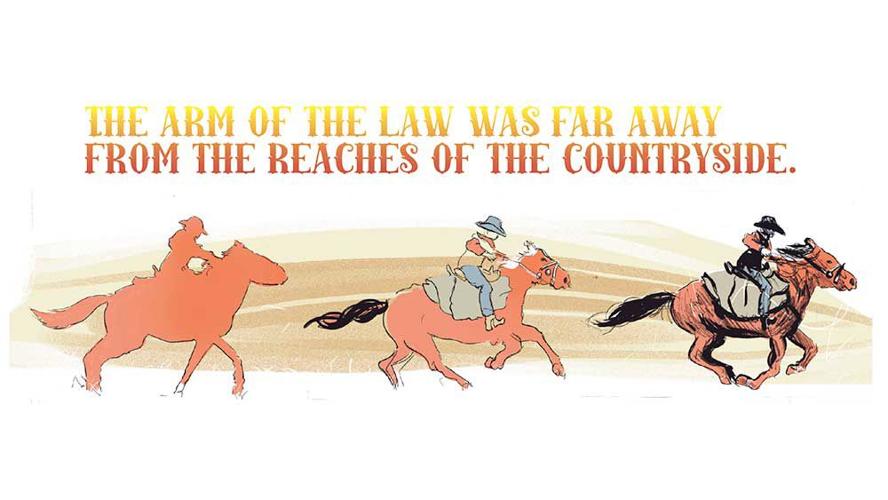
It is a story of a time, just 150 years ago, when the arm of the law was far away from the reaches of the countryside, where law-abiding settlers often had to fend for themselves. It is also a time when, on the heels of the Civil War, the nation remained deeply divided, and while California was ostensibly a pro-Union state, many of its residents had supported the Confederacy.
In short, it was a time when the West was trying to become less wild, and more civilized.
This tale starts on the ranch owned by Henry’s father, James Lynch, in that bucolic valley at the foot of Tierra Redonda, a remote place seemingly far removed from the troubles of the world.
But sometimes, those are the places trouble likes best.
AFTER COMPLETING THE HOUSE with Soberanes, Lynch traveled back to San Francisco to meet his wife Alice – whom he had married there in 1856 – bought two mules, and returned to Tierra Redonda with their first-born son James, who was just a year old.
In the early years, the only enemies were the elements, and a grizzly bear, which Henry writes “made war on the sheep” and that “a constant war had to be waged against him.”
Against the elements, the Lynches, like all ranchers, were defenseless.
“During the wet year of 1861 it rained at this place sixty inches in less than three weeks and nearly changed the face of nature when the flood gates of Heaven were opened up and it rained fifteen inches from dark to daylight,” Henry writes. “Following this, the dry year of 1864 came when no rain fell and cattle and sheep died by the hundreds.”
(The “wet year” is a reference to the Great Flood of 1862, the biggest flood event in recorded history in California, Oregon and Nevada.)
But the real trouble started when the Civil War ended in 1865, and in the years that followed, Henry writes, “A bad element began to creep into the region. Renegades from all over and murderers evading the law came into the county.”
It was a time and place, Henry writes, when “everyone went armed and one did not ask a man any questions.”

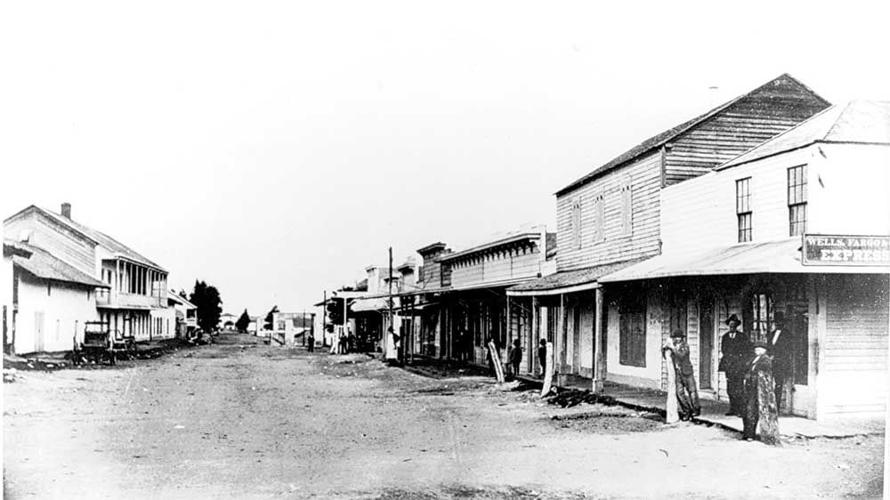
Alvarado Street at Pearl Street, 1875. The Wells Fargo Express office on the right is now the location of the Ordway drug store.
IN THE LATE 1860S, A GROUP OF THREE MEN who went by Martin Hurges, George Starr and Jake Tremble arrived to the area, and by 1870, had laid claim to a large swath of government land in the “Valley of the Nacimiento,” near Lynch’s ranch.
According to Henry’s account, Hurges was the leader, and stood about 5-feet-11-inches, weighed about 165 pounds, was about 30 years old, and “had colorless, thin, straggling hair, and dead-looking blue eyes with eyebrows as heavy and overhanging as a mean mustang horse.”
Hurges was also, according to Henry’s account, a member of Quantrill’s Raiders, an infamous pro-Confederate fighting group led by William Quantrill, who waged guerilla warfare around the Kansas and Missouri border. The group – which had been disavowed by the Confederacy – carried out ambushes on troops and raids on towns, one time killing about 200 men and boys in a single raid.
With the ending of the Civil War, some members of Quantrill’s Raiders came west, including notorious outlaw Jesse James, who, after committing a bank robbery in Kentucky in March 1868, came to Paso Robles and stayed with his uncle through the spring of 1869.
Also among those men, Henry writes, was Hurges, who “seldom talked except when drinking and then his talk would always be boasting of the deeds of violence and cruelty which he had taken part in…
“He had lived to tell the tale of the blood, ashes and devastation they had left behind them in Kansas and Missouri,” Henry writes of Hurges, “of men and women he had murdered in cruelty, merely for the sake of seeing them die.”
Hurges and his two cohorts, Starr and Tremble, built a cabin near the fork of the Nacimiento River, and “farther back in the hills was a large cave where they kept cooking utensils and a supply of provisions.”
The vast area of land they claimed, illegally, was used as a range for the horses and cattle they stole.
According to Henry’s account, a “peaceable man” attempted to cross the land they claimed and was “beaten almost into insensibility with the butt end of a heavy Colt revolver.” Hurges told the man “he alone” was the law in the area, and his revolver and rifle “would enforce his law against anyone who dared dispute his right” to the 50,000 acres he claimed.
A Jan. 5, 1871 newspaper article the Monterey Republican provides further detail.
In August 1870, the story reads, “[Monterey County] Sheriff [Thomas] Watson received information that two desperadoes, named Martin Hodges and George Starr, were burning houses, beating people, and committing other acts of outlawry in Harris Valley, a settlement some five miles from Pleyto Station, and about 120 miles south of [Monterey].”
Watson sent Deputy Guthrie to arrest them (no first name given for Guthrie), but Guthrie turned back after he was threatened with being shot by Hurges and Starr. So Watson sent Guthrie to redouble his efforts with backup, a man named George Bushton – who would go on to work for Lynch – and they spent a month unsuccessfully searching for Hurges and his men.
Law enforcement in that time was a dangerous business, where men traveled mile after mile on horseback through rugged country, alone, often not knowing who to trust.
When Guthrie and Bushton finally got a lead on the whereabouts of Hurges and his men, Hurges was apparently tipped off. Four outlaws, “concealed behind the trees and fence, from whence protruded several gunbarrels,” threatened them with death of if the two men tried to arrest Hurges.
Guthrie and Bushton went their separate ways, and last heard from Guthrie was a letter he sent to Lynch in November – about three months after the manhunt started – to inform Lynch he was heading to Cambria for more men. He was never heard from again, and was believed to have been assassinated on his way.
Lynch, meanwhile, had recently purchased an additional piece of land from the state on the Nacimiento River, expanding his ranch, and brought in a young Scotsman named William Muir (no relation to John Muir) to tend his sheep there.
But Lynch did not arm Muir with a gun.

ABOUT SEVEN MONTHS LATER, in May 1871, Hurges made his move.
“Muir appeared at the ranch, bloodied and scarred around the face and head from a beating he had received at the hands of Hurges,” Henry writes, adding that Hurges had told Muir, “I will put my brand on you so that when I see you again I will know you – and… I will kill you.”
Muir reported the sheep he was tending had been scattered, and some of them killed, so two of Lynch’s men – Bushton (who had accompanied the deputy sheriff on his manhunt), and another named Sweet – joined Muir to round up the sheep.
A few days later, the three men were sitting atop a hill about two miles from Lynch’s ranch when Hurges, and his two cohorts Starr and Tremble, drove horses down a trail below them.
Lynch’s men were unsure what to do in the moment – they didn’t think they’d been spotted – but as Hurges and his men passed through an oak grove, they rolled off their horses, took positions behind the trees, and opened fire.
Sweet made for a pile of rocks, as did Muir, and Bushton sheltered behind a sapling.
In the resulting melee, Sweet took a rifle shot square in the chest, and Bushton got hit badly in a thigh and arm.
Muir fled, and told Lynch – who had heard the gunfire, and along with some ranch-hands, jumped on a horse to ride toward it – all that had happened.
Along the trail, they soon met Sweet, who had miraculously survived the shot in the chest, but it took awhile to find Bushton. He wasn’t where the shooting had occurred – though there were plenty of dead and crippled sheep – and they eventually found him under a tree, “hot, weak, bloody and shaken.”
Assessing Bushton’s dire condition, Lynch turned to his oldest son, James, who was 13, and told him to get his horse saddled up to ride to San Luis Obispo for a doctor. If Bushton was going to have a chance, he said the doctor would need to catch the stage that left San Luis Obispo at midnight – in just six hours. He told his son of three different ranches to switch out his horse on the way.
“Ride fast and remember,” Henry writes, channeling his father, “that there will be horses alive when you and I are dead!”
WORD OF THE BATTLE TRAVELED FAST, and Lynch’s friends from the countryside gathered at his ranch in a show of solidarity.
Lynch’s son James, meanwhile, had succeeded in his mission, and the doctor was able to save Bushton’s arm – though it would take months for him to recover – while Sweet, who had been shot in the chest, was in remarkably good shape; the bullet that struck him had glanced off a rib.
But it in the immediate aftermath of the gun battle, the men who gathered at Lynch’s ranch, numbering about a dozen, were ready for a fight: They got a tip that Hurges was rounding up men “to finish the job and murder everyone and burn the place to the ground.”
Around midnight, a “column of fire” shot up from Lynch’s barn – next to which was a pile of “about 50,000 pounds” of sheep wool – and the men gathered about Lynch’s house decided it was a trap to draw them into the open, near the light of the fire. Instead, they stayed in their posts.
Daylight finally arrived, and no attack had been made. But there were tracks of “at least 15 horsemen with the gang,” Henry writes.
Within days, Hurges was arrested for attempted murder, but was released on bail in Monterey until George Bushton – who’d been shot in the arm and leg – could recover to take the stand in court.
In his recovery, George was tended to by his brother Jim, who sat at George’s bedside “day and night,” Henry writes. The doctor had been able save George’s arm, but it was “hopelessly crippled,” and Henry writes that while caring for his brother, Jim’s “dark eyes were full of pity, but then they would harden with a terrible hate as he thought of the man who had caused all this suffering.”
Jim Bushton would meet that man soon enough.
ON THE NIGHT OF SEPT. 4, 1871, Jim Bushton went out on the town in Monterey with his brother George, who had by now recovered, and other friends, and ultimately ended up at the Union Saloon, on the corner of Pearl and Tyler streets. The crowd was sizable, about 70 or 80 people.
There, they saw Hurges, and Hurges saw them.
Later court transcripts are fragmented, and sometimes conflicting, so it’s hard to know exactly what happened next.
According to Henry – who wasn’t there (and was still just a boy) – Hurges stood by the corner of the bar, his hand on his sawed-off Colt revolver in his right pocket, and began lobbing insults at them as he drank.
Around 11pm, the Bushtons and a few friends made their way out of the saloon, and Hurges followed them out.
According to court testimony by various witnesses – which is transcribed in Ambush, Arson & Murder – Hurges may or may not have called Jim a “son of a bitch” and said he wanted to kill him. Multiple accounts say that Jim responded by saying he wasn’t armed; he called Hurges a coward and a “f… ing son of bitch” in Spanish.
The two were only a few feet apart and a melee soon erupted, and a few shots were fired. Hurges fell on the ground and Jim came down on top of him. According to witnesses, it was not clear if Hurges fired his gun before Jim attacked him with a knife, stabbing him multiple times.
According to Jim’s testimony, Hurges shot first, after saying “stop, you son of a bitch,” and then Jim lunged at him.
But multiple other witnesses – including medical examiners – said Hurges never got his gun out of his pocket, and shot through his pants toward the ground, burning his groin with gunpowder.
One witness said Hurges, after Jim was pulled off him by the sheriff, crawled back toward the saloon “all on fire right in the cratch of his pantaloons.”
Hurges died moments later. Jim was tried for murder in March 1872.
Had the incident occurred in the country – which was still gripped by vigilante-style justice – it’s fair to assume the consequences would have been different.
But it occurred in downtown Monterey, with dozens of witnesses, many of whom were allied with Hurges. So it ended up in a court of law, with a prosecutor who allegedly shared Hurges’ secessionist leanings.
Jim Bushton was found guilty and sentenced to death by hanging, but after multiple pleas to the governor from powerful citizens – including the judge who presided over the case – arguing the verdict was unjust, and only supported by pro-secession residents, the death sentence was commuted to a life sentence. Jim Bushton lived out the rest of his days in San Quentin.

MONTHS LATER, A CARAVAN OF HORSES ARRIVED at Tierra Redonda driven by Chris Franks, a Monterey County Sheriff’s deputy, who had a rifle across his saddle.
On one of the horses rode a ragged, bloodied man, whose left hand was cuffed to the saddle and whose legs were tied under the horse’s belly.
The man was Jake Tremble, one of Hurges’ cohorts, and Franks, who Henry describes as a “squared-jawed, descendant of the Vikings,” told the rancher James Lynch the story of his manhunt.
It started with robbers holding up a stage coming from the New Almaden quicksilver mine, in the hills south of San Jose, where one of the robbers had been killed by a guard. That man was George Starr – the other of Hurges’ cohorts.
Word got to Franks that not long after, men stole about 20 horses from a ranch near Hollister, and were headed down the Salinas Valley, along the river. Franks saddled up, and the trail left by the herd led him toward Jolon.
Switching out horses with ranchers where he could (a common practice in those days to keep horses fresh, and fast), Franks followed the tracks southwest across the rugged wilds of the Santa Lucia Mountains, with its steep peaks and deep canyons, and down San Carpoforo Creek, in the opposite direction taken by Spanish explorer Gaspar de Portola. After crossing into San Luis Obispo County, and seeing tracks on the beach near where the creek met the sea, Franks then began bearing southeast, south of Tierra Redonda.
Franks then realized where Tremble had gone – the cave at Marten Spring where Hurges and his men would keep their provisions. Franks approached the cave cautiously, “keeping himself well hidden,” Henry writes, and he saw Tremble making dinner over a fire at the mouth of the cave, his back turned.
Franks stood from behind a bush and pointed his rifle at Tremble, ordering him to put his hands up. Instead, Henry writes, Tremble went for his pistol, and Franks fired and “tore the knuckles completely off the back of [his] hand.”
Then Franks moved on Tremble – who had fallen back and lost his weapon – and hit him in the head with the butt of his rifle and put him in handcuffs.
After leaving Lynch’s ranch, Franks turned Tremble over to federal authorities, who wanted him for robbery and murder. He was sentenced to death.
In Henry Lynch’s epilogue, he writes that Franks “has since changed his residence to Valhalla. He was truly one of the last of the old race of fighting sheriffs who, when duty called them to get a bad man went out and got him, pitting his own skill and courage and iron nerve against that of a desperado, whose stake in the game was his life, while the stake that the sheriff played for was merely to say that he had done his duty.”
(0) comments
Welcome to the discussion.
Log In
Keep it Clean. Please avoid obscene, vulgar, lewd, racist or sexually-oriented language.
PLEASE TURN OFF YOUR CAPS LOCK.
Don't Threaten. Threats of harming another person will not be tolerated.
Be Truthful. Don't knowingly lie about anyone or anything.
Be Nice. No racism, sexism or any sort of -ism that is degrading to another person.
Be Proactive. Use the 'Report' link on each comment to let us know of abusive posts.
Share with Us. We'd love to hear eyewitness accounts, the history behind an article.