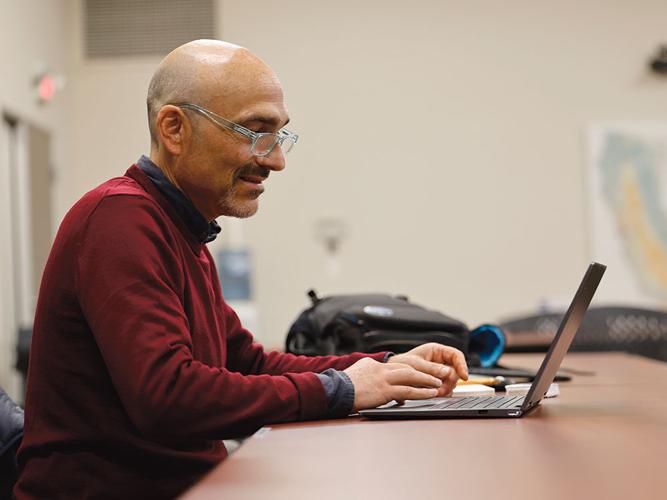

ON MONDAY AFTERNOON, OCT. 13, A GROUP OF 20-SOME REPRESENTATIVES OF COUNTY AGENCIES, NONPROFITS AND POLICYMAKERS are gathered in a conference room at the Monterey County Office of Education headquarters in Salinas. They’re here for the monthly meeting of the Monterey County Children’s Council, composed of 27 members representing agencies serving children directly or adjacently. Members hail from the Monterey County Office of Education, County Health Department and Social Service Department, the juvenile justice division of Monterey County Superior Court, the District Attorney’s Office and the Public Defender’s Office. The council’s mission statement is to provide “leadership and policy direction to encourage the development of a comprehensive and collaborative delivery system of services to children and youth in Monterey County.”
They meet to discuss issues like nutrition services and foster care. On this particular day they’re focusing on the how of their mission – a delivery system of services.
They break up into smaller groups to talk about weak points in that delivery system. Eric Mora is an aide to County Supervisor Wendy Root Askew, and is representing her as an alternate on the Children’s Council. As the sole Spanish speaker in the District 4 supervisor’s office, he is charged with answering the call when monolingual Spanish-speaking constituents knock on the door. When somebody shows up in person to their county supervisor’s office for help, “it’s often people on the verge of getting an eviction notice, or they already did,” Mora tells his group.
And often, they aren’t looking for a county supervisor at all – they find a county office searching on a map.
“I have nothing to tell them other than, ‘I have directions to the Social Services building.’ Usually they come just before closing. I feel horrible saying, ‘Run, go to Seaside, they are about to close at 5!’” Mora continues. But he is not a social worker; he is not trained to assess eligibility for benefits; and many of the constituents who are most desperate are not equipped to go online for support. Constituents who are better-resourced, Mora adds, often send emails and may request appointments ahead to talk to their supervisor or her staff. When people show up with a surprise knock on the door, it’s almost always because they are in a crisis.
This type of scenario – a person in desperation when it comes to paying the rent or utility bills or having enough money for food – is not shocking to the people in this room. This coalition of government and nonprofit agencies is acquainted with helping people facing hard times. What they are focused on today is a potential solution to help those constituents get the help they need more efficiently. And Josh Madfis, vice president of community investments at United Way Monterey County, thinks he has the answer.
“The goals of the Smart Referral Network are to help residents access, navigate and benefit from services in our county,” Madfis tells the group, “and to improve outcomes.”
Madfis is presenting to this roomful of agency representatives as an evangelist for the system, hoping that they will adopt the Smart Referral Network. But before he traveled around pitching agencies on why to use it, he saw a gaping hole in the technology used to deliver community services in a web of dozens of nonprofit and government agencies. So he decided to invent a better way.

After a career working abroad for years and then the Central Valley, Josh Madfis landed at United Way Monterey County in 2017. “I really feel like all points have led me here,” he says. “I think Monterey County is really special in the degree to which people are willing to collaborate.”
MADFIS IS NOT A TECH GUY, but he has become one, spending roughly half his time developing and pitching the Smart Referral Network. After college, he served in the Peace Corps as a teacher in Chad from 1994-96. “That really lit a fire for me,” he says.
He continued teaching children and educators – on the Hopi and Navajo reservations, on the island of Mauritius – and then worked for a refugee camp in the Republic of Congo, managing 16 different schools, some of which he visited by canoe. He started to develop ideas for how to best deliver education in difficult circumstances. “If there isn’t collaboration it’s chaos, and there’s duplication of services,” he says. “I started to really develop a passion for collective impact.”
His career brought him back to the United States, and eventually to United Way Monterey County in 2017. He quickly started to see a frustrating recurrence of a problem – it was hard for clients to get the help they are entitled to and to navigate systems that are supposed to help them, but in actuality can be quite cumbersome.
“Even if you do know what’s out there, you might not know if you’re eligible or how to access it,” he says.
You might get a referral to call a particular organization – maybe a behavioral health agency suggests you are also available for SNAP benefits, or a county supervisor’s aide thinks you might qualify for emergency housing. Even the 211 call system managed by United Way might suggest places to call for your urgent need – such as addiction counseling, rental assistance or food – but it’s up to the caller to follow through. What if, instead, the agency doing intake passed along a client’s information to everyone else, and those agencies contacted the person in need? “We tried to develop a referral that actually results in a referral,” Madfis says.
To do that, Madfis reached out to tech developer ThinkLogix. United Way hired them for an initial $45,000 to build a referral system.
The result became the Smart Referral Network, which case managers at 90 agencies in Monterey County have signed an MOU to utilize. United Way eventually spent $363,000 on the project, plus staff time and other indirect costs.
It got off to a bit of a slow start with just 42 referrals among eight participating agencies in 2019, then got a jumpstart in 2020 when California American Water contracted with United Way to distribute utility assistance for people who needed relief on water bills.
Then came a rental assistance program from the City of Monterey, launched in mid-2020 during the pandemic. The County of Monterey’s Department of Social Services hired United Way to distribute nearly $1.25 million in federal CARES Act money, then came a contract from the County to distribute $50 million in state relief funds. Suddenly, the portal was booming – in 2021, 44 agencies used it to make 13,350 referrals.
Since it launched six years ago, it has resulted in 18,317 referrals made, although the annual usage dropped off a cliff after the pandemic, to just 488 referrals in 2024.
(That decrease was due in part to the end of pandemic relief programs, and also the region’s Medi-Cal provider, Central California Alliance on Health, pulling out and instead opting to develop its own system. Madfis has tried unsuccessfully to recruit CCAH back into the fold. “Building a parallel [community information exchange] risks undermining – not strengthening – our collective impact,” he wrote in an email to CCAH officials in August.)
The decrease in usage is why Madfis is presenting to the Children’s Council in October, urging this group to utilize the Smart Referral Network.
“In the course of your career, you have your rolodex of referral relationships,” Madfis says. “But when you go, that rolodex goes with you. I am trying to institutionalize those relationships. Where we are going with this is better access to client data, and better coordination among service providers.”
The logic is that the more agencies are involved, offering portals to more programs, the more effective it is.
“Using this referral software is real systems change,” Madfis told the Children’s Policy Council on Oct. 13. “We need systems leaders to adopt it.”
DESPITE OUR TECHNOLOGY-ORIENTED WORLD, technology is relatively new to the realm of community-based organizations where people still talk about rolodexes. After a 37-year career in tech, with time at the likes of Microsoft, Amazon and IBM, David McCann is now semi-retired, working as chief technology office for United Ways of California from his home in Orange County.
“We as humans are journeying through the most rapid era of digital transformation we’ve ever done,” he observes. “I buy my airline tickets on Expedia, I listen to music on Spotify, I bank from my phone. Everybody is having to modernize. The last people to do it are community-based organizations. It’s the last part of society that hasn’t modernized the way they handle data. Really, CBOs are late to the party.”
They are arriving at the party now, with the Smart Referral Network developed by Madfis – which is now also licensed to United Way chapters in Tulare County and Kings County – and a similar system developed in Orange County called Get Help, now deployed in Orange, Riverside and San Bernardino counties. “Monterey is on the leading edge,” McCann says.
This is in part driven by people like Madfis and McCann, and the hundreds of case managers they work with.
It’s also driven by the State of California. “Agencies are frustrated as hell,” McCann says. “Everybody is saying, we are spending a lot of money, but we are not getting outcomes. We need to use the taxpayer dollar better to coordinate social care so we get a better return.”
In 2021, Assembly Bill 133 was signed into law, an omnibus trailer health bill bringing a new vision to how various health programs in California are administered, tracked and compensated. The legislation established an initiative called CalAIM, charging the California Department of Health Care Services with reenvisioning how Medi-Cal (the state version of Medicaid) is delivered, seeking to focus on preventive and holistic interventions.
The legislation also tasked the California Health and Human Services Department with developing the Data Exchange Framework (DxF), in which social services agencies and medical providers share data – a lot like the tools United Ways are utilizing, with a focus on medical providers.
AB 133 led to $47 million in state grants to organizations to implement these goals, including a $475,000 grant to nine United Way chapters (Monterey County’s among them).
The state funding unlocked fundraising potential for development and enhancement of local-level systems. McCann estimates about 75 percent of funding comes from government, the rest from philanthropy. “We are not a for-profit software company,” he notes.
There’s pressure – and now funding – from government to transition to a modern referral system. But perhaps the most significant driver is the case managers who are actually using the Smart Referral Network or similar systems day-to-day.
IMAGINE THE SITUATION for a case worker at one of the 90 local organizations that has signed on to use the Smart Referral Network, where thousands of clients show up in various stages of crisis. At Sun Street Centers, a nonprofit that focuses on substance abuse prevention and treatment, the focus of a client is usually on the problem immediately in front of them.
“We spend about an hour-and-a-half with someone. Maybe they need food stamps, maybe they need some kind of supportive living, maybe they need dental care,” Sun Street Centers’ CEO Anna Foglia says. “But people are not thinking about referrals in that moment.” That moment for some clients is that they’ve been picked up and dropped off by police at Sun Street’s sobering center; it’s hard to follow through on anything besides what is immediately in front of them.
The old-fashioned way of handling referrals for those clients is to hand them a piece of paper that they can use, if they remember to. Using the Smart Referral Network, a case worker can quickly click through and tag all of the agencies and programs that a client might be interested in, generating a notification to those other agencies to call the client and follow up, instead of expecting the client to do so.
George Myers doesn’t think he would have ever followed up on a referral on his own – he can’t imagine keeping track of such a piece of paper. But now, as he prepares to graduate on Nov. 21 from a three-month residential sobriety program at Sun Street, he’s already set up with a range of services. He’s on the waiting list for Section 8 housing, he’s getting psychiatric care and dental work, plus discounted bus passes so he can get to his new job.
“My options are very wide now, where I had none before,” Myers says. “It is all going to work out for me, I’m sure.”
Myers did not walk into Sun Street Centers looking for housing or dental care. He came in looking to quit drugs. But having a home has been transformational. “I just don’t want to go back to being homeless,” he says. “Homeless is a very hard spot for an addict.”
Myers has been addicted to drugs since he was 13 years old. Now 51, he’s sober and employed for the first time in his life, and has aspirations for a career. He can’t get a driver’s license yet – but one of his referrals is to get help clearing DUIs on his record so he can. And once that happens, he dreams of getting licensed to become a truck driver. (“Why not travel?” he says.)
This idea of having a dream at all is new to Myers. He has been homeless for years, and spent eight years in prison. Through his sponsor he got connected to a plumber, who hired him to dig holes for new pipe at a project in Prunedale.
“I don’t complain about the work, because it’s something new,” Myers says. “I proved myself. I can look in the mirror, shave, talk to people.”
His case manager, Fatima Torres, knows exactly what Myers is talking about – she’s been there.

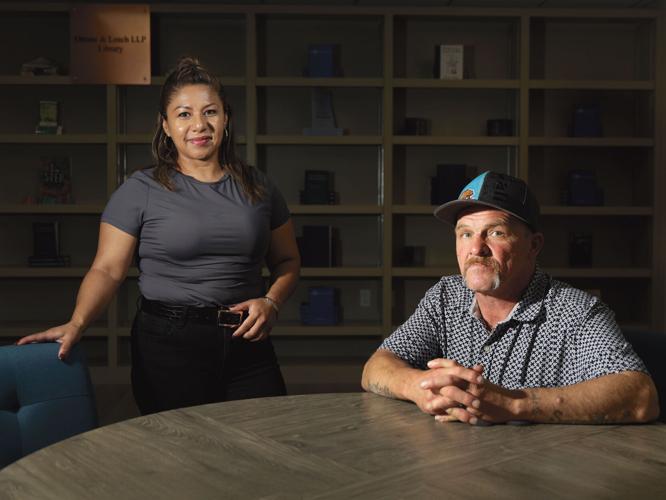
George Myers, right, with his case manager, Fatima Torres, at Sun Street Centers. “The structure here is awesome,” Myers says. “They have been through it, they are not by a book. It makes us feel like we can do it. They make you feel really comfortable - I feel loved.”
TORRES’ PATH TO CHANGING HER LIFE happened through referrals, the old-fashioned way. It started after multiple DUIs and prison time, when she confided in a colleague that she was having a tough time and experiencing anxiety; the colleague suggested she go to Sun Street Centers. That set her on a path from one helpful service to another helpful service, and Torres followed up on each step. She went to Planned Parenthood Mar Monte for a medical appointment, and a standard questionnaire revealed she was a survivor of domestic violence.
“I disclosed a lot of things,” she says. “It was like opening a pandora’s box of options.”
They referred her to another nonprofit, YWCA Monterey County, where she got assistance filing for a restraining order. She got help renewing documents related to her immigration status. She got help securing custody of her daughter. Counseling helped her reframe who she was and discover confidence in herself.
And she’s still getting help; through the California Department of Rehabilitation, she’s getting a laptop and support toward a bachelor’s degree. Torres is bilingual (her other language is Spanish – “I speak it, I read it, I dance it”) and she intends to pursue a degree in interpretation.
Torres navigated her way through the analogue referral system starting in 2019, following through on one agency’s suggestion to go to another then another. It took her out of a period of what she describes as hiding to the present in which she is thriving.
“If I would’ve known there was something like [the Smart Referral Network], just imagine what could’ve been,” she says. “It could’ve saved me time. But maybe I had to go through that journey myself to know that was the case.”
That awareness makes Torres a big user of and advocate for the Smart Referral Network. She meets a client like Myers and clicks through all of the services that might be relevant. He may be eligible for housing assistance but unlikely to follow up himself. A client may need legal aid, but never pursue it on their own. If they consent for Torres to share their information, she can do so with a simple computer interface. She says it’s more efficient than word-of-mouth, and it works better – the burden is on the agency, not the client, to follow up.
Myers got referrals for dental work at Pearl Dentistry; discounted bus passes from MST; mental health counseling; housing; and educational assistance at the Department of Rehabilitation, which he will use toward his truck driver’s license goal.
Myers got connected to his plumbing job through word of mouth, but Torres has found referrals to the Salvation Army useful for clients who don’t see a path into the workforce and need résumé help.
“They were really surprised that they put together something so professional based on scratch paper,” she says. “It was a big deal.”
A TECHNOLOGY-BASED REFERRAL NETWORK that includes sophisticated privacy and cybersecurity features to protect sensitive client data is, of course, a business, and business is competitive. Increasingly, for-profit companies are getting into the space. The Smart Referral Network is licensed for a fee to United Ways in two other counties now, but they may develop their own similar systems.
Even if it’s not the Smart Referral Network developed locally that takes off, it is providing a template for a social service providers everywhere across the country. “It could become a national model,” McCann says. “Monterey County may be leading the charge for the whole country.”
But even locally, there are challenges. The Smart Referral Network works best when there is widespread adoption. Madfis says CCAH backing out to develop its own equivalent tool was a big setback.
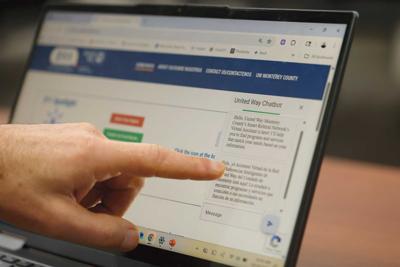
(In a statement, CCAH Chief Technology Officer Cecil Newton says, “We remain committed to supporting Monterey County residents by connecting them to vital resources that promote healthier lives and welcome continued collaboration with United Way that serve to meet our members’ needs.” The group also contributed a $50,000 grant toward developing a chatbot component to the Smart Referral Network.)
And while part of the benefit is that it allows service providers to “close the loop” and monitor whether follow-up happened, clients may still decline services. At least this technology enables a case worker to monitor that another agency followed up. Still, the rate of closed-loop referrals is just 51 percent, according to United Way’s data.
At nonprofit Community Human Services, which operates shelters Casa de Noche Buena in Seaside and Shuman Hearthouse in Monterey, Evangelina Ochoa says the tool helps case managers verify that other agencies followed up with a client. “Picking up the phone, we don’t see the end result,” she says. “We don’t know if they made that connection.” (CHS case managers routinely refer clients to Monterey County Office of Education, Central Coast Center for Independent Living and Valley Health Associates, among others.)
Even if the Smart Referral Network or similar tools do become the norm, with more agencies opting in and a higher closed-loop rate, Madfis is under no illusions that such a tool can fix all of the root causes and bring prosperity to all – the underlying societal issues these organizations are addressing remain.
“Most jobs don’t pay enough,” Madfis says, noting Monterey County’s leading industries in agriculture and hospitality. “Until we have a more robust economy, we are just stacking chairs on the Titanic.”
McCann, a Brit, has lived in the U.S. for 27 years and still finds the scale of homelessness shocking. “Why has America got 1,000 billionaires and 700,000 homeless people? That is a moral crime. Every one of us should wake up every day, look in the mirror and feel ashamed,” he says. “I am in this because I hate homelessness. It is a moral crime. I want to solve this.”
A technological portal might not end homelessness, but it does create accountability among agencies aiming to solve it. And it surely does something for someone – the story of George Myers may end differently because he decided to walk in the door of Sun Street Centers and then got connected to much more.
“I am tired of being incarcerated,” he says. “I am sick and tired of being sick all the time.”
He is set to graduate on Nov. 21, then hopes to land a spot in Sun Street’s sober living housing while he remains on the Section 8 waitlist. One resource opens up another resource, as it did for Torres, now Myers’ case manager.
“It’s a domino effect, how things happen,” Torres says. “You never know who you are going to encounter. If those resources would not have been there for me, I would never be where I’m at.”
(1) comment
Where are services for people that aren’t drug addicts, have a job, paying for housing, a cell phone, paying water and utilities, buying their own food but then they are let go from their employment? They’ve applied for new jobs but nothing has come through and now need financial help to not end up homeless and on the street with a wife and two kids. They’ve applied have no family to help. What does one do? It seems best to become a drug addict then one becomes eligible for free services to get back on their feet. How is the aforementioned person able to receive services?
Welcome to the discussion.
Log In
Keep it Clean. Please avoid obscene, vulgar, lewd, racist or sexually-oriented language.
PLEASE TURN OFF YOUR CAPS LOCK.
Don't Threaten. Threats of harming another person will not be tolerated.
Be Truthful. Don't knowingly lie about anyone or anything.
Be Nice. No racism, sexism or any sort of -ism that is degrading to another person.
Be Proactive. Use the 'Report' link on each comment to let us know of abusive posts.
Share with Us. We'd love to hear eyewitness accounts, the history behind an article.