

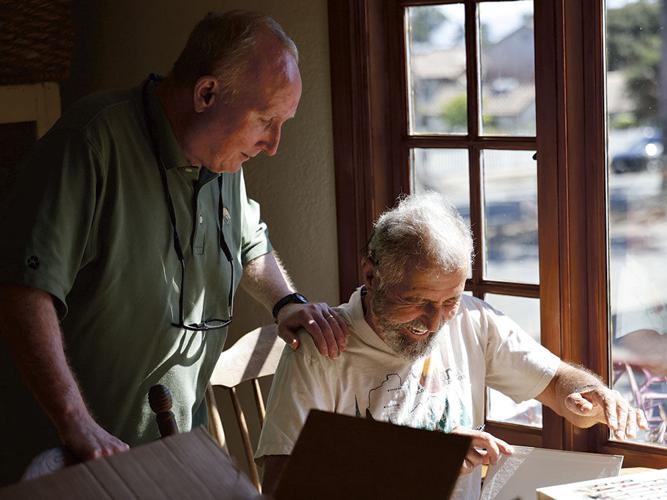


CHANGIZ LAHIDJI AND STEVE MCCULLOUGH GREW UP ON OPPOSITE SIDES OF THE PLANET – Lahidji in Iran, McCullough in Los Angeles County. Lahidji was raised in the Zoroastrian faith, McCullough is the son of a Baptist minister. Lahidji is always happy and laughs easily, McCullough is more serious. An entire generation separates them – Lahidji is 74, McCullough 54.
They have two very important aspects in common: Both are retired U.S. Army soldiers who went through similar training and fought in similar regions and both share a love of all people.

Changiz Lahidji in his Pacific Grove home, where the walls are filled with memories and accolades from his 24 years in U.S. Army Special Forces and 12 years as a military contractor. He retired as a master sergeant.
Each has survived perilous battle situations – Lahidji as a Green Beret in on Special Forces A-Teams in the 1980s and 1990s and then as a military contractor, McCullough as a rapid deployment combat engineer after graduating from West Point in 1992 until he was nearly killed in a bomb blast in 2002, leaving him permanently disabled and suffering from traumatic brain injury and severe post-traumatic stress disorder.
It was a chance meeting at the Ord Community Commissary in Seaside earlier this year that brought the two Pacific Grove residents together, when Lahidji suggested McCullough read his 2018 autobiography, Full Battle Rattle, written with author Ralph Pezzullo, detailing Lahidji’s childhood in Iran, his 24 years in the U.S. Army Special Forces and 12 years as a military contractor.
McCullough listened to the audiobook immediately after the meeting, amazed that they had attended the same Army schools and fought in some of the same hot spots.
“We’ve been running around, getting into trouble ever since we met,” McCullough says. “We call each other blood brothers.”
The brothers are now on a new mission, to bring more awareness to Lahidji’s autobiography and find someone willing to make a documentary about his extensive combat career, as well as to spread the word that immigrants like Lahidji are a vital part of the fabric that makes the U.S. strong.
The mission is important, but maybe more important is the friendship that bolsters the two men as they face challenges. McCullough has taken on the role of protector and champion for Lahidji. Lahidji helps bring some peace and joy to McCullough’s challenging life as a disabled veteran.
“He’s a very happy man,” McCullough says of his friend. “He’s seen it all and done it all, and unfortunately my head was injured in such a way that I don’t get much dopamine or serotonin, so I rarely smile – except when I’m around my wife and daughters.”
Several minutes later, as McCullough continues talking about Lahidji and his accomplishments, the corners of his mouth start to curl up – he’s smiling.
“That’s what he does,” McCullough says. “That’s the impact he has, right there.”
CHANGIZ LAHIDJI’S (PRONOUNCED CHANG-GEEZ LA-HEED-GEE) IMPROBABLE STORY IS A SERIES OF SUPERLATIVES. “You’re looking at the only person on the Earth that spent time in the Iranian Special Forces and 24 years in the [U.S.] Special Forces A-Team,” McCullough marvels.
Lahidji writes in his 2018 book that he served on U.S. Special Forces A-Teams longer than anyone else in history, 24 years total. He went on to serve 12 more as a private contractor, completing over 100 combat missions in Afghanistan. He was wounded multiple times on the battlefield and while training.
“It’s just an impossible story,” McCullough says. He likens Lahidji to Audie Murphy, the most decorated combat soldier of World War II, who participated in major offensives against the Germans. Like Murphy, Lahidji served in numerous major U.S. military events, including the Iranian hostage crisis, U.S. Embassy bombing in Beirut, 1983 U.S. invasion of Grenada, first Gulf War and Black Hawk Down (the Battle of Mogadishu).
Lahidji grew up in Iran, one of six children. His parents followed the teachings of the Prophet Zoraster, and he was taught Zoroastrianism’s main tenets, humata, hukta, huvarshta: good thoughts, good words, good deeds.
He says his family was “nominally Muslim” and never went to mosque. (In the book he’s labeled as “the first Muslim Green Beret” – Lahidji indicates it was the publisher’s idea – but says he doesn’t consider himself to be Muslim and is quick to point out that Persians didn’t become Muslims until the Arabs invaded in the 7th century.)
As a young boy, Lahidji dreamed of moving to the U.S., inspired by Hollywood movies. John Wayne was his hero and he loved Wayne’s Westerns like The Searchers and Rio Bravo, “and of course The Green Berets,” he recounts in the book.
Leaving Iran would not be that simple, however. At 18, he learned he would have to serve in the Iranian military before receiving permission to leave the country. He enlisted and went on to become a member of the Iranian Special Forces, serving three-and-a half-years. Afterward he worked in a record factory, saving up enough money to move to the States. He left Iran in 1974.
Lahidji’s uncle and brother were already living in the U.S., working as owners of gas stations, one in Santa Clara and the other in San Jose. Lahidji worked for $2.50 an hour, riding a bike between stations. At night, he took classes at San Jose City College and West Valley College. Eventually he got a green card and his uncle helped him get his own gas station in Palo Alto. (Oil companies were giving stations away to anyone who could pony up $2,500 for the first tanker delivery.)
Business wasn’t for Lahidji. He sold the station in 1977 and walked straight into an Army-Navy-Marines recruitment office with the goal of becoming a Green Beret or Army Ranger.
There were no positions open at the time, a recruiter told him, so he joined as a medic. Before long he was in Airborne School. During the last week of training he sprained his ankle on a jump from a tower, didn’t tell anyone, and went right into jumping out of planes.
On the last day, after the last jump called the “Hollywood” jump, he was limping badly and could barely stand at attention.
“The captain in charge of Airborne School stopped in front of me and slammed a pair of brass wings into my chest. The pin stung like hell,” Lahidji recounts in the book.
“I shouted, ‘Airborne!’
I was an Army Ranger.”

McCullough looks on as Lahidji signs copies of Full Battle Rattle.
MEDIC TRAINING WAS DIFFICULT FOR LAHIDJI, who struggled with learning medical terms while still improving his English. He also had not let go of his dream of becoming a Green Beret. Eventually he was able to transfer to infantry and in 1979 he graduated from Special Forces training – one of only 35 men who graduated out of an initial 275.
“The pride I felt in reaching my goal of becoming a Green Beret – the first Iranian and Muslim Green Beret in history – was enormous,” Lahidji writes in the book. Three months later, he was training for what would be his first mission, gathering intelligence for rescuing more than 50 hostages inside the U.S. Embassy in Iran, during what came to be known as the Iran Hostage Crisis (see excerpt, p. 22).
After enduring hateful slurs and physical beatings from fellow soldiers who equated Lahidji with the Iranian extremists who had kidnapped the hostages, he was determined to show them that he was an American who loved his country and loved his comrades, even those who berated him. He wanted to prove that he was one of them.
With help from a friend, he wrote a letter to then-President Jimmy Carter asking to be sent to Iran to assist in freeing the hostages.
“Please give me permission to choose an A-Team and deploy to Iran to free the American hostages,” he wrote to the president. “I know the area well, and used to play soccer at the stadium across the street from the U.S. Embassy. With your approval and support, I am sure I can come up with a plan that will succeed. Please don’t say no.”
Months later, Lahidji was on a flight to Tehran, under the guise of visiting family – he packed decoy gifts of polo shirts, blue jeans and boxes of See’s candy. He carefully gathered intel but unfortunately, Operation Eagle Claw, as it was called, encountered multiple challenges and was aborted by Carter, upon advice of field commanders. Lahidji was left to find a way out of Iran safely, with only his wits to help him. It was a perilous journey, but he made it out and back to Fort Bragg, to the astonishment of the other members of his unit. They thought he had died.
“Changiz, you’ve proved you are one of us,” he remembers one of the soldiers saying.
The comment was bittersweet.
IN A FULL-CIRCLE MOMENT IN 2004, Lahidji was working as a contractor in Darfur, Sudan, when he was asked to drive a delegation of dignitaries on an U.N. mission. The dignitaries were Carter, Archbishop Desmond Tutu and Nelson Mandela’s wife, Graça Machel.
In the book he recalls the conversation he had with the former president: “‘You probably don’t remember, but during the early days of the Iran Hostage Crisis, I wrote you a letter offering to volunteer to go into Tehran.’
“[Carter] frowned. ‘I’m sorry that didn’t go well, Changiz.’
“‘No need to apologize, Mr. President. Not to me. The important thing is that the hostages returned home alive.’
“‘Eventually, yes,’” was Carter’s reply.
A photo of Lahidji posing with Carter in Darfur hangs inside his Pacific Grove home, alongside dozens of other pieces of memorabilia from his long military career.
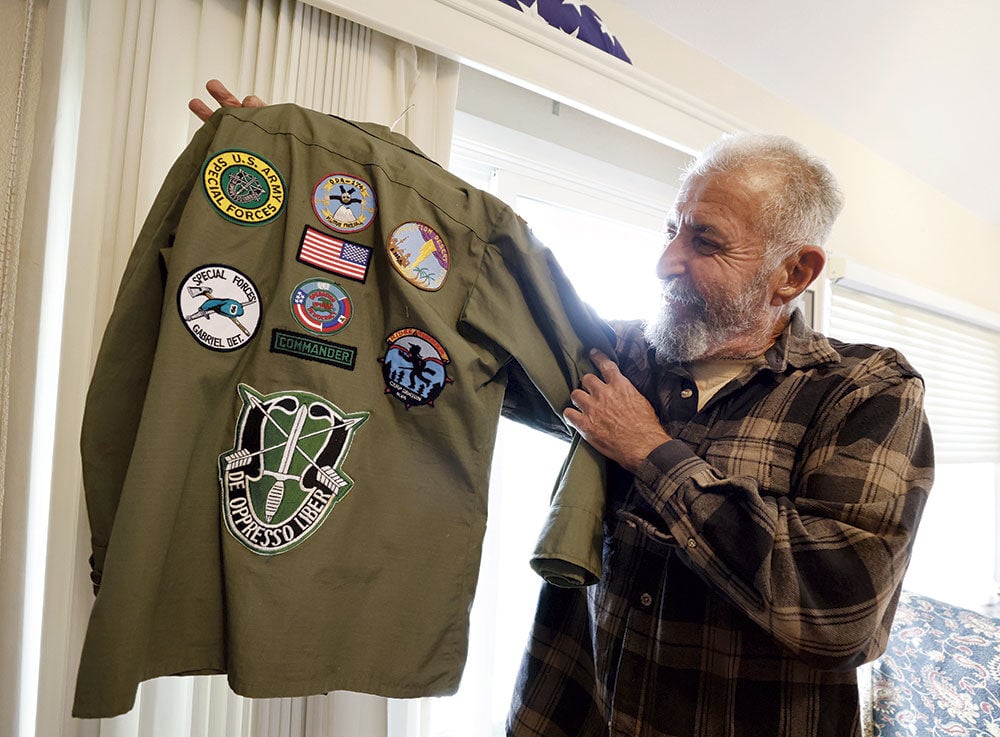
Lahidji shows off a jacket with military patches collected during his career. It’s just one of dozens of items he’s saved from his time in the Army and as a military contractor overseas.
AS LAHIDJI WAS OFF TO TEHRAN on his first secret mission as a Green Beret in 1980, McCullough was a 10-year-old kid growing up in Claremont, 32 miles east of Los Angeles. Like Lahidji, McCullough’s parents taught him to love all people. They initially lived in Carson in a mostly-Black neighborhood. He remembers there was a Black family down the street with the same last name.
“The Black McCulloughs would ride by and yell, ‘Hi, white McCulloughs!’ And we’d yell, ‘Hi, Black McCulloughs!,” he recalls.
In Claremont, they lived on a diverse cul-de-sac, where there were frequent street parties, dinners and potlucks. “None of this divisiveness,” he says. (He prefers to focus on the similarities he and Lahidji share – their military careers, of course, but more so their love of all people.)
McCullough describes himself as an ambitious high school student, excelling in his classes and playing “every sport you can think of.”
When he was 15, McCullough says he was pinpointed by the U.S. Military Academy West Point with a packet of information about the prestigious school. He was inspired by the call of “duty, honor, country,” and how his family lost many members in World War II. He wanted to defend the country.
“I said, ‘I’m going there.’ So right when I turned 16 I went through the process of getting authorized by my congressman,” McCullough says. He applied nowhere else. He had to meet with a committee for an interview, but he had no nice clothes – he wore his father’s shoes with socks stuffed into the toe boxes so they’d fit.
He remembers being a cocky teen who lost that cockiness soon after arriving to West Point. “They take that away, right away,” McCullough says. The academy was tough and there was little sleep, he says, but he remembers finding ways to have some mischievous fun even if it meant getting punished later. He graduated with a degree in systems engineering.
Those four years made the training he received in the Army, through Sapper Leader Course (elite combat engineer training), Ranger School, Airborne School, Air Assault School and Mountain Warfare School, relatively easy, McCullough says. He later went on to earn two master’s degrees in different areas of engineering, taking classes at night.
As a combat engineer, McCullough was deployed to various locations including South Korea and throughout the Middle East, moving 12 times over the years. One day while at a patrol base in the desert with his platoon awaiting the next mission, he received a call on a satellite phone, one used only for emergencies, only to learn there was no emergency – the Army wanted him to come to West Point to teach, not engineering, but psychology. “That’s just the Army,” McCullough says.
He had to get a degree first, so he chose the University of Washington since his wife, Julie McCullough, was working in Seattle at the time. He says he had done all the work toward the degree except his dissertation, when the Army called assigning him a new mission in the Middle East during the “global war on terror,” post-9/11.
It was a call that changed the trajectory of McCullough’s life.
He is not allowed to talk about the mission, other than to say he was severely wounded by explosives. He’s had 30 surgeries since. With his physical disabilities and PTSD, he spends most of his days in bed. He has issues with hearing and lost his ability to read and has recurring seizures. He’s assisted by a sweet service dog, Fergus, originally trained to help people with autism connect with other people, a quality McCullough needs so he doesn’t isolate, he says.
McCullough tried to go back to teaching after his initial recovery, but the brain injuries he suffered made it difficult. He came to Pacific Grove in 2005 with his wife and two daughters while still serving the in Army. He finally retired as a decorated major in 2010. That same year, McCullough was named “Veteran of the Year” in Monterey County.
LAHIDJI SPIED MCCULLOUGH AND FERGUS in the commissary one day and felt motivated to talk to a fellow veteran who looked like he needed help.
“That’s who I am, I love people. I always laugh, even if a guy or a woman doesn’t like me, I don’t care,” Lahidji says, with a wave of his arm. He introduced himself and the two talked for a bit. Lahidji asked McCullough if he’d be interested in reading his book, Full Battle Rattle, and gave McCullough his phone number. (The title refers to the combat gear a soldier carries into battle.)
McCullough says following along on audiobooks has been a struggle for him, but Lahidji’s book was different. “I just couldn’t stop,” he says. “I think it was a day-and-a-half later [that] I called him, and I go, ‘Dude, lunch.’ Next thing you know we’re hanging out all the time.”
Despite McCullough’s disabilities, which often leave him unable to complete tasks, he became energized by wanting to help Lahidji in the face of discriminatory practices – McCullough complained up the chain of command of a bank after a local branch refused to cash a check for Lahidji, for example. Believing Lahidji had been unfairly treated in his book deal, McCullough helped him end his contract with the publisher and retain the rights to his book.
“I have to sleep a lot, but I have time,” McCullough says. “And when I get into a helping mode – that I can do lying down 18 hours a day.”
Lahidji says that at first, he didn’t think McCullough could help him, but “I could tell as he was talking to me he was talking from his inside, his heart,” Lahidji says. “He is helping me try to expose my life to the people so they know what I did and we can do. I’m very pleased. I guess God put him in my way.”
“Working with Changiz has been a real blessing,” McCullough says. “It’s been a mutually beneficial relationship on the whole.”
As advice for young people, Lahidji offers that there are some things more important than chasing money.
“Don’t ask too much, do what you can do for yourself and your country. Money is good, don’t get me wrong, but invest in honesty and friendship,” he says.
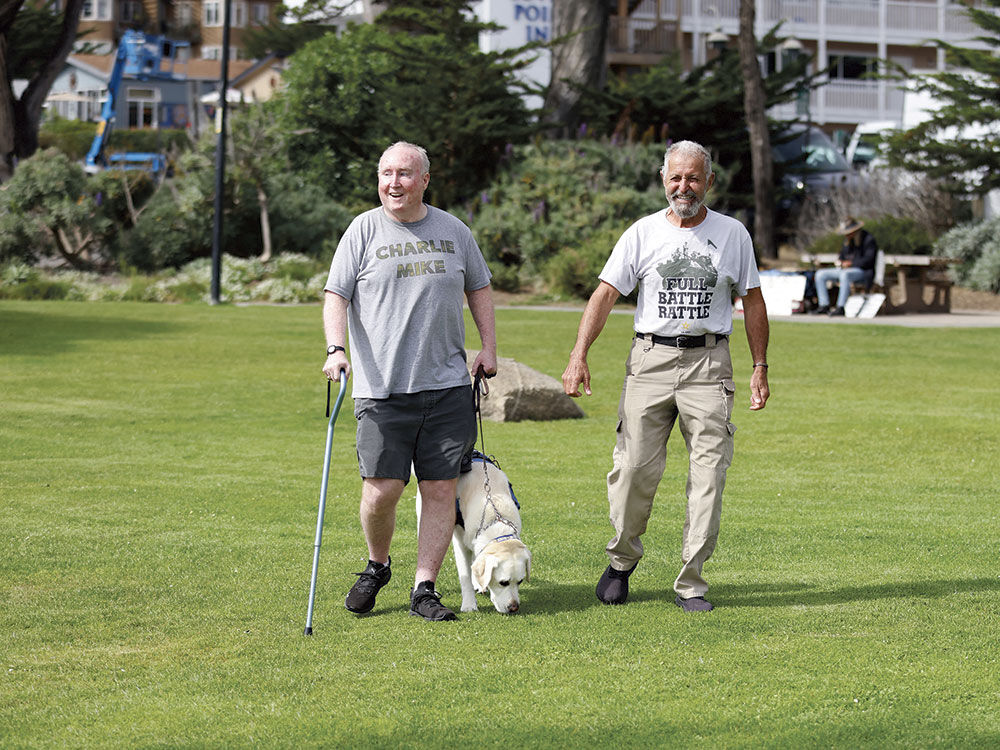
Top: McCullough (left) says a traumatic brain injury has inhibited his ability to produce dopamine and serotonin, so he rarely smiles except around his wife and daughters, and now occasionally when hanging out with his new friend and fellow veteran, Lahidji.
PART OF WHAT MOTIVATES MCCULLOUGH is his anger over the racism Lahidji has been the target of, both during his military career and in civilian life, some overt, some subtle.
Lahidji shrugs when asked about the racism he’s encountered and in his ever-jovial manner says that when it happens he smiles and says, “Come on, I’ll buy you a beer, don’t worry about it. Let’s go talk about it.”
“People get away with treating him poorly,” McCullough says. “People need to know that he exists, they need to know the things he has done, and the fact that he’s an immigrant.” The two men believe that vetted immigrants are a valuable asset to the U.S.
Lahidji, who calls himself an “American by heart,” has his own personal message for the Republican presidential nominee: “I want to say to Mr. Trump, not all immigrants are bad. We [helped] build this country, regardless of white, blue, yellow, black – I don’t care. To me, God said, don’t beg [for] anything – do, work and help people and help your comrade and be honest.”
Recently they ordered 100 copies of Full Battle Rattle for Lahidji to sign in both English and Farsi. Some of the proceeds from sales will go to the Wounded Warrior Project. (“I owe them my life,” McCullough says.)
The signed copies are currently for sale locally at River House Books and Bookworks, as well as on eBay. Ultimately, Lahidji and McCullough hope the book falls into the hands of someone who will carry Lahidji’s unique immigrant story to wider release as a documentary.
McCullough can’t get out very much due to his disabilities, but since meeting Lahidji he makes a point of going out during the week with Fergus to join his friend on walks, to share stories, make plans and mostly, to invest in their new friendship.
(0) comments
Welcome to the discussion.
Log In
Keep it Clean. Please avoid obscene, vulgar, lewd, racist or sexually-oriented language.
PLEASE TURN OFF YOUR CAPS LOCK.
Don't Threaten. Threats of harming another person will not be tolerated.
Be Truthful. Don't knowingly lie about anyone or anything.
Be Nice. No racism, sexism or any sort of -ism that is degrading to another person.
Be Proactive. Use the 'Report' link on each comment to let us know of abusive posts.
Share with Us. We'd love to hear eyewitness accounts, the history behind an article.