


There’s an hour before security arrives to kick us out of a trashed hotel room on the Las Vegas strip. The only door is locked shut from the outside, and the room key is nowhere to be found. We reach into pillowcases and poke at bubbles in the wallpaper, anywhere there might be a hidden key. Dresser drawers and suitcases under the bed where the key might be all have combination locks.
A television set on a dresser plays The Hangover, and we wonder if some scene or line of dialogue from the comedy might point to a solution, but we’re too fixated on finding clues – fast – to pay attention.
There are keys for locks in some obvious places, like one taped to the back of a “Do Not Disturb” sign. As we search, a digital timer counts down the minutes before security busts in and we’re doomed.
That’s the premise of this game: Working together, our team has 60 minutes to get out – to escape a room – hence the name of the business. The avenues for escape are produced by solving puzzles, answering trivia questions and cracking number combinations.
My friend Moises Calvillo, part of our escape team, stops fiddling with a combination lock that’s frustrating him early in our attempt and suggests some strategy: Redeem one of the three clues from the game master.
“We should ask for help if we don’t have a big breakthrough after 30 minutes,” he says. “Otherwise, I don’t think we’ll get out of here.”
Half an hour later, Calvillo’s suggestion seems prophetic. With just 25 minutes to go, we have just two locked drawers open – and that’s because one of those locks was mistakenly left ajar after a previous game.
By now, our group’s friendly spirit has faded away. Instead, there are heated arguments – one increasingly impatient friend wants to rip up the bed and another’s shouting that’s not in the rules, while I keep turning over things I’ve turned over 10 times already.
Our group decides it’s time for some guidance, and a friend rings the bell beside the timer.
Dennis Zmijewski, one of two game masters at soon-to-be-open Escape Room Salinas, breaks the fourth wall of our theatrical escape mission: He enters the room, his eyes on an iPad that displays directions to complete the game.
Zmijewski gives a hint – “look in the mirror,” he says, in part – revealing something potentially helpful that was staring at us the whole time.

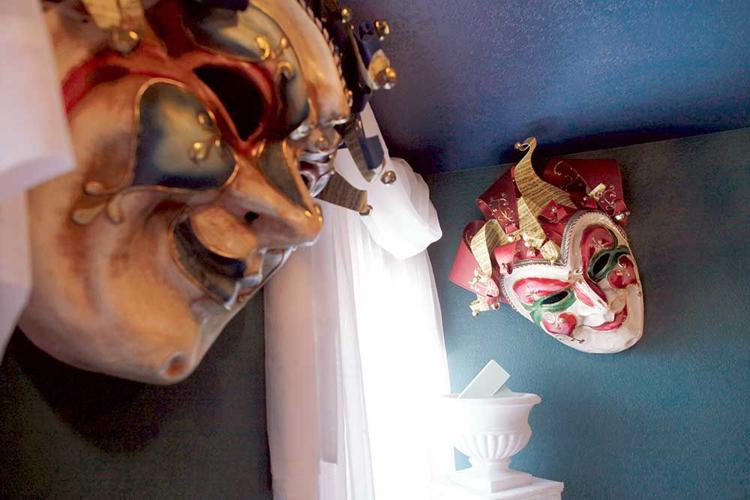
Mounted masks at Exodus Monterey in the Masquerade Manor room;
That neither I nor anyone in my group has noticed it makes me doubt our critical thinking skills.
But in the escape room, it turns out, it’s part of the fun to find out that you’re not as in control – or as clever – as you think you are.
•~•
The origin of escape rooms can be rooted to point-and-click computer games of the 1980s, such as Planet Mephius, which played like a choose-your-own adventure novel. Crimson Room, another innovative Japanese game released in 2004, further propelled the escape room genre with new depth and detail, but was still a single-player computer game. The 2007 opening in Tokyo of Real Escape Game, which proclaims itself as the pioneer of “the original live-action Escape Game” on its website, indicated that the escape game format would find success in the real world. Like the video games, players had to solve puzzles in order to escape and win, but the live-action version allows for fun interactions impossible to experience in the isolation of chair in front of a computer.
Much like the recent gaming craze of Pokemon Go, escape rooms were suddenly spreading across the world. Major franchises have been founded throughout Asia and Europe, most notably in Singapore and Hungary. Real Escape Game opened the first official escape room in the United States with the addition of its San Francisco location in 2012, and since then the trend has firmly established itself as part of the mainstream entertainment diet.
This year’s South by Southwest festival in Austin, Texas featured escape room installations as interactive advertisements that put players in the worlds of Star Wars: Rogue One, Prison Break andGame of Thrones. President Barack Obama and his family famously visited Breakout Waikiki, an escape room in Honolulu, during his second term. (They escaped with 12 seconds to spare.) While escape rooms were a virtual unknown in the United States a decade ago, there are now an estimated 1,500 across the country.

At the annual EG Conference in Carmel this spring, virtual reality pioneer Brent Bushnell stood on stage and confessed …
And now, with the launch of two new spots opening in Salinas and Monterey this summer, Monterey County is learning it cannot escape the escape-room craze either.
Monica Berriz, who owns Perfectly Pressed Juice Bar and now Escape Room Salinas, became an escape enthusiast because she saw how it encouraged communication and cooperation.
“You have to work as a team to win,” Berriz says. “Whether you escape or not, the joy is in the experience of working together.”
Her success with the juice chain and experience with an escape room in San Diego planted the entrepreneurial seed for Berriz.
“It was the perfect platform to bond with my family,” she says. “People get home and they’re so segregated on their cellphones. But with escape rooms you have to interact with each other and laugh along the way, or else it won’t work.”
She started doing her homework, visiting 15 of them throughout the U.S. with her husband and business partner, Luis Ocon of Ocon Family Chiropractic. Now her daughter, Ari Lysacek, and Lysacek’s boyfriend, Zmijewski, manage the day-to-day operation of Escape Room Salinas, which opens this week.
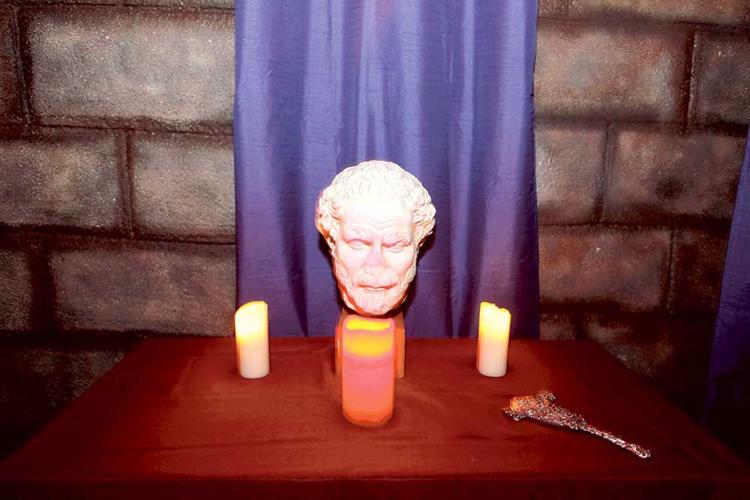
They also recruited AJ Hughes, owner of Escape Room Tucson, to consult on fundamentals such as game flow and themes for the six rooms. There’s the minimalist room called The Mysteries meant for couples, The Hangover-inspired hotel room, the otherworldly Area 51 lab with an alien body lying on a table and a creepy lair that serves as the setting for The Council’s Judgment.

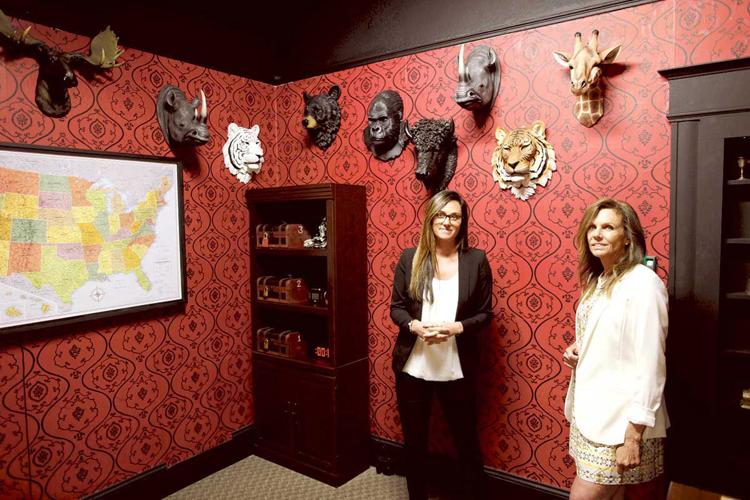
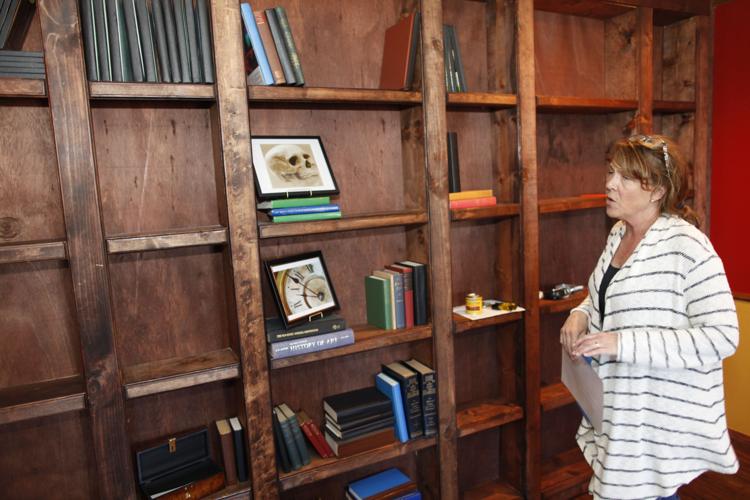
Christina Riddoch, co-owner of Exodus, in Sherlock’s Study.
For Barrie and Christina Riddoch, putting an escape room near tourist-dense Cannery Row was an easy decision to make. The husband-and-wife team co-owns Exodus Monterey on Wave Street near where Christina formerly owned and operated several other businesses.
Their new endeavor opened Aug. 2.
At Exodus Monterey the rooms are based on concepts that have proven successful in other locations around the country. Sherlock’s Study, for example, includes a detective’s hat on a coat rack and old books stacked on floor-to-ceiling shelves. The Masquerade Manor room has large masks from what could be a Mardi Gras parade mounted on the wall and crystal lights on the ceilings.
In other words, this is not something that happens on a screen. It’s all real.
“People don’t just want to buy stuff anymore,” Barrie says. “They want to make memories.”
•~•
A closet-sized room that’s off-limits – and invisible – to players serves as the gamemaster’s control center at the Exodus Room. There’s a television that streams footage from cameras in each space so the gamemaster can see where players get stuck. A cart holds one laptop for each escape room concept, allowing gamemasters to dispense hints and trivia (to earn clues) as needed.
Chad McLain is the CEO of Exodus, and the Riddoches’ business partner. McLain opened the first Exodus in 2014 in Anaheim, and the Monterey location will be his sixth.
He is confident the trend is very much on the up.
“I’d say it was the opportunity to unplug and be in the game that attracts people,” McLain says. “Sprinkle on top the fact that it spread like wildfire on social media, and there you go.”
This desire of consumers to “unplug” seems inconsistent with the ongoing, and meteoric, rise of virtual reality. (See story below)
McLain thinks they can and should coexists. He compares the two booming entertainment trends to, say, the video game Mario Kart and actual go-kart racing. “There will be those who choose virtual reality, those who choose escape rooms, and a cross-over market that chooses both,” McLain says.
Dr. Krzysztof Pietroszek is director of the Game Research Lab at CSU Monterey Bay, where students and faculty focus on researching human-computer interaction, robotics and computer graphics – new-fangled elements of gaming.
That said, some of the projects that Pietroszek and his students are working on are less oriented toward entertainment. One project, UniVRsity, aims to deliver the college experience to students in areas where universities are unavailable or unreliable; professors give their lectures to a virtual classroom of students who appear as digital avatars. “This is useful for kids living in refugee camps, or students in remote areas who cannot afford to move or pay tuition,” Pietroszek says. “The system also allows people with severe motor disabilities to participate in class.”
Working with the Graduate School of Medicine at Kyoto University, faculty and students are designing a smartphone-based surgery simulator that’s meant to deliver virtual reality medical training to developing countries.
Pietroszek pictures a future where VR will find its way into all aspects of life, but he also sees the need for people to retain some humanity – which they can do through challenges like escape rooms.

Detail inside The Council’s Judgement Room, the biggest room in Escape Room Salinas;
“Computers and mobile devices do separate us from fellow humans,” Pietroszek says. “While people do create social connections online, the majority of this connection is superficial and not comparable to connections we may have with a real friend.”
Still, Pietroszek thinks less digital entertainment like Exodus will have trouble keeping up with virtual reality platforms: “Escape rooms are what live theater, cinema or paper books are slowly becoming – a wonderful, yet niche form of entertainment,” he says. “Mainstream entertainment will be dominated by virtual reality and augmented reality.”
•~•
Back in The Hangover room of Escape Room Salinas, the digital timer shows we have 10 minutes to go. The chances of escape seem small. There are still two locked drawers, one of which must surely contain the literal key to our freedom. We’ve used up all three of the clues from our game master.
The timer on the dresser beeps with a 30-second warning. Some group members sigh. I’m more amazed than dismayed – I realize that for nearly an hour, I was so fully absorbed in this adventure that time has flown by.
A pair of pink fuzzy handcuffs dangle from my wrist. They provide a reminder of how desperate we’ve gotten: For a brief moment it seemed like putting them on could somehow help in our quest.
Zmijewski opens the room’s door and proceeds to let our group know where we went wrong. He points to numbers on corners of the mirror, then urges us to see the reflection that reveals more numbers on the corners of the wall behind us. He explains that both sets of numbers could and should have been arranged to form the shape of an arrow that illustrates the correct order of the numbers.
He opens the door that our group couldn’t unlock and lets us out. He leads us to the reception area where we pose in front of the Escape Room Salinas logo.
Some in our group hold up props like a fake mustache, a key and a small sign that reads “Almost” as Zmijewski snaps a photo of us for Facebook.
The photo posted to social media provides evidence we’re back in a world that’s always connected. We may not have escaped – or qualified for the scoreboard displaying fastest times – but we found an escape from the real world.
EXODUS MONTEREY is open Wed-Sun. 765 Wave St., Monterey. $20-30/person. 324-0513, exodusescaperoom.com/monterey.
(0) comments
Welcome to the discussion.
Log In
Keep it Clean. Please avoid obscene, vulgar, lewd, racist or sexually-oriented language.
PLEASE TURN OFF YOUR CAPS LOCK.
Don't Threaten. Threats of harming another person will not be tolerated.
Be Truthful. Don't knowingly lie about anyone or anything.
Be Nice. No racism, sexism or any sort of -ism that is degrading to another person.
Be Proactive. Use the 'Report' link on each comment to let us know of abusive posts.
Share with Us. We'd love to hear eyewitness accounts, the history behind an article.