

When it came to sniffing out quirky but potentially lucrative business opportunities, John Osborne had the nose of a sophisticated bloodhound.
There was an exclusive development agreement he struck in 2005 through his Bejjan Holding Corp. with Haynes Enterprise Inc., where company founder Bryan Haynes, a former special effects artist at film industry giant Industrial Light & Magic, had put together a team to develop ultra-thin and printable light and sound electronics. Bejjan wanted to take that technology and develop strategic marketing agreements with companies like Nike – putting lighted electronic messages on Nike-branded balloons, for example, and selling them at major sporting events.
What kid wouldn’t want a light-up balloon?
All Osborne needed to make the idea fly was capital.
He reached out to a business associate named Claude Wilson, a Marina resident like himself and a retired U.S. Army sergeant whose last posting after 20 years of service was at Fort Ord. Osborne showed Wilson the agreement for what was called the power-flex lighting system – an agreement bearing the signature of Haynes chairman James Schuler – and then he made Wilson a proposal: If Wilson invested the $250,000 Osborne needed, Osborne would give him a 50-percent stake in a marketing company they would form. The marketing company, meanwhile, would receive 50-percent net profit of any agreements it struck using Haynes’ technology
There was another quirky (albeit macabre) idea called The Selfie Doll project, and the paperwork Osborne showed to potential investors, including Wilson, was even more impressive than the lighting idea. The Selfie Doll, which Osborne trademarked in 2014, was a potential multi-million dollar business, according to Osborne’s detailed financial projections. The Selfie Doll would enable a parent whose child had died to have an image of the child’s face imprinted on a doll, which they could keep and display as a remembrance. Osborne formed a company around it: a large doll, complete with wi-fi capability, moving eyes and lips, a liquid-crystal display and the capability to play back audio recordings, would cost $153 to produce and sell for many times more than that.
Within three-and-a-half years, Osborne’s projections showed, Selfie Doll LLC would have debt-free net cash flow of $13 million a year.
In an agreement struck in 2018, Osborne assigned Wilson 50 percent of his 25-percent stake in Selfie Doll LLC. Wilson, meanwhile, was to receive $28,475 in capital reimbursement in a complicated deal that involved Osborne’s neighbor, George Gerena. The payment was to come from an escrow account Osborne had helped arrange for Gerena, who was in bad health and had granted Osborne power-of-attorney over his financial affairs; Gerena’s house, at 3059 Mildred Court in Marina, needed some work, so Osborne took out a loan on it.
Then came Nov. 19, 2020, slightly more than two years after Osborne gave Wilson part-ownership of The Selfie Doll company.
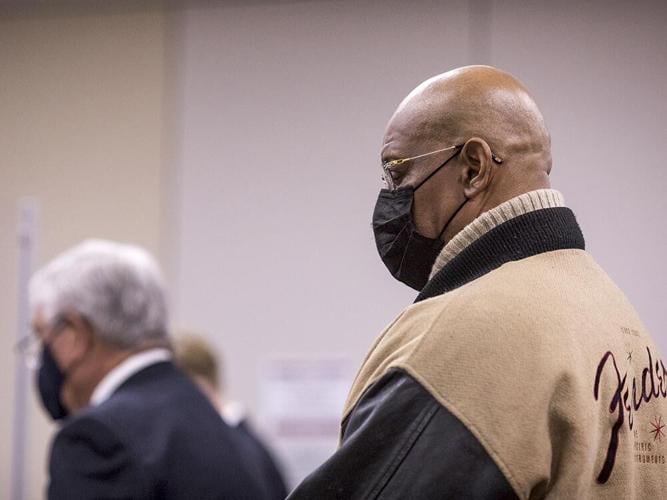
That day, Judge Julie Culver presided over arraignments in Monterey County Superior Court and Osborne appeared via video from the Monterey County Jail, with a bail set so high – owing to so many felony charges filed against him – that Osborne couldn’t post it. As the brief hearing came to a close, Culver warned him that he was to have no contact with Wilson or Gerena.
“No attempt to dissuade them from testifying, no communicating with them,” she said. “Any violation will get you into further trouble, do you understand that, sir?”
“Yes ma’am,” Osborne answered.
That agreement with the Industrial Light & Magic veteran to put superthin lights on cool marketing material? According to prosecutors, that was a fiction.
The Selfie Doll project, with its sophisticated financials and fat projections? According to prosecutors, that was mostly fiction as well – Osborne started registration of the LLC in Delaware in 2015, but never finished the paperwork; by 2016, Delaware canceled the application.
All of the business deals were fantasies, ones that mixed real technology (or the potential for it), with Osborne’s fertile imagination and his ability to sell the promise that, for a small investment, his investors could reap big rewards.
Haynes, the ILM veteran, had never heard of Osborne. Schuler, the chairman of Haynes’ company, hadn’t heard of Osborne either and hadn’t signed any agreement with Bejjan Holdings.
And Bejjan Holdings didn’t actually exist.
Fiction, fiction and fiction.
What is fact, though, is that the 84-year-old Wilson, the Army veteran who had saved almost $800,000 during his lifetime and should be enjoying retirement, has lost almost everything since he began investing in Osborne’s deals. Gerena, Osborne’s neighbor, is now under temporary court-ordered conservatorship because he has dementia and can’t care for his own needs. He’s already lost the home he inherited from his parents, the home next door to Osborne’s.
Osborne, meanwhile, has a lot to lose too.
If prosecutors can prove he ran an epic con game on both men, the 62-year-old is going to lose his freedom.

John Osborne in 2010 pitched an idea to the city of Marina to turn the former Fort Ord maintenance garage into a technology hub, including an airport security company whose technology would enable TSA agents to scan passengers more quickly. The building is now CSUMB housing.
IN THE 2016 BOOK The Misfit Economy: Lessons in Creativity From Pirates, Hackers, Gangsters and Other Informal Entrepreneurs, co-author Alexa Clay turns the idea of entrepreneurship on its ear, and seeks out what lessons can be learned from those who operate on the fringes and outside the bounds of legality. In an essay titled “How to Pitch Like a Con Artist,” she writes that “the art of the con involves thinking through other people’s motivations, needs and ambitions.” You need to hook your target with collateral (spreadsheets and projections to profitability, for example); ride the tails of someone else’s legitimacy by establishing a link to an already credible business (signed deals and marketing agreements, for example); and manage your reputation and craft an alter ego (put on a social mask, so to speak, in how you present yourself to the public).
Based on multiple cases and judgments in U.S. Bankruptcy Court, Osborne crafted more than one alter ego, international man of mystery style. In one instance, a man named Soroush Jaramanian was seeking repayment of a debt and was introduced to Osborne. According to records in the case, Osborne claimed he was a lawyer and CIA investigator, frequently worked with prosecutors and could assist Jaramanian in recovering the money.
Jaramanian paid him $50,000 to recover the $120,000 debt – but Osborne, after taking the payment, didn’t do anything to recover the money.
Then in 2016, Osborne filed for bankruptcy. Jaramanian’s attorney, David Trapp, moved to have the $50,000 Osborne owed Jaramanian declared “nondischargeable,” meaning that despite filing for bankruptcy, Osborne would still owe him. A judge agreed.
A bankruptcy judge in 2017 also agreed $116,000 that Osborne owed to a man named Vernon Adams was nondischargeable debt. In that instance, Adams in 2005 had invested in a company Osborne started called I Cubed. Osborne, according to court records, told Adams he was an attorney, that he had venture capital backing and that NASA had constructed a prototype of I Cubed’s product – a portable device that could instantly transcribe and store medical records. Adams invested $30,000, and only found out later that neither the company nor the device were real. He sued and won $70,000 in damages, plus his initial investment, plus interest.
Between those two cases alone, as of 2017, Osborne was in nearly $175,000 of debt that could not be discharged even through bankruptcy.
2017 is the same year, according to papers filed on Jan. 27, 2021 by the Monterey County Public Guardian’s Office, that Osborne obtained power of attorney from George Gerena and took the loan out on Gerena’s home on Mildred Court.
The loan went unpaid and the house was sold in foreclosure to a company called Breckenridge Property Fund 2016 LLC, which specializes in snapping up homes out of foreclosure. Breckenridge then sold the home to a company started by Wilson and Osborne, with Osborne negotiating the terms. The interest alone on the loan they took out is 9.75 percent, resulting in interest-only payments of $3,200 a month.
According to the District Attorney, the entire transaction was based on fraud. Gerena was allowed to remain in the home, but he had already been declared incompetent to handle his own affairs when the power of attorney was granted. According to the Public Guardian, Gerena, who has a type of dementia known as Wernicke-Korsakoff syndrome, doesn’t know what year it is, he doesn’t remember his parents are dead, he doesn’t remember having an adult son and he requires 24-hour care.
When the Public Guardian acted on an anonymous tip, and found Gerena in his home in December 2020, he was malnourished, had no food in the house and only $20 in his bank account.
Meanwhile, Osborne, who had sold his shares in the company he formed with Wilson, transferred the home back to Gerena without Wilson knowing it – three years after Osborne took a $200,000 certified check from the proceeds of the loan he took out on the property.
The District Attorney’s Office states that $200,000 was tied up in The Selfie Doll project. Gerena, who by then was in the throes of dementia, purportedly agreed to pay Osborne a total of $600,000 for a share in Selfie Doll LLC.
OSBORNE WAS ARRESTED NOT LONG AFTER HE TRANSFERRED THE MILDRED COURT PROPERTY BACK TO GERENA. On Jan. 20, the District Attorney filed an amended complaint with a slew of new charges – 14 counts of theft from a dependent adult; three counts of fraud in the offer, purchase or sale of securities; three counts of making untrue statements or omissions in the sale, purchase or offer of securities; two counts of forgery (one for the fake Schuler signature, one for the deed of trust on Gerena’s home); identity theft (for using Brian Haynes’ information); procuring and offering a false or forged document; and conspiracy.
The conspiracy charge happened while Osborne was in jail; according to the DA’s complaint, Osborne allegedly had an inmate at the Monterey County Jail named Victor Carrillo call Osborne’s son and tell him to archive Osborne’s email in the cloud, rendering it inaccessible to law enforcement. On a separate call recorded from the jail, Osborne and his son discussed deleting all of the emails entirely, according to the complaint.
After Osborne was able to prove to a judge’s satisfaction that his bail money didn’t come from the proceeds of any alleged crime, he was released from jail on Dec. 17, 2020 to await trial. In a separate action, he’s also facing a lawsuit brought by Wilson.
When a case is ongoing, few people connected to it are willing to speak about it. Marina Police Det. Rachel Maldonado declined to speak about the investigation. Osborne’s first attorney, Xavier Nady, did not respond to a voicemail or registered letter requesting comment.
Osborne, also reached via registered letter, initially said he wanted to speak about all of the confusion surrounding his case. On Feb. 8, he hired a new attorney, Shawn Mills, to represent him and Mills said nobody would comment for this story.
Wilson sued Osborne – and also named Gerena as a defendant in that case – over the purchase of the foreclosed home. According to Wilson’s attorney, Daniel Hollingsworth, they’re moving to reach an agreement with the Public Guardian’s Office, which is now in charge of Gerena’s affairs, and dismiss Gerena from the suit.
In his written response to Wilson’s lawsuit against him, Osborne, who is representing himself in that case, states as follows: “I John L. Osborne IV hereby categorically deny any and all references of impropriety regarding my 30-year relationship with plaintiff Mr. Wilson. The fact of this matter is that Wilson has been fully vested of intellectual property rights he has not paid for and has refused sale of said assets two times due to greed. Wilson and his associates are in direct violation of numerous loansharking and tax laws. I am looking forward to the opportunity of clearing my family’s name and to appear before your honor’s court to unveil the dishonesty and trust that has been betrayed due to plaintiff’s spouse’s discovery of his improprieties and attempt to shift blame and libel and slander defendant.”
Wilson, through his attorney (Hollingsworth), issued a written statement in response to a request for comment from the Weekly. “Osborne always told us the money would be repaid but that never happened,” Wilson writes. “We don’t have much faith that we will ever be able to get back what we lost. We just hope that it does not happen to anyone else and there will be some accountability for what he has done.”
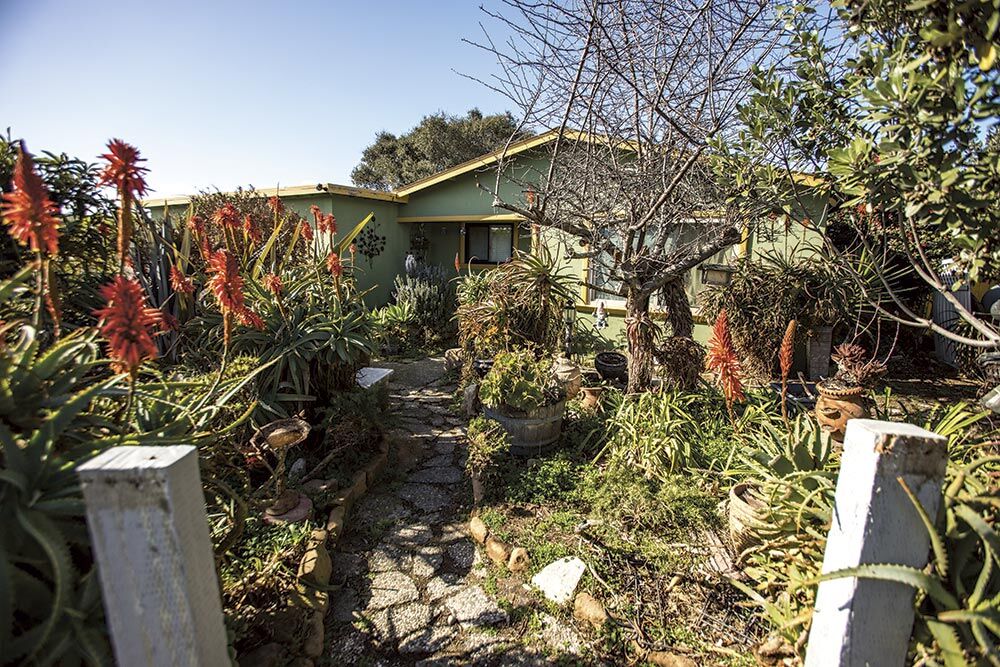
A view of Osborne’s home on Marina Court. A neighbor of Osborne’s is an alleged victim of a real estate fraud; George Gerena, who suffers from dementia and has been found not competent to handle his own affairs, gave Osborne power-of-attorney and subsequently lost his home to foreclosure. The county Public Guardian’s Office is working on a deal to get the house back.
THE CRIMINAL INVESTIGATION INTO OSBORNE CAME, at least in part, following the filing of the civil lawsuit against him on May 8, 2020. Marina detective Maldonado, Hollingsworth says, dug into the basics of the lawsuit and unraveled many of the details, starting just after Adult Protective Services reached out to the Marina PD on May 30, 2020, to say Wilson was likely a victim of financial elder abuse.
In papers filed in the criminal case, Maldonado writes that over the last 10 years, Wilson lent money to Osborne for numerous business proposals. Wilson “told the reporting party that he had lost about a million dollars,” she states. And Osborne’s wife told the police their bank account was nearly empty.
At least some of the money – $100,000 – reportedly went to pay for Osborne’s son’s tuition at Oxford University; Maldonado determined the son never attended Oxford and the $100,000 was never repaid. (Another neighbor, identified in the criminal complaint as 92-year-old Vernon Leischer, loaned Osborne $5,000 for Oxford tuition and was also never repaid.)
Wilson also gave Osborne $81,450 last March so he could make improvements to a home he said he owned at 1473 Luxton St., in Seaside, according to court records. Once the improvements were made, he would sell the property and pay Wilson back.
The only problem was, Osborne didn’t own 1473 Luxton St.
Wilson, Maldonado added, never knew that Gerena was completely dependent on Osborne.
Maldonado also confirmed with Haynes and Schuler they had no agreement with Osborne or Bejjan Holdings, and that Schuler hadn’t signed the agreement Osborne showed to prospective investors, including Wilson.
Describing his client, attorney Hollingsworth says: “He’s upset and angry that his family has lost the money.
“His current situation is that the suit is their last hope of getting any money back, but it might have already gone down the drain. I’m trying to fight to get some money back so they can live comfortably.”
Al Glover has known Claude Wilson for 40 years, dating back to when Glover was a brigade commander at Fort Ord. When Glover retired from the Army in 1976 as a colonel, he went into real estate development, building offices, apartments and subdivisions in Seaside. Wilson, who Glover describes as “a likable guy, and very friendly,” became part of his investment group, and stayed a member for about 15 years.
He sold his interests in Glover’s development team to go into another venture, about the time he met Osborne.
“I thought there was something wrong the first time I met Osborne,” the 89-year-old Glover says. “I’ve been in business for a long, long time, and I’ve been around guys in the pit and I’ve been around presidential candidates, so I’ve run the gauntlet as far as people I’ve met. And there was something about this guy that struck me. I don’t know what kind of magic he had that drew Claude to him. Claude had so much confidence in the guy. I’m still trying to figure it out.”
About 18 months ago, Osborne and Wilson asked Glover for a $150,000 loan. They said, according to Glover, “‘We need some money and we need it badly.’
“They were buying something, and I don’t know what it was but they were in escrow and were supposed to be paying it off,” Glover says. But $150,000 was more than he was willing to give, so he wrote a check for about $4,000, with the understanding the two would pay it back in a year.
The repayment never happened, but Glover is more concerned about his friend than the loss of a few thousand dollars.
“This guy took him to the cleaners. He carried him to the cleaners,” Glover says. “I don’t know how he was able to convince him to go to the bank and get big money. I’m just happy that he’s out of the guy’s control.”
(1) comment
Once again, a great and compelling article, well researched and compellingly written. Scam artists beware, Mary Duan is on the case. I also love the cover of this week's MCW. Very eye catching.
Welcome to the discussion.
Log In
Keep it Clean. Please avoid obscene, vulgar, lewd, racist or sexually-oriented language.
PLEASE TURN OFF YOUR CAPS LOCK.
Don't Threaten. Threats of harming another person will not be tolerated.
Be Truthful. Don't knowingly lie about anyone or anything.
Be Nice. No racism, sexism or any sort of -ism that is degrading to another person.
Be Proactive. Use the 'Report' link on each comment to let us know of abusive posts.
Share with Us. We'd love to hear eyewitness accounts, the history behind an article.