The buildings where we work, live and visit do more than keep us warm and dry. They have a life of their own.
In their highest form, these spaces can elevate our spirits, open our imaginations, even enrich our lives.
The opposite is also true. Architecture can dampen us, diminish our appetite and steal our souls.
Most communities are not built with a master plan. Lot-by-lot and building-by-building, structures are approved and constructed, with sometimes-haphazard aesthetic results. Our communities are defined by this effort as these buildings will live well beyond us. They are our collective legacy.
Architects Frank Lloyd Wright, Charles Moore and Julia Morgan have all made their mark on Monterey County– and we’re better off. So, too, we’ll be forced to cohabit with the work from many unknown designers whose imposing and uninspired big box behemoths hug the highways and demonstrate what happens when functionality is the only criteria.
The good news is that over the past 20 years the community has witnessed impressive changes to the architectural landscape. Hundreds of millions of dollars have been spent, much of it in positive ways.
This list, while not comprehensive, recognizes many of these new public spaces. Architects, planners, builders, review boards and council members– take note. Inspire and challenge us. Be visionary. Create spaces where we can move freely and breath fully. Make a space where we– and our children– want to know your name.
Outer Bay Wing, Monterey Bay Aquarium, Monterey
 David Packard, one of the visionaries and chief funder for the Monterey Bay Aquarium, had an appreciation for the dramatic. The Aquarium opened its doors 24 years ago, but Phase Two resulted in the transformational Outer Bay wing, opening in 1996 at a cost of $57 million. It bridges land and sea, contains the largest piece of glass in the world (54 feet long, 15 feet tall, 13 inches thick, 78,000 pounds) and holds back a million gallons of water.
Post Ranch, Big Sur
 Sitting atop a cliff west of Highway 1, the Post Ranch Inn is a site-come-true. Mickey Muennig delivered a world-class design 16 years ago. Through a modern integration of glass and wood, the inn and restaurant capture the drama and spaciousness outside their windows, demonstrating that man-made design can parallel natural beauty. While Post Ranch Inn may epitomize luxury, it’s still within economic reach for the masses, even if it means sipping a cocktail on the deck of the Sierra Mar Restaurant.
National Steinbeck Center, Oldtown Salinas
 When the $11 million center opened in 1998, a bright light for Salinas’ Oldtown Redevelopment was ignited. Replacing an empty lot on Main Street, the 15,000-square foot building features interactive exhibits to honor Salinas’ most famous citizen. Designed by Salinas architect Peter Kasavan, its glass entryway rotunda is a defining feature, providing visitors a modern, spacious room with great views to the sky and into Old Town. In 2003, the $4 million agricultural wing opened. Steinbeck Center spurred the opening of the popular Maya Cinemas in Oldtown, and has helped the restaurant and art scene emerge.
In 1993, internationally acclaimed architect Charles Moore designed a contemporary exhibit space for the museum (Moore also designed the Weekly’s buildings in 1959 and 1960). A modern, angular space typical of Moore’s work, the Dart Wing features natural wood and exposed beams, and incorporates the outdoors into the indoors, utilizing an outdoor atrium to bring in natural light. In 1991, Moore was bestowed the American Institute of Architects Gold Medal, its highest honor, putting him in the elite company of I.M. Pei, Le Corbusier, Frank Gehry and Frank Lloyd Wright.
Moss Landing Marine Lab, Moss Landing
 When the Loma Prieta earthquake struck in 1989, the Moss Landing Marine Lab failed perfectly, FEMA engineers said. The building slid two yards toward the ocean, sank 18 inches and stretched one yard; every wall buckled and crumbled (but the doorways stood). No one was injured, though the building was destroyed. The lab reopened 11 years later in 2000. Designed by SMP Architects of San Francisco, Moss Landing Marine Lab was one of 60 projects in the U.S. in a pilot program for LEED (Leadership in Environmental and Energy Design) certification with the U.S. Green Building Council and was the first LEED building in the Cal State University system. The 60,000-square-foot building cost $13.8 million and services graduate programs for seven campuses, 120 students and 250 staff. The building footprint occupies only two acres of a 21-acre parcel; a model for coastal development and environmental stewardship, it is sculpted to conform to the hillside with all-natural landscaping.
Monterey Bay Aquarium Research Institute (MBARI), Moss Landing
 Not to be deterred by the earthquake that took out the Moss Landing Marine Lab, MBARI moved to its spacious new headquarters near the same site in 1995. Constructed on sand and Salinas River sediments, the building is supported on 412 steel piles that are an average of 65 feet long. There’s also a major concrete seawall in front of the building. Built with more than 7,000 cubic yards of concrete and nearly 1 million pounds (a total of almost 122 miles) of steel reinforcing rods, the facility houses MBARI’s 230 employees. The lucky ones (and there are many) have ocean views from their offices.
CSUMB’s World Theater, Science Building and Library, Seaside
 CSUMB opened in 1994 with fanfare and a challenge: to affordably convert 2,000 acres of a former Army base into a college. The World Theater’s re-opening, which paired its original silver screen with state-of-the-art technology, was a promising sign of what was to come. CSUMB’s first new building was the 2003 Chapman Science Academic Center, a 68,000-square-foot, $22 million building with science labs, lecture hall and state-of-the-art multimedia technology. CSUMB’s first LEED-certified building, the Tanimura & Antle Family Memorial Library, will open in December. At 136,000 square feet, with a towering atrium and sweeping views of the Monterey Bay, it features sustainable design elements including natural light, low energy and water use, healthy carpets, and high-recycled-content materials. The $64 million building was designed by San Francisco’s EHDD Architecture, architects of the Monterey Bay Aquarium and the new MPC Library.
Monterey Peninsula College Library, Monterey
 In 2003, MPC opened its first major structure since the 1970s, the $21.5 million Library and Technology Building. The building requires no air-conditioning, utilizes passive solar heat capture to prevent heat loss, and contains low-energy glass. The 67,000-square-foot library overlooks Monterey, is open to the community, and contains approximately 55,000 volumes and thousands of CDs, DVDs, audio/video tapes.
Monterey Sports Center, Monterey
 The $18 million recreation facility was an immediate hit when it opened in 1992 and financially viable, surprising its critics (including the Weekly). With high ceilings, exposed beams, abundant windows and oversized skylights, local architects Thorne and Anderson created a highly functional space featuring a 30-meter swimming pool, basketball courts, weight and exercise rooms. The Center outgrew its original 56,000-square foot and in 2002; a $7 million addition increased its size to 71,000 square feet.
Cannery Row and The Clement Monterey, Cannery Row, Monterey
 Cannery Row has been transformed from a decaying industrial strip to a bustling Mecca for locals and tourists. While much of the metamorphosis is attributed to the Aquarium’s allure (it attracts nearly 2 million visitors a year), with the opening of The Clement Monterey hotel this year, one of the last remaining undeveloped parcels on the Row came into being. The project, envisioned since the ’80s, took five different developers and cost more than $80 million. It finally opened with 208 rooms and a swank restaurant and bar. The architecture, inspired by the Arts & Crafts movement, maintains the feel of the Cannery warehouses in its use of brick, tin and wood. Also delivered to Cannery Row in 2008 was the opening of the long-anticipated IMAX Theater.
Embassy Suites, Seaside
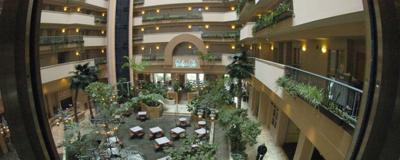
 Seaside City Hall also had a dream for a major hotel, and it, too, took longer to manifest than anticipated. In 1995 the Embassy Suites opened at an estimated cost of $22 million. The concrete-and-steel structure is the tallest building seen for miles and inspired much criticism from Peninsula residents because it sticks out like a sore (pink) thumb. While the exterior it is unlikely to win any awards, the hotel does have its architectural strengths, including an interior 12-story atrium filled with of plant life and aquariums. Peregrine falcons have taken residence under the hotel’s neon sign.
Bernardus Lodge, Carmel Valley
 In 1999 Bernardus Winery presented a grand architectural addition to Carmel Valley and reinforced Monterey County’s wine country status. Grapevines, olive trees and herb gardens welcome visitors to the site. An ochre and terra cotta-colored stucco lodge, complete with oversized fireplaces and warm interior styling, epitomizes country elegance.
Science Building, York School, Monterey
 In 2003 the private secondary school (in its 50th year) built the county’s first certified green building, an eco-science building that’s energy-efficient (including photo-voltaic solar panels and sensor controlled lighting) and resource-conscious (with waterless urinals and framing that reduced lumber use during construction).
Chartwell School, Seaside
 In 2006 Chartwell opened its new campus, the first school in the country to achieve a LEED U.S. Green Building Council Platinum rating. With its 30-Kilowatt solar energy photovoltaic array, a cistern for catching water to irrigate plants and energy efficiency throughout, the building is top in its class. Chartwell serves 130-plus K-8 students, kids who have a wide range of learning challenges.
The Baths at Esalen Institute, Big Sur
 A landslide from the El Niño storms of 1998 wiped out the famed baths at Esalen, known for its spiritual teachings, edgy classes and hot springs, and created the nonprofit’s greatest challenge– and opportunity. Architect Mickey Muennig faced a challenging site to build on, the rocky ledge perched just 50 feet above the Pacific. It took 500 steel rods, each between 27 and 40 feet long, plunged into the rock and interconnected with metal mesh to secure the structure. A $5 million project, the bathhouse re-opened in 2002.
The Osio Theater, Monterey
 This 1999 building is notable because it was the first New Urbanism project in Monterey, with a theater, café and retail on the ground floor, and rent-controlled housing upstairs, all the product of a unique partnership between a private developer and the city of Monterey.
Jerrold Lomax building, Sand City
 Jerry Lomax, a well-known architect from Venice Beach, designed this mixed-use building in the emerging West End of Sand City. The condo-office building, featured in the September 2005 Architectural Digest, showcases open lofts for residents, each about 2,200 square feet, with commercial space on the ground floor. Lomax now resides in one of the condos.
The Design Center, Sand City
 Replacing warehouses with living and working spaces, the brand new four-story Design Center features two matching towers and 83,000 square feet of space, built at an estimated cost of $15 million. It was built with 31 condominiums on the top two floors and large retail showrooms on the ground levels, with plans for a café/restaurant. Local architect Al Saroyan designed the building. (This project has run head-on into a slowing housing market, is mostly vacant and reportedly under financial strain.)
Monterey County Government Center and Administration Building, Salinas
 As anyone who’s been caught speeding knows, the Superior Courthouse in Marina (1997) is a well-designed building, almost so welcoming it takes the pain out of going to court. So, too, is the city of Pacific Grove’s $3 million Civic Center (2002), which offers the public a great space to experience government sausage being made. But the biggest and most impressive new administrative public building is the county’s new 136,500-square-foot Government Center, which houses new chambers for more than 500 county employees, including the county supervisors, Planning and Building, Public Works, County Council, the Assessor and Human Resources. The $24.4 million building, designed by Hellmuth, Obata and Kassabaum, opened in 2005, and is filled by natural light from its numerous large windows. It has the most comfortable seats in town– necessary for those painfully long, general plan meetings.
Salinas Valley State Prison, Soledad
 The rooms and windows are small and the neighbors, not so nice. That basically describes the interior of the 300-acre Salinas Valley State prison, opened in 1996 at a cost of $236 million to house 1,552 inmates. This complex was a major addition to the Soledad Prison, for minimum and maximum security inmates.
NOTABLE REHABS
Golden State Theatre, Monterey
 The Reid Brothers, architects of the famous Hotel Del Coronado in San Diego, designed the Golden State Theater, which opened in 1926. By the end of the century the State needed major repair (it smelled bad and had terrible sound). Warren Dewey, a former L.A. recording music engineer and producer, was the man for the job. Dewey converted the triplex back to a single theater, added new seats and restored the original pipe organ, and made the place golden again, at a cost of $3 million. With its digital lighting and projection room, the 1,000-seat State Theatre re-opened for live theater and film in 2006. Dewey for president!
MBEST Headquarters, University of California Santa Cruz, Marina
 Overseen by UCSC, the Monterey Bay Education, Science and Technology Center (MBEST), headquartered at the old Fort Ord, is a sign of good things to come for Marina. Its open space, with local artists’ work in full display, is compatible with MBEST’s mission to foster interaction between public and private education and research institutions, government research agencies, private business and policy makers.
Window-on-the-Bay (WOTB) Waterfront Park, Monterey
 Perhaps known for more of what it isn’t versus what it is, WOTB has been a priority in the Monterey City master plan since 1939. The project extends from Wharf Two to Park Avenue. During the past 20 years, the city has purchased and demolished a number of commercial properties (Vapor Cleaners, Color Ad, Cellular One, Luce-Carmel Meat, the Fugazi/Honda) in an effort to create the waterfront park. We’ve witnessed the widening of Del Monte Avenue, burying of the power lines, and the construction of volleyball courts, lawns and gardens. In this post-Prop. 13 era, when cities have fewer local taxes, WOTB is an innovative project, and a smash hit for our community.
Sunset Center, Carmel
 Built originally in the 1930s, the Sunset School originally serviced 700 students; in the ’60s, it became a community resource, the Sunset Center. A $21.4 million restoration project was completed in 2003 and it reopened with outstanding acoustics and sight lines, a spacious glass-window foyer and Carmel stone patio.
West End Café/Ol’ Factory, Sand City
 Whatever you can say about Morgan Christopher, colorful figure that he is, one positive contribution to our community has been his two busy cafés: Morgan’s (now called East Village in Monterey) and Ol’ Factory. His latest venture is a great example of urban-chic architecture. Ol’ Factory is a former warehouse transformed into a café and bar, with high tin ceilings and contemporary art, an open-air feel with roll-up garage doors. The rehab was done using primarily green building materials.
Navy Postgraduate School iron fence, Monterey
 The old expression “Tall Fences Make Good Neighbors” takes on a twist with the foreboding iron fence the Navy school installed around its perimeter post 9-11. At a price tag of $2.1 million, the 2004 fence is an aesthetic improvement, but not very inviting.
Monterey County Weekly building, Seaside
 1n 1991 (Phase One) and 1997 (Phase Two), the Weekly remodeled the Seaside Professional Building, designed by famed architect Charles Moore (see above, Monterey Museum of Art). We tore out red shag carpets (some even on the walls), installed over 30 skylights to increase natural light, and replaced every window and sliding door with double-pane insulated glass. The building merges natural elements of the outdoors directly into the office space with its multiple courtyards and atriums. Moore revisited the building in 1991, and approved of our redesign. In 2007 we installed a 33-Kilowatt solar energy system to provide 100 percent of our power; in 2008, the Weekly became a certified green business.
(0) comments
Welcome to the discussion.
Log In
Keep it Clean. Please avoid obscene, vulgar, lewd, racist or sexually-oriented language.
PLEASE TURN OFF YOUR CAPS LOCK.
Don't Threaten. Threats of harming another person will not be tolerated.
Be Truthful. Don't knowingly lie about anyone or anything.
Be Nice. No racism, sexism or any sort of -ism that is degrading to another person.
Be Proactive. Use the 'Report' link on each comment to let us know of abusive posts.
Share with Us. We'd love to hear eyewitness accounts, the history behind an article.