
A few weeks ago, Sen. Bernie Sanders, I-Vermont, became impossible to ignore.
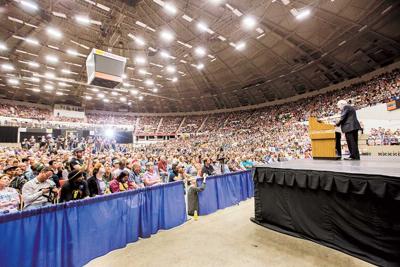
As 10,000 people cheered and chanted his name, the 73-year-old senator summited a stage in a Madison, Wisconsin arena and took his place behind a wooden podium. He raised his right arm to wave at a sea of supporters and embraced his wife, Jane, with his left.
Then, peering up at the distant nosebleed seats, Sanders did something unusual: He grinned.
“Whoa,” he said.
Whoa, indeed.
In the 43 years since Sanders first ran for office, skeptics have doubted him. They never believed he could serve as mayor of Burlington, defeat an incumbent congressman or chair a Senate committee. Well before he entered the presidential race in April, Beltway pundits had long since written him off as an also-ran.
But by the time Sanders arrived in Madison at the start of a four-day tour of the Midwest, CNN declared it the “summer of Sanders.” By the time he departed, new polls and fundraising reports showed him gaining on Hillary Clinton. And in perhaps the clearest sign of validation, reporters who’d been asking Sanders about Clinton in every interview started asking Clinton about Sanders.
At Wisconsin’s Veterans Memorial Coliseum, the senator let loose a few more “whoas” as he scanned the crowd of mostly white faces holding blue and white “Bernie” signs.
“In case you haven’t noticed,” he said, “there are a lot of people here.”
He grinned again.
But Sanders’ smile quickly faded. As he launched into his speech, any hint of optimism was supplanted by his assessment of modern America.
The economy, he said, was “rigged” by greedy billionaires more interested in tax breaks than in feeding hungry children. Republicans had “gotten away with murder for too many years.” His opponents would exploit a corrupt political system to defeat him.
“Ber-nie! Ber-nie! Ber-nie!” the crowd chanted.
No matter how Sanders fares in the nation’s never-ending presidential tryouts, this was the moment his campaign became real. No candidate to date had attracted so many supporters under one roof. And a surprising number of Democrats said they were convinced Sanders could and should win.
But with success comes scrutiny. A super PAC allied with third-place Democratic rival Martin O’Malley, the former Maryland governor, aired a negative ad focused on the Vermonter’s mixed record on gun control. And now that Sanders has gotten Clinton’s attention, he’s sure to face incoming fire from the most formidable campaign apparatus assembled by a non-incumbent presidential candidate.
The real test for Sanders is whether he can withstand the scrutiny and keep the energy alive. It’s a long road to the Iowa caucuses next winter.
But Sanders, a former long-distance runner, has been training for this race all his life.
He’s ready to run.
• • •
Sanders should’ve been pleased the next day when he reached Fort Dodge, Iowa – a 25,000-person town with an economy based on corn and gypsum.
After filling the Madison arena the night before, he had lured 600 people to a breakfast speech that morning in Rochester, Minnesota. Hours earlier, Quinnipiac University had released a new poll showing that he’d more than doubled his support in Iowa in the previous month, from 15 to 33 percent. And his own campaign had announced he’d raised an impressive $15 million in his first two months in the race.
But Sanders sounded like he had an ax to grind. He repeatedly ripped into the media that afternoon during a town hall at Iowa Central Community College.
“The media regards politics as either a baseball game or a soap opera,” he began.
It’s possible the senator was bent out of shape over a story the New York Times was about to publish on his writings in the Vermont Freeman newspaper in the early 1970s. In one essay from that era, he suggested cancer might be caused by unresolved hostility toward one’s mother or having too few orgasms.
Or perhaps he’d heard from friends and family that news outlets were examining his early love life. A week later, VTDigger.org, the Daily Mail and Politico would all disclose on the same day the heretofore unreported fact that Sanders’ son, Levi, was born to a woman he never married.
The press, he frequently suggested before entering the race, would seek to destroy him and his family.
“Will the media allow a serious discussion about the issues?” he asked his audience. “Maybe they will. Maybe they won’t. I’m not sure that they will.”
Most recent coverage of his ascendant campaign has been fawning and uncritical. The national media has appeared eager to replace the tired story line of Clintonian dominance.
On his way out the door of the community college, Sanders tolerated a few questions from a handful of local and national political reporters before abruptly cutting them off.
“All right, thank you very much,” he said, pushing past them toward a waiting car.
• • •
As Sanders has drawn more fans to rallies, skeptics have questioned whether such support exists outside liberal metropolises.
But in the three days Sanders spent crisscrossing rural, western Iowa, excitement was palpable even in the tiniest burgs. When he drove two hours from Fort Dodge to Sioux City, he found more than 400 people waiting to see him at Morningside College, a small, liberal arts institution.
Introducing him was a graduate student named James Johansen, who praised Sanders for daring “to stand up for the LGBT community” decades earlier. Johansen did not mention Clinton, who waited until 2013 to embrace gay marriage. But his point was clear.
“As a gay man who was recently married, I do not take that kind of courage lightly,” he said. “I know that it is because of the courage of people like Bernie Sanders that my family today can be recognized and treated equally under the law.”
Sanders picked up where Johansen left off. “James well knows that that struggle has been going on for decades and decades and decades,” he said. “People had incredible courage standing up and saying, ‘I’m gay, and you’re going to know I’m gay. I’m not going to hide it anymore. And you’re not going to discriminate against me anymore.’”
Early in Sanders’ standard stump speech, he delivers a harsh indictment of conservative beliefs.
“[Republicans] are saying that women are not mature enough to be able to go out and buy the contraceptives they need” and that “same-sex marriage should not be allowed to happen.”
“That,” he said, “is their view of family values.” Sanders said his idea of family values was to guarantee 12 weeks of paid family and medical leave.
But later in his stump speech, Sanders contradicts himself, arguing that Americans must not let social issues divide them at the expense of economic ones.
“In a democracy, people are gonna have different points of view,” he said as he wrapped up his speech at Morningside College. “Yes, we may disagree on abortion. Yes, we may disagree on gay rights. Yes, we may disagree on guns… but do not get deflected from the most important issues facing you, your kids and your parents.”
• • •
In his four days of rallies, town meetings and parades, Sanders addressed foreign policy just twice – and only when audience members asked.
“You haven’t mentioned the Middle East yet,” one woman observed near the end of the question-and-answer period in Sioux City.
“That’s because you haven’t asked me yet!” Sanders exclaimed, drawing laughter from the crowd.
Before the woman could pose her question, Sanders interjected.
“Everybody knows that we live in a dangerous and very complicated world. And if I had a magic solution, I’d get on the phone with the president right now. I don’t. You don’t. Nobody does. And that’s the simple truth.”
After highlighting his votes against the Gulf War and the Iraq War, Sanders jumped forward. He approaches foreign policy much the way he does economic policy: The wealthiest nations must pay their fair share.
In March, when the Saudis called on the U.S. to deploy combat troops to oppose the Islamic State group known as ISIS, he issued a blistering statement noting that Saudi Arabia “is controlled by a multi-billion-dollar family.”
To destroy ISIS, he argued, “The Muslim nations themselves must lead that effort. They have got to get their hands dirty.”
The next day, Sanders faced a question on a very different global conflict. A woman, who identified herself as a naturalized citizen originally from Central Europe, asked, “If you were the president at this point, what would you do about [Russian President Vladimir] Putin’s imperialistic tendencies and his annexation of eastern Ukraine?”
“Putin is a dangerous guy. ISIS in the Middle East is an extraordinarily barbaric organization, and both have got to be combated,” he said. “Nobody has any simple, easy solutions to a very complicated and dangerous world. Putin is one part of it. ISIS is another part. You’ve got Iran with concerns about a nuclear weapon there.”
But the lesson from Iraq, he argued, was that “the United States cannot do it alone.” It must “put together broad coalitions” to counter Russia and “mobilize the Muslim countries in the Middle East” to counter ISIS.
“OK,” he said. “We’ve gotta get moving on.”
For a guy who’s served in Congress since George H. W. Bush was president, Sanders doesn’t display much depth on international affairs. Asked last fall about his interest in the subject, he said, “It’s very easy for the Congress to get deflected away from the needs of tens and tens of millions of American people, and I don’t want to see that happen. But that’s not to say that foreign policy is not of huge consequence.”
His general philosophy – the U.S. ought to avoid unilateral military engagement whenever possible – mirrors that of many Democratic primary voters. And he’s wise to contrast his opposition to the Iraq War with Clinton’s support for it. But when Sanders faces the former secretary of state on a debate stage this fall, he’ll likely face tougher questions than, “Is ISIS bad?” And he’ll have to answer them.
• • •
After Sanders departed his visit from the Better Day Café, Lynn and Paula McCullen chatted with a friend. Retirees who moved from California to nearby Fonda, the McCullens said they were glad to see so many people from such a conservative area turn out to see Sanders. They noted that their congressman, Rep. Steve King, R-Iowa, is among the most conservative in the nation – and, according to Lynn McCullen, “a buffoon.”
“It’s heartening to see there’s that many people who have their head straight,” he added.
As in much of western Iowa, the Latino population has grown significantly in recent years, as immigrants have found work on farms and in processing plants. In Denison, 50 miles south, more than 40 percent of the population is Hispanic.
But when Sanders arrived there later that afternoon to march in a July 3 Independence Day parade, the preponderance of those participating in and observing the festivities were white.
Sanders appears to abhor unscripted moments with supporters, and milled around awkwardly outside the United Food and Commercial Workers Local 440 union hall, gamely posing for selfies. He kept asking field director Phil Fiermonte for direction, but he didn’t receive any.
As he waited for the parade to begin, the candidate briefly entertained questions from members of the local media. Lorena López, editor of the Spanish-language newspaper La Prensa, based in western Iowa, was one of them.
“Latinos trust in President Obama. Latinos talk a lot today about you,” she said. “What do you have to offer Latinos?”
Sanders, who has faced criticism from some Latino leaders for failing to focus on their issues, dove right in.
“Well, we are going to fight as hard as we can to pass comprehensive immigration reform,” he said. “The bottom line is, we have 11 million undocumented workers in this country, and they deserve a path to citizenship, and I believe that very strongly.”
Then he shifted to more comfortable territory: “When we look at economics in America, what we find is that Latinos and African Americans are often at the bottom of the line in terms of decent paying jobs and other aspects of our economy.” For that reason, he argued, providing free college tuition and raising the minimum wage would help Latinos more than most.
López, who said she interviewed Obama four times as he campaigned in Iowa, sounded unimpressed.
“He and all the candidates need to focus on the pain of the people – the real pain, you know? People are suffering,” she said. “Hillary and Sen. Sanders are talking about immigration reform, but they are not offering something. They are just talking.”
By the time the parade’s convoy of fire trucks, vintage tractors and a Mustang convertible-riding mayor began chugging down Broadway, only a smattering of residents lined the route. In his traditional parade garb of a button-down shirt, chinos and sneakers, Sanders worked the left side of the road, while Jane Sanders worked the right.
“Go get ’em, Bernie!” retired archaeologist Larry Abbott shouted as Sanders walked by a Hy-Vee grocery store.
“Everything I’ve heard him say is just right,” Abbott explained to a reporter. “I just sent in my donation this morning.”
But Abbott’s support might not presage a landslide win. “Since the mid-1960s, Obama’s the only one I voted for that got elected,” he confessed.
• • •
When Sanders announced he was running for president, he had just one person on the campaign payroll.
“I think it’s fair to say that we did not anticipate the speed with which these large crowds of people would come to the campaign,” said Jeff Weaver, Sanders’ campaign manager. “So it’s been a bit of a challenge, but it’s better than the opposite challenge.”
To the untrained eye, Sanders’ Iowa operation, which includes 27 of the campaign’s now 50 staffers, appeared surprisingly organized.
Volunteers and staffers swarmed every event, signing in audience members, handing out donation envelopes and marching in parades. Even after he reached the end of the Denison route, many Sanderistas kept working the crowd.
Clayton Christiansen, a Nebraska City property manager and newly minted volunteer, walked 16th Street, attempting to engage with residents.
“Are you familiar with Bernie Sanders?” he asked an older couple and a younger woman sitting together on a porch.
The older man looked annoyed by the intrusion but offered, “We hope he beats Hillary.”
“We do, too!” Christiansen replied with a smile.
That night, more than 80 Sanders volunteers stalked the entrances to Council Bluffs’ Mid-America Center as some 2,600 people streamed in. The volunteers would not let audience members pass without extracting their contact information.
Since Sanders supporter Neil Young called out Donald Trump for playing “Rockin’ in the Free World” at his campaign launch, the song has warmed up the crowd at most Sanders rallies. By the time it blared across the room, every seat in the Mid-America hall was filled.
The crowd skewed younger than at events elsewhere in Iowa, perhaps because it was taking place just across the Missouri River from Omaha. Cory Journey, a 20-year-old college student, said he and three friends had traveled 45 minutes from Lincoln, Nebraska, to hear Sanders speak. He said he’d learned about the event via Facebook.
“No one’s reading the paper anymore,” he explained to a newspaper reporter. “It sounded like a good thing to do on a Friday.”
After a self-identified transgender woman introduced Sanders, the senator took the stage and uttered words that have come to sound familiar.
“This is by far the largest meeting we have done in the state of Iowa,” he said to a roaring crowd. “Let me begin by telling you something I think other candidates will not do: That is basically the truth.”
And he was off.
• • •
Hours before Sanders packed the Mid-America hall, 850 people turned out to see Clinton in Hanover, New Hampshire, a liberal hub key to any Democratic candidate.
She seemed to have Sanders in mind when she proclaimed in a speech at Dartmouth College, “I take a back seat to no one when you look at my record in standing up and fighting for progressive values.”
The next day, Clinton was pilloried in the press when two campaign staffers pulled out a rope at a Gorham parade and literally dragged along reporters who came too close to the candidate. Though the incident was surely overblown, it neatly illustrated the frustration national reporters feel about a candidate who has largely avoided the press.
Sanders is hardly warm and fuzzy with the press. Other than a few liberal commentators, he appears merely to tolerate them. But as he marched in an Independence Day parade on his final day in Iowa, his campaign staff left the rope at home. A handful of reporters and photographers roamed free along the parade route – and Sanders even took a question from Seven Days, Vermont’s alternative weekly.

Sanders’ candidacy has flipped the narrative for presumptive Democratic presidential nominee Hillary Clinton. Reporters who once asked Sanders about Clinton are now asking Clinton about Sanders.
Asked how the parade compared to those back home, he said, “In many ways it’s similar. Very nice people. Yep.” Then he raised his hand as if to say, “Enough is enough.”
Jane Sanders, ever ready to smooth out her husband’s rough spots, jumped in.
“It’s different. I mean, everybody knows him there,” she said of Vermont. “But there’s a lot more folks that know him now.”
Often the biggest hit at parades in Vermont, Sanders attracted more than a few raised eyebrows from the Union County residents who lined the streets of Creston.
“Hey! Socialism doesn’t work, buddy!” one man yelled as the senator marched by. “Give it up!”
Sanders looked straight at him, then looked away, his tight smile unchanged.
Most locals in Creston, Iowa, appeared more bemused than offended by Sanders’ presence in the parade – and some seemed downright appreciative that he’d taken the time to visit this small town, population 7,887. As Sanders passed a parking lot in which two Confederate flag-adorned pickup trucks were parked, Creston High School band director Mike Peters jogged up to Sanders to ask for a selfie. The senator complied.
“Ever since I’ve seen this gentleman on Bill Maher… I’ve started identifying with the things that he likes to do,” Peters said. “He has a vision for what this country needs at this point.”
Later that day, the senator marched in one final parade – in the Des Moines suburb of Waukee. Thanks to its close proximity to the state capital, the Sanders campaign managed to turn out an astounding 130 people to walk with him.
David Leonard was not one of them. The retired high school counselor, decked out in a purple Dallas County Democrats T-shirt, said that he “loves Bernie Sanders.” But he doesn’t plan to vote for him.
“I agree with everything he stands for, but I’ll probably end up caucusing for Hillary Clinton, because it’s high time we had a woman president. For another thing, she’s highly qualified – perhaps the most qualified. And I think she will beat any Republican they put up against her,” Leonard said.
“Whereas with Bernie, they’re going to throw the socialist label at him,” he said. “And there will be closet talk of his being a Jew. I don’t think he could be elected.”
Sanders’ fired-up fan club clearly felt otherwise. As he marched past the town green and a skyscraper of a grain elevator, they hoisted signs reading “Iowa Bern Stormers” and “End the Corporate Oligarchy.” Several young men wore signs on their backs that said “Bern Unit.”
A young boy in a purple shirt led the pack of Sanders supporters and every few minutes yelled, “When I say, ‘President,’ you say ‘Bern!’
“President!”
“Bern!”
Sanders, who argues vociferously in his stump speech against the deification of politicians, mostly ignored the deranged mob at his heels. He focused instead on greeting and shaking hands with those who appeared receptive.
“Hi. Hello,” he said. “Hi. Hello. Bernie Sanders. Hi. Hello.”
By the time he reached Waukee High School, a mile and a half later under a hot sun, the former runner was definitely feeling the burn.
“Oh, my god!” a red-faced and sweaty Sanders exclaimed to his wife.
Whether he was referring to the unending parade route or the number of supporters willing to follow him wasn’t quite clear. But for the first time since he addressed the crowd in Madison, he displayed visible signs of happiness.
“That was fantastic,” he said.
(0) comments
Welcome to the discussion.
Log In
Keep it Clean. Please avoid obscene, vulgar, lewd, racist or sexually-oriented language.
PLEASE TURN OFF YOUR CAPS LOCK.
Don't Threaten. Threats of harming another person will not be tolerated.
Be Truthful. Don't knowingly lie about anyone or anything.
Be Nice. No racism, sexism or any sort of -ism that is degrading to another person.
Be Proactive. Use the 'Report' link on each comment to let us know of abusive posts.
Share with Us. We'd love to hear eyewitness accounts, the history behind an article.