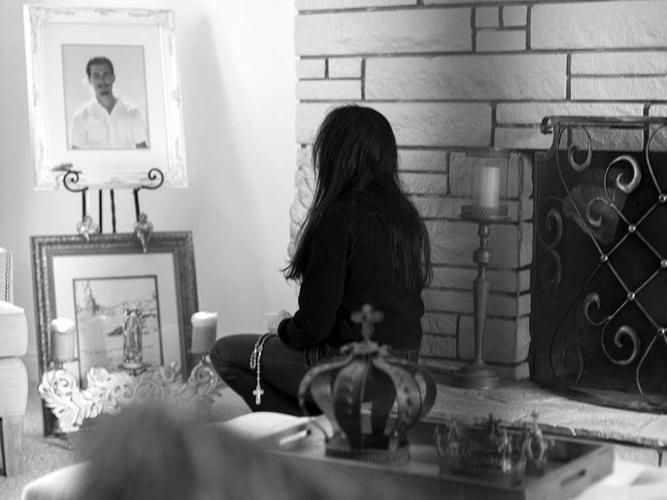

VERONICA RAMIREZ SITS ON THE FIREPLACE HEARTH inside her Prunedale home, rosary beads draped loosely over her left thigh. Warm morning sunlight pours in through a window, giving a soft glow to the room’s clean white carpet and white walls.
She mouths a long prayer. When finished, Ramirez stands up, brushes strands of jet black hair out of her face and looks up at a large, white-framed photograph of her late son, Nikolas “Nikko” Malliarodakis. He is standing against a blue sky, his handsome face smiling at the camera. Lit candles surround the altar. Ramirez sits here daily to talk to God, and to Nikko.

Veronica Ramirez prays the rosary at home in front of a photo of her late son. “It’s a time I sit and contemplate,” she says. “It helps relax me.”
“The rosary takes a bit of time to pray,” says Ramirez. “It’s a time I sit and contemplate. It helps relax me. My days are hard and I cry out for Nikko. I don’t accept it.”
She has a breakdown everyday.
“I contemplate not living, but (my daughter) Bella is here so I need to be here for her,” Ramirez says. “I need to find my way back to my faith again and try to cope, so I can be the mother she needs.”
The death of her son has been hard.
“We didn’t know how to deal with it,” she says. “My husband (Fernando) and I were both very angry at God and I lost my faith.”
Malliarodakis, 24, was killed in a car crash in Moss Landing on March 21, 2016, after 19-year-old Lynnea Hernandez swerved into oncoming traffic near Molera Road in Moss Landing and slammed into a car driven by Malliarodakis. He was headed back to work at Field Fresh Farms in Watsonville after having lunch at home in Monterey with his fiancee.
Hernandez and six friends, who were on spring break from UC Santa Cruz, were driving to Big Sur. While Hernandez was driving her Lexus SUV heading south on Highway 1, the friends were seen on Snapchat – a social media app – singing, dancing in their seats and passing a marijuana pipe around in the car, according to the Monterey County District Attorney’s Office. At one point, according to the DA, Hernandez was seen looking straight into the camera, taking her eyes off the road. Lillian Scott, a friend of Hernandez’s, was seated in the middle back seat of the SUV. Scott was also killed in the crash. Other passengers in Hernandez’s vehicle (including Hernandez herself) sustained major injuries.
In January 2018, Hernandez pleaded guilty to two counts of vehicular manslaughter with gross negligence for each person killed and two counts of reckless driving causing injury to her passengers. She was sentenced on March 23, 2018 to six years in state prison.
“What I ask God for is how to cope with it. I used to ask for him to take that day back and erase it,” Ramirez says. “I guess I’m accepting that every day I wake up, it still happened. Coming to terms that it wasn’t going to change and I needed to figure out what else could I do, because I was killing myself just wanting it to change.”
While Ramirez has struggled with faith as a way to cope with understanding loss, others may turn to substance abuse and other unhealthy defense mechanisms. Amy Somers, a licensed professional crisis counselor with the Monterey County Rape Crisis Center, explains how coping strategies can widely differ based on how people experience and understand their own traumas.
“Everybody has experienced trauma at some level and it’s not talked about – everything from a death in the family to parental divorce,” Somers says. “As a child, those things can be horrific and shape their personality later. Our society doesn’t encourage weakness. We are just supposed to just get on with it.”
When trauma is not addressed, it can lead to other health issues, and research has shown that prolonged exposure to adverse experiences – particularly in children – makes it harder to cope.
That’s where allies, including professional services like therapy, come in.
“First, I try to address the anxiety and stress, so they learn how to breath and get out of the fight-or-flight mode and feel safe,” Somers says. “When we don’t talk about our trauma, we keep it inside and it becomes super internal. It can turn into chronic body problems manifesting in different ways.”

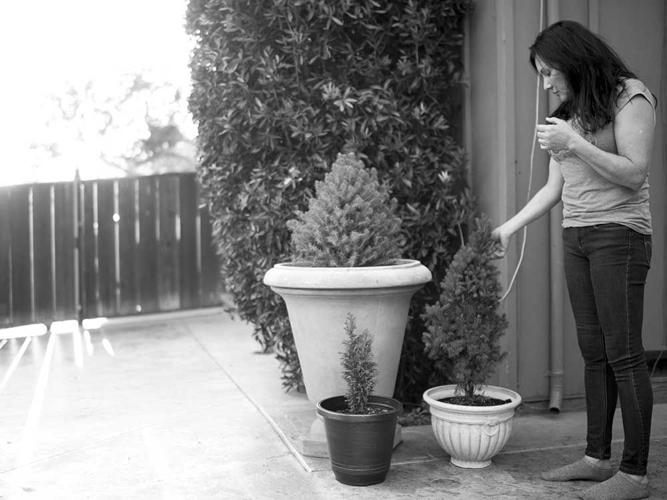
Veronica Ramirez looks at new growth on a spruce tree in her backyard, one of three trees under which she buried her son’s ashes on what would have been his 25th birthday in 2016, a few months after the fatal car crash. When Nikko was about 3, Ramirez would read to him at a bookstore where they came across the children’s book The Giving Tree. “He couldn’t believe the tree did all that!” she says. “I bought the book, and every day I still read it to him.”
She sees clients come with insomnia, chronic anxiety and stress. It’s common for sexual assault survivors to gain weight or develop an eating disorder. “In the long run, a client who comes to us and hasn’t dealt with their trauma often has a lot of issues,” Somers says. “Life just breaks down and they are totally spent. We just start with where they are.”
IN THE YEARS AFTER Carole Hernandez was raped, she struggled to find a healthy coping mechanism.
“For sometime after, although I knew what had happened to me, I was so much in shock,” Hernandez says. “I couldn’t emotionally connect with what happened.”
About a year afterward, as Hernandez started coming out of her shock, she went into a deep depression. She would sleep 21 or 22 hours a day. If she took a shower, that was a big accomplishment for the day.
“I was just trying to not feel my feelings about what happened,” she says.
Professionals say that not wanting to feel is normal after a traumatic experience like rape.
“Sexual assault is a very intimate form of trauma,” Somers says, “because control of your body is taken away in such an intimate way. It is shocking to the system.”
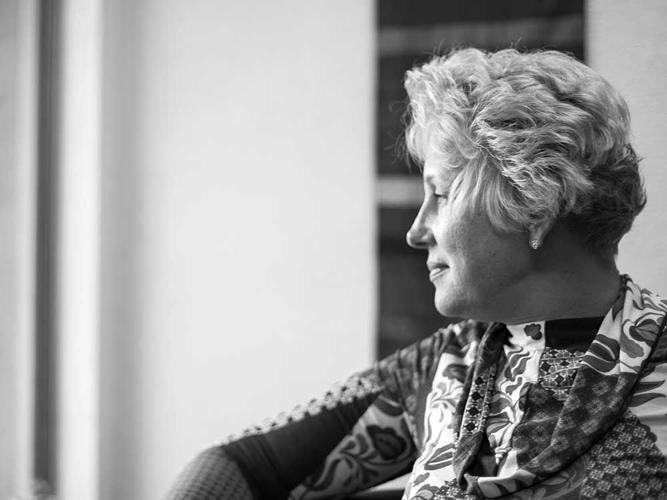
Hernandez, now 54, sits on a leather lounge chair inside the Monterey County Rape Crisis Center’s Salinas office. Posters with positive quotes and warm-colored tapestries hang on the walls. Various small plants soak up sun on a windowsill. Hernandez looks out the window as she recounts her assault in late-December 2009 at a motel in Salinas. Her voice wavers.
“Basically what happened is I was a girl who had a car and I was around some rough people,” she says. “I was introduced to someone who I found out later was going to rob me, because I was getting some money in the next few days.”
Hernandez had been using drugs and ended up in a motel room with two men who forced her to take off her clothes and took pictures of her for blackmail. The two men did whatever they wanted to her. Hernandez remembers knowing she needed to find a way to get out.
“I was thinking of breaking one of the beer bottles and cutting them, but it was two guys against one girl… ” she says. “I was in survival mode.”
When her fight-or-flight response kicked in, Hernandez grabbed her keys off the dresser and bolted for the door. One of the men was running behind her outside the motel. Hernandez stopped suddenly, turned around and screamed at him, “Leave me the fuck alone!”

“I was in so much emotional pain that I was scared to death to go through recovery,” says Carole Hernandez about slipping into substance abuse following her sexual assault 10 years ago. “To save my life meant opening up and being vulnerable. It’s become easier to talk about it.”
She then went into the lobby and called 911. The police arrived a short time later.
“I had been up for two days and was falling asleep when the police came,” she says. “I don’t remember how I got to the hospital.”
When Hernandez woke up in the hospital, a woman introduced herself as an advocate from the Rape Crisis Center.
“I never knew anything about her other than her first name, but she stayed with me during that time and made sure I was taken care of,” Hernandez says.
From there, the recovery process was hard. She fell back into drug use and was severely depressed. After about seven years, she did a six-month susbstance abuse recovery program at Door To Hope and got professional counseling through the Rape Crisis Center, where she confronted the trauma she had been trying to mask with drugs.
“I’ve never had so many people who wanted to help me.” Hernandez says. “I had a whole network of people that were on my side.”
Hernandez had family in Monterey County, but they didn’t know how to support her.
“They tried to help me, but nobody knows what to say to someone going through this,” she says. “I really needed those professionals.”
Now, she’s been drug-free for more than three years.
“I started grieving that this happened to me and that I caused myself more trauma with the substance abuse,” she says. “The only way out is to go through it. I tried to hide it, sleep it away and use drugs. I tried to minimize it, but ultimately, if I did not start working on my trauma, I was not going to stay clean. If I don’t stay clean, how will I be able to have people I love – like my son – in my life?”
With counseling and advocacy, Hernandez found that she finally had people on her side.
Lauren DaSilva, deputy director at the MCRCC says while trauma recovery can differ widely, there are some common themes.
“It’s not uncommon for people to experience post-traumatic stress disorder and have coping mechanisms that are unhealthy, like substance abuse and suicidal thoughts,” says DaSilva. “Even a person’s personality before a trauma can change or be amplified after a traumatic experience and change how they cope.”
Almost a decade after she was assaulted, life is better for Hernandez, and she sees changes in her own response.
“I’m a lot calmer now and not as jumpy,” she says. “I am able to share what happened without being re-traumatized by it.”
She has replaced substances with exercise and likes to be outside by the ocean. She says therapy was crucial in helping her feel normal again.
“There is a lot of taking care of myself now,” she says. “Having people in my life I feel safe with is important and being aware of who I’m going to let in my inner circle. I can reach out and ask for help and don’t feel alone.”
In 2017, the Monterey County Rape Crisis Center saw over 1,000 people; of those, 75 percent were survivors, while the remaining 25 percent were significant others of survivors. Of the survivors last year, 50 percent were under age 18.
The nonprofit provides counseling, as well as services like advocates who go to the hospital alongside survivors, in addition to direct them to legal assistance.
While Hernandez isn’t working currently, she is applying for jobs and taking classes at Hartnell College in Salinas. She enjoys studying psychology and wants to work in a field that helps others in the way she was helped.
“I lived my life without being open to help for so long. Now I have all this help and my vision of the world keeps changing and growing,” she says. “I wake up every day feeling like I won the lottery, because I’m not in that old way of life. I get to get up and go to school. I never thought I’d be able to do that.”
Hernandez looks out the window of the Rape Crisis Center.
“It sure is beautiful out there.”
SOMERS, A RAPE CRISIS COUNSELOR, says finding the space to stop and process is step one to trauma recovery.
“Socially for adults, we are not allowed to deal with trauma,” she says. “Maybe you got assaulted on a Friday, but you have to go to work on Monday.”
That lack of focus on a self makes it hard for healthy coping.
“When you are stuck in your mind, you are often looking to the future and stressing out, or looking at your past and reliving the trauma, so coming out of your head and into your body is the first thing I work on with clients,” Somers says. “It’s hard, because (for that person) it has been so unsafe to be in the body for so long that when a person finally comes into their body, it can be uncomfortable.”
Amie Miller, Monterey County Health Department Behavioral Health Director agrees, and says her office’s goal is to help people let go. But because trauma is so open-ended, that can be difficult.
“Trauma is not a diagnosis, but rather post-trauma care is about how we approach the work we do,” Miller says. “Assuming everyone has experienced trauma at some level, it is our job to meet them where they are at. What we know about trauma is it takes a lot of the sting away when people realize they are not alone.”
Hernandez’s initial efforts to not feel her pain are a normal reaction to a traumatic experience.
“All the body wants is to process and feel it,” Somers says. “It didn’t kill them the first time, so it won’t kill them to remember it.”
For Ramirez, however, processing her pain is still a daily battle. She tried grief counseling, but says it wasn’t for her; she found herself on the brink of shouting at the therapist.
“Bella has been going and I think it has helped her,” Ramirez says. “I don’t think it will ever help me.”
Even that reluctance to participate in therapy – and an impulse to yell – are normal responses to trauma, Somers says.
“A lot of therapy is holding space and figuring out what they need,” Somers says. “Some days they need someone to listen, or to draw or just scream.”

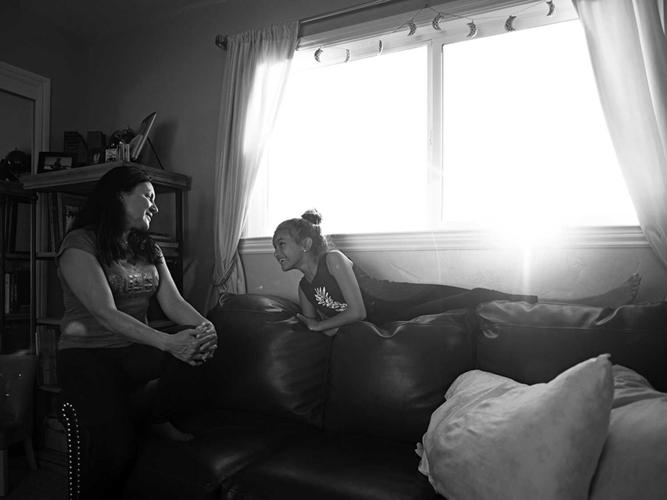
Veronica Ramirez, left, smiles at her 10-year-old daughter, Bella, inside her late son’s bedroom as the sun goes down on March 28, 2018. “Every day in Nikko’s room, I try to watch the sunset,” Ramirez says. “Bella prays with me at night. She always asks God to help me with my pain. I feel like I need to heal for Bella, because she sees me suffering.”
A FEW MONTHS AFTER her son’s death, Ramirez and family planted a pine and two spruce saplings, and buried his ashes under the young trees, on what would have been Malliarodakis’ 25th birthday, July 7, 2016. Around that same time, Bella joined a singing group that focused on traditional Mexican folk songs, many of which have lyrics about loss. She sang at the tree planting at the family’s Prunedale home.
“That was one of the first times she sang publicly,” Ramirez says. “For Bella, music has been healing.”
At night, Bella prays with her mother.
“She always asks God to help me with my pain,” Ramirez says. “I feel like I need to heal for Bella, because she sees me suffering.”
Ten-year-old Bella’s strength helps Ramirez cope: “I guess we bounce off each other, because she really helps my husband and I.”
TWO YEARS LATER, Ramirez looks at the new growth on a 2-foot pine tree in a large pot.
“I am compelled to give my son life again and watch him grow,” she told the Weekly in 2016, just after planting the trees. “I pray somehow all his heart and soul spread throughout this earth.”
Ramirez looks out at the sunset from her backyard and talks to no one in particular.
“I should put his tree in the ground soon. It’s planting season.”
(0) comments
Welcome to the discussion.
Log In
Keep it Clean. Please avoid obscene, vulgar, lewd, racist or sexually-oriented language.
PLEASE TURN OFF YOUR CAPS LOCK.
Don't Threaten. Threats of harming another person will not be tolerated.
Be Truthful. Don't knowingly lie about anyone or anything.
Be Nice. No racism, sexism or any sort of -ism that is degrading to another person.
Be Proactive. Use the 'Report' link on each comment to let us know of abusive posts.
Share with Us. We'd love to hear eyewitness accounts, the history behind an article.