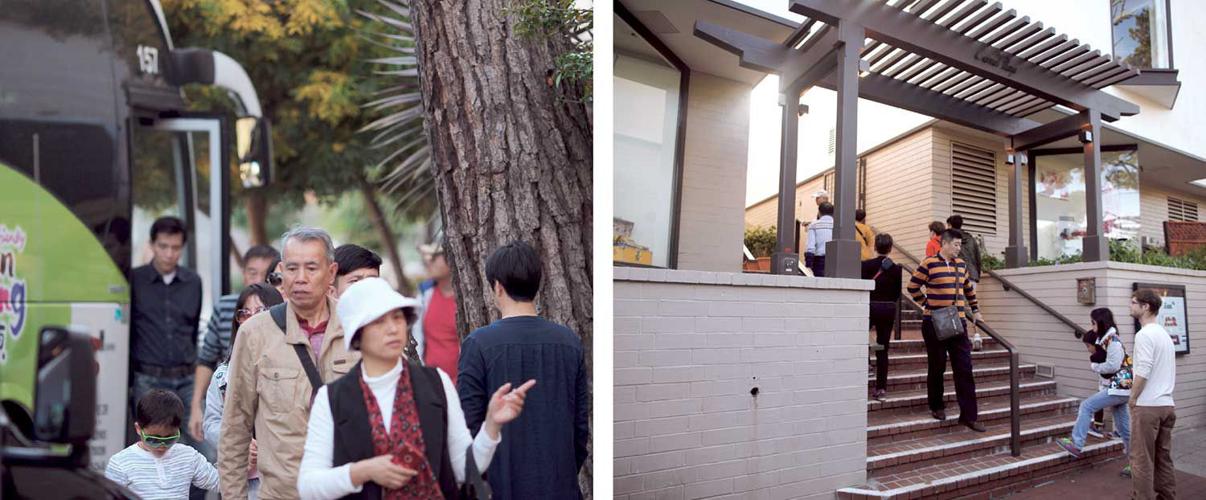
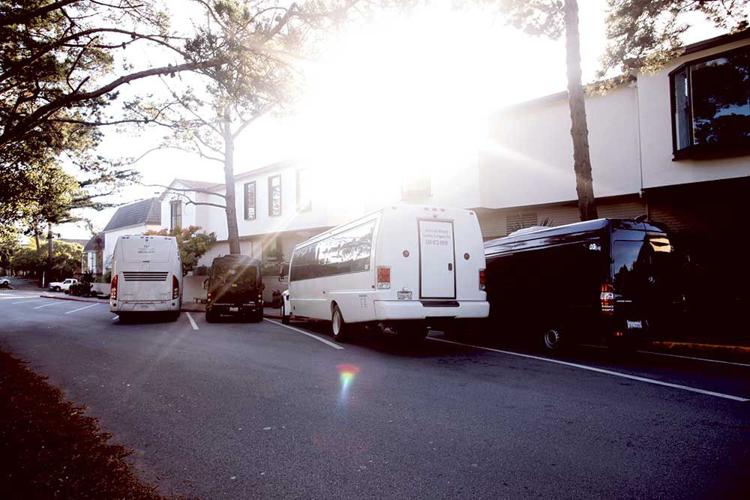


Chinese tourists step off tour buses parked along Junipero Street, along one side of the Carmel Plaza. Many tourists frequent the plaza’s restaurants and shops, accessible by stairs directly to the bus parking area, especially if they only have an hour or two in the town, leaving little time to see the rest of the village. Visit California estimates that on average, Chinese travelers spend $2,090 each while vacationing in the state.
IT’S A BLUSTERY DAY IN CARMEL a week before Thanksgiving, and between intermittent rain showers, gusts of wind create swirls of autumn leaves in the sky near Devendorf Park.
A city crew is busily hanging holiday lights and decorations on the tall redwood tree that greets visitors who enter the village coming down the hill on Ocean Avenue. Today the sidewalks are quiet, but next week they’ll be bustling again with tourists. The narrow sidewalks lined with granite stones might not get as dense with visitors as Car Week in August, but Thanksgiving weekend gets busy with lots of families gathering.
Because things are quiet on this chilly gray day in Carmel, however, does not mean there are no tourists in town. There are always tourists in Carmel, even during the off-season. Such is the draw of the “crown jewel” of Monterey County, as Rob O’Keefe, vice president and chief marketing officer of the Monterey County Convention and Visitors Bureau, told residents at a meeting of the Carmel Residents Association in March.
On this mid-week fall day, the tourists in town include a dozen or so couples, some conversing in foreign languages in the town’s commercial district. There’s a small group of female friends on a getaway and at least one family of adults from China The clusters of visitors wander the village, browsing the shops and dashing into cafes to get out of the rain at lunchtime.
At Carmel Plaza a few blocks away, there’s another group of tourists in town. Their visit will be less meandering, and last little over an hour. It’s enough time to grab a bite to eat in the Carmel Plaza area and do some window shopping. Just after 1pm, the visitors emerge, mostly in pairs, from the Plaza’s back stairs facing Junipero Street and make a left turn toward a tall white bus, chatting as they walk. A few hold to-go boxes. Once everyone is aboard, the bus driver climbs up into his high seat, and the engine begins to rumble. The bus pulls out and does a slow U-turn at Seventh Avenue. They’re off to the next stop on their California vacation.
What might look like an ordinary chain of events in any U.S. coastal town is, to some Carmelites, extraordinary – and not in a good way.
Since the Chinese government made the visa process easier for its citizens in recent years, millions of Chinese visitors have come to California. Visit California, a nonprofit marketing group, estimates 1.16 million Chinese visitors came to California in 2015 alone. Tourist industry insiders say the visitors’ focus used to be on the “triangle” of San Francisco, Los Angeles and Las Vegas, but Monterey County is growing in popularity, in part thanks to marketing efforts by the MCCVB in China. Carmel residents say they’ve noticed a definite uptick in Chinese visitors to their village, including those arriving in large tour buses for an hour or two.
Also on the rise: complaints from residents. They involve tourists smoking and dropping cigarette butts. Groups that pass through briefly not eating in local restaurants or staying overnight at inns. Overcrowded sidewalks. Tourists taking photos in the middle of the street or wandering into backyards. It all adds up to a degradation of Carmel’s European village charm, critics say. Some have called for a ban on all advertising. They also want Carmel to attract the “right kind of visitors,” who leave little impact behind – except cash.
It’s not a new hew and cry. Carmel has always had tension between commerce and residents since the town started to grow in the early 1900s. Political forces have swung back and forth. Currently, residents – represented in large part by the Carmel Residents Association – have strong sway with the City Council and City Administrator Chip Rerig. But, as Rerig says, it’s a balance.
As much as residents would love to have Carmel all to themselves, the tourists are here to stay. The dollars they bring into the city makes up two-thirds of its annual $23 million budget.
ABOUT 50 RESIDENTS ARE GATHERED INSIDE CARPENTER HALL for a town hall meeting called by the Carmel Residents Association on an afternoon in March. On the stage overlooking the audience sit five speakers; moderator (and CRA member) Dave Armstrong stands at the podium. Sitting at the table next to him are four local tourism professionals – MCCVB’s O’Keefe, former Carmel Chamber of Commerce executive director Monta Potter, the general manager of the Portola Hotel and Spa in Monterey – and a Carmel resident – Janine Chicourrat, and Amy Johnson, innkeeper of the Carmel Country Inn.
Also on the stage is CRA member Dave Mosley. After brief introductions down the table, Armstrong invites Mosley to speak first. He explains how he came up with a list of positive and negative impacts of tourism on Carmel, and starts with the positive: the revenue that tourism dollars bring. He stops there, then throws down a gauntlet of negatives.
“I identified increased commercialism, an overall degradation of the quality of Carmel’s restaurants, retail stores and the charm of the city, rising lease rates, damage to roads, trees and beaches, increased noise from traffic and cars, increased litter and trash, cigarette butts and those unsightly black plastic butt cans on city sidewalks,” he said. For good measure he added parking and crowded sidewalks, and ended the list with increased crime. (Police Chief Paul Tomasi says most crime comes not from tourists, but people in other parts of Monterey County who target the elderly. Of tourist-related crime, mostly DUIs or drunk and disorderly conduct, he says, “It’s not that bad.”)
Mosley – a retired engineer who ran for City Council in 2016 and lost to hotelier Bobby Richards and Jan Reimers, whose family owns commercial property in Carmel – later raised the specter of setting a limit on the number of tourists. “Are we ultimately going to get to be a city where there just isn’t enough room for all the travelers and cars that want to be in Carmel?” he said. “It would be nice to walk the streets of Carmel and not be run over in one of the intersections.”
Mosley all but suggested putting a fence around the 1.1-square-mile city and locking the gate.
Constructing a wall around the small enclave of tiny homes among the oaks, pines and cypress trees is not a new idea. Early 20th-century residents flirted with the idea of constructing a fence like their next-door neighbor, Pebble Beach, but the idea never took hold. What did take hold in Carmel was a conflict as deeply rooted as the town’s dense forest on the sea.
As the town grew during that time, the bohemian writers and artists who were drawn there were disturbed by waves of pilgrims who read about Carmel’s white beaches and Forest Theater productions in big city newspapers, according to an account in the 1992 book, Creating Carmel: The Enduring Vision.
Shops catering to tourists popped up along Ocean Avenue, leaving some residents nervous about rampant commercialism invading their quiet residential town. When business owners suggested paving Ocean Avenue shortly after the city incorporated in 1916 – so that horse and buggies and those newfangled horseless carriages wouldn’t get stuck in the mud – some residents saw it paving the way for hordes of visitors. It would take until 1922 when voters approved a ballot measure to lay pavement.
That same year, a large resort hotel was planned for the beach dunes near the foot of Ocean Avenue. Residents protested the town would turn into Coney Island. The real estate developer with a strong vision of building a village by the sea, Frank Devendorf, came to the rescue, selling the property to the city for just $15,000. (There is now a public parking lot in that vicinity.)
The push and pull between residents and tourists continued, and later the fears about becoming Coney Island turned into fears of becoming another Santa Cruz, a comparison that still gets used today. (In a dust-up this year over the types of restaurants Carmel should allow, “Let’s not turn into [downtown Monterey’s] Alvarado Street” was heard.)
While the idea for a fence and gate never got off the ground, another “legal wall” was proposed, Creating Carmel’s authors, Harold and Ann Gilliam, write. It became known as Carmel’s “Magna Carta.” It is Article 96, and today it is posted on the wall behind the dais where City Council members meet every month.
It reads:
“THE CITY OF CARMEL-BY-THE-SEA is hereby determined to be primarily, a residential City wherein business and commerce have in the past, are now, and are proposed to be in the future subordinated to its residential character; and that said determination is made having in mind the history and the development of said city, its growth and the causes thereof; and also its geographical and topographical aspects, together with its near proximity to the cities of Pacific Grove and Monterey and the businesses, industries, trades, callings and professions in existence and permissible therein.
“Adopted by Ordinance No. 96 passed on this 5th day of June 1929.”

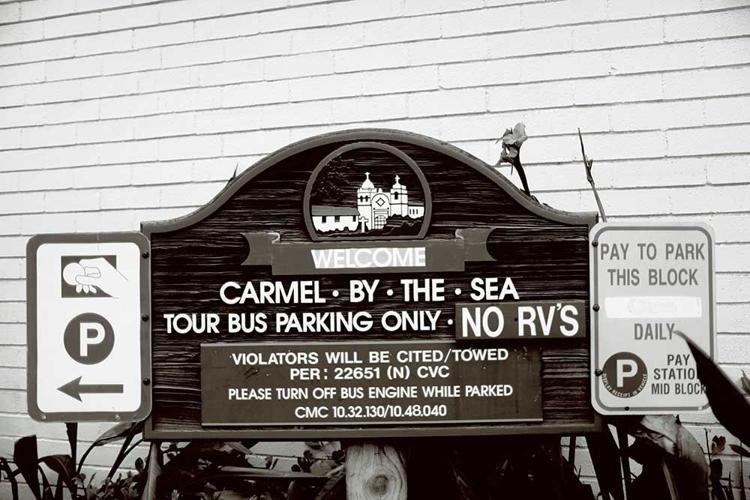
Carmel City Administrator Chip Rerig says the city is weighing signage to make sure tour buses stay on the city’s truck route. This sign on Junipero Street directs tour bus drivers to the bus parking area. A self-service pay station is located in the middle of the block.
SINCE THAT DECLARATION OF CARMEL’S “RESIDENTIAL CHARACTER” taking priority over business and commerce, the push and pull between the two forces continues to shape nearly every debate at City Hall. The tension famously came to a head in 1986, when Carmel’s most famous resident at the time, Clint Eastwood, ran for mayor after the city kept delaying on a permit he wanted for a commercial building next to his restaurant, The Hog’s Breath Inn, on San Carlos Street.
Eastwood challenged incumbent mayor Charlotte Townsend – a proponent of beating back commercialism whenever possible – and won in a landslide on April 8, 1986. News agencies from around the world crowded around Eastwood the next day for a press conference at the Sunset Center. His electoral win served as a magnet for tourists from all over the globe for years to come, says Carrie Theis, a city council member and owner of the Hofsas House, a hotel just up the street from Hog’s Breath.
“When Clint was mayor in the ’80s, that was huge. People were coming from all over to see him,” Theis says.
Despite the bump in tourism, the city was not immune to market forces. Data charting occupancy from Visit Carmel, the independent nonprofit that manages marketing for Carmel’s hospitality improvement district made up of the town’s inns and hotels, shows a steep decline starting with the dot-com bubble bursting in the late ’90s, exacerbated by 9/11. Another deep dip comes with the recession beginning in 2008. It took 14 years, until around 2015, for Carmel to return to the same occupancy levels – just over 70 percent – as the early ’90s.
The uptick in hotel occupancy rates comes precisely around the same time the latest wave of Chinese tourists came to the U.S., as a direct result of changes in China’s visa policies, combined with the growth of its middle class. According to statistics from the U.S. Department of Commerce National Travel and Tourism Office, the number of travelers from the People’s Republic of China nearly tripled between 2012 and 2016, growing from 1.4 million to almost 3 million.
“The last five years we have been targeting China as one of our key international markets, along with Canada and Mexico,” O’Keefe says.
About five years ago, the MCCVB started by planting seeds on two popular social media sites in China, Weibo and WeChat, positioning Monterey County as a distinct travel area from well-known destinations like San Francisco and Los Angeles. Next, they built relationships with travel agents and tour operators in China, in part through bringing Chinese travel professionals on what are known as “fam (familiarization) trips.” They also bring groups of journalists to visit; one group is scheduled to visit in December. O’Keefe recently traveled to China as part of the ongoing outreach.
“We’ve positioned Monterey [County] as the quintessential California experience,” he says. “We have a lot of what Chinese visitors are looking for: wine country, golf, and scenic beauty.”
The MCCVB’s target Chinese travelers are the ones that are now a growing sector of the market, what’s known in the industry as the “Frequent Independent Traveler,” according to U.S. stats. They travel in smaller groups or families, and don’t necessarily ride the big tour buses. They stay in the county longer and have more money to spend.
Daniel Shen, president of Lion Tours based in Los Angeles, is one of O’Keefe’s industry contacts. Lion Tours acts as a middleman between companies in China coordinating trips for groups and individuals and tour operators in the U.S. Shen says there’s a growing interest among Chinese travelers of all types to come to Monterey County because of the natural beauty (and good air quality) of the region.
“They don’t experience such things in China,” he says. “When they come here, they can take a deep breath.”
PETER WANG OWNS ROCKY POINT RESTAURANT in Big Sur and is a real estate investor and former member of the board of trustees of the Middlebury Institute of International Studies in Monterey, and sees opportunity when it comes to Chinese visitors. He agrees that the scenic beauty is a big draw for Chinese travelers, and for the wealthier ones, golf and red wine are also incentives. Last week, his restaurant – which offers a spectacular view of Big Sur, what he calls America’s last frontier – was the site of a traditional Thanksgiving dinner with a special feature, a whole roast pig.
Wang welcomed an elite group of Chinese travelers, called the China Entrepreneur Golf Club. The 50-member group first played a round at the Pebble Beach Golf Links, stopping at Wang’s home at the 13th hole for a beer before heading to Rocky Point. Wang says the group represents “small entrepreneurs” whose businesses make up 5 percent of total exports from the U.S. to China.
His staff spread out the turkey, pig and all the traditional fixings to show the travelers the true meaning of the iconic U.S. holiday – and to build business relationships between China and California.
“All I want to do is teach them how to give thanks to our American friends,” Wang says. “That’s how we build a long-term relationship, so they come back again.”

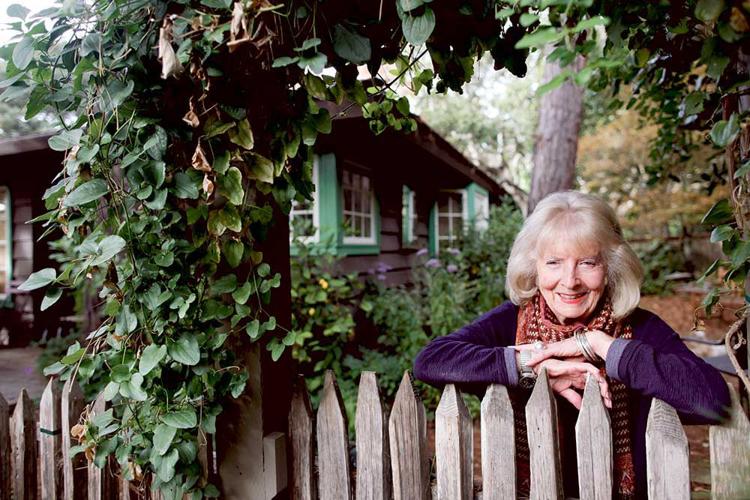
Barbara Livingston served on the Carmel City Council for 12 years, before retiring in 2004. She’s still a fixture in council chambers representing the Carmel Residents Association as its current president. The CRA wants the city to crack down on tour buses.
BARBARA LIVINGSTON IS SIPPING TEA at a small cafe table on the deck in front of her quaint single-story cottage home, a few blocks from downtown Carmel. Her blond hair is perfectly coiffed, just as it is when she sits in the front row of every Carmel City Council meeting, as the official voice of the Carmel Residents Association. The 88-year-old has lived in Carmel 31 years, and for eight has presided as CRA president.
“Carmelites used to be able to take back our town when school started,” she says, between sips of tea.
For months now, one of her top issues she’s petitioned the council about: tour buses. “I think they’re getting bigger,” she says. She and others say the buses bring exhaust and damage roads and trees.
“They don’t do anything to improve the aesthetics of the village,” she says. Her biggest complaints: The bus riders are never coming back and they don’t buy anything when they’re here.
“They spend only one hour here because tour bus drivers have them on a rigid schedule,” she says. She believes the only businesses that profit are delis near the tour bus parking area, like Bruno’s, and the Carmel Cocoa and Coffee Bar on Carmel Plaza’s first level.
“And then to add insult to injury, the city charges them $10 an hour for parking,” Livingston continues. “And here’s the kicker: The fine is $30 [for unpaid parking]. That’s it. I’m very critical that the city has not addressed the issue of at least increasing fees.”
The $10-an-hour parking fee is the highest among the cities surveyed by Carmel staff for an October report to City Council. San Francisco charges $5 an hour; Monterey charges nothing. Other cities charge by the day, like Santa Cruz, which charges $30. To get into Pebble Beach, tour buses pay $5 per person on the bus.
Fees are under review, City Administrator Rerig says, and may be increased in the future. They’re still in the early stages of considering it.
Rerig and his staff presented a report on tour buses Oct. 3 to City Council. A half-dozen people spoke out against the buses, asking if the city could prohibit larger buses, only allowing smaller ones. The response from city staff was not what they wanted to hear.
The city can determine which streets commercial vehicles can travel, but stringent ordinances beyond that could draw attention from the California Public Utilities Commission or generate legal challenges.
“Can we prohibit tour buses altogether? Probably not, under state law,” Rerig says.
The council took no formal action on that report, but directed staff to review fees and step up enforcement of tour buses, making sure drivers pay for an hourly permit from a self-serve electronic kiosk near tour bus parking, and that they are staying on the prescribed commercial route.
“We’ve seen a marked improvement,” Rerig notes.
Also in that Oct. 3 report: Tour buses bring a chunk of money into city coffers. From May 2016 through April 2017, the city sold 3,358 hourly parking permits, bringing in $41,070, about what the city budgeted for beach patrols this year.
Rerig can’t forget that it’s tourist dollars that keep the city running, but he says the push of the CRA (and all residents) is real.
“I think it has a very profound impact,” he says, adding that the goal of City Hall is to enhance the quality of life of residents. “I think that’s universal. That’s the job of every local government, quite frankly.”
As to Livingston’s complaint that the people in the tour buses don’t spend money in town, it’s unclear whether or not that’s true. Local tourist professionals are quick to point out that not all tour buses are the same or stay for only short periods of time – some smaller buses include those prized “frequent independent travelers,” and there are buses carrying travelers from all over the world, as well as the buses that carry cruise ship visitors. Theis says the cruise ship guests stay for up to half a day.
Even if they do only stay for a brief time, it’s good for future business, Theis says. “From my standpoint, we’re giving them a piece of Carmel so they’ll come back and stay the night.
“I’d rather have a tour bus of 25 people than 25 cars. It’s all about the balance.”
DONNA HOFSAS AND HER THEN-HUSBAND FRED came to Carmel in 1947, purchasing some cottages at the north end of the commercial district. They lived in one and rented out the rest. After a trip to their homeland of Bavaria, they decided to build into the steep hillside a four-story inn. Theis, Donna’s granddaughter, carries on the tradition today, managing Hofsas House with her mother, brother and son.
As an innkeeper and City Council member, she sits at the crux of the push and pull between commerce and residents. She’s keenly aware of Article 96, but she’s also aware that as long as there’s been a Carmel there’s been a business district. The businesses did not follow residents, the two sides came up together. The point of Article 96 was to not let the town’s residential character get lost.
“Thank goodness for the residents,” Theis says. “They kept Carmel the way it is. If you do business in Carmel, you have to learn and appreciate the uniqueness of Carmel and why you do business here.”
Part of that uniqueness – “the Carmel way,” she says – means change and acceptance of the new sometimes takes time.
“It took us awhile to get music in the restaurants,” she says. (That allowance came eight years ago.)
This summer, a smiling Theis appeared in Middle Land, a travel magazine published in Chinese and English, directed at the Chinese market. The article extols the virtue of the Bavarian-style inn, but it also broaches a delicate subject, namely, the differences in cultural norms between Chinese and Americans.
“We asked if there was any constructive criticism she could offer to help acculturate Chinese into Western living,” the article states, in an interview with Theis. Theis suggested the travelers don’t often understand how loud their voices are in public.
Theis says she’s heard other complaints from residents, like Chinese tourists stepping out into streets to take photographs, and wandering into backyards, unaware of private property issues.
Smoking, cigarette butts and litter were such hot issues at CRA’s March meeting that Visit Carmel decided to produce a “Love Carmel Like a Local” cardstock tent. It now sits in all of the city’s hotel rooms.
“Welcome to Carmel-by-the-Sea. During your visit, please don’t leave any trash or cigarette butts on our beaches or in downtown areas,” it reads. “Together, locals and visitors can work together to make sure our city remains beautiful for everyone.”
Editor's Note: The print version of this story named Clint Eastwood's mayoral opponent Marge Townsend. It was Charlotte Townsend. Harold and Ann Gilliam's last name was misspelled.
(1) comment
I was in Jackson Hole this Summer and they are grappling with the same issues regarding Chinese visitors who stop their car in the middle of the street to get out and take a photo, not minding that traffic backs up behind them. Or, throwing trash down wherever they feel like it. City Council might reach out to them and brainstorm ways to manage the cultural differences
Welcome to the discussion.
Log In
Keep it Clean. Please avoid obscene, vulgar, lewd, racist or sexually-oriented language.
PLEASE TURN OFF YOUR CAPS LOCK.
Don't Threaten. Threats of harming another person will not be tolerated.
Be Truthful. Don't knowingly lie about anyone or anything.
Be Nice. No racism, sexism or any sort of -ism that is degrading to another person.
Be Proactive. Use the 'Report' link on each comment to let us know of abusive posts.
Share with Us. We'd love to hear eyewitness accounts, the history behind an article.