
For kids, it can be a hard-knock life on the Monterey Peninsula’s cultural scene.
In July 2014, Old Fisherman’s Grotto restaurant ignited a media conflagration over a sign discouraging children. In May 2015, writer Jessica Jackley was controversially kicked out of the TEDWomen Conference in Monterey for having her 5-month-old baby with her.
Classical music and arts organizations everywhere claim to want to attract younger, more diverse, and newer audiences, including families and novices. The Carmel Bach Fest is no different (see story, previous page). But recently my wife and I were asked to remove our toddler from a local classical music concert.
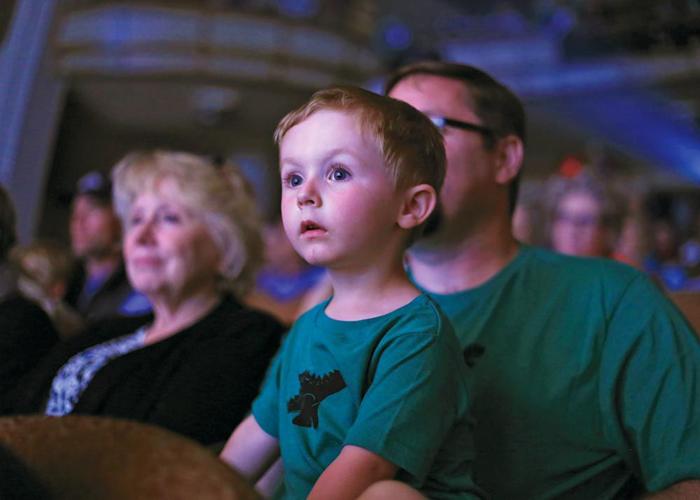
Last May, a joint performance by Ensemble Monterey Chamber Orchestra and Cantiamo! Cabrillo at the Carmel Mission promised beautiful and exultant music in a program titled “Fanfare.” I suggested to my wife that we take our 2-year-old boy, expecting he would enjoy the music – or fall asleep.
The night of the concert, we sat in the back pew. The seven or so rows ahead of us were nearly empty. The orchestra and choir occupied the altar of the mission from where they filled the basilica with the sublime sounds of Monteverdi, Purcell, Strauss and others. Our child ate it up. Great.
Then he began to investigate nearby objects, tried to “talk” to us (the music mostly obscured this), and after the crescendo of one song, said, “Ooh. Big.” A couple sitting in front of us didn’t complain, but we intervened with paper, pencil and a book. It worked for awhile, but when the remedy waned, my wife took him outside (the doors were left open) to roam the grounds until intermission.
After intermission, as the choir walked down the aisle to the altar – during a quiet lull – the choir director turned to us and audibly and visibly shushed my son.
My wife and I looked at each other like, “Did that just happen?” Then an usher came up behind us and asked, upon orders given to her, if we could take our child outside, or allow them to.
We opted for a third solution. We left.
“It’s inhuman to let people hear vibrant music and expect them to sit on their hands.”
A few days later, I asked Cantiamo! Cabrillo music director Cheryl Anderson, the one who shushed us, for her take.
“Loud and full and resonant is great, and to balance that sound we chose to interject some a cappella works [into the program] to give the ear a full menu to satisfy,” she wrote by email. “The Rihards Dubra unaccompanied work we did, Oculus non vidit, is hugely impactful on the audience because of its immense beauty, its poignant dissonances, its wide-ranging dynamics, its surprising ending of aleatory risen to a fever pitch and followed by shocking silence.
“Unfortunately it was during the fever-pitched ending and immediate silence that the child’s vocalization occurred,” she continues.
That would be the “Ooh. Big.” She says that at intermission audience members commented on my son’s “vocalization,” and that at the start of the second half she heard him beginning to be fussy, and could not pause to discuss it, so shushed him. Ironically, my wife and I perceived the shush was louder than any sound our son had made, and less consistent with the spirit of the music. And because Anderson had already ordered an usher to ask us to remove him, it seemed moot and punitive.
Cathleen Gable, concert manager for the Carmel Mission, says that Anderson has been “very gracious” to her, and she’s enjoyed a good working relationship with Cantiamo! Cabrillo. But she approached us at the parking lot to invite us to stay.
“I asked [three people] if your son had been disruptive and they told me ‘no,’” she observes. “I felt, as facility manager, I could invite you back into the mission.”
We decided to go home. Our invitation to enjoy the concert, it seemed, had been revoked.
But it touched off a sequence of questions.
Is it appropriate to bring kids to classical music concerts? What if they are still and quiet? If they make noise or fidget, how much is acceptable? When adults cough, snore, talk, let cell phones buzz, or clap out of turn, should they be asked to leave? At what point do the rules and protocol inhibit enjoyment – even attendance?
Rob Klevan has been a music educator for more than 42 years with the Monterey Jazz Festival, York School, CSU Monterey Bay and elsewhere. He’s also conducted numerous concerts and performed at Carnegie Hall.
“I feel that for the sake of a sane and civilized society, it is extremely important to keep the arts alive, particularly music,” he says. “The best way to perpetuate the arts is to expose our children to them at an early age. If [arts] organizations hope to survive, they must find a way to attract younger audiences.”
How young is appropriate?
“Only the parents know,” Klevan says.
He and his wife also happen to be the couple in front of us at the Fanfare concert, and he says they were not disturbed by my son, but reports that some of the performers called the “Ooh. Big” comment “unfortunate.” He speculates they might feel the same way if, instead, an adult had sneezed loudly.
Anderson says she was simply exercising deep respect for her field. She grew up in a musical family, and has studied and performed music since she was a child. She compares music’s “exactitude of pitch, rhythm, intonation, phrasing, dynamics, articulation, formal structure, word stresses, ensemble sensitivity and balance” to brain surgery.
“Once you have spent your life investing yourself in developing your craft,” she says, “to be then doing your music and have noises interrupt the most fragile, delicate part of it is like being stabbed.”
I can respect an austere atmosphere for contemplative music.
My wife and I brought our son, as a newborn, to a Carmel Bach Festival concert called “Fresh Voices,” comprised of hushed, avant-garde pieces by Arvo Part, John Tavener, Henryk Gorecki and David Lang. We sat in the rear, on the aisle, ready to make a dash if we needed to. During the performance, a phone belonging to a woman several seats away began chiming. For a full minute. Our baby, meanwhile, nursed, listened and slept.
We’ve been careful.
But we’ve also tried to cultivate our kids’ ears, acclimate them to environments that could otherwise intimidate, and enjoy beautiful music together.

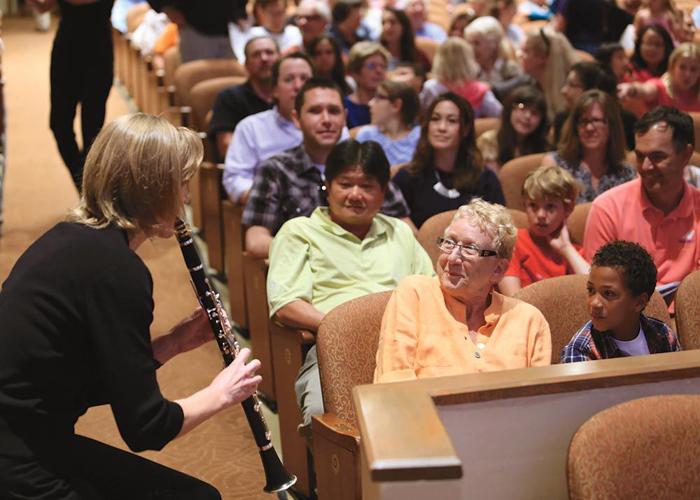
Clarinetist Ginger Kroft serenades the audience at the 2015 Carmel Bach Festival family concert.
We all abide by rules in restaurants, workplaces, civic ceremonies and our own homes. One local theater company prohibits babies from kids’ musicals.
David Gordon, tenor soloist and the Bach Festival’s dramaturge, says, “It’s inhuman to let people hear vibrant music and expect them to sit on their hands. I want classical music to find ways to make itself something friendly for kids.”
The energy of music finds a match in the souls of children. It inspires them to listen, dance, sing, react. To stifle that natural exuberant communion with music seems like the definition of repression. It’s an eerie sight to see rows and rows of concert-goers’ heads keep rigid as statues while passionate, rhythmic music courses through the air.
Rock-and-roll, hip-hop, dance and pop music have captured so many hearts because they deliver on their promise of exuberance, of release, of freedom.
Gordon concedes – Anderson does too – that it’s tricky balancing between, as he puts it, the “desire to be part of the music” by applauding or exclaiming, and minimizing distraction.
Though the Bach Festival has no official policy, Gordon says “the average kid under 5 will not be happy lasting through one of our concerts.”
That leaves open the possibility of partaking in part of a concert. My wife and I have left with our kids during the intermission of Monterey Symphony concerts.
Another source of friction seems to be in the definition of “disruption.”
In a report on his blog The Rest Is Noise, longtime New Yorker music critic Alex Ross defends audience noise: “Having been hissed at, [first-time concertgoers] may never attend again. And let’s remember that shushing is itself noise. I often hear ‘Shhhh!’ from another part of the hall without having heard whatever minor disturbance elicited it. There is something dismaying about this narrow-eyed watchfulness on the part of connoisseurs and this fearfulness on the part of neophytes.”
The venue makes a difference.
“To be doing your music and have noises interrupt the most fragile, delicate part of it is like being stabbed.”
The Monterey Symphony plays the same concert program at both the 1,500-capacity Sherwood Hall in Salinas and the 718-seat Sunset Center in Carmel. The ones at Sherwood Hall are cheaper, the audience younger and more diverse. Parents with kids will feel more comfortable there, where audience “noise” just comes across as atmosphere.
The symphony’s board chairman, Lee Rosen, says they “truly value our next generation of music-lovers” as evidenced by their discount tickets for children, students and families, and their hosting more than 6,000 children at 10 free youth concerts in the last school year. But…
“We rely on parents being sensitive to both the needs of their children as well as the needs of other audience members,” Rosen writes by email.
They’ve found that kids can endure – maybe that’s not quite the right word – about 45 minutes of classical music per sitting. But they’ve put together an FAQ guide about concert etiquette that addresses dress codes (formal wear is not necessary), clapping (wait until the end of an entire work) and coughing (try not to).
And about kids: “Are my children welcome to attend the concert? Yes!”
Anderson says she loves working with children’s’ voices, has taught them her entire life, and believes that the joy that music fills children with should be “completely indulged and channeled.”
Maybe toward open rehearsals, or kids’ concerts. But concerts like Fanfare, in her estimation, are a different matter.
“The concert, itself, for musicians, represents the apex of our preparation, devotion, discipline, technique development and careful study,” she says. “There’s a special relationship the instrumentalist has with sound.”
For classical music organizations worried about their audience aging out, they have to ask who is a concert for – the artist or the audience?
The Bach Festival offers family ticket discounts, and Carmel Music Society offers free tickets to kids in grades K-12 with a paying adult. But they have their mainstay audience to contend with: older people with disposable income, long free of the consideration of children, and maybe not ready to concede the etiquette.
Gordon tells the story of a conductor, Leopold Stokowski, born in 1882 in London, who was conducting an outdoor concert in the ’60s when an airplane flew over. He shook his fist at the plane and left the rostrum. (He later came back.)
At the Monterey Jazz Festival, the sound of airplanes soaring above the Fairgrounds has been immortalized on live recordings by Billie Holiday and Dave Brubek – who improvised it into his playing – the “disruption” just a unique hallmark of the place and the moment.
“If I were asked to adjudicate,” Klevan says, “I would go with the child. Let’s keep playing the music and enjoy real life in the room.”
Classical music has to surmount prejudices to find and keep new listeners: that it’s boring, elitist, obsolete, homogenous or requires study.
A classical music concert is not school. Kids do not have to attend. If they weren’t there, what would be lost? Maybe a long and mutually sustaining relationship between music and audience?
The next time a baby or child cries, exclaims, laughs or says, “Ooh. Big,” at a concert, it might help to hear it as the sound of the next generation being introduced to this beautiful inheritance of music.
(3) comments
A Response to “The Art of Listening”
Dear Editor – this letter is in response to the recent article, The Art of Listening. The article raises some very legitimate questions. It was occasioned by the author’s experience in a concert last May of the Ensemble Monterey Chamber Orchestra, of which I am the Conductor. In this concert, titled Fanfare, the orchestra was joined by Cantiamo! Cabrillo. Cantiamo! is a highly acclaimed, elite vocal ensemble.
One of the choir’s unaccompanied pieces, Oculus non vidit, by Ruhards Dubra, builds to an overwhelming crescendo of random sound followed by a sudden, dramatic silence. It was at the exact instant of this silence that the author’s 2 year old “vocalized.” I was sitting off-stage-left when this occurred while the choir was performing from the front of the Mission. What I and many others heard from the child was nothing less than a full-out yell.
Why should this matter? The answer is both complex and relational. Music, for me, and for many, is the aural and external expression of our own inward, and deeply layered emotive lives. There are as many styles, kinds and occasions of music as there are shades of our sentience, and as many ways to appropriately respond. For many listeners music is an expression of complete joy, to be joined by clapping and dancing. For others it is entertainment, to be enjoyed by laughter and commentary. These are just one end of the broad spectrum that is music. Beethoven taught us that at the other end of that spectrum lie both personal redemption and transformation to a higher realm of feeling and being. As serious classical performers and audience members we are not silent during such works because of some perceived code, but because the overwhelming power of these works rivets us into astonished and reverential awe.
A great painter crafts her work on a blank canvas. A great musician crafts his work on a blank canvas of silence. To disturb this silence is similar to defacing an art work. This may seem an overly dramatic comparison, but the concert work in question involved over 1,300 person/hours of intense rehearsal, not to mention lifetimes of training and discipline by all involved and the many thousands of dollars necessary to produce the concert. The only purpose was to convey a musical message of truth and beauty to the audience, but this was tarnished in an instant.
The author’s basic assumption, and one commonly held, is that “classical” music is dying as our audiences age. I first heard this argument over six decades ago as a young person in school music classes. I have heard it repeatedly ever since and I am convinced that it is wrong. The greatest music, classical or not, encompasses every human experience from the deepest grief and loss to the highest levels of joyful transcendence. In order to respond to this music a listener usually requires considerable life experience and the emotional maturity and age that come with it During my lifetime, our audiences have not been aging out, but aging in.
I applaud Mr. Ryce’s good intensions in bringing his toddler to the concert. Was it an appropriate concert for a two year old? Probably not, and after this our group will make this clear in order to aid parents. There are many other musical settings in which exuberant children can flourish, and I hope that Mr. Ryce seeks these out. I highly recommend the web article: HOW TO GET (YOUR KID) TO CARNEGIE HALL, at https://www.babble.com/entertainment/how-to-get-your-kid-to-carnegie-hall.
As for the child’s outburst, I choose to take it as a positive review.
Dr. John Anderson
Conductor, Ensemble Monterey and
Chair, Division of Creative Arts
Monterey Peninsula College
Great article - I'm totally for including children in everything. I took my daughter everywhere - even when she was a baby - and usually she was just fine. If she became loud or fussy, I'd remove her from the place. She learned how to behave in restaurants and concerts and any other place by observing the adults around her - that's how kids learn - and basically she was what people would call 'well-behaved' in public places.
I respect parents who are ready to take the child outside if he or she get fussy or starts to cry. I dislike having a meal out or a concert ruined by a screaming kid whose parents are totally oblivious to the noise. At a recent Monterey County Symphony concert a family with several small children sitting behind us where talking, jumping around and crunching on potato chips (and crackling the bags) so loudly that I found my self turning around to glare - and ended up moving away so I could enjoy the concert.
If child is just doing what normal kids do, whispering or commenting, squirming around in the seat - there is certainly no reason to eject him or her from the concert. I think for this concert director, it was definitely more about her and her music than it was about audience enjoyment. So much for attracting a younger audience - LOL!
Great article and a wonderful closing sentiment... we need to as humans realize we do not exist in a vacuum, that this path is not our path with others getting in our way... the way is shared, the path is our shared adventure on this earth... a child being awed should be a beautiful thing to us, knowing that what we love is being introduced to a new experiencer should be the realization of what we want most! We should be proud of this... because it really is a beautiful thing.
Welcome to the discussion.
Log In
Keep it Clean. Please avoid obscene, vulgar, lewd, racist or sexually-oriented language.
PLEASE TURN OFF YOUR CAPS LOCK.
Don't Threaten. Threats of harming another person will not be tolerated.
Be Truthful. Don't knowingly lie about anyone or anything.
Be Nice. No racism, sexism or any sort of -ism that is degrading to another person.
Be Proactive. Use the 'Report' link on each comment to let us know of abusive posts.
Share with Us. We'd love to hear eyewitness accounts, the history behind an article.