
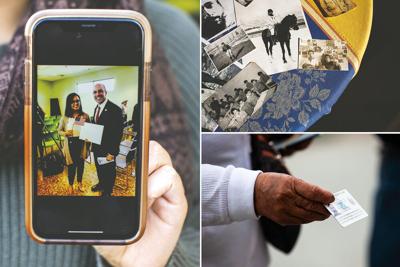
SINCE THE EARLY 2000S, IMMIGRATION HAS BEEN THE SUBJECT OF COUNTLESS HEADLINE-MAKING POLICIES. President Donald Trump ran on a campaign of building a wall on the U.S.-Mexico border to keep undocumented immigrants out of the United States. He enacted the so-called “Muslim Ban,” and tried multiple times to rescind-the Obama-era policy of Deferred Action for Childhood Arrivals (DACA). And the past three presidents – Barack Obama, George W. Bush and Trump – have all at some point separated families entering the country illegally and increased deportations.
A lot of fervor accompanies the policy debate over immigration, despite stagnation for decades. In federal policymakers’ eyes, the last major piece of legislation that could provide an eventual pathway to citizenship was in 1986 under the Immigration Reform and Control Act, signed by President Ronald Regan. It marked the first time in U.S. history that employers could face financial penalties for employing undocumented workers. But it also granted amnesty to around 3 million undocumented immigrants who were already in the country. By most estimates, around 1 million of that cohort eventually became citizens.
In the background of the immigration policy debate, there is a common refrain: Do it the legal way. The legal process for becoming a citizen is mostly a bureaucratic one, more than a political matter. In the simplest terms, it involves filing paperwork; paying a fee (today, $640 – in October, a federal court order has blocked U.S. Citizenship and Immigration Services from raising that fee to $1,170); taking a civics test of 10 questions; then being sworn in.
But things can get complicated and be delayed in the legal channels, too. U.S. Rep. Jimmy Panetta, D-Carmel Valley, knows firsthand because he has a number of staffers who work on immigration and citizenship cases. “I am that bridge back and forth from the government,” he says. “And these days, the number of those who lose faith in our government is growing.”
People lose faith for a number of reasons when it comes to immigration, Panetta says. Policies are always changing, people don’t know what immigration status they are eligible for and the paperwork contains jargon that only an attorney can interpret.
There are an estimated 60,600 undocumented immigrants who are working in Monterey County, according to a 2017 analysis by the Institute of Taxation and Economic Policy, and an estimated 10.5 million in the U.S., according to the Pew Research Center.
While Washington policymakers debate the fate of undocumented immigrants, the Weekly set out to look at some stories of people who have already taken existing (legal) pathways to citizenship. There are an estimated 9.1 million people in the U.S. who are lawful permanent residents, or LPRs, who are eligible to become citizens, with California having the most of any state at an estimated 2.34 million LPRs in 2019, according to the U.S. Department of Homeland Security. That’s 2.34 million people in California who could potentially vote, run for office, qualify for certain government programs, move freely between counties and access other benefits.
Panetta’s immigration team is in part responsible for turning that potential into reality, helping applicants navigate the process. Often, his team is not needed and a resident becomes a citizen within roughly seven months. For others, the process can take years.
Panetta says immigration gives the United States an innovative and competitive edge on the global stage. “The Central Coast generally has an understanding of the value of the huge sacrifices immigrants made to fulfill their dreams here,” he says.
The privileges of the American Dream have drawn immigrants who are fleeing their countries or just searching for a better life to the U.S., and the privileges of citizenship have drawn many to apply for and receive citizenship status. In Monterey County, they include people like María Ambriz, Kayhan Ghodsi and Jesus Alvarez Espinoza. The stories of their legal immigration journeys are below.

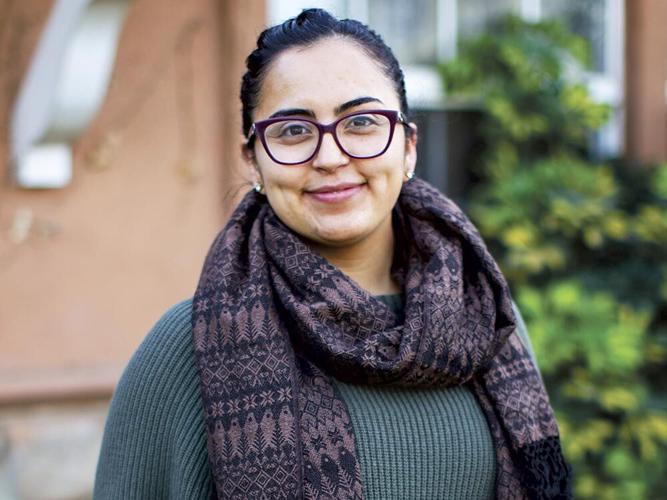
María Ambriz says her dad’s work in agriculture motivated her to pursue her education. “My dad would come home dirty and beat up,” she recalls. “He’d say stuff like, ‘This is why you go to school so you don’t come home like this. If you go to school, you control how you work – your work doesn’t control you. If you’re hot you can put the AC on. If you’re cold, put the heater on.’”
MARÍA AMBRIZ WAS BORN IN A SMALL TOWN IN MICHOACÁN, MEXICO AND FROM WHAT SHE REMEMBERS, SHE HAD A GREAT CHILDHOOD. Her family, though poor, grew and harvested corn and made a living through farming. Her father put in extra work. He would come and harvest corn during the winter and during the rest of the year, he’d go across the U.S.-Mexico border to pick a variety of crops on the Central Coast. “He was everywhere in this area,” Ambriz says. “Watsonville, Castroville, Salinas.”
Though this was a happy time in her life, there were some harsh realities about growing up poor and in rural Mexico: lack of education and upward mobility.
“The United States has a better quality of education and more opportunities, scholarships and everything,” she says. Eventually, her father found a pathway to a better life: he received amnesty in 1986 under the Immigration Reform and Control Act, becoming a permanent resident.
Ambriz and her siblings followed years later in 2000, when everyone in her family was granted permanent residency. She was 6 when she rejoined her father permanently in Salinas. It was a bit of culture shock moving to the U.S. at first, despite having some cultural insulation being surrounded by other Mexican families like hers in Salinas.
Ambriz graduated from Everett Alvarez High School and went on to study politics and community studies at UC Santa Cruz. Eventually, she became a community organizer for the Monterey Bay Central Labor Council. Her job was to connect low-income workers – many of them migrant workers like her father once was – with resources and sometimes even help them apply for citizenship.
It hadn’t occurred to her that she too could benefit from U.S. citizenship. Then Donald Trump was elected president. She saw how his rhetoric and policies struck fear into the people she was helping in her job. “It was all his crazy threats,” she says. “How could someone say that and do that?”
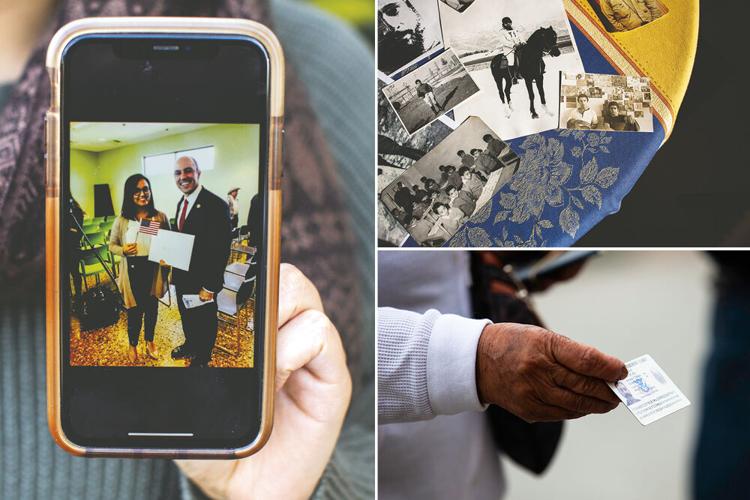
Then came another motivation: She attended a swearing-in ceremony for newly naturalized citizens on Cesar Chavez Day in 2017 at the Cesar Chavez Library in Salinas, and heard Panetta address the group.
“He talked about our duty to serve and engage in our community and the importance of voting in elections,” Ambriz says.
It was that speech that inspired her to take action and apply for U.S. citizenship herself.
It was largely a straightforward process for her. Ambriz already knew how to fill out the N-400 application from work, and her documents were in order. She could speak English fluently and had been mostly educated in the United States. With some monetary help from her family for the application fee, she submitted her application. She breezed through the civics test since she learned American history in school. In October of 2017, she was sworn in.
It was that step, the end of the naturalization process, that was the hardest for Ambriz. She knew as a part of her oath she would have to renounce her loyalty to any other country, including her homeland of Mexico. Ambriz occupied both identities, growing up in the United States but was also proudly Mexican. But she recited the oath of allegiance to the United States – “I absolutely and entirely renounce and abjure all allegiance and fidelity to any foreign prince, potentate, state, or sovereignty” – and became a U.S. citizen.
At 27, she voted for a U.S. president for the first time (it wasn’t Trump). She continues her work helping immigrants, many of whom are from Central America and Mexico, unionize in her capacity as a field organizer for the International Brotherhood of Teamsters.
Today, Ambriz is confident in embracing both her citizenship and culture: “I can be both,” she says. “I’m Mexican and I’m American.”

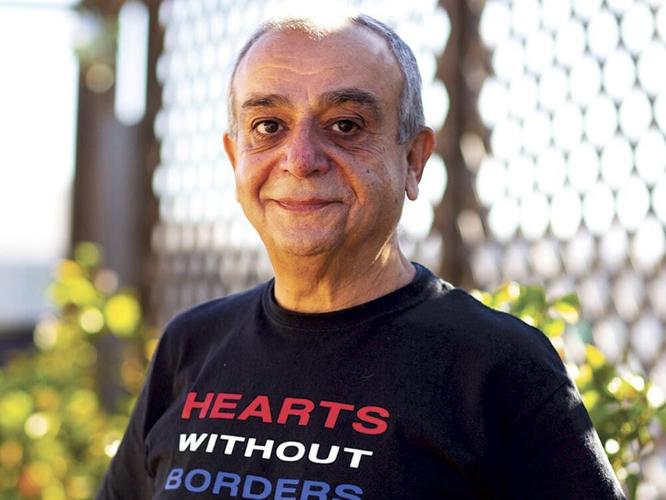
Kayhan Ghodsi had fond memories of his childhood in Iran and when he initially returned with his wife, Margaret White, he had no intention of leaving. But the political climate grew tense and the Iran-Iraq War made things worse. So he made the difficult decision to leave and built a permanent life in the U.S.
KAYHAN GHODSI WAS BORN IN IRAN FOUR MONTHS AFTER THE CIA-BACKED COUP REINSTATED MOHAMMAD REZA PAHLAVI AS SHAH IN 1953. That was good for him at the time because he came from a military family and wanted to continue the tradition. Unfortunately for young Ghodsi, he was turned down for service “because I had flat feet,” he jokes.
Looking for another career path, he left Iran. He went to college in Paris in 1973, where his brother was studying on a scholarship. He graduated after five years there, then decided to move to California in 1978 to study at the San Francisco Art Institute. There, he met his ex-wife; they eloped in 1979 and Ghodsi graduated in 1980.
Meanwhile, his home country was going through immense changes. It started with the 1978 Iranian Revolution, and when he returned to Iran (wife in tow) to help do some technical work for various news agencies in 1980, Iran was at war with Iraq.
His country that he loved had changed. “You could smell the fascism when you stepped off the plane,” he says. “The customs agent looked at my wife and then looked at me and said, ‘You know all women here wear a hijab now.’”
At this point Ghodsi wasn’t a permanent resident nor a citizen of the United States. He didn’t have a green card or a work visa. He hadn’t planned to return to the U.S. But after two years in Iran, they were making plans to leave the country. His wife, a U.S. citizen, could come and go from Iran, but Ghodsi couldn’t. So he called in a favor from someone he knew working at the German Consulate to get him a visa to travel back to the U.S. via Germany.
The roundabout plan worked. In 1983, he returned to the U.S. on a regular traveling visa and promptly applied for a green card, which would allow him to stay as a permanent resident. He got a job at the Hyatt Regency, had two daughters and eventually opened his own 600-square-foot cafe in Berkeley in 1988. He served tea, coffee, salads and sandwiches to a steady flow of regular customers, befriending many of them.
One of those customers/friends was Contra Costa Deputy District Attorney Gary Koeppel, who convinced Ghodsi to apply for U.S. citizenship.
“I never really thought about it,” Ghodsi recalls. “But he said to me, ‘If you want to live here, it is your duty to vote.’”
It was still a difficult decision. Though Iran has changed, he still held on to certain traditions – drinking black tea in the afternoon, celebrating the Iranian New Year – and it wasn’t easy to renounce that part of himself.
“I looked at my daughters and they are half me, half American,” he recalls.
But in 1990 he decided to apply. A lawyer friend helped him with the paperwork. And within less than a year, in 1991, Ghodsi became a U.S. citizen.
Today he resides in Sand City, where he’s an artist and an organizer in his community. For the first time, he ran for office, seeking a seat on Sand City City Council in November. (He lost.) Seeking elected office was in some ways the culmination of his rights as a citizen, even if he still holds onto his Iranian identity: “Culturally, I am homeless,” Ghodsi says, “but I’m an American citizen.”

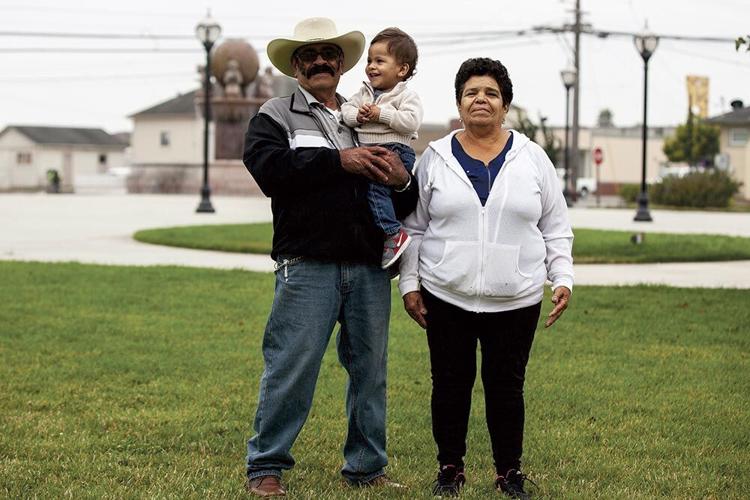
Jesus Alvarez Espinoza and Carolina Alvarez have lived in Monterey County since 1984, and in 2018 applied for citizenship. Jesus is still waiting for a lengthy process to conclude after years of gathering and filing paperwork.
THERE ARE SOME NATURALIZATION CASES THAT ARE EASY, AND SOME THAT CAN TAKE YEARS. If an applicant has been a permanent resident for at least five years, speaks passing English, is under the age of 50 and has all their essential documents (birth certificate, green card, social security card, etc.) in order, becoming a United States citizen should take about seven to 10 months. But there are cases like husband and wife Jesus Alvarez Espinoza and Carolina Alvarez, who applied to become citizens back in April 2018.
Within a month of filing their papers they started attending citizenship classes at the Castroville Library, where they could both learn and practice for the required civics examination. There are 100 potential questions on the test, and prospective applicants are asked to answer 10. Carolina has low-level literacy in Spanish, and cannot read in English. In cases like hers, the U.S. Citizenship and Immigration Services allows nonnative English speakers over the age of 50 to take their civics test in their native language. Instead of relying on reading, even in Spanish, she memorized all 100 potential questions – and she aced the test in 2019 and was sworn in as a citizen.
Her husband, however, has not completed the process. He was born deaf, and does not have the ability to talk.
Richard Shields, a volunteer at the library who has been helping the couple with their citizenship process, translated a conversation with the Weekly. The only thing Jesus is able to do in terms of reading and writing is sign his name. “It was because his father made him put together the letters when he was young – this is all he can do,” Shields explains.
Jesus’ disability meant they needed letters from his primary care provider, plus additional forms that non-disabled applicants don’t have to provide. Shields recommended they get support from Panetta’s immigration caseworkers. They helped Jesus find the correct paperwork and identify problems in his applications, so he and Shields understood what was needed.
Born in Tierras Blancas, in Michoacán, Mexico, Jesus and Carolina moved to Monterey County in 1984, when he was 28 and she was 30. They left their five children with relatives in Mexico, before establishing Castroville as their home and then raising the rest of their three youngest children there.
Jesus and Carolina worked in the fields and processing plants, mostly in strawberries. When work slowed down in the winter, Jesus was always one of the few lucky workers his employers would keep on to help with processing.
But at 64, the physical labor is catching up with him. Citizenship would mean he would have an easier time getting unemployment benefits. He could technically claim unemployment as a permanent resident, but that would require his green card, which is physically enclosed with his immigration application. Jesus says primarily he wants citizenship so he can move more easily between California and Mexico, where family still lives.
Shields, interpreting for Carolina, offers a more urgent perspective on why: “They’re going to need those benefits. He’s an older guy and come winter, they’ll be overwhelmed with a small grandchild to take care of.” (The grandchild they’re taking care of is barely a toddler, the son of their youngest son.)
Jesus was scheduled to be sworn in back in September, but then USCIS informed him they needed even more paperwork: a confirmation that his children were citizens. They say the paperwork was signed, but Panetta’s caseworkers – who are helping mediate the process between him and USCIS – have yet to receive or process the extra pages.
“It’s frustrating because he’s just been waiting so long – years at this point,” Shields says.
Jesus has yet to have a set date to be sworn as a citizen.
(0) comments
Welcome to the discussion.
Log In
Keep it Clean. Please avoid obscene, vulgar, lewd, racist or sexually-oriented language.
PLEASE TURN OFF YOUR CAPS LOCK.
Don't Threaten. Threats of harming another person will not be tolerated.
Be Truthful. Don't knowingly lie about anyone or anything.
Be Nice. No racism, sexism or any sort of -ism that is degrading to another person.
Be Proactive. Use the 'Report' link on each comment to let us know of abusive posts.
Share with Us. We'd love to hear eyewitness accounts, the history behind an article.