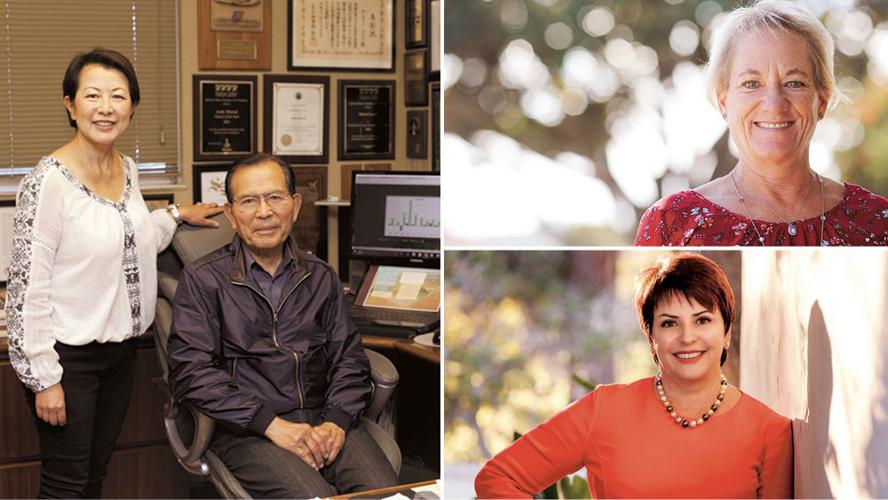


(L) Teresa Matsui says her drive to be philanthropic is to advance the work her father, Andy Matsui, started: “My motivation is just honoring my father.” (UR) Margaret D’Arrigo-Martin says she got involved in volunteering as a kid alongside her mom, who was passionate about programs supporting foster and adopted youth. D’Arrigo-Martin and her five siblings are adopted. (LR) “If we’re able to improve things for others and create opportunities, it’s up to us to help pay it forward,” Tonya Antle says.
The growing wealth gap and 1-Percenters are now part of the vernacular nationwide, and the disparities are on display every day in Monterey County: There’s hunger in the Salad Bowl of America, homelessness where the world’s wealthiest recreate and a lack of library services where the favorite son is a Nobel Prize-winning author.
Philanthropy presents one way to shrink those disparities, leveraging wealth for the benefit of people and organizations that need it most – to run housing programs, homeless shelters, art museums, music groups. Donors may get their names emblazoned on libraries and schools, but they give for other reasons: because they care and they want to see a stronger, more vibrant community.
And they give big. The annual Monterey County Gives! campaign, which launches Nov. 9, has raised more than $9 million since 2010. But there are many millions given independent of MCGives! This year, the Monterey Peninsula Foundation and Community Foundation for Monterey County – two of the partners in MCGives! – anticipate distributing $35 million in grants.
“You’d be really, really hard-pressed to go to another market our size and find two foundations generating that kind of grantmaking,” says Dan Baldwin, president/CEO of the Community Foundation. “There’s no question that this is a very generous community.”
For proof, he points to 2016 data compiled on behalf of the Foundation Center, comparing hundreds of community foundations across the country. Monterey County ranked 31st for gifts per capita, at $83.24.
Baldwin notes a trend he’s seeing: reinvesting in education at a local level. In the past year alone, three donors have worked with the Community Foundation to launch scholarship funds to support their employees and employees’ family members to attend college. They’re the True Leaf Farms Scholarship, of the Salinas agribusiness Church Brothers; the Morse Foundation of the Monterey Peninsula Country Club; and the Raymond H. Costa Family Scholarship Fund launched by Raymond Costa, who owns 10 McDonald’s franchises in Salinas and the Salinas Valley.
“We have stepped up our attention and emphasis on developing scholarship funds,” Baldwin says. “We’re seeing lots of evidence that people care about the future of the county. Philanthropy is one of those really wonderful barometers of how much people care about a place – and the people and its future.”
The Weekly spoke with three local philanthropists, all influential women, about why they give and what philanthropy means to them. Tonya Antle is a co-founder of a new business, Organic Produce Network. Along with her husband, Tanimura & Antle CEO Rick Antle, she donates to the Boys & Girls Club, Salvation Army and the Women’s Fund of the Community Foundation for Monterey County.
Margaret D’Arrigo-Martin is a third-generation D’Arrigo of the agribusiness company D’Arrigo Bros., and now the vice president of community development at Taylor Farms. She funds two scholarship funds at Hartnell College: The Alexis Claire Martin Fund, named for her late daughter, and the Margaret D’Arrigo-Martin Fund. She’s also a co-founder of IMPOWER, a women-focused group operated by the Salinas Valley Chamber Foundation.

The Matsui Foundation’s gift of land, valued at $20 million, to Hartnell College earlier this month is the largest gift in Hartnell’s history.
Teresa Matsui, president and CEO of Matsui Nursery, a Salinas orchid grower, is now the sole employee the Matsui Foundation, started in 2004 by her parents, Andy and Mary Matsui. The foundation has granted more than $5 million in scholarships to 146 Monterey County students, and over $4 million in three-year scholarships to computer science students enrolling in the CSin3 bachelor’s degree program offered by Hartnell College and CSU Monterey Bay. On Nov. 2, Teresa announced the foundation would be making a gift of 215 acres of land – valued at $20 million – to Hartnell, the biggest gift to the college in its history.
Weekly: Do you consider yourself a philanthropist?
Antle: I would hope everyone can consider themselves a philanthropist. I think of it as giving your time, talent or treasure, or possibly all three, toward a community program or nonprofit. Everyone, no matter your age, education or economic status, can be a philanthropist.
At the annual Women’s Fund luncheon, everybody does check-writing. We get teary-eyed because girls who are just starting out are writing $10 or $15 checks, a significant amount to them. It’s come full circle: It’s, “You helped me, and I want to pay it forward.”
D’Arrigo-Martin: Absolutely. Philanthropy is a huge part of who I am. I was raised in a very fortunate situation; my mom was always out in the community volunteering, and I started volunteering when I was very young. I tend to give a bigger amount to a few, rather than sprinkle it around, because I want to narrow down my scope and focus on women, youth and education.
What inspired you to start giving philanthropically?
Antle: There were two entry points for me. The first was through our kids doing service hours (through a school program). Our kids come to us each Christmas and say, in lieu of a gift, please give to a nonprofit. That was my aha! moment – that service hours really did translate to philanthropy. It makes me very proud.
Becoming an Antle was also an entry point for me. Rick’s great-grandparents came west during the Dust Bowl migration. The Salvation Army was there when they needed it most. When you come from a modest upbringings, you always give back to those that took care of you.
Matsui: In my dad’s business, he became successful beyond his wildest expectations. When someone comes into a significant amount of wealth and never expected it, I think most people would naturally feel a sense of wanting or needing to share it.
And recognizing it wasn’t entirely one person’s doing – there are others who contributed to that success. It’s the sense of wanting to share one’s good fortune.
My parents also have a strong Christian faith. There are a number of factors. “I have money that I don’t need, my business doesn’t need, my kids don’t need” – that was how my dad approached his scholarship recipients.
D’Arrigo-Martin: My daughter was born in 2003 and died at 6-and-a-half weeks from sudden infant death syndrome. [Philanthropy] helped me to get through my grief when I was dealing with that. I was in so much pain. When something like that happens, money becomes kind of immaterial. I joined the national board of First Candle/SIDS Alliance, and became a SIDS advocate and grief counselor.
I resigned after six or seven years on that board. I really wanted to get back into my community and make an impact here locally. My daughter really inspired me to do more.
How do you decide what causes to support?
Matsui: Education is something really practical. It’s easy to understand the connection between: I give money for a scholarship, and a young person has been able to go to college. Perhaps they become a teacher or a doctor, a scientist, a businessperson – you can see a fairly clear line between the act of giving and very tangible results.
D’Arrigo-Martin: Most of my donations have been for scholarships at Hartnell, primarily to women in the community. I don’t really care what they’re studying, I just want to help women. There are so many women out there in the community that don’t see opportunity for themselves, whether it’s going into STEM or agriculture. I want to support them in any way I can.
Antle: Rick and I have chosen to give to nonprofits that directly improve the lives of our [T&A] workers and their families. That’s our filter.

Donations from Tonya and Rick Antle helped expand Girls’ Health in Girls’ Hands from serving 18 kids about a decade ago to serving 700 a year.
How do you know if it’s working? Are there metrics, or any follow-up, to see if your philanthropy is having an impact?
D’Arrigo-Martin: I really have no strings attached. In one case, of a young woman at Hartnell, she wants to be a photographer. I used my fund to buy her the camera of her dreams. I said, “Check in with me in six months, I want to see some of your work.”
Antle: My touchpoint on that is Girls’ Health in Girls’ Hands, a program of the Women’s Fund. We got involved 10 years ago. It started with 18 young ladies in King City and they were at a crossroads: They were worried about not getting into a gang, not getting pregnant, and graduating high school. Then 17 of the 18 went on to college.
That program now helps over 700 young ladies throughout Monterey County each year, and this year gave out almost 40 scholarships to young ladies going on to higher education.
It’s in its 10th year, and over 86 percent of participants say they can see them going beyond high school. That is huge.
There are a lot of established organizations you can give to that advance these missions on a national scale. Why give on a local level?
Antle: When I go to a Girls’ Health in Girls’ Hands retreat, I see the impact. We’re at Asilomar State Beach, and some of these kids have never seen the ocean. We go sit on the dunes and have our sack lunch and talk about college and family. That’s direct connection, and connectivity is so important. I see it firsthand.
Matusi: My dad’s original intent was he hoped that students would gain a college education and then have reason to come back to the Salinas Valley and Monterey County. A number of students have done that. But what we were seeing, especially with computer science students, was the vast majority of them were getting jobs outside the area, at top class tech firms and financial services firms. They have great prospects. But they’re not coming back and contributing to the fabric of the community, because we just don’t have the kind of tech jobs these graduates can command. We thought about, well, should we continue to support this?
I started to feel this program is producing a pool of potential employees for huge Silicon Valley companies that have plenty of cash, and want greater diversity in their workforces – and each of our classes was close to 50-percent female and 80-percent Latino. It got to the point where we started thinking, maybe these tech companies should be putting their money where their mouths are and supporting program like this.
There are needs in the community right now. Some of the programs being offered at Hartnell lead to jobs in health care or vocational training like learning how to be a welder. It dawned on us, an institution like Hartnell could really leverage this [land], and do something amazing that could benefit far more people than our individual scholarships ever could.
I want to talk about the role of philanthropy more broadly. When we rely on donations to fill the gaps and help meet basic needs – housing, food, education, arts institutions – is it a sign that we’re not doing something right as a society? Should we be relying on generosity to achieve these things?
D’Arrigo-Martin: I’m torn on that. I realized long ago our community is very unique, and the ag community is extremely generous. I think they feel a sense of obligation to give back because they are so successful. They want the community to be rich as far as culture, education, people – they want the community to be successful. They do it willingly.
Companies are very successful, and take that and reinvest it into people and community.
Antle: I think we’re in troubling times in general. I’m so frustrated. It’s hard to watch the news. Our world has never been perfect. Until things change, there is great need right here in our own backyard.
If you look at the Greek definition of philanthropy, it is the love and caring of all humanity. I think that is beautiful – and brilliant. It’s about sharing the love and care for others.
With that in mind, it’s part of the big picture: There are so many things that need to be done. We need to fill the gap where government isn’t doing their part. And we are so fortunate in Monterey County, where we are taking care of our own. It makes me really proud.
(0) comments
Welcome to the discussion.
Log In
Keep it Clean. Please avoid obscene, vulgar, lewd, racist or sexually-oriented language.
PLEASE TURN OFF YOUR CAPS LOCK.
Don't Threaten. Threats of harming another person will not be tolerated.
Be Truthful. Don't knowingly lie about anyone or anything.
Be Nice. No racism, sexism or any sort of -ism that is degrading to another person.
Be Proactive. Use the 'Report' link on each comment to let us know of abusive posts.
Share with Us. We'd love to hear eyewitness accounts, the history behind an article.