
A poker chip weighs 11.5 grams. It feels heavy, solid and valuable in your hand.
Most card players have this way of shuffling their chips. They can’t keep their hands off them while they stare at the ever-changing array of cards. They accordion them back and forth from one hand to the other like tiny Slinkies. Or repeatedly lift and drop the stacks on to the green felt of the table with a precise, cascading rhythm.
Accented by the taut slaps of the cards and the murmur of the dealers, the chips create a percussive soundtrack to the drama of Mortimer’s card room in Marina. Yet more often than not it’s a song of unrequited love. They may own those chips now, but chances are they will be someone else’s soon.
~:~ ~:~
At any given time there are two primary games running at Mortimer’s: blackjack and Texas hold ’em.
Neither is what I would call “recreational.” The players are almost all locals and all regulars.
But the blackjack table is far more forgiving for a hack like myself, primarily because you can convince yourself you’re only playing against the dealer – which really isn’t true, but I didn’t figure that out until the general manager pointed it out to me days later. Regardless, there is more laughter and camaraderie at the blackjack table. The other players can be encouraging and, if you’re lucky, they might even give you some advice. But again, I’m not a capable card player and, in hindsight, that advice was terrible.
In contrast, the Texas hold ’em players are as stern as border guards. Many of them wear sunglasses, headphones and hats pulled sharply down over their foreheads. They rarely speak, hardly move and many spend so much time at the table that they take their meals there – typically Korean food brought in from the restaurant up the street.
I spent three long days and nights at Mortimer’s and never summoned the courage to sit at the Texas hold ’em table.
I am not long on common sense, but once thought I could sense when I was out of my depth.
I was wrong.
Even as I avoided the shark tank, I still managed to lose most of what I will be paid for this article.
~:~ ~:~
“David” is a 31-year-old poker player from the Monterey Peninsula. He’s widely considered the best in the county and is universally admired by his colleagues as a legitimately nice guy. Regardless, as one other player said with a laugh, “I don’t like to play with him.”
Dressed in baggy clothing, sunglasses, an Oakland Raiders hat and Beats by Dre headphones, he sidles in on a Friday night and takes a seat at the hold ’em table. On Sunday he will fly out to Las Vegas to enter the World Series of Poker for the fourth consecutive year.
David asked not to be more precisely identified because – between scaring away invites to illegal cash games and the threat of robbery – it’s still something of a liability to be a high-profile poker player in Monterey County. He started playing poker as a teenager in local house games. He discovered an aptitude. Although he doesn’t play much at Mortimer’s anymore because the stakes are no longer high enough (the room discontinued no-limit games years ago), it’s still where he got his start when he turned 21, and everyone in the place warmly greets him. After a few years of honing his game there he began branching out to Tahoe, San Jose and eventually Las Vegas.
Eight years ago, he was working at the front desk of a Monterey hotel and realized he could make more money playing poker, so he went pro. Like many other young players, David was initially inspired by the legendary Chris Moneymaker, the everyman who came up through the Internet poker community to win the main event at the 2003 World Series of Poker.
Today, players speak about Internet poker in hushed tones. In 2011, the U.S. Justice Department raided the three most popular poker sites – PokerStars, Full Tilt Poker, and Absolute Poker – and shut them down overnight, seizing about 76 bank accounts in 14 countries and five domain names. After the raid, the thriving online poker scene folded like a bad hand. As a result, most players shifted to live games like those played at Mortimer’s and, across the street, at Cal’s Marina Club.
There are still ways to play online, but no one will readily admit that they do it. Yet despite the bad press generated by the online raid, poker’s general reputation has enjoyed a significant boost in the last decade.
“Poker used to be frowned upon,” David says. “But ever since ESPN started televising the World Series, now it’s more of an accepted sport. Moneymaker made it clear that it didn’t matter what your credentials were, if you had game, you had a shot.”
Yet it hasn’t always been an easy ride for David. In 2010 he almost went bust after a bad run in a series of no-limit games. He knew he was good, but recognized he needed to evolve as a player if he wanted to step his game up to the next level. He focused on more efficient “bankroll management” and rigorously studied game theory. After a few big tournament scores, he managed to right his financial ship and in the last few years, certain doors have begun to open up – including sponsored berths in the World Series.
“Make no mistake,” David says. “Poker is the most complete, cerebral, strategic game there is. You never see the same situation. It’s a game of super-high variance. You have to look at large sample sizes and you’re constantly gauging the influence of the cards, the chip stacks, player personalities… it’s 80 percent skill.”

Daytime Mortimer’s bartender Elaine Rude works as den mother of sorts for the Marina landmark.
The dealers at Mortimer’s aren’t a particularly talkative bunch, whether they’re dealing or not. Trevor Hartman deals across the street at the Marina Club and he’s been in the business since 1992.
After attending dealer’s college – yes, there is such a thing – he began his career in Los Angeles and worked in San Jose before ending up in Marina.
When asked why he does it, he shrugs and says, “It’s a job.”
The Marina Club is the smallest place he’s ever worked. According to Hartman, that has an upside. “There’s a lot more camaraderie here and the gamblers are far more responsible. You don’t hear as much about people losing their houses and businesses,” he says. “To be frank, there are just a lot more assholes in Los Angeles and San Jose.”
Hartman says there is an allure to the casino business, but also a dark underbelly. The job requires long hours and what Hartman calls “exhausting mental strain.” Dealers have to be flawless and fast, like machines, hand after hand, hour after hour. And the stakes are high for them as well. When fortune goes south for a player – especially a drunk player – they look for anyone else to blame other than themselves. The person slinging the cards in front of them is a very easy target.
“People come to enjoy themselves and when they’re in a good mood, then it’s a fairly pleasant place to be,” he says. “But more often than not there’s just this looming cloud of negativity because of the losing.”
I WOULDN’T CALL THE PLACES “FUN.” THERE IS A LOT AT STAKE.
What’s the biggest player meltdown Hartman has ever witnessed? “Some guy lost it all and decided to pull out his dick and piss on the dealer,” he says, shaking his head. “You can’t get paid enough to deal with that kind of abuse.”
Granted, that story’s an extreme exception to the rule. During the three days I spent in the Marina card rooms I saw mostly respectful, focused players and, like Hartman says, a climate of camaraderie. Nonetheless, let’s just say I wouldn’t call the places “fun.” There is a lot at stake.
On Saturday night I played next to a gentleman in his 60s who was draining gin and tonics and betting heavily. When he’d depleted his generous stack of $20 chips, he called the floor manager over and asked for “another” $5,000 in chips with a desperate joviality. Everyone at the table gave each other a somewhat pained and slightly amused look. When the floor manager returned and asked for a check to cover the chips, this man was too buzzed to accurately fill it out on the first try.
But the floor manager knew him by name so I assume he’d done this before and I hoped he could afford it. Hell, who am I to tell some retiree how to spend his money? Regardless, by the time I got up from the table, he had already blown through a sizable number of his replenished stacks.
A simple takeaway there: Alcohol is not a gambler’s friend, which is a big reason why both of Marina’s card rooms are conveniently attached to bars.
~:~ ~:~
Like the card room itself, Mortimer’s décor has not changed much in decades. Also, like the card room, it caters to a tight-knit crew of locals that know each other intimately.
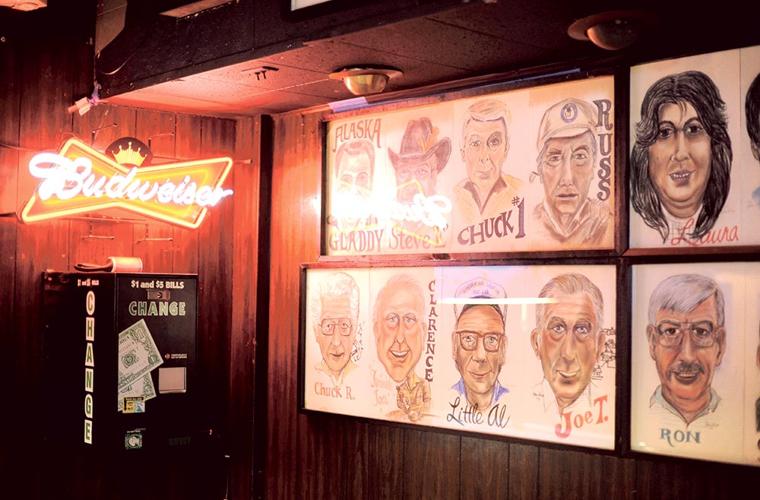
On the dark wall of Mortimer’s is an extensive gallery of framed caricatures representing aged men and women with nicknames like Zipcode, China Charlie and 3 Card Monte. Their grotesquely exaggerated and sagging features gaze down into the gloomy room and watch the regulars’ backs as they hunch up against the bar.
“Those are all the people who have died,” Elaine Rude says from behind the bar. “They were the morning crew who would show up at 6 in the morning… for decades.”
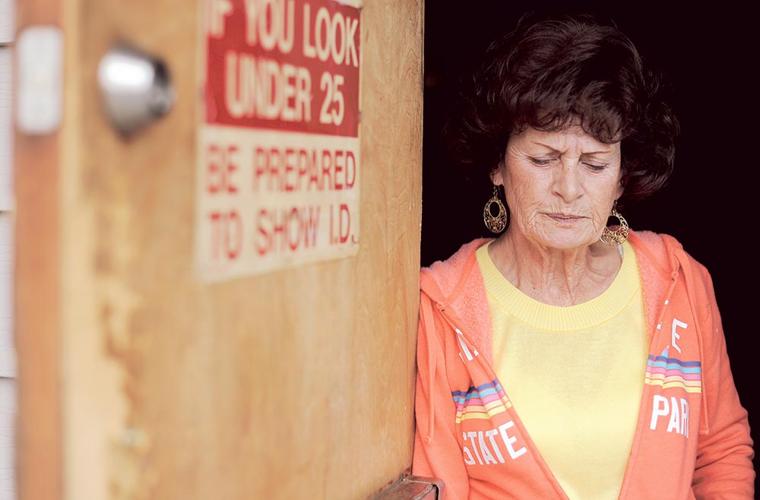
Rude would know. She’s been working behind the bar at Mortimer’s for 27 years. Although she’s turning 70 this year, she still dresses impeccably in color-coordinated outfits and maintains a fine coif of suspiciously dark hair. She also takes no shit from anyone and patrols the place with an air of indifferent, slightly exasperated confidence.
A few days after she told me about the gallery of dead drinkers, I found her own caricature up there in the far upper left corner of the wall.
She just smiled, “Well, we’re not all gone yet.”
When asked about the card room next door, she shrugs her shoulders. “I don’t really pay attention to what goes on over there anymore. They come and get drinks and go back,” she says. “It used to be funner though, I tell you that. Everyone’s so damn serious these days.”
When I ask her what was fun about it, she is momentarily demure.
“When Fort Ord closed, everything changed,” she says. “But that’s an old story. No one wants to hear that around here anymore.”
Instead, she tells me a story about a gambler who lost his car’s pink slip to one of the other players about 20 years ago.
“A couple hours later the guy’s wife showed back up with the police,” she says with a laugh. “Boy, was she pissed. Didn’t see him for a long time – though I did just run into him a couple months ago. Seems to be doing alright now.”
Rude is something of a den mother for the day crew of regulars. Among them, there’s C., an avid science fiction reader and Budweiser guzzler who appears to work there in some capacity, depending on who’s behind the bar. His father brought C.’s family to the area when he was stationed at Fort Ord 40 years ago. But long after his family moved on, C. has stayed in Marina. He’s happy to chat about just about anything, but lights up when you ask him about whatever paperback he has stuffed in his back pocket. His knowledge of the science fiction genre is impressive, but his ability to articulate these ideas – for instance, the merits of being a dragonrider in Pern – has a tendency to wane as day drifts into night.
There’s T., a grandmother who doesn’t look a day over 35. She also appears to help behind the bar now and again. For whatever reasons, she has been out of contact with her real family for quite a few years, but seems to have replaced them with this new surrogate family of regulars. I don’t believe I have ever not seen her at Mortimer’s.
There’s J., a pot-bellied, ex-NASCAR driver who inexplicably opened a vortex to the afterworld in a house on the outskirts of downtown Los Angeles years ago. If you let him, he will tell you the entire story and show you Polaroids of the ghostly phenomenon. Apparently he was featured on the defunct Fox television show, Sightings. Believe it or not, I found him remarkably lucid and credible.
There’s also a blond, Amazonian bartender who moonlights as a bounty hunter; a full-blood, ex-special forces Comanche with a Norwegian-American girlfriend; an aging Puerto Rican percussionist; and a well-worn but still natty, ex-gambler who has patented a portable ashtray you carry around in your pocket.
LIKE THE CARDPLAYERS IN THE NEXT ROOM, THESE ARE NOT AMATEURS.
“Works for joints too, son,” he says.
Despite its Scythian interior, it’s a colorful place. The common denominator with these and many other people I met at Mortimer’s is they can drink. Like the card players in the next room, these are not amateurs.

The lineup of characters in the bar next door honors longtime loyalists who have allegedly passed on.
Jesse Crawford is the general manager at Mortimer’s. His brother is a floor manager. His mother manages the books. He has a vision for what these card rooms could be. He was also just diagnosed with cancer last week.
But he shrugs off the recent diagnosis. Instead he wants to talk about the possibilities of Mortimer’s Card Room.
“In terms of the industry, we’re not even a step-brother, we’re a cousin to the step-brother,” he says. “Nevada is the king. One step down is New Jersey, a step past that are the Indian casinos – then you have the card rooms.”
Yet he insists that card rooms provide something the bigger casinos can’t – a social connection.
“It’s our appeal,” he says. “We’re more working-class. We know all our customers by first name, we know their businesses and their families.”
Regardless, there is unprecedented potential and Crawford sees it clearer than anyone else with whom I’ve spoken. Mortimer’s and Cal’s own two of only three licenses in Monterey County and they are the only card rooms in the state of California that are across the street from one another, but those licenses will run out in 2020.
The dealer, Trevor Hartman, agrees with Crawford. He says the two places really don’t compete with each other – they have different clientele. Regardless, he doesn’t understand why Mortimer’s and the Marina Card Room don’t combine their licenses and make an effort to draw a larger, tourist-based crowd.
“This place stays hidden and only caters to locals,” he says. “They’re like the card rooms that time forgot. Someone needs to step in and make this happen.”
“Never going to happen,” Elaine says, a cigarette dangling between her fingers.
I don’t argue with her. She disappears down a trapdoor behind the bar and returns up the drastic stairs carrying a case of beer in both arms a few minutes later. Woman’s in good shape for 70. Today she’s wearing a bright pink sweat suit and matching dangling earrings.
When I ask her about the relationship Mortimer’s has with the card room and bar across the street she flashes a pearly smile.
“Oh, we don’t really care, but I know they send people over all the time to spy on us,” she says. “They want to see how our business is doing. Healthy competition, I guess.”
When I ask “Jay,” a longtime card room veteran who’s worked at Cal’s Marina Club for 16 years and Mortimer’s for three years in security, maintenance and dealer roles, he agrees with Hartman at least on one point – there really is no competition.
“Two entirely different kinds of people,” he says. “[Mortimer’s] is more business-oriented customers – more professional. Where across the street there is a more common element… you know, field workers, mechanics… ”
Before I can ask him another question, a dealer steps out of Cal’s Marina Club and asks him what “the fuck” he’s going to do with the chips he has on the table. Jay is gone.
One thing everyone can agree on is that the Marina card rooms need capital if they are ever going to realize their collective potential before the licenses expire in six years.
“If we want to entice players, we need to change the exterior of this place. We need to change the vibe. Make it more welcoming,” Crawford says. “My ultimate dream is to build a hotel-casino-concert venue here.”
Crawford knows the industry. When he entered it 16 years ago, there were 200 card rooms – now there are 88. He recognizes that Marina has something very unique, not just financially, but also culturally.
He points at the Texas hold ’em table.
“Take a look,” he says, “ Right there you have Korean, Middle Eastern, Hispanic, Vietnamese, Chinese and American. What other business will you see all of these different people at one table? This is a universal language.”
According to Crawford, the Monterey County card scene also generates a lot of ringers. In the last World Series of Poker, he says, there were eight people from Monterey County in the final 200. There’s also a preliminary event solely for casino employees. He told me Mortimer’s sent five players and three finished in the top 10 percent of the tournament.
~:~ ~:~
There is a dignity here at Mortimer’s that transcends conventional expectations. Yeah, gambling and alcohol are vices – too much of one or the other and you may be scrambling for a $40 motel room at 1 in the morning. But as you read this, there are probably 20 million people wasting their lives in front of one kind of glowing screen or another. Personally, I’d rather bet on the flop card – but then, as I established early on, common sense has never been my strong suit.
Maybe the people down here give up something of themselves, but they are far more whole than most people I encounter. They are incontrovertibly alive and engaged with one another. And that counts for something.
So about that loss. I may have dropped a few hundred and change on the table, but in the end I gained far more than a stack of 11.5-gram chips.
(0) comments
Welcome to the discussion.
Log In
Keep it Clean. Please avoid obscene, vulgar, lewd, racist or sexually-oriented language.
PLEASE TURN OFF YOUR CAPS LOCK.
Don't Threaten. Threats of harming another person will not be tolerated.
Be Truthful. Don't knowingly lie about anyone or anything.
Be Nice. No racism, sexism or any sort of -ism that is degrading to another person.
Be Proactive. Use the 'Report' link on each comment to let us know of abusive posts.
Share with Us. We'd love to hear eyewitness accounts, the history behind an article.