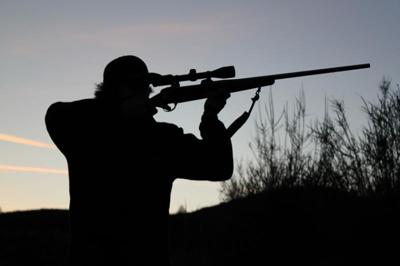
As Matt Murry drives into the Carmel Valley hills, his eyes dart across the landscape like a bird of prey.
Behind him in the four-door pickup sit Neil and Etul Gavande, a father and son from Palo Alto. The two are clad in camouflage, and Etul, who is 7, has his face painted black.
“I love hunting here,” Neil says. “We’ve always been lucky with Matt.”
Almost on cue, two turkeys dart from the brush and across the dirt road. “Holy… !” Murry says. The birds run along a barbed wire fence just down from the shoulder, and Neil scrambles to load his shotgun.
It’s spring turkey season, and Murry – who guides part-time throughout the county – is leading the Gavandes on a turkey and pig hunt.
“Out of the truck!”
Neil pulls Etul across the back seat to exit away from the turkeys, then carefully hands him the loaded shotgun. Murry and I watch from the front seat as they work their way around to the front bumper until Etul has a clean shot at a turkey trapped along the fence.
A few seconds pass. “Shoot!” say Murry and Neil. “Shoot, Etul!”
The barrel slackens.
“I don’t like shooting,” Etul says softly.
It’s easy for me to relate with the little guy – I’ve never shot anything except for a tree, and I felt bad about that. But recently, something in me began to change. An animal kept recurring in my daydreams, one that once startled me on a Big Sur trail: a big, black, brutish wild boar.
That itch led to research, which in turn led to this story about boar hunting, a journey into a Monterey County tradition that predates Steinbeck and can be tastier than Monterey Jack. At times there are thoughts of boar sausage and boar bacon. But more often, there are revelations of how ferocious and destructive wild boars can be, why boar hunting is so popular among hunters and why even vegetarians should consider giving it a shot.
• • •
Boar blood spills more in Monterey County than anywhere else in California. It has led the state in reported boar kills 18 of the last 20 years. The county’s topography and terrain play their part, but the simplest explanation for the fact so many encounter their end here is that it’s not far from their beginning.
The late Carmel Valley landowner George Gordon Moore, an avid hunter, was the first to bring wild boars to the West, and he released a dozen at his 20,000-acre Rancho San Carlos – which today is the Santa Lucia Preserve – in the early 1920s. Their genes have spread to at least 56 of the state’s 58 counties since.
The California Department of Fish and Game pins the 2011 wild boar population at anywhere between 250,000 and 1 million statewide.
Marc Kenyon, DFG’s statewide coordinator of bear, mountain lion and wild pig programs, can offer no reliable estimate as to the county’s wild boar numbers, but a little back-of-the-envelope math gives an indication of a robust swine presence. There were 505 reported pig takes in the county, more than 14 percent of the state’s total, in the 2010-11 season. Every hunter and official I spoke with said maybe 10 percent of pig kills are reported – perhaps to avoid the $21-per-boar tag fee – suggesting maybe 5,000 pigs were hunted in Monterey County last year. And many more survive the season, hinting at a countywide boar population well into the tens of thousands, and reproducing quickly.
In the former Fort Ord, the U.S. Bureau of Land Management just completed a wild pig abatement project. According to BLM’s Bruce Delgado, there were as many as 180 wild pigs in its approximately 20,000 undeveloped acres before the trapping began, which translates to about 5.7 pigs per square mile in the backcountry.
“Wild pigs are highly intelligent and adaptable,” says Kenyon of the DFG. “As a species, they are capable of making a living in a broad range of environments – from extremely arid regions to rain forests to boreal forests that receive up to 10 feet of snowfall annually.”
Today’s wild pigs are a hybrid of the pure Russian boars Moore brought to the area almost a century ago and feral domestics that have escaped the pen.
The physical characteristics of a boar can seem superheroic. The black, bristly hair growing around the head, neck and ribs is thick, but not nearly so thick as the calloused skin underneath, known among hunters as the “shield.” The shield is typically 1 to 3 inches thick and allows boars to pass through barbed wire fences painlessly, and can even stop arrows or bullets. A set of ever-growing teeth can tear apart a deer’s belly, and long, lethal tusks can root up soil or be used to impale a rival pig. Boars can run in bursts at up to 30 miles per hour, and unless they’re hit with a bullet right between the eyes, can keep on charging.
An excerpt from a letter Moore wrote in 1963 offers more detail. “The biggest boar we ever killed on the ranch, when hung, measured 9 foot from tip to tip,” it reads. “The skin on his neck was 3 inches thick; 11 bullets were found which over the years had been imbedded in the fat.”
• • •
There are things you want around when one of those big, shielded boars is charging at 30 miles per hour. Like a gun. And a bullet. Absent those items, quick thinking also helps.
Murry knows from experience. He was on a hunt, just 15 years old at the time, driving along on a four-wheel ATV. When a boar bolted across the road in front of him and headed down a ridge, Murry didn’t think twice. He jumped off the quad, hit the ridge, and fired down at the pig as he had countless times before. Thinking it was dead, he hiked after it.
“I came around a corner and this pig came running,” he says. “I forgot I only put one bullet in my gun. I went to shoot it, my gun went, ‘Click,’ and I cocked it again, and it went, ‘Click, click, click.’”
As the boar steamrolled toward him, Murry backpedalled and ran up a tree. After minutes of intense sweat, luck found another bullet in his pocket and he drilled a must-kill shot.
“That was kinda scary,” Murry says. “[Boars] are just solid muscle. They’ll mow right through you.”
Whereas most kids’ backyards had a fence, Murry’s went as far as his eyes could see, and as far as his feet, or someone else’s wheels, would take him. And wherever it was he found himself, he was likely to be aiming at something.
The Salinas Valley native, now 20, has been a licensed hunter since 6, when he studied tirelessly to pass a 100-question written test while his peers fingerpainted. He has successfully hunted ducks, quail, bobcats, deer and coyotes. At the age of 12 – armed with a bow on his uncle’s River Road property – he took down a five-bearded wild turkey that was the biggest recorded in the state, and which is now on display at Hunter’s Supply in Salinas (see sidebar, p. 20).
For a time, Murry got really into bow-hunting, and then, hunting with dogs. But now he’s back to a rifle, and there’s no animal he hunts more than boars.
“There’s just something about pigs,” Murry says. “There’s a certain rush to it.”
It’s the same rush that has fueled boar hunting’s popularity for centuries, and the rush that brought them here.
• • •
When Moore released his dozen boars almost a century ago in Carmel Valley, he might not have understood the depth of the destruction he was unleashing, but he did achieve what he set out for: a lifelong supply of what might be the perfect prey. Boars, a formidable, ever-replenishing invader that can be hunted year-round, are a renewable resource for satisfying one of man’s most primal instincts – to bring home the bacon.
Having introduced wild pigs on a 100,000-acre ranch in North Carolina, Moore later wrote, “Within a couple of years they had taken over the mountain.” He had three boars and nine sow brought from the Ural mountains of Russia, the same number he brought from his North Carolina to Carmel Valley.
According to the Department of Fish and Game, wild boar are capable of tripling their population every year, and eradication is thought to be futile. “Eliminating wild pigs from a mainland setting the size of California would be impossible,” Kenyon says. “Immigration from surrounding habitats, illegal transport into [the state] for hunting purposes, and the topography [and] terrain would provide safe harbors for pigs.”
Moreover, he adds, “Pigs have a great capacity to remember where certain items are in the environment, such as hiding places, sub-surface water sources and unique food sources.”
As a vegetarian for over a decade, I long ago lost my taste for blood, but learning about the ecological havoc boars are capable of inspired renewed cravings for pork chops. Put simply, hunted wild pig meat transcends sustainability; it is sustainable-plus.
“Wild pigs have the potential to cause the most amount of damage of any vertebrate species in California,” Kenyon says. “Because of their affinity for sensitive habitats, they can cause an extensive amount of damage in a very short amount of time.”
Though omnivorous, boars subsist primarily on succulent vegetation, and the “sensitive habitats” Kenyon refers to are the ones along waterways – streams, rivers, etc. – which are critical to the functioning of our state’s ecosystems.
Any conservationist has good reason to regret – if not resent – Moore’s shortsighted negligence. But ironically, the best response left today is to grab a gun, jump in a Prius and head for the hills. Or in my case, follow Matt Murry around.
• • •
Boars prefer to hang out in the daytime, but when people start to shoot at them, they take to less visible shifts. Since local boar are under moderate hunting pressure, they tread about in the dawn and dusk hours (though when things get too heavy, they go completely nocturnal).
So when I first meet Murry in the Salinas Valley, it’s a couple of hours before sunset.
A few others and I jump into Murry’s Chevy and we roll up toward a 2,000-acre ranch in the Gabilan Range, east of Gonzales, that he has been hunting for three years with the permission of the landowner. Most serious pig hunters have similar types of arrangements. Because hunting pressure and human activity are typically lighter on private land, it offers the best odds for a successful hunt. In the 2010-11 (year-round) season, 93 percent of the reported pig takes in the state happened on private land.
I’m feeling hopeful, and after a few minutes of sliding along the dirt roads, Murry skids to a stop and grabs his “binos.” Looking across a ravine, he spots a bobcat, invisible to the other six eyes in the truck.
“I’ve got crazy-good vision: 20/12 or something,” he says. The eye specialist who gave him that number said it was the third time she’d ever seen it. “But I’ve also got a trained eye to it,” he adds. “I’ve been doing it forever.”
It is approaching dusk, and Murry scouts for upturned soil, evidence of the rooting process. He hits water holes, hoping for fresh tracks.
“I know there’s pigs here,” he says. “They’re just hiding.”
I had not imagined that pig hunting in California is primarily done by driving around in a truck, but with the wide range to cover, it is understandably the best way to scout around.
As the air cools and the sky grows darker, Murry parks his truck and grabs his rifle: go time. We set out on foot, tracing a loop to all the rooting spots we saw earlier. At 6 feet tall, Murry has a long stride and an easy gait, and though he’s the one carrying the rifle, the photographer and I struggle to keep up.
The only sounds are birds and the leaves crunching under our boots, and my anticipation keeps ratcheting higher. But after a 35-minute dash, the truck comes back into sight, and I know the hunt is over without a shot.
The next morning Murry and I head out well before sunrise to try our luck again at the same spot.
“I know they’re up there,” he says. In the drive across the valley, two barn owls fly across our lights, ethereal reminders of the world that lives while we sleep.
We climb the mountain in silence. Just before we reach the top, Murry stops the truck, and we wait. Fog ascends from the valley, enveloping us. After a few minutes, we resume climbing, come level, and Murry flips off his headlights. We roll across the property at a predatory creep. The world grows lighter, and the leafless oaks that surround come aglow with lichen.
As we hit the spots he identified the previous evening, Murry waxes nostalgic about a time when the property was covered with deer. But as soon as mountain lions moved in, that quickly changed.
“Mountain lions will eat one deer a week,” he says, “and they also kill for fun. So you’re talking like 75 deer every year.” When no deer are around, he adds, they’ll take pigs.
With the light increasing, our time grows shorter. As we come over a hill I see the Pinnacles pointing out of the fog.
Murry’s eyes are elsewhere. He frantically grabs his binoculars and peers through the windshield. After a second he murmurs, “Don’t move,” and slides out of the truck. I’m thinking this is it. But then he lowers his binos.
“Mountain lion,” he says, hardly believing it. “In all the times I’ve been hunting, this is only the second time I’ve ever seen one. They are the most elusive critters out there.”
The sky brightens as we drop down the mountain. Murry shakes his head.
“That’s hunting,” he says.
• • •
A wet March passes before I see Murry again, giving me reason to feel lucky. When I had first spoken to him about optimal conditions for bagging a pig, he said he looked forward to spring. “It’s prime time. The barley heads out, and the pigs are everywhere.”
We meet this time at the gate of another 2,000-acre ranch, this one in Carmel Valley, just a few miles away from where Moore launched the West Coast’s population. Daylight savings is in effect, and it is still plenty bright at 5:30pm. It is here that I meet the Gavandes, and as Neil is loading up Murry’s truck, I can’t take my eyes off his giant rifle, a Barrett .338 Lapua. Neil reports that it is military-grade and has a range of two kilometers. A sniper.
“Four thousand dollars for the rifle, $4,000 for the scope,” he says.
Minutes later Etul hesitates over his turkey shot. Sensing their moment, the birds retreat across the road and up a grassy hillside. “Take a shot!” Murry says.
Neil and Etul set up with the shotgun at the base of the hill, tracking the turkeys as they run side by side. Etul looks down the sight, and after a long moment, finally blasts one off. The turkeys skip, flutter, but they stay moving. Neil then takes the shotgun from Etul and comes to his feet, aims and shoots. The birds jump again, then sprint out of sight.
“I think [Etul] got him!” Murry says. He charges up the hill with his rifle.
After Etul’s shot – and miss, it turns out – we drive to other side of the hill, close to a wooded gully. Murry senses the presence of poultry and pulls out a turkey caller (a slate call, in the lingo), consisting of a 3 – or 4-inch narrow cylinder, and a small, circular, chalkboard-like surface to twist it against. “We’ll set up and call ’em in,” says Murry.
He works the slate with dexterity. After a minute, we hear reply gobbles.
“They’re just over the ridge,” Murry says. We set out on foot with Neil and Etul in front. The turkeys come into sight, and when they see us, they make through the trees across the gully.
Neil reacts quickly and guides Etul to a clear shot. He hands Etul the gun, and the little guy aims and shoots without pause. One turkey escapes, but the other goes limp, sliding down the oak leaves.
As Murry prepares the turkey for a photo op – an impressive older male specimen, or “tom” – I ask Neil how long he’s been hunting. “Since I was his age,” he says, nodding to Etul, who is prodding the turkey with a stick. “It’s the kind of thing that gets passed on.”
Murry announces that it is time for pigs. He gets a call from Brian Ferrasci, a 10th generation Carmel Valley native (and sometimes boar hunter) whose parents own the ranch we are hunting on. Ferrasci has been seeing pigs lately, and he tells Murry exactly where.
Minutes later, as we drive into a valley, Murry spots a boar rooting under an oak tree. “There’s a pig! He’s right there!” The rest of us then see it, about 250 yards distant at the end of the valley. We scramble out of the truck. “Be quiet!” whispers Murry. “He doesn’t see us!” Neil sets up his Barrett on a tripod and puts his eyes behind the scope.
“Wait until he comes out in the open a little bit, and you can get a clean shot,” Murry says. The oblivious boar keeps rooting his way toward us, and finally Murry says, “Shoot! Shoot!”
A piercing crack splits through the valley and the boar drops sideways. The pig squeals, its feet run through the air, and Murry pulls up his rifle and sights, ready for a finishing shot. But no need – a few seconds later, the boar rolls down into a dry creek, dead. “Ho-ho!,” Murry says, looking giddy.
“That was awesome!” Neil says. After hours of combing ranchlands without luck, it all happened in less than a minute. When I look back at the gun – which looks like it might have been designed to take out the Taliban – I realize the boar didn’t stand a chance. But that’s not the point. The best kind of kill is a clean one, and a single bullet from the Barrett is better than 22 shots from a .22.
• • •
Hunters are comfortable getting blood on their hands. Murry’s preparing to cut into Neil’s pig when we are joined by Ferrasci. “That’s a nice one,” he says. The boar is of fairly pure, bristly black stock, and they put it between 230 and 240 pounds. A nice mature male, they agree. Neil glows.
After making the incision down the abdomen, Murry rolls up his sleeve, digs his arm in, and begins pulling out organs. The sound is like one might imagine: a flatulent squelching and splurting. The process takes only a few minutes, and then Murry and Ferrasci load the carcass onto Murry’s truck in order to drive it to a nearby tree to be hung and skinned.
When the pig is strung up, the two hunters take to it with knives and begin slicing through connective tissue. Neil is hoping to get the meat butchered – he has promised some friends sausage – and they discuss who to take it to, and how to store it in the meantime.
As Etul keeps begging for the chance to slice off some skin (no one seems eager to oblige), I recall Neil saying that they had gone surfing the day prior. Now that the hunt is over, I ask Etul which he likes better. “Hunting,” he says.
The response is cheering, because if he inherits his dad’s Barrett, he’s sure to get plenty of boars. And then of course there’s Murry, the young Jedi, completely dialed in and hunting several times a week, an accidental eco-warrior.
For my part, I’ll still pass on the wild boar sausage, but I’ll be cheering the hunters from afar. These pigs need predators.
Book a hunting trip by calling Matt Murry at 601-5228.
(0) comments
Welcome to the discussion.
Log In
Keep it Clean. Please avoid obscene, vulgar, lewd, racist or sexually-oriented language.
PLEASE TURN OFF YOUR CAPS LOCK.
Don't Threaten. Threats of harming another person will not be tolerated.
Be Truthful. Don't knowingly lie about anyone or anything.
Be Nice. No racism, sexism or any sort of -ism that is degrading to another person.
Be Proactive. Use the 'Report' link on each comment to let us know of abusive posts.
Share with Us. We'd love to hear eyewitness accounts, the history behind an article.