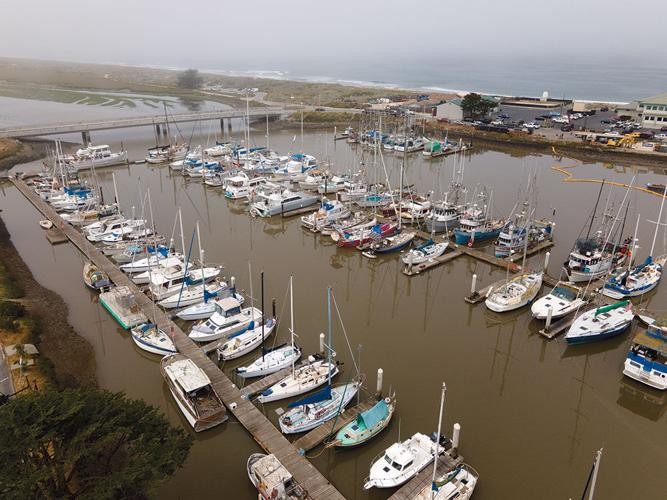


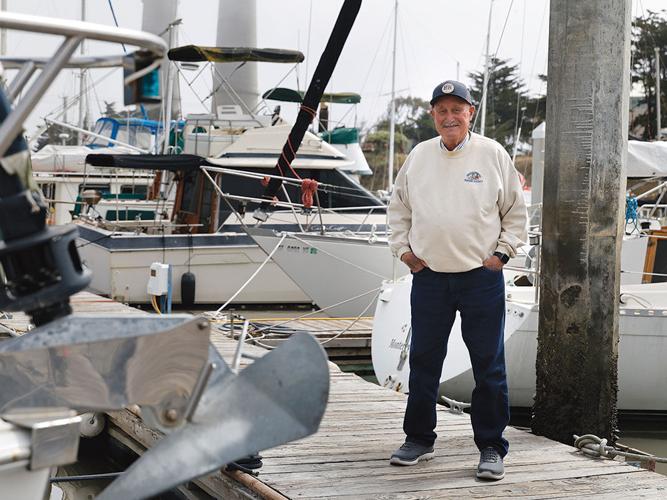


The Moss Landing Harbor District is responsible for keeping the harbor running smoothly, including regular dredging to keep access into and out of the harbor clear. While the harbor is focused in one area near the mouth of Elkhorn Slough, the district boundaries go inland to ensure a large enough tax base.
IT’S A LITTLE BEFORE 6PM ON A TUESDAY IN CASTROVILLE INSIDE THE NORTH COUNTY RECREATION CENTER, the community’s familiar gathering place for kids activities and senior lunches. Silvia Vázquez opens up a small, windowless multipurpose room off the lobby and judges whether to pull together two long tables to create a makeshift dais. Figuring two members of the Castroville Cemetery District will be absent for the June meeting, she decides one table will be enough.
Trustees – and sisters – Debra Torres and Rachel Torres breeze into the room, followed a couple of minutes later by Trustee Mary Paredes. They join Vázquez, sitting at the end of the table, who has worked as the district’s general manager for 21 years. Chair Grant Leonard and Trustee Pepe Jimenez are absent due to work commitments that night.
The June 10 agenda includes a report on how many burials took place inside the Castroville Public Cemetery in April (three), approving the 2025-2026 budget ($265,000 in revenues and expenditures), electing a new chair for the 2025-2026 year (they elect Debra, previously vice chair), a discussion about a project to build new niches for cremains and Vázquez’s request for four days off to take vacation (approved).
In this small community, the cemetery located a few miles away in Moss Landing is “deeply, deeply personal” to families where generations of loved ones are buried, Leonard says. When a person comes to a board meeting with a question or a concern, chances are they will know the trustees well. They may have gone to school with them, chatted with them at the store or live in the same neighborhood.
“This is the most fundamental form of government,” says Kate McKenna, executive officer of Local Agency Formation Commission of Monterey County, which is charged with creating districts and approving and assessing their services. “It’s local residents serving as leaders, and by and large, locally funded as well.”
Special districts are perhaps more accessible to residents than even city councils and the Monterey County Board of Supervisors, and yet they don’t get the same attention as their bigger cousins.
In Monterey County, 42 independent special districts provide everything in their service areas from mosquito abatement to water, roads, parks, sewers, community events and more. They range from tiny districts like Cholame Cemetery District in Parkfield to the expansive area of the Monterey County Regional Fire District, to the county’s largest airport in Monterey and the Moss Landing Harbor District. Every county resident receives one or more services from a special district, McKenna says.
There are tough challenges for the districts, especially the small ones. Required to follow the same rules as cities and counties, some struggle to keep up. It’s left some to question if there are too many districts or if there’s a more efficient way to deliver services.
“You have to remember that these districts are formed by the constituents,” says Neil McCormick, CEO of the California Special Districts Association, a 501c(6) not-for-profit association created in 1969 to promote good governance among the growing number of districts.
“Special districts are created by voters and paid for by the voters,” McCormick says. Ultimately, it’s up to the community to decide if a district forms, merges or dissolves.
WATER – OR RATHER THE LACK OF IT WHEN MOST NEEDED – was what sparked the call for California’s first special district, the Turlock Irrigation District in Stanislaus County. Farmers organized to create the district in 1887 after getting frustrated by an inconsistent water supply for their cattle and crops. With a new public entity to oversee the efficient distribution of water resources, farmers were able to increase their output, as well as diversify the types of agriculture they pursued.
It didn’t take long for other communities in California to adopt their own water districts, including in urban areas. In 1915, the first mosquito abatement districts were formed to combat the spread of diseases.
Special districts were taking hold across California through the middle of the 20th century, multiplying to just over 2,000 today. In Monterey County, some of the first districts were created in the 1930s to provide cemetery services.
Unlike cities and counties which are considered general-purpose districts, special districts provide specific services, or a set of services, within a defined geographic area. They are usually financed by taxes approved by voters. Some will also collect fees for certain services to cover the cost of providing them. The leaders of the districts are either elected by voters or appointed by the county’s board of supervisors to a fixed term of office.
(School districts are not considered special districts, because they receive state and federal funding and must adhere to state and federal regulations.)
“We like to say special districts are the closest form of government to the people they serve,” McCormick says.
Where there are people, there is going to be politics, and although special districts are dedicated to delivering services, there are politics to reckon with as well.

Vincent Ferrante, vice chair of the harbor district board, formerly served as the board president for the California Special Districts Association and remains heavily involved in lobbying efforts at the state and national levels to bring the needs of the districts to lawmakers’ attention.
WHILE MCKENNA SERVES AS THE EXECUTIVE OFFICER OF LAFCO, a paid staff position, it’s governed by a board of seven commissioners and four alternates representing elected officials from cities and the county, plus elected or appointed special district board members and one member of the public at large, selected by the LAFCO commissioners.
The idea is to have representation across cities, the county and the districts, but in a county as geographically diverse as Monterey County, sometimes competing interests come into play.
Case in point, LAFCO Commissioner Mary Ann Leffel – an elected member of the Monterey Peninsula Airport District Board, appointed to a special district seat on LAFCO – was part of a controversial 5-2 vote by the LAFCO board in 2021 to deny a step in a voter-approved public buyout of private water utility California American Water. (The Monterey Peninsula Water Management District, the intended buyer, is pursuing eminent domain over Cal Am. The issue remains unresolved nearly seven years after a majority of voters said they wanted it to happen.)
Leffel’s vote angered some constituents, who formally filed to recall her from her MRY board position in 2022. The recall failed to garner enough signatures to make it onto the ballot.
Leffel won reelection to the LAFCO board – representatives of the 42 districts elect who will represent them on that regional body – in 2022. Then she again won reelection to the airport district board last November, besting her challenger by 2,000 votes despite raising less money.
AT A LAFCO MEETING ON JUNE 23 inside the Monterey County Board of Supervisors Chambers in Salinas, Leffel was somewhat incredulous as she and the other commissioners were reviewing a staff report about seven special districts, including two in Spreckels, a small, unincorporated community outside of Salinas.
The Spreckels Community Services District and the Spreckels Veterans Memorial District share the same staff – just one way districts in smaller communities cope with the challenge of staffing. Despite the attempt at efficiency, the staff had fallen behind on state-required annual budget audits and trainings on ethics and harassment prevention. The districts’ staff blamed it on the death of a contracted auditor and a statewide shortage of auditing firms.
“I don’t know having your auditor or financial person die has anything to do with the two mandatory trainings of ethics and harassment,” Leffel said. “To me, the way it was written [in the report], I was like, ‘Really? I don’t think we’re going to blame that on a finance person who’s a third party.’”
LAFCO’s mission is to oversee the orderly formation of districts, their boundaries and authorizing new services. It also strives to preserve open space and agricultural land and discourage urban sprawl. LAFCO’s staff’s duties include conducting municipal service reviews, like the one the commissioners reviewed and approved on June 23. There are informal duties as well, McKenna says.
“Some of our districts are struggling to meet all of the obligations that local governments have to live by in terms of budgets, audits, public access to meetings, public access to information and financial reporting requirements,” she says.
The requirements may seem minor but they’re there to create transparency for constituents and make sure taxpayers’ money is being properly handled. Ethics and harassment trainings are meant to keep both employees and the district safe.
“Some of our districts are quite small – that is they are lean, they have little if any staffing and lean budgets – so we also provide informal support to particularly those districts, and help them accomplish the minimum requirements needed to function, and to have them establish modern practices,” McKenna says.
She prefers a soft touch with districts that are out of compliance with state regulations, rather than punishment. During the June 23 meeting she told impatient commissioners – who themselves have to follow the same regulations in their respective municipalities and districts – she would contact the Spreckels general manager and “encourage compliance much more quickly,” suggesting six months.
That wasn’t good enough for Commissioner Ian Oglesby, mayor of Seaside.
“My only concern is we should bring them up to speed as soon as possible,” he said. He couldn’t support six months, especially since they’d been out of compliance for much longer. “They’re responsible to their districts’ residents, right?”
Oglesby agreed to McKenna’s suggestion that the district be compliant with the trainings by July 31.
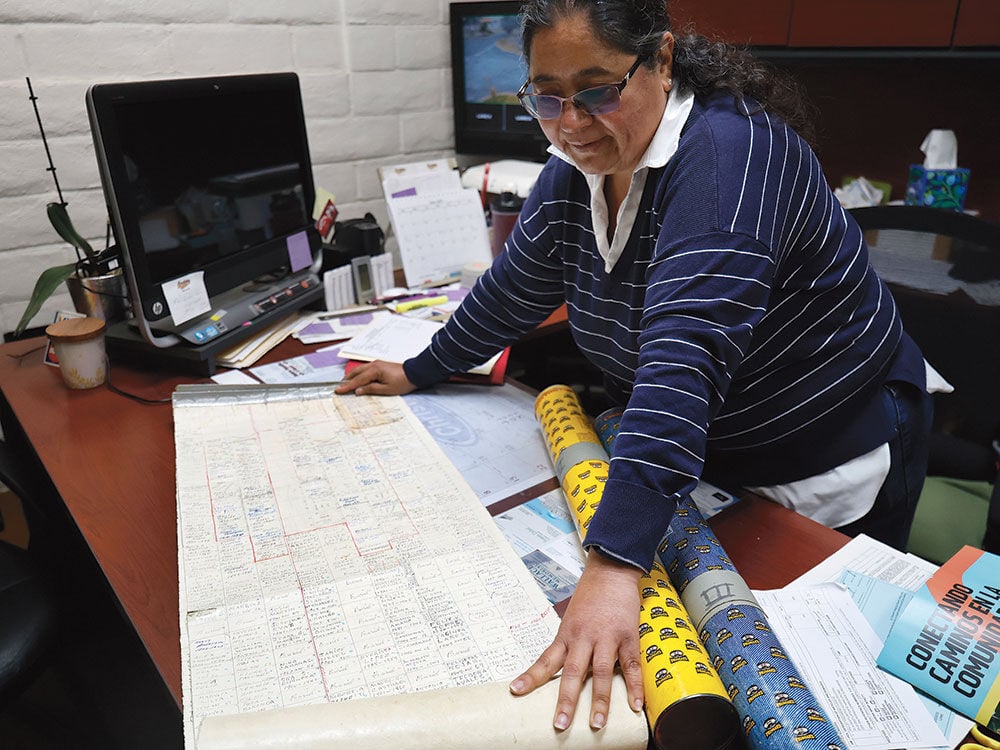
Castroville Cemetery District General Manager Silvia Vázquez rolls out the paper cemetery map previously used by staff. One of her first tasks when she took over 21 years ago was to transfer the information to a spreadsheet.

The plots were filled in with pen or pencil for decades.
SEVERAL YEARS AGO, THE GREENFIELD COMMUNITY WAS FACING A DILEMMA. Two of its special districts – the recreation district and the cemetery district – saw multiple board members retire with no one interested in taking their place. The idea was floated to use the same set of people for both districts. Supported by Monterey County Supervisor Chris Lopez, responsible for appointing the board members, the board and county officials decided to try it out.
Since 2020, the districts’ board meetings take place on the same night, the third Monday of each month. The Greenfield Cemetery District convenes at 5:30pm in Lions Hall, adjourns, then at 6:30pm the Greenfield Public Recreation District convenes. David Kong, chair of the board for both districts, says it’s working well.
“The hard thing about that is we basically only have one full-time employee and a part-time employee,” Kong says. “You can’t get more lean and efficient in terms of government.”
McKenna calls what began as an experiment in Greenfield a big step toward efficiency.
“It’s hard to find willing and qualified residents who are willing to serve on these local government boards,” McKenna says. “What has occurred in the Greenfield area is a big help in the community.”
Kathleen Lee, a longtime member of the Monterey Peninsula Regional Park District who currently serves as chair, puts an emphasis on what’s needed to be qualified, especially as governance becomes more technical and regulated.
“There is an increasing level of sophistication needed that doesn’t always match the resources a special district has,” she says. “What you’ll see, especially in Monterey County, people end up serving for a long time because people aren’t stepping up to do it.”
The job requires a fair amount of training and getting used to working within public meeting laws, she says: “You want to make sure you’re doing it right.”

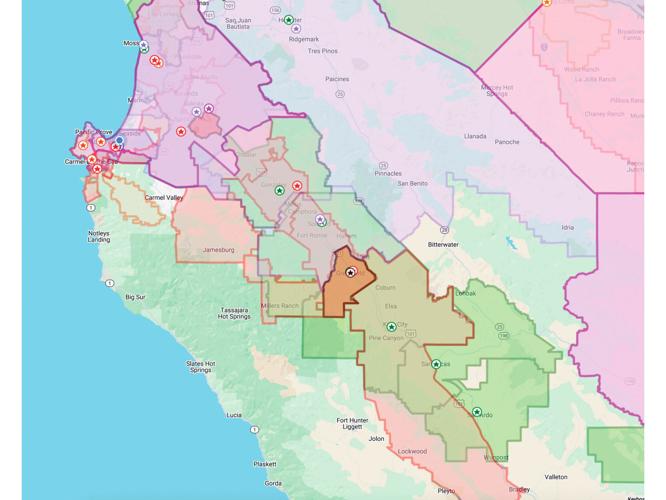
This shows just some of the district boundaries in Monterey County on an interactive map produced by the California Special Districts Association, available at csda.net/about-special-districts/map.
BESIDES STAFFING AND FINDING QUALIFIED VOLUNTEERS, there are other challenges, McCormick says. The cost of building infrastructure keeps going up, as do labor costs. Districts may struggle to pay competitive wages to attract professional staff, especially in regions where the cost of living is high. Conversely, some past compensation packages have come under scrutiny for being too high.
At Salinas Valley Health, when former CEO Sam Downing stepped down in 2011, he received a controversial $3.9 million supplemental package in addition to a $150,000 annual pension plan. His salary when he left was $668,000 a year. A state auditor later ruled the package was within industry standards. An MPRPD general manager back in 2010 drew scrutiny for being one of the highest paid in the state at $306,000 annually – the Los Angeles Times used it as an example of inflated government salaries. The next GM was paid $154,500.
With all the challenges faced by districts, it’s made some question if there needs to be fewer districts, with some possibly merging, either joining existing community services districts that provide a set of services – for example the Pebble Beach Community Services District, which oversees fire, wastewater collection and treatment, garbage and other services – or merging with another similar district.
Merging could mean greater efficiencies and savings by sharing staffing and other resources, Lee says. Leaders need to ask themselves if they are being good stewards of tax dollars.
“We owe it to the taxpayers,” Lee says.
McKenna offers a scenario where all the county’s cemetery districts – there are eight – merge into one, although she doesn’t see any new consolidations in Monterey County anytime soon.
Soon after she took over at LAFCO, there were some consolidations of fire districts and the Castroville Community Services District, formerly the Castroville Water District, merged with a county services area to handle water, sewers, street lighting, parks and other services. (A county services area is similar to a special district but is governed by the Board of Supervisors and is considered dependent on the county, while special districts are independent; Monterey County has about 40 CSAs.)
“The easy consolidations have been done and the harder consolidations have been done. Now it’s down to the nearly impossible consolidations, primarily because of funding issues that are systemic to local governments,” McKenna says. “It’s very difficult to have a financially sustainable district take over operations for a special district that is struggling.”
It’s why LAFCO continues to look for other ways to support new solutions for districts, like encouraging sharing of staff or boards. “We look for small steps forward to help these special districts,” McKenna says. “We all want them to succeed and continue to deliver essential services to their communities.”
Not all districts are struggling. Larger districts like Pebble Beach’s, the Monterey County Regional Fire District, Salinas Valley Health and Monterey Peninsula Regional Park District have been stable and continue to thrive, even in the face of occasional upsets. The park district, for example, survived conflict with its last general manager, Rafael Payan, who resigned in the face of being placed on administrative leave. The district board hired a new manager, Eric Morgan, on July 2.
ONE OF MONTEREY COUNTY’S BIGGEST CHEERLEADERS for special districts is Vincent Ferrante of North County. Ferrante didn’t know a lot about special districts until 2002, when a friend who knew he kept a boat at Moss Landing suggested he run for the Moss Landing Harbor District.
Ferrante ran in a field of 10 candidates seeking three open seats and came in third after running a strategic campaign on a platform of supporting both the fishing industry and environmentalists’ concerns. He began his first four-year term and went on to run again and again – five times. He’ll be up for reelection for a sixth term next year.
Ask him about what’s important to the harbor district and he’ll talk passionately about the importance of dredging and keeping the infrastructure up to date. As the former president of the board for the California Special Districts Association, he talks just as passionately about special districts generally and the need to educate the public about them.
His focus as president in 2017 was on spreading the word about special districts through education, especially in the schools.
“We need to get more recognition within the education system throughout the United States in textbooks, civics classes or government classes, to let students and others know about special districts,” he says. “We know we have a federal government, state government, county government, city government, but nobody knows about special districts.”
As president of the California board, Ferrante was in a good position to talk to special district organizations elsewhere in the country, and the CSDA is in the lead nationally by coordinating the National Special Districts Association, which strives to give 40,000 special districts across the country a voice. “We have advocacy staff in Washington, D.C. that lobbies federal issues for us, and we have more states coming into the fold,” Ferrante says.
The group created districtsmakethedifference.org, a website that educates students and the public at large about what districts do. McCormick says they’re working on a “special districts 101” to fit into middle and high school curriculums. They run a high school student video contest, awarding scholarships to top submissions.
McCormick believes that even if the public doesn’t know the granular details, they know the services exist.
“They may not know the term ‘special district’ but they know they are there when they need them,” he says.
WHILE THE NUMBER of the county’s special districts may contract a bit in the future, that number could increase – if voters agree, and at the moment that’s a big “if.”
During the LAFCO discussion on June 23, the community of East Garrison and the East Garrison Community Services District came into sharp focus. Currently the CSD is a dependent district, relying on the Board of Supervisors for its governance.
McKenna says when the East Garrison district was created in 2006 the intent was always for it to become an independent district, which is why LAFCO’s policy continues to be that it will assist the county in achieving that goal. The report reviewed by the board that day stated staff will encourage the county to conduct a feasibility analysis about becoming independent every five to seven years.
Leffel thought the county needed to pursue an analysis sooner rather than later. County Supervisor Wendy Root Askew, representing the county on LAFCO, reminded the commission that residents resoundingly rejected becoming an independent district in November 2022 – Measure E was defeated 67.5 to 32.5 percent. If sentiments shift in the future, East Garrison could become the county’s newest independent district.
For the existing districts, leaders have formed a strong bond with each other, meeting quarterly as a chapter of the CSDA, sharing ideas and encouraging one another in their efforts. They’re excited for the chance to network with others from around the state at the CSDA annual conference taking place this year in Monterey on Aug. 26-27.
Workshops will tackle some issues of the moment that all governmental bodies face, including wildfire prevention, managing public protest in the face of rate increases and how to handle misinformation during elections. Other workshops include being an effective board member, following transparency laws, financing projects and what to do about board vacancies.
For those who come a day early, there’s a chance for Ferrante’s Moss Landing Harbor District to shine – a pre-conference event includes a tour of the district, lunch and a boat tour of Elkhorn Slough.
(0) comments
Welcome to the discussion.
Log In
Keep it Clean. Please avoid obscene, vulgar, lewd, racist or sexually-oriented language.
PLEASE TURN OFF YOUR CAPS LOCK.
Don't Threaten. Threats of harming another person will not be tolerated.
Be Truthful. Don't knowingly lie about anyone or anything.
Be Nice. No racism, sexism or any sort of -ism that is degrading to another person.
Be Proactive. Use the 'Report' link on each comment to let us know of abusive posts.
Share with Us. We'd love to hear eyewitness accounts, the history behind an article.