This wasn’t normal.
The boy usually guarded his iPod touch closely, never leaving it laying around, never letting his mother or sister look at it. But it was there, sitting out. Her brother had been busted that same day for violating probation – he was a tagger and the cops knew it – and with him locked up in juvenile hall, it wasn’t like he was there to stop anyone from prying.
The sister picked up the device and began tapping her finger on the screen, looking at her brother’s Facebook account, at the conversations he had and the things he kept hidden. That nagging feeling, the one that told her something wasn’t right with him – and hadn’t been for some time – proved true. She told her mother they needed to take what they had found to the police.
The mother said no. She wanted to talk to her son about it first.
It would be a full week before the mother fell apart. A full week before she was arrested at her home shortly after she walked into the front office at Laurel Wood Elementary School and begged for someone to call Child Protective Services to take her two younger children because she could no longer cope. And a full week and a few hours more before, at 10:23 that night, the sister went to the Salinas Police Department, stood in the lobby with 40 pages of screenshots from her brother’s Facebook account and insisted someone read what she had read.
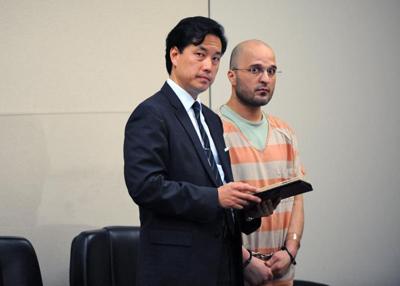
A day later, police armed with search warrants walked into Salinas High School and arrested counselor Gilbert Olivares, a guy kids flocked around and and told their problems to, on suspicion of child molestation.
Even seasoned cops flinch when they’re faced with someone accused of taking advantage of a child. But as they cuffed Olivares that day and walked him out of the school, they had no idea just how shocking and extensive the details would become – that they would soon be reviewing 7,000 pages of text messages, and learning Facebook would respond to a court order with 10,000 pages of Olivares’ chat logs.
And it would be several more days before they knew about the videos.
• • •
Perhaps the most haunting thing about Monterey County Superior Court Case #SS120521A, the People of the State of California v. Gilbert Olivares, is how close it came to never being filed. What if the then-14-year-old boy hadn’t been put into juvenile hall? What if he had logged out of his Facebook account? What if the sister, an adult no longer living under her mother’s roof, hadn’t been so suspicious about the messages her brother exchanged with his counselor?
What if, with her brother in juvenile hall, her mother in jail facing a pair of misdemeanor child endangerment charges and her two elementary-school-age siblings in the custody of CPS, she never took the screenshots to the police in the first place?
Absent the string of unlikely events, the 34-year-old Olivares, a five-year employee of Sunrise House who was deployed as the on-site drug-and-alcohol resource counselor at Salinas High, would likely still be in his office today. It’s a large and comfortable space as school offices go, about 200 square feet with an adjacent private bathroom, neatly tucked away in a quiet spot near the school’s bell tower.
The Weekly is not using the names of any alleged victims or their families members. The 14-year-old who went to Juvy will be called John Doe # 1 (JD1). In addition, the Weekly has agreed to keep confidential the name of a Salinas High School teacher who spoke to a reporter, because the Salinas Union High School district has ordered employees not to talk to the press. JD1’s mother, contacted at her home, declined to speak to reporters; her story, and that of her son, has been put together with official records and public documents obtained from Monterey County Superior Court.
Some who knew him say Olivares could seem aloof with staff at Salinas High, but was immensely popular with the kids, who called him “Mr. Gilbert” and joined the “just-say-no” clubs he formed at the school.
And others who know him say he seemed spectacularly good at his job.
“He appeared to go out of his way to help kids in trouble,” says the mother of one Salinas High teen. She met Olivares through her volunteer work in the community and, in the way that parents often do, asked him to keep an eye out on her son.
She says police have told her that her son was on the receiving end of sexual texts. Upon hearing about the charges, she says her first instinct was, “This has to be a mistake.”
She elaborates: “He talked to kids about all sorts of things. Students trusted him because he knew how to talk to them,” she says. “He was an adult the kids could go to and say, ‘This person trusts me and I trust him too.’”
Trust was the one thing his job required most of all.
• • •
“Where’s my pic nigger… Where’s my pic haha… yur shy, yur not gonna take a pic or whaa… tomorrow in my office bathroom haha with my phone… yur not down (no homo)… come to my office tomorrow nig… when are you gonna cumm threw… cumm threw nigger.
“The other day meant something to me.”
As laid out in the statement Salinas police used to obtain warrants to search Olivares’ house and JD1’s house, Olivares told JD1 he had some spray paint he was willing to trade in exchange for a picture. What kind of picture isn’t specified, but the messages he exchanged with the teen on Facebook – excerpted in the probable cause document – get increasingly sexual.
“Like I’d get u the paint but u won’t come threw haha,” Olivares messaged him on Nov. 19. “Where all the bitches at nigga… all waiting to Get pounded by u again cuz they heard yur big like a boss haha.”
And on Dec. 20: “I wanna Hear new stories of u pulling bitches ; ) getting yur Lil cack wet : D.” The teen responds by telling him he doesn’t have any recent stories, and Olivares messaged back: “Booooo I want u to To get yur Lil Cack in it.”
On March 6, the day JD1 was arrested, Olivares asks him, “When u down to make $$$$$$$ the dirty dirty way haha.”
The teen asks him what he means, and tells him he’s “down,” but Olivares counters the teen isn’t down “to make easy $$$$$$ hahah.”
The easy money, he says, would come by being a hustler or “man whore.” The teen says “hustler” and Olivares responds, “I’ll put u to do some clean sex work for $$$$ haha.”
Even before the victims started talking, the police had reams of evidence, an electronic trail strongly suggesting criminal activity. But as Assistant District Attorney Stephanie Hulsey points out, creepy text messages aren’t always enough to make a case. “We’re talking about touching,” Hulsey says, referring to statutory rape violations. “That’s something that can be facilitated by social media or technology, but to have the offense you’re going to have touching.”
It was on Olivares’ iPhone that investigators would find the videos that brought national media running to Salinas – and lead parents all over the country to question what they really know about their kids.
• • •
SPD Investigations Sgt. Chris Lane is a cop out of central casting, a beefy ex-football player who’s been with the department for 18 years, the last four as a sargeant. He measures his words carefully. Ask about the videos of students left alone with other students, and he’s blunt: “It goes from kissing all the way to having sex in his office.” There are different degrees in each video. “Not all are sexual intercourse, and not all are kissing,” he says. “In some [Olivares] sets up the camera. He’s there before and after… not in a sexual way. It’s ‘Hey, how are you guys,’ and then he leaves.”
Salinas police say that on his iPhone they found 13 videos allegedly recorded by Olivares of at least 11 kids engaging in sexual activity in his Salinas High office. A 14th video also shows sexual activity, but police aren’t sure who’s in the video or where it was shot. Police allege he turned on the iPhone’s video recorder, hid the device and left it running while he left kids alone in his office.
Lane says police don’t believe the kids knew they were being taped; Olivares provided passes to the kids that allowed them to leave class. How some of them ended up having sex in their high school counselor’s office – that’s another question altogether.
“I believe they thought he was a friend of theirs,” Lane says. “The ones that were found to be in videos, they felt betrayed.”
There are indications, Lane says, that a few of the kids knew they could use the office to be alone with their boyfriend or girlfriend, but there’s no evidence they knew what other students were doing in there.
“To them, it appears he was like another student,” he says. “They treated him like that, they spoke to him like that. He gained their trust by acting the way they acted and texting the way they texted. He had counseled some of them and gave them some good, sound advice.”
But, Lane says, that sound advice came with a hitch.
“It’s how he was able to gain their trust,” he says, adding that some parents of alleged victims are now suffering medical issues in the aftermath, although he declines to specify what kind. “These parents feel like they were completely duped,” Lane continues. “They trusted him to deal with their children who, in some but not all cases, were having issues. He was supposed to be helping them, but what has he done? He’s made it 10 times worse than it was to begin with.”
Salinas police just finished reviewing the 7,000 pages of text messages, some dating back to 2009, between Olivares and various students. Lane expects police will present “a lot” more charges to the district attorney based on some of the messages.
Facebook has cooperated throughout the investigation, and just turned over a disk containing reams of chat logs in response to a court order.
“We are overwhelmed with what we have to look at now,” Lane says.
• • •
Absent the string of unlikely events that led JD1’s sister to the police station, it’s possible that none of the alleged victims – 11 of them so far, identified in court papers as John and Jane Does – would have ever gone to the cops.
That’s partly because teenage victims are often loathe to view themselves as victims. The special attention they receive from recognized and admired adults is part of the insidious process perps use to gain access, known in academic and law enforcement parlance as “grooming.”
“I better b A homie I fkn love u,” Olivares texted JD1.
It’s this kind of informal language that sexual predators generally use to test the waters and soften boundaries.
“[Olivares] presented himself as their buddy, he acted like one of them,” Lane says.
Predators slowly ease victims into the idea that sexual contact is OK – and maybe even get them to think they’re the ones who initiated it.
The first definitive survey of sexual misconduct in schools came in the form of a 2004 report, commissioned by the U.S. Department of Education at the request of Congress, and estimated more than 4.5 million students – nearly 10 percent of school-aged kids – are subject to sexual misconduct by a school employee sometime between kindergarten and 12th grade.
Study author Charol Shakeshaft, professor and chair of Educational Leadership at Virginia Commonwealth University, says most abuses – on the scale of 80 to 90 percent – go unreported. Among younger victims, that might be because they can’t even understand or articulate what’s happened to them. For high schoolers, it might be that they don’t view themselves as victims.
In two recent sex abuse convictions of educators, the Jane Does were reluctant to cooperate with police because they thought they were beloved romantic partners, not crime victims. (See sidebars, p. 23 and 25.)
But whether or not minors consent to touching or penetration, they’re victims all the same, Shakeshaft says. “What we find in long-term studies is they have the same problems as those who do identify [as victims]. They may say, ‘I love him or her,’ but in the long term, there are the same kinds of effects as the kids who say, ‘I didn’t want this to happen.’”
Grooming can give kids the perception they’re in charge, but it’s an insidious process of exploiting easy targets. From her Las Vegas home where she teaches private piano lessons, Terri Miller, president of SESAME (Stop Educator Abuse, Misconduct and Exploitation), caught wind of the Olivares case on her Google alert, when it caught her attention partly because of the large number of victims, and because he was a counselor.
“Kids are like the frog in the boiling pot,” Miller says. “They’re simmering there, and it’s feeling good, and before you know it they’re cooked. That is the best way to describe the grooming process.”
She then goes on to recite what sounds like something of a how-to guide for hunters or trappers of prey: “It starts with maybe some sexual harassment – some sexual jokes, or an accidental brushing of their body. Then, to full-out groping, and then engaging them. It’s gradually breaking down their moral boundaries, their physical boundaries and then,” she pauses for dramatic effect, “they’re a victim. A child cannot consent with full knowledge when they have been groomed by an adult.”
Shakeshaft and Miller distinguish between bona fide pedophiles (many of whom never actually act on their sexual preferences) and opportunistic offenders, who find out they can get away with having sex with minors – which first requires talking to them, increasingly virtually.
“There’s 24/7 access to their targets now through social media, texting and email,” Miller explains. “They seem to be able to groom them as often as they can.”
Miller’s proposed solution is an outright ban on the electronic communications that landed Olivares in John Doe 1’s sister’s (then Salinas PD’s) sights to begin with. “What we would like to see is prohibition against this kind of communication,” she says. “There is absolutely no need for a teacher to be communicating with a student outside of the approved school network.”
That means no exchanging cell numbers, friending on Facebook or email address swapping.
But that kind of wholesale prohibition on social communication can make it more difficult for counselors working with troubled kids to do their jobs.
Jim Rear, the executive director of Sunrise House, a Joint Powers Authority that deploys substance abuse counselors to Salinas schools, says different kids respond to different methods of communication. He looks back on his experience as a basketball coach and teacher in Salinas schools, and points to the fact that no one way of talking to a kid fits everyone.
“Kids have these little feelers, bullshit feelers, and they can tell if you’re bullshitting them in a heartbeat,” Rear says. “It’s ‘I am who I am, and the kids are who they are and I can reach each of them using a difficult mechanism.’”
And Facebook and texting, he says, is now part of that. It’s not the means of communication in the Olivares case that distresses him. In its 41 years in existence, Sunrise House has never had a blemish.
“As I’ve said, this is a ‘who knows’ circumstance,’” says Alan Styles, a former Salinas mayor and Sunrise House board member. “This is one of those things you couldn’t have predicted and nobody would have known it. It’s similar to a guy who walks into an office building and blows people away. There’s no thought. He just started doing it.”
Assistant District Attorney Stephanie Hulsey is quick to point out that sexual misconduct has been going on since well before students and teachers could exchange text messages privately, late at night, without a suspecting parent listening in on a land line.
The electronic trail can become essential as corroborating evidence for prosecutors, especially when children don’t view themselves as victims and don’t want to talk.
And besides the fact that prosecutors rely on witness testimony to nail cases, cooperating can be cathartic for victims, Hulsey says: “Victims may think they are worldly. They sense they have power in this, exerting sexuality over older men. What they don’t realize until later is they are being exploited.”
Olivares will next appear in court on June 13 for a calendar call, with a preliminary hearing set for June 15. He currently faces 53 charges, including 21 counts of committing lewd acts on a child, 13 counts of sexual exploitation of a child, 13 counts of using a minor to perform prohibited sexual acts and a count each of child molestation and possession of child pornography.
JD1’s mother also goes to court in June for trial on the child endangerment charges. Because juvenile cases are strictly confidential, officials won’t say if JD1 remains in juvenile hall.
Sunrise House hopes to have a counselor back in Salinas High by the time the new school year begins in the fall. The starting salary, at about $12 an hour, is low.
“Anyone who will do this job for the pay they get has to care about humanity and kids and families,” Rear says.
(0) comments
Welcome to the discussion.
Log In
Keep it Clean. Please avoid obscene, vulgar, lewd, racist or sexually-oriented language.
PLEASE TURN OFF YOUR CAPS LOCK.
Don't Threaten. Threats of harming another person will not be tolerated.
Be Truthful. Don't knowingly lie about anyone or anything.
Be Nice. No racism, sexism or any sort of -ism that is degrading to another person.
Be Proactive. Use the 'Report' link on each comment to let us know of abusive posts.
Share with Us. We'd love to hear eyewitness accounts, the history behind an article.