


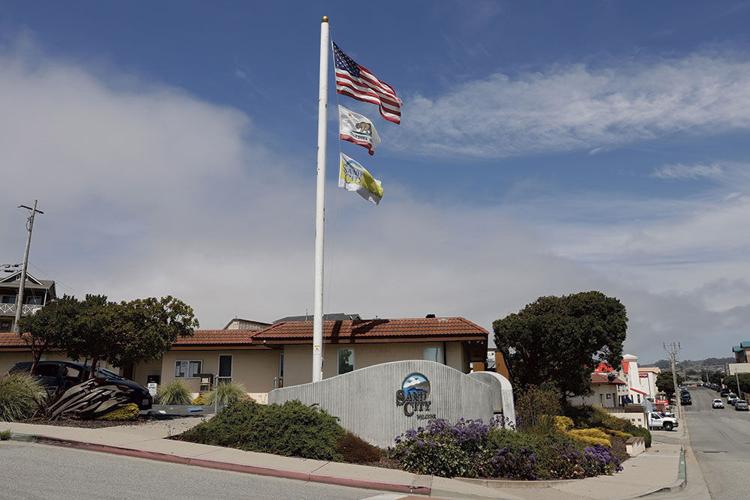


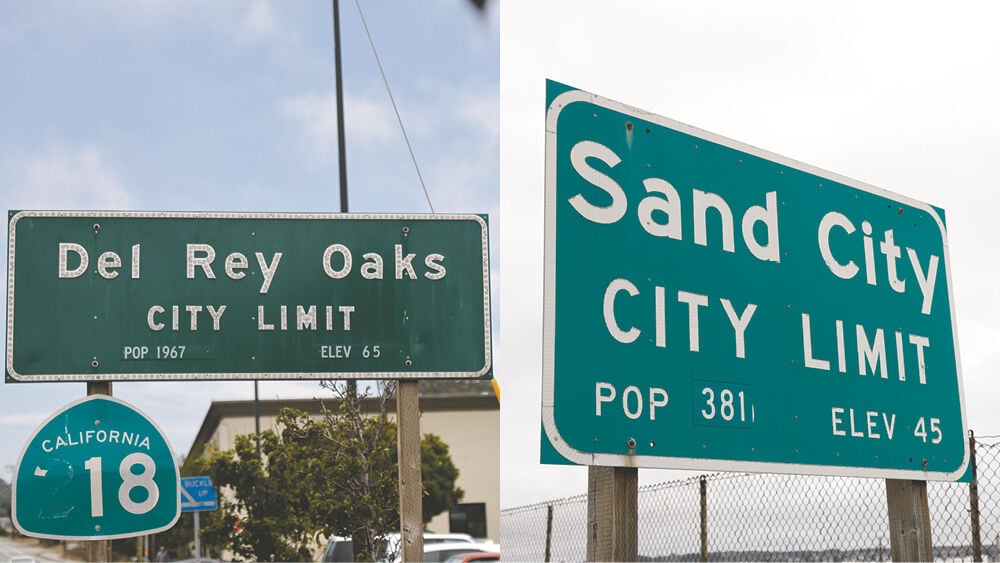
Both Del Rey Oaks and Sand City are not only small in terms of land, but population: Del Rey Oaks has just under 1,600 residents, while Sand City has just over 300.
On Sept. 3, 1953, the first Del Rey Oaks City Council meeting was held in the cement-floored garage of William Pacchetti, where the meetings would continue to be held for the next year-and-a-half.
When Sand City incorporated in 1960, there were just over 100 registered voters in the city, and it too didn’t have a suitable location for council meetings. So for the first few years, they were held at the Church of God, northeast of the current City Hall. (Its first city hall building, which it purchased from the Seaside Redevelopment Agency for $75 in 1961, was a former house that was 300 square feet, and not big enough for council meetings.)
Two small cities, two distinct identities, and two common throughlines: Residents of both cities wanted self rule, and neither wanted to be a part of Seaside. (In the case of Del Rey Oaks, residents also chose to not become part of Monterey.)
Whether or not that’s a good thing is a matter for debate, but what’s undeniably true is that if the Monterey Peninsula was all the part of one city, or two, there would be economies of scale – less overhead for city staff, and more in-house expertise.
Del Rey Oaks is a bedroom community – it’s quiet, it has no downtown and is home to just one restaurant, Tarpy's, at the city's southern border along Highway 68. It’s a city where you come home to eat and sleep, hang with your family, take a walk and perhaps sunbathe on the patio.
Sand City has a Bohemian energy and beautiful murals now line the city’s West End district, a home of many hippie squatters in the late 1960s. From its inception, though, Sand City has also had a pro-business, libertarian streak, and in the run-up to a mayoral recall election in 1969, some of those hippies’ homes were reportedly demolished by bulldozers from a construction company owned by the city’s first mayor, who the “hippies” were trying to recall (more on that later).
Per the 2020 Census, the population of Sand City was 325, while Del Rey Oaks was 1,592. Combined, that’s less than 2,000 people, yet their elected officials have wielded outsized political power on various regional boards for decades.
Should either of these cities exist? It’s a good question, but also moot – they do. The question that prompts the most illuminating answer is: Why do they exist?
Here’s why.

THE CITY OF DEL REY OAKS STARTED OUT AS A SUBDIVISION NAMED DEL REY WOODS, owned by Pacific Grove businessman and banker Thomas Albert Work, aka T.A. Work, a Scottish immigrant who bought a large tract of land – from what is now Seaside to Marina – from a fellow Scottish immigrant named David Jacks, a cunning real estate magnate who at one point during the late 19th century owned almost the entire Monterey Peninsula.
Some of the language in the Del Rey Woods deed restriction – dated April 22, 1941 – while not unusual at the time, remains jarring: “No Mongolian, Hindus, Malays, Negroes, or Philipinos (sic) shall use or occupy any building on any lot, except that this covenant shall not prevent occupancy by domestic servants of either of the aforesaid races employed by an owner or tenant.”
The naked racism aside, it’s interesting that Latinos were not included in that deed restriction – perhaps because they owned the land before Scotsmen did.
That deed restriction was binding until Jan. 1, 1965. (Coincidentally, on July 2, 1964 – just six months before that date – Congress passed the historic Civil Rights Act.)
The deed language was also quite restrictive in other ways. “No building shall be erected on any residential lot or plot nearer than 20 feet to the front lot line, and on corner lots not nearer than 10 feet to any side of street line.” Front yards were required, by law.
Just under a decade after the subdivision was formed, there was talk of Del Rey Woods annexing to the City of Monterey. Nearly 200 residents showed up to a meeting at the Monterey City Council chambers to discuss the matter – including Sam DeMello, who owned a nursery in Seaside and who would later become Del Rey Oaks’ mayor – and spearhead the effort to incorporate.
A March 21, 1951 article in the Monterey Peninsula Herald paraphrases what DeMello said at the meeting: “Nobody should be frightened by the ‘bogey man’ of Seaside annexing to Monterey. He added that he feels Monterey has been guilty of bad government in the past (he pointed to the El Estero Park development), and asked what had ever been done for outlying Monterey areas.”
And so the drama began.
Meetings were held that spring among Del Rey Woods residents to decide whether to stay unincorporated or annex to Monterey or Seaside – which was not yet incorporated, but leaders of its incorporation effort had included Del Rey Woods in their initial plans.
In June of 1951, the Monterey City Council granted Del Rey Woods residents permission to circulate a petition to annex to Monterey, which would require signatures of 25 percent of the subdivision’s property owners to qualify for the ballot.
A politically charged energy suddenly suffused the small city – something it has continued to be known for, 70-plus years later – because even though it qualified for the ballot (the election was set for Jan. 8), there was an opportunity for opponents to collect protest signatures. If they got signatures from just over 50 percent of the area’s property owners, they could scuttle it before the election.
A “protest” meeting was held at Monterey City Hall on Nov. 20, 1951. In advance of that meeting, the Herald published a story Nov. 15 that probably turned up the temperature even more.
As those for and against annexing into Monterey were running their campaigns, the Herald reported that both sides were “working like beavers to get the necessary signatures and the pros out to prevent achievement of that goal.
“Secrecy surrounds much of the goings on with each side unwilling to disclose what progress has been made. Rumors of midnight meetings, covert house-to-house visits and skullduggery of various types are running rife, much of it without foundation. Persons who signed the pro-annexation petition are changing their minds and signing the protest papers and vice versa.”
A pamphlet put out by the anti-annexation group reportedly read, in part, “Despite the claims of the pro-Monterey group, this is NOT a choice between Seaside and Monterey… Seaside cannot and will not take us… It looks like the pro-Monterey faction NEEDS the boogyman of Seaside to scare you into Monterey.”
(By all appearances, it should be noted, Seaside could have taken in Del Rey Woods when it incorporated, if the subdivision’s residents wanted it.)
A Herald story from Nov. 20, 1951, the day of the meeting, reads in part: “Anti-Seaside people, however, fear that if Monterey annexation is defeated, a move to be included with Seaside might be inaugurated and succeed.”
That night, at the meeting in Monterey, City Clerk E.C. Walker had the protests laid out to count while Assistant City Clerk Chester H. Stalter, per the Herald’s reporting, sat next to his side with an adding machine. Before the protests were counted, Walker announced that 267 parcels were in the area, and that 134 would stave off the election.
As the protests were being counted in alphabetical order, “there was a growing murmur in the crowd.” The required threshold of protests, 134, was reached while the names were still in the letter “S” – it was clear the election to join Monterey was off, at least for now.
“After the crowd left,” a contemporaneous Herald article reads, “Police Chief Charles Simpson closed the door to cut down the jubilant noise from outside.”
But it wasn’t the end of something. It was the beginning.
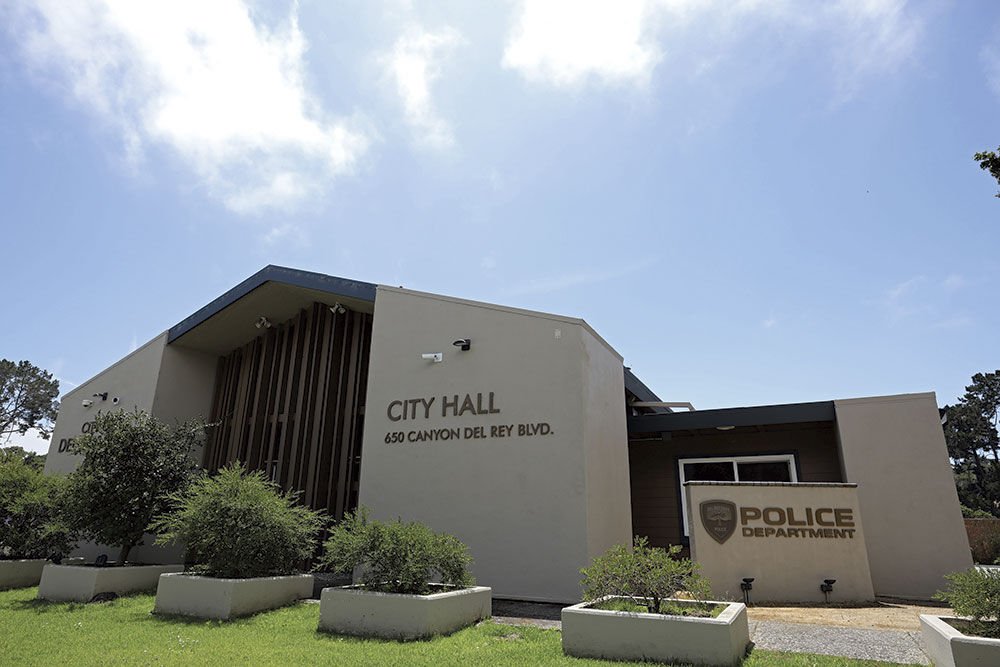
Del Rey Oaks City Hall
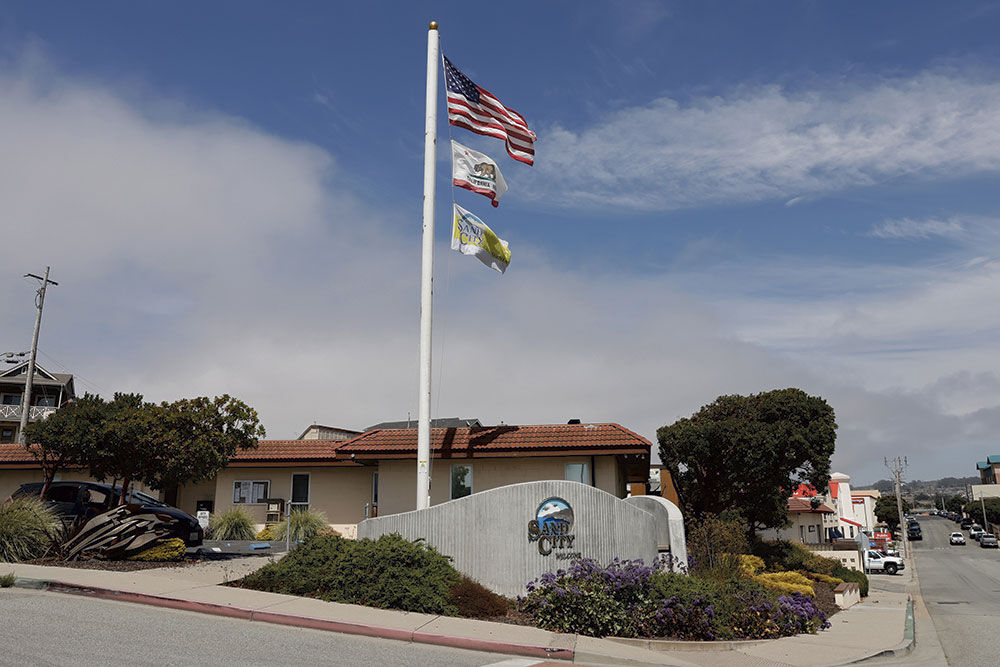
IN THE SPRING OF 1953, MOMENTUM BEGAN TO BUILD IN DEL REY WOODS TO INCORPORATE, with efforts advancing both to become part of Seaside and to become part of Monterey. In May, the board of the Del Rey Property Owners Association decided to prepare a petition to that end to be submitted to the County Boundary Commission at a May 25 meeting. DeMello would draw up the legal description of the boundaries. All the while, leaders of the movement to incorporate Seaside – and include Del Rey Woods in it – had already submitted their petition to the County Boundary Commission, which approved it. And in Monterey, the City Council had already referred to the Planning Commission the boundaries for an annexation of Del Rey Woods.
The next step for any of these efforts was to submit a petition for a special election to the County Board of Supervisors with the signatures of at least 25 percent of the property owners in the area, and whichever faction submitted the petition first would nullify the other efforts until the election was held on the matter – in other words, it was a race.
On the evening of May 25, DRPOA members voted 128-30 to incorporate and to immediately begin the circulation of a petition to do so. At the meeting, DeMello said the community was caught in a “squeeze play between Monterey land grabs and Seaside incorporation.”
He suggested a different plan.
“If we form our own city,” DeMello continued, “we will have no problems with parking and shopping and no particular police problem.”
The plan, DeMello said, was to have one policeman on call on a 24-hour basis, have a part-time treasurer and city clerk, while legal and engineering duties would be outsourced.
Those looking to incorporate moved fast, and submitted their petition to the County Board of Supervisors on June 1 with signatures of 292 residents that comprised 40.4 percent of the area’s property owners whose land accounted for 48.5 percent of the area’s assessed valuation (both had to hit the 25-percent minimum threshold).
Donald Smith, a Soledad attorney hired by incorporation proponents to navigate the process, reportedly told the supervisors, “Inasmuch as we appear to be in a race with the city of Monterey to annex this area, I feel these petitions should be verified as soon as possible.”
In June, the county assessor certified the petition, and a special election for incorporation was set for Aug. 25.
An Aug. 24 Herald article about the election reported that on Saturday, Aug. 22, pro-incorporation proponents began circulation leaflets with bullet-point arguments for why – representation on a local level, local control of tax money, preservation of community identity, etc. – and that anti-incorporation proponents responded with their own leaflet the next day.
“Two newspaper carriers were induced by incorporation supporters Saturday to include pro-incorporation leaflets in their wrapped Heralds,” the article reads. “This was done without authorization of The Herald and, in fact, is contrary to the rules of this paper.”
That pamphlet argued that the yearly fights among residents whether to annex to Monterey or Seaside, or stay in unincorporated county, has led to divisiveness in the community.
“Each faction takes sides in the argument with resultant animosity between neighbors. We believe we have struck a common ground where all can work together for the good of all with formation of a city. We also feel we cannot afford the expense of a yearly fight nor the loss of a neighbor’s good will.”
In the Aug. 25 election, 303 voters turned out – about 80 percent of the area’s registered voters – and proponents prevailed by a 169-134 margin.
And like that, in 1953 with a 35-vote lead, Del Rey Oaks became the ninth city in Monterey County.

The South of Tioga project, when completed, will include a hotel and two apartment buildings that will double, if not triple, Sand City’s current population.
BEFORE SEASIDE WAS INCORPORATED IN 1954, there were efforts to include what would later become Sand City within its boundaries – the coastal strip of land, after all, was the oldest neighborhood in the Seaside community – but those efforts were rebuffed by property owners, many of whom operated industrial businesses in the area.
North of Olympia Avenue, Seaside’s western boundary would be the Southern Pacific railroad tracks, which run along Del Monte Boulevard.
At the time, there were two sand mining operations on the beach, which utilized “draglines,” mechanical scrapers that dredged sand directly from the surf. After the newly formed Seaside’s general plan called for the beach to be designated for recreational use, the industrialists on the coastal strip of sand feared another annexation attempt. So they decided to get ahead of it, and submitted a notice of intent to the county on Sept. 18, 1959, to circulate a petition for incorporation, and to set the city’s boundaries at Fort Ord to the north and Seaside to the east and south.
Among the proponents was Robert McDonald III, co-owner of Monterey Sand Co., which owned one of the sand mining operations on the beach. McDonald told the Herald in a Sept. 19 story: “The people here want to control their own destiny.”
Other supporters of incorporation included Granite Construction Co. – which also operated a sand mine on the beach – and local excavating contractor Phil Calabrese, who would become the city’s first mayor, a role in which he served until he died in 1977 at age 59.
In a Sept. 23 article in the Herald, Monterey resident Ben Tanner, a contractor whose business was located in what would become Sand City, said of incorporation, “Our interests are not those of the city of Seaside. We just don’t carry enough weight and county services are inadequate. We need road improvements now. It may not be a good thing, but it is better than anything else.”
Resident A.J. “Ace” Williams, a retired Army sergeant, was quoted saying, “Seaside can’t stop us from incorporating. The majority here doesn’t want the form of slap-stick government Seaside has always represented.”
Seaside Mayor Joe Cota, whose business Cota Transfer and Storage Co. was located in the proposed Sand City, was a leading opponent of incorporation, and in November 1959 argued that annexing to Seaside would result in a cheaper tax rate.
McDonald, the sand mining industrialist, responded, telling the Herald, “The mayor’s arithmetic is mighty poor. But don’t be too harsh on him. Because he is criticizing us he is the greatest booster for incorporation that we have.”
Cota was out of town and unavailable for comment, but about a week later, in a Nov. 11 story in the Herald, he “apologized for a mistake he made in addition,” and also said he was stepping down as the leading opponent of incorporation.
A Nov. 13 story in the San Jose Mercury News reported that the biggest challenge for incorporation proponents was “not whether they can get a majority of 114 registered voters to go for incorporation but whether they can round up one-fourth of the property owners by Dec. 18 to petition for an election.” (If they could not meet that deadline, they would have to wait another two years before trying again.)
The challenge, according to Milton Thompson, an attorney for sand mining interests backing incorporation, was that “some of the 1,200 property owners in the area are scattered all over the world.”
The deadline was met, and the election was set for Tuesday, Nov. 18, 1960. The population of Sand City at the time was 681, with 112 registered voters.
On Nov. 18, voters favoring incorporation prevailed, 45 to 25, and Sand City was officially born. How many of those voters actually lived in Sand City, however, is unclear: Calabrese, the city’s first mayor, by all appearances lived in Carmel Valley.
After he died, his wife Muriel told the San Jose Mercury News in 1986 that she and her husband owned several houses on the Monterey Peninsula. “The biggest part of his time was spent here, in Sand City,” she said. “I lived in Carmel Valley. But there’s no law that says he couldn’t visit me there, is there?”
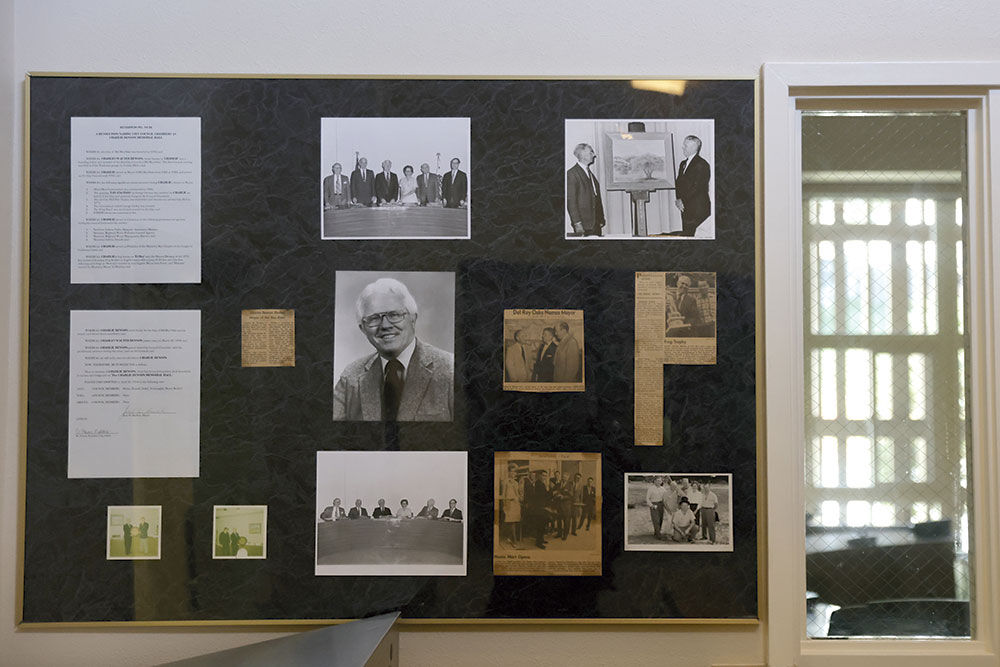
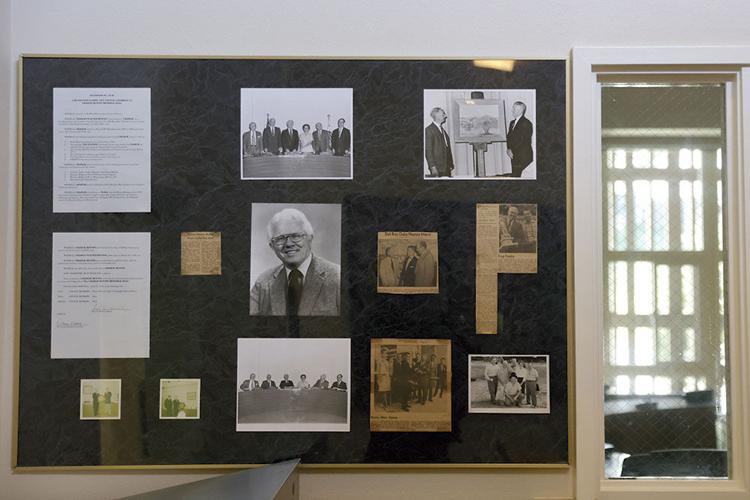
Del Rey Oaks City Hall was dedicated on June 26, 1971, after the young city outgrew a building in Del Rey Park. The current city hall is a retrofitted former Seaside Fire District station, and just inside the walls contain pieces of the city’s history.
SAND CITY’S TRANSITION FROM A CITY OF INDUSTRY TO ITS CURRENT IDENTITY of an artist-friendly community with a pro-development, industrial-chic vibe started in the late 1960s, concurrent with cultural shifts in California in that era.
Rent was cheap at that time in Sand City and by 1969, it became a hippie enclave. And the so-called hippies wanted to change the leadership of the city, and spearheaded a recall of Calabrese that year, an effort that made national news.
The crux of their campaign pitch was that the city’s industrialists were razing homes to make way for industrial warehouses, forcing out residents, hippies among them.
In the run-up to the election, hippies from elsewhere took up residence in Sand City to boost the chances for a recall. Calabrese countered by bringing in mobile homes for his employees who did not live there, so they could vote. At one point, bulldozers from Calabrese’s construction company reportedly leveled a group of shacks that were home to 20 hippies.
“There’s a small town near Monterey, California, called Sand City,” said Chet Huntley, an NBC news anchor, in a 1969 news clip. “It has a mayor who’s a millionaire contractor, but also has a hippie population which doesn’t like him, and recently the hippies put on a campaign to get the mayor out, but they lost.”
The recall effort failed by a 2-1 margin.
In 1970, Calabrese also saw to it that a planned concert with an expected 40,000 attendees – this was just three years after the legendary Monterey International Pop Festival – wouldn’t happen. Even though the city denied the event permit, the promoters said they were going to throw the concert anyway, so Calabrese reportedly got on a bulldozer and moved a mountain of sand to block the access point. The show was subsequently canceled.
That same year, Calabrese’s company built a seawall on the shore of the beach with rip-rap – broken concrete – in an effort to build a coastal road, Vista Del Mar.
He succeeded in building the road, but his seawall couldn’t save it – erosion from sand mining eventually undermined it, though evidence of the road is still visible today.
That road, one could argue, was a metaphor – change was coming for Sand City, whether its founders liked it or not. In the 1980s, federal regulators clamped down on the sand mining operations in the tidal zone of southern Monterey Bay due to their impacts on coastal erosion. By 1990, the sand mining operations on Sand City’s beach had ceased.
The city, and its businesses, pivoted: Monterey Sand Co. – co-owned by McDonald, a leading incorporation proponent – developed the Sand Dollar Shopping Center (which included Costco, on the site formerly occupied by Calabrese’s construction company) even before its mine was shut down.
The Edgewater Shopping Center to the north soon followed, and the city’s leadership, led by longtime former mayor David Pendergrass, who retired in 2017 after 39 years on the job, shifted the city’s focus away from industry. Currently, sales tax from those shopping centers accounts for about $4 million a year – 39 percent of the city’s revenue.
The Independent, a slick four-story apartment building with 61 units, was completed in 2008, and since 2011, has been home to Post No Bills, a popular craft beer bar that has now become part of the city’s social fabric. And pre-construction is underway on the South of Tioga project, which will provide 420 residential units, 216 hotel rooms and a restaurant.
The city started a mural festival in 2021, we.Art, that hires artists to adorn the walls. Nearly all the (formerly) blank walls in the West End of the city are now splashed with beautiful murals
Sand City, once defined by industry, is now hip. That’s in large part because leaders were nimble and forward-thinking, and recognized the youthful, creative energy in the city as an asset. And from a future revenue perspective, with its shopping centers and the prospect of a luxury hotel, it’s in a catbird seat.
SIXTY-PLUS YEARS AFTER THEIR INCORPORATION, the two small cities face diverging futures.
Sand City is poised to continue its transformation, as development in the city has historically faced little to no pushback, aside from the California Coastal Commission. The South of Tioga project promises to be transformative, with the potential to more than double the population of the city.
Del Rey Oaks, meanwhile, is stuck in amber, as the city’s revenue sources are minimal. (Sales tax revenue from Safeway is significant, but the city won’t disclose how much it is, exactly: City Manager John Guertin says doing so would be illegal, as it would give potentially valuable information to Safeway’s competition.) And though the city brings in $3,022 per resident annually, it doesn’t add up to much in a city with just over 1,500 people.
City leaders have long looked to potential development. One option is a 17-acre parcel north of Canyon Del Rey and east of the Frog Pond Wetland Preserve. Efforts to develop that site have already faced opposition from residents of the city’s condo complex, The Oaks, which is south of Canyon Del Rey and looks down on the 17 acres.
The city was also granted about 310 acres in the former Fort Ord, and before it disbanded, the Fort Ord Reuse Authority gave Del Rey Oaks $8.8 million to rebuild South Boundary Road – a project that is necessary to facilitate such development, as there are no underground utilities along the road. But Guertin doesn’t think that will be nearly enough to rebuild the road.
Both cities now have a smaller population than when they were incorporated decades ago, but at least Sand City is growing. Del Rey Oaks is projected to bring in $4.7 million in the coming fiscal year, which is just enough to keep its staff – both administrative and police – afloat, for now. And there’s nothing in the offing, for at least several years, that could potentially boost that number in a meaningful way.
Ultimately, both cities have become what they set out to be more than 60 years ago: Sand City is a place for enterprise, where business and new ideas are welcome, if the market supports them.
Del Rey Oaks is, and will remain for the foreseeable future, a bedroom community with little latitude to increase its revenue. How long that remains sustainable is an open question, but it is what residents, back in 1953, voted for.
It seems likely they’d vote the same way now.
--
Correction: The original version of this article incorrectly stated that Del Rey Oaks has no restaurants, and has been corrected to indicate that it has one, Tarpy's (which lists its address as being in Monterey).
(0) comments
Welcome to the discussion.
Log In
Keep it Clean. Please avoid obscene, vulgar, lewd, racist or sexually-oriented language.
PLEASE TURN OFF YOUR CAPS LOCK.
Don't Threaten. Threats of harming another person will not be tolerated.
Be Truthful. Don't knowingly lie about anyone or anything.
Be Nice. No racism, sexism or any sort of -ism that is degrading to another person.
Be Proactive. Use the 'Report' link on each comment to let us know of abusive posts.
Share with Us. We'd love to hear eyewitness accounts, the history behind an article.