
HERITAGE HARBOR WAS THE TALK OF THE TOWN WHEN IT WAS BEING BUILT IN 1978, the last remaining puzzle piece of the City of Monterey’s redevelopment of its waterfront through urban renewal, which finally got sign-off from the feds in 1962. It’s a stone’s throw from where a party led by Sebastián Vizcaino in 1602, and then Junipero Serra in 1770, held a mass under the canopy of an oak.
The idea for Heritage Harbor was for a themed shopping mall – local history being the theme – and it was a failure before it was even finished, its developer bankrupted.

Though it is located right next to the Rec Trail and is open to the public, Heritage Harbor attracts scarcely a glance from passersby.
Some believe Heritage Harbor was cursed.
But its failure has a much simpler explanation: It was a bad idea, poorly executed, that seemed destined to fail even if everything had gone right. That’s because, despite being in a central location and right on the water, it’s hiding in plain sight.
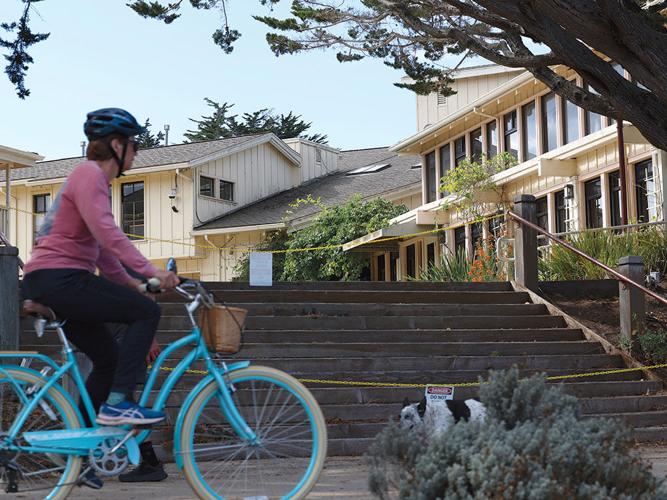
You can drive by Monterey’s waterfront going to and from New Monterey and never see it – it’s overhead in the tunnel – and people walking or riding by on the Rec Trail might not notice the unassuming office buildings, windows tinted out, set back off the trail behind a row of cypress trees.
How did that happen?
Because over 60 years ago, when the leaders of Monterey decided to clean up the waterfront, improve traffic and remake part of downtown – all while condemning people’s homes and businesses – they were pretty much just making it up on the fly.
AS AMERICA ENTERED ITS POST-WORLD WAR II TRANSFORMATION, the federal Housing Act of 1949 sought to ensure the housing in America’s cities was up to modern standards, in good supply and available and at a fair price.
The landmark legislation empowered cities to use federal funds for “slum clearance” to remake entire neighborhoods. In Monterey’s case, that “slum” was lower Alvarado Street, the waterfront and surrounding neighborhoods.
Those were living, breathing neighborhoods with people in homes they owned and operating businesses they owned. Monterey still had a working waterfront, if in decline with the fishing industry, and the military presence in town ensured there were plenty of pool halls, bars and sex workers when soldiers had their paydays.
In the fall of 1957, the City of Monterey’s urban renewal era began, as the City Council – with the endorsement of State Parks, the Monterey History and Art Association, the Downtown Merchants Association and the Monterey Peninsula Chamber of Commerce – approved a resolution declaring the need for an urban renewal agency in the city and that “opportunity is knocking on the door.”
The initial champions of urban renewal in Monterey, according to a 1978 report from the city’s renewal agency, “felt that a great many of California’s most historical edifices stood in Monterey and would benefit from an urban renewal program which would protect and enhance these structures.”
When the Custom House Redevelopment Project came before the Monterey Planning Commission and then City Council in the spring and summer of 1961, opponents fell into two main camps: Residents who didn’t like the size and location of the proposed buildings, streets and parking; and residents who would stand to lose their homes, businesses, or both.
The City Council approved the project plans 4-1 in July.
Among those standing to lose their home was Maria Garcia, a Spanish immigrant who came to Monterey in 1919. With her late fisherman husband, she had bought the First Brick House in 1924 and turned it into a popular restaurant shortly thereafter that remained open until 1951.
“Mama” Garcia, as she was affectionately called, told a San Francisco New-Call Bulletin reporter in July 1961, “The house is mine. Those roses – my husband put them in 40 years ago. Where I go if they take my house? I got no place to go.”
Meanwhile, the adjacent Whaling Station was the charming home of Mr. and Mrs. Wesley Dodge, a developer working to revitalize Cannery Row. The Dodges sought a temporary restraining order to stop the renewal plan but dropped it a month later.
The plan was radically changed in the subsequent months when a design team was brought in led by architect John C. Warnecke, who designed the campus of UC Santa Cruz. Warnecke modified the plan to disperse parking, reduce the size of the Alvarado pedestrian mall to a single block, and to improve traffic flow with an underground tunnel beneath a plaza by the Custom House and Pacific House.
Federal approval came in March 1962 – just a month after the modifications were revealed – with a $6.6 million loan and $4.5 million grant, and the city and its renewal agency accepted funds in June.
Just six months later, Del Monte Properties Co., on behalf of lessee Draper Co., had a hearing before the Monterey Planning Commission to allow a shopping center on 47 acres on Carmel Hill. According to a Dec. 14, 1962 story in the Monterey Peninsula Herald that would later come to be called the Del Monte Shopping Center, “no opposition was voiced at the hearing.”
THE POLITICAL MOMENTUM WAS FIRMLY BEHIND THE CUSTOM HOUSE PROJECT, but some property owners and residents didn’t feel it was right, the government condemning people’s property for redevelopment.
One couple, Mr. and Mrs. Sebastian Patania – her name is unmentioned in every news story – had been in their home at 192 Olivier St. for 42 years, and rented out the bottom floor for income.
On Jan. 28, 1966, the Patanias had to be carried out of their house by sheriff’s deputies under a court order. The couple broke back into their house Feb. 1 and boarded it up.
On Feb. 3 deputies carried them out again – “struggling, kicking and shouting,” according to a Herald story – and the Monterey Urban Renewal Agency ordered their house to be bulldozed that same day. It was.
“Mrs. Patania, shouting from a window before her eviction,” the Herald story reads, “cried out repeatedly, ‘Is this Russia? Isn’t this America? Isn’t there any freedom any more?’”
On the night of Feb. 5, Mayor Minnie Coyle was hanged in effigy from a telephone pole in front of where the Patanias’ home once stood. In the rubble, someone had also left an epitaph reading, “Here Lies the Constitution of the United States.”
The Patanias, and their daughter Mayme Maciera, served 35 days in jail for violating court orders.
(The Ginza restaurant, now a Benihana, was a few lots away but allowed to remain because it was a restaurant and conformed with project plans.)
Mama Garcia died in 1965, and per the Herald’s obituary, she was “a gay and colorful little personage” who, along with her late husband Juan, “were universally loved and respected by the many tourists who sought out the Brick House for its Spanish cuisine, as well as by local residents.”

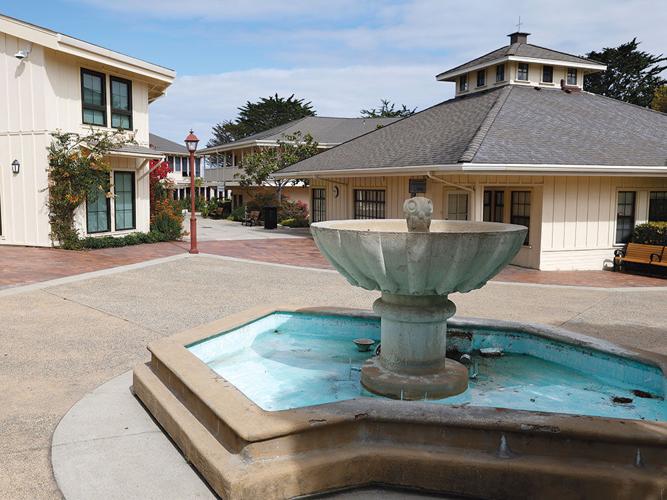
A small plaza with an empty fountain sits in the middle of what was supposed to be a shopping mall, but is now a sleepy office park.
WHILE DEL MONTE CENTER SAILED RIGHT ALONG and had already secured a Macy’s, the Custom House project stalled in recruiting a tenant. But the City Council decided to move ahead with the tunnel anyway in 1966 by accepting a supplemental $4.3 million federal grant to construct it.
After groundbreaking for the tunnel on Jan. 10, 1967, Gov. Ronald Reagan made budget cuts that threatened the State Parks Custom House Plaza project’s funding. With State Parks support, city officials and a representative from the Monterey History and Art Association met with Reagan, and he came through with $75,000 (out of $440,000 requested) and promised the rest next year. The plaza – the land – was part of the city’s required contribution to the project, in order to become part of a state park.
A 1967 story in the magazine California Living reads, “Monterey will have turned itself around so to speak and once again will be wedded to the sea. The historic adobes will no longer be obscured by dismal vistas of broken down pool halls and poker parlors. There will be a judicious mixture of commerce, culture and entertainment in a harmonious yet traditional setting.”
The tunnel was opened and dedicated in April 1968; Custom House Plaza was dedicated in September of 1969.
Then in March 1971, the mall developer and J.C. Penney pulled out, leaving the city holding the land and federal debts to pay off, so the feds gave a $4.8 million grant to reduce interest payments.
A new plan was developed in 1972 and came together quickly with three basic areas: historical, commercial, and conference center with an adjoining hotel and parking. Rather than wait for everything to happen all at once, the City ditched the single-developer strategy and took the lead on the conference center, which would include a 1,400-seat theater.
But in a September 1973 joint meeting with city and federal and state preservation officials, the latter two determined the height, mass and bulk didn’t work with the historical surroundings. Thus, the theater was eliminated.
The conference center broke ground Jan. 20, 1975, though the hotel was met with delays.
And as Alvarado Street was being transformed into tidy new businesses – the Wells Fargo building was one – focus shifted to the last remaining urban renewal piece, the 4.5-acre parcel near the Wharf once home to the Patanias and Garcias, among others.
In mid-1975, amid a competitive group of three applicants, the city’s renewal agency selected Pebble Beach developer Don Berry to build “Heritage Harbor,” a shopping mall built around an idea of Monterey’s history, with two historic buildings, now vacant.
HERITAGE HARBOR WAS TO OCCUPY 168,852 SQUARE FEET OF LAND on two parcels – split by Pacific Street – with retail, office and restaurant buildings totaling more than 87,000 square feet and a 235-car parking garage.
Monterey architect Paul E. Davis, whose firm Berry hired to design the development, told the Herald in a Feb. 2, 1976 story that a J.C. Penney wasn’t suited to the area anyway – he thought a resort-style development was going to be a waterfront hit. “This is one of the most, if not the most, valuable, suitable pieces of real estate in California,” he said. “Eventually it will have more to offer than the Carmel area from an interest standpoint.”
Berry obtained his permit from the recently formed California Coastal Commission in December 1976.
On April 22, 1977, with the $7.4 million conference center set to open within a week, a $17.4 million hotel under construction and all the city’s federal debts paid off, the federal government’s 20-year involvement in Monterey’s redevelopment was done, having contributed more than $12 million in funding over the life of the project.
Berry, meanwhile, secured a $6.3 million construction loan in November 1977, and purchased the 4.5 acres from the renewal agency on Nov. 22 for $438,138. A groundbreaking ceremony was held Dec. 16, 1977, and in a picture in the Herald, both Berry and his wife Bernice, with Fisherman’s Wharf behind them, each hold shovels in the dirt, smiling for the cameras.
But for the project, digging did not go well – construction of a four-level parking garage on Pacific and Scott streets unearthed Indigenous remains in April 1978 and construction on the garage was brought to a halt.
That delay quickly sent the project off the rails. In March 1979, 20 shops were ready to open, but the city wouldn’t allow any of them to open until the parking garage was done; excavation and shoring had been done, but construction hadn’t started yet. Additionally, Berry had to build a pedestrian bridge from the garage over Pacific Street to the shops; Berry also had to lower Pacific Street – which used to run roughly level – so that the pedestrian bridge wouldn’t dwarf the Old Whaling Station. All that would take until at least October. Berry, who was pushing for the city to allow shops to open if he had a shuttle system, told the Herald at the time that he stood to lose nearly $500,000 if the shops didn’t open until autumn.
Berry was also wrapped up in litigation at that time with his architect, Paul Davis, who sued Berry and his wife for $163,000 for breach of contract. As delays in opening continued, it all fell apart. The city finally allowed a shuttle system, but Berry was sued by multiple tenants – some had purchased inventory going to waste – who also weren’t paying rent until the parking garage and bridge were complete, which took until August 1980.
Despite Mayor Gerald Fry calling Heritage Harbor “a sleeping giant” in June 1981, the damage had been done: Berry, and his financial partner in the project, Cal-American Income Fund, went bankrupt. In a 1982 foreclosure sale, Lloyds Bank of California purchased Heritage Harbor for $8.7 million.
Tragically, Berry’s wife and business partner, Bernice, died in a car accident in Sacramento in October 1984. Then, on Jan. 1, 1985, just after midnight, the 58-year-old Berry took his own life.
Former mayor Fry told the Herald the next day, “It was terribly unfortunate that he got involved in a project that was really beyond his sophistication.”
STEVE VAGNINI, THE FORMER LONG-TIME COUNTY ASSESSOR, has long believed Heritage Harbor was cursed. He had one of the last businesses to hang on in Heritage Harbor, until 1981.
Vagnini’s First Brick House Bookstore was just across from the actual First Brick House, and he still vividly remembers why he decided to close up shop: A “distinguished” looking man in his 40s, Vagnini recalls, walked into his shop one day that summer.
“He looked like a scholar, he had the most incredible gold-rimmed glasses,” Vagnini says.
“He said, ‘I really admire what you’re trying to do here, but it’s never going to work. Do your research.’ That’s when I started to learn about urban renewal.”
Vagnini recalls that Berry was very distraught about the Indigenous remains – he knew the project had already led to painful evictions, people dragged kicking and screaming out of their homes. Vagnini believes the place is cursed, and he’s always associated it with the parking lot, the delays, the unearthed burial site. When he thinks of the potential curse, he thinks of that.
Seaside resident Linda Yamane, who has Indigenous heritage and for a time monitored construction digs around the Peninsula, points out that there have been a lot of remains unearthed around the Peninsula over years, and on properties that are currently prospering.
Tim Thomas, a local fisheries historian, has heard it was a Sicilian curse.
But Daryl Hawkins, a retired architect who helped design Heritage Harbor not long after he had graduated from Cal Poly, has a more nuanced view of why Heritage Harbor failed, aside from the early financial setbacks.
“Part of the problem,” says Hawkins, a Monterey native who says he was told by God to become an architect, “is they’re kind of tucked in out of sight, and not on the main path by Fisherman’s Wharf.”

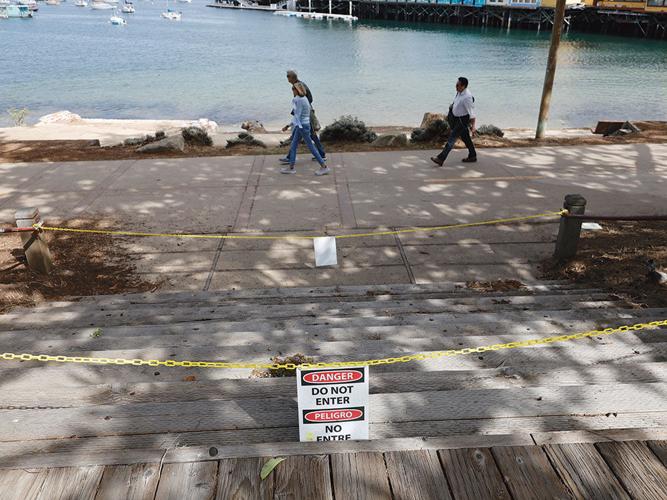
A primary access point from the Rec Trail to Heritage Harbor is currently blocked off, and no one seems to notice.
WHEN THE MONTEREY CITY COUNCIL HELD A STUDY SESSION on Wednesday, March 26 to review a draft economic development strategy, Janine Chicourrat, managing director of the Portola Hotel and Spa, was among the first members of the public to address the council.
Assistant City Manager Nat Rojanasathira had just finished a nearly hour-long presentation outlining the draft strategy, which among other things, lists the city’s perceived strengths, weaknesses, opportunities and threats – the so-called “SWOT analysis.”
Chicourrat was there to talk about opportunities.
“I got to Monterey about 17 years ago, and to the Portola, which was in disrepair, along with the Monterey Conference Center. And I was told ‘no’ over and over again, that that would never happen and we would never re-create it,” she said. “And lo and behold, we had the momentum, we got it done, and we’re reaping the benefits today.”
Chicourrat paused for a beat, looked at the council members, then launched into her pitch.
“I want to encourage you all to dream big. And what I mean by that is, you need someone from the outside to come in with vision,” she said, someone with redevelopment experience who knows how to finance it, and how to bring the community together behind it.
“I see three big assets here in Monterey that have huge potential,” she continued. “The first is Heritage Harbor… ”
Chicourrat went on to list the two other big opportunities she saw – converting Alvarado Street into a pedestrian-only promenade, and putting a hotel on Wharf 2 – and then Rob O’Keefe, president and CEO of See Monterey, spoke next.
Before O’Keefe even got to his microphone, he started echoing Chicourrat’s thoughts about Heritage Harbor, where See Monterey’s office is. “Huge opportunity,” he said.
The Monterey Bay Aquarium bought Heritage Harbor in 2009 for $20 million, and currently uses some of it for its own offices and leases out the rest to nonprofits and small businesses. State Sen. John Laird and Assemblymember Dawn Addis rent district offices there.
When she spoke to council in March, Chicourrat said she’d had conversations with Aquarium Executive Director Julie Packard about the idea of reimagining the property. Other community leaders have privately raised questions about the potential for housing there.
Ann Marie Nemanich, the Aquarium’s chief financial officer, says current leasing arrangements with tenants means “it could be years before viable options for Heritage Harbor are assessed and it enters its next phase.” That said, she adds, “The property’s future is open for several pathways if the time comes that it’s no longer needed for Aquarium staff space.”
But anyone who’s interested in redeveloping Heritage Harbor, one would think, would also look around the neighborhood.
THE CUSTOM HOUSE is State Registered Historical Landmark No. 1, registered on June 1, 1932.
First constructed by the Mexican government in 1827, it’s where the government used to collect taxes on shipments.
Yet on a recent, picture-perfect Saturday afternoon, as dozens stream by on the Rec Trail, both the store and museum are empty, save for the two women working in them.
The vast Custom House Plaza, dedicated on Sept. 6, 1969 by State Parks and the City of Monterey, “reflects the atmosphere of the early days, and complements the many historic buildings and sites preserved for the enjoyment of present and future generations,” according to its plaque. In other words, same as it never was.
Empty.
Inside the Pacific House, first constructed in 1847 for the U.S. Navy, is a museum telling the history of the area. A family of three chat briefly with a State Parks guide before stepping out – otherwise, empty. Behind the Pacific House is the Memory Garden, designed in 1927. According to the State Parks website, it’s the most visited garden in Monterey, and popular for weddings. But on this sunny Saturday afternoon, empty.
Just a stone’s throw from the walls of the Memory Garden is the corner of Olivier and Scott streets, where Heritage Harbor begins. Here is where the Patanias owned a home that they lived in while renting the bottom floor for income – gone.
Inside Heritage Harbor, walking amid the tinted windows, the only visible soul is a man with a leaf blower.
The lovely, and quite out-of-place-looking First Brick House, owned by State Parks, is open on Saturdays but no one is inside. One panel is about urban renewal and how Mama Garcia lost her home, which is now an empty museum.
Just next door, the charming Whaling Station, former home of the Dodges and now also owned by State Parks, is locked, the curtains closed. The peaceful garden out back is empty.
Peeling around to where the Aquarium has its offices, the view of Fisherman’s Wharf is splendid. The wooden stairs down to the Rec Trail are closed off by caution tape, and the scores of people passing by every minute don’t seem to know Heritage Harbor even exists, as their eyes are drawn to the water or what’s ahead of them, not uphill through the trees.
Back down at Custom House Plaza, the Monterey History and Art Association’s Stanton Center, home to a spacious, two-story maritime museum built on land owned by the city, sits mostly empty.
Yet within sight, one can see that the promenade on Alvarado Street is alive with people, walking by or dining outside, while Custom House Plaza is desolate.
The plaza is part of Monterey State Historic Park – the land was the city’s gift to the state for the tunnel project – and is Heritage Harbor’s cousin, the other waterfront piece of Monterey’s urban renewal.
The project achieved its goals in important ways: the Lighthouse Tunnel, a costly infrastructure job that required state and federal funding, helped smooth longstanding traffic woes by the wharf. It also cleaned up the waterfront, made it nicer and ensured the protection of some of the city’s oldest buildings, an important priority for the city’s leaders at the time.
But how is it that a place so central to the city is so lacking in life?
Because people, and their cars, are passing by underneath and out of sight, precisely as designed.
(4) comments
Thank you for this interesting history about the redevelopment of that area. I worked on a redevelopment project in my previous community and I helped people who were being relocated from their homes, find new ones because they were fairly compensated by the developer of the project. There were no federal funds involved which would have required this but that's how they did it anyway. All of the tenants I dealt with were much better off in their new homes due to the decrepit nature of their former ones. I'm saying all that just to point out that when federal funds are involved, businesses and homeowners are supposed to be adequately compensated for relocating. Perhaps that didn't happen in this case.
When I first moved here I worked at a coffee shop that was at Heritage Harbor and we were very limited in what signage we could put out trying to attract people from the Rec Trail. That business failed due to extremely poor management but I once dreamed about taking it over, attracting customers from the local businesses and drawing people in with a good marketing plan. I'm not surprised to hear that Steve Vagnini (and others ) were able to run successful businesses there.
The plaza and has been an event space . It was empty because there was nothing going on...everyone knows the plaza is full every time there is a special event there. I for one would love to see the city concentrate their funds elsewhere...like on North Fremont Street, where there are empty lots everywhere on one of the busiest traffic corridors in the county. One intersection has a huge underused parking lot and three other completely vacant spaces on the other three corners. Literally zero homeowners and businesses would be displaced by developing those four corners into housing, retail, or event space.
In fact, the hotel at the corner at Casa Verde and Fremont is finally being developed only because a private investor decided to take it on.
It would be deeply ironic and very expensive to redevelop Heritage Harbor into anything other than what it is right now...offices. I hope the City of Monterey will stop ignoring the area of North Fremont Street where they spent years and a lot of money building a bike lane in the middle of the road that is so underutilized as to be pointless.
Thank you for your in-depth research and presentation of the complex journey of Heritage Harbour. Too many locals are not aware of the historic value of the area. Hence the tourist aren’t educated to utilizing history as a valued experience in the area. It’s time to lift the curse and value what’s close hand. Knowing and appreciating history is one of the greatest life lessons about how to succeed going forward.
In September 2018, I began a master’s in psychology program at Brandman University at Heritage Harbor. It was an incredibly convenient place to get my degree. During Covid, classes went fully online, and the school was eventually purchased by UMass. So, there’s a bit more history of Heritage Harbor - many locals have degrees from Brandman and got to walk a few feet to the wharf during class breaks.
There is a cumbersome parking area between the complex and the Wharf/Custom House area that could easily be removed. A pronounced walkway could lead towards Heritage Harbor, and a statue or sculpture of some appropriate type could provide a focal point that would encourage people to take the short walk to the Heritage Harbor complex. I’m sure planners will know exactly what to do to draw foot traffic towards the complex.
As a local who spent some important hours of my life at Heritage Harbor, I’d love to see it used for the benefit of locals and/or visitors once again. It’s unfortunate that the story began so sadly. It’s definitely time for a new, happier chapter, though many locals have already benefited from Brandman’s former presence and given back to the community through skills learned at Brandman. Perhaps the curse can now be lifted.
[smile] What a great article! I grew up in Monterey during this period of time and this story reminded me of all of the events that transpired with the urban renewal projects in Monterey!
Welcome to the discussion.
Log In
Keep it Clean. Please avoid obscene, vulgar, lewd, racist or sexually-oriented language.
PLEASE TURN OFF YOUR CAPS LOCK.
Don't Threaten. Threats of harming another person will not be tolerated.
Be Truthful. Don't knowingly lie about anyone or anything.
Be Nice. No racism, sexism or any sort of -ism that is degrading to another person.
Be Proactive. Use the 'Report' link on each comment to let us know of abusive posts.
Share with Us. We'd love to hear eyewitness accounts, the history behind an article.