



When Allison Langhoff considers wine, she tips the conversation in an unexpected direction. “I always talk about coffee,” she says.
Comparing the two beverages is not as outlandish as it might first appear. Go back three or four decades and coffee was either black or with cream and sugar. Now menus have become a gauntlet of cortados, flat whites, mazagrans, cold brews, pour-overs and more.
The array of options has Langhoff beaming. “Look at how they’ve met demand,” she says of coffeehouses. “We need to start meeting other demographics.”
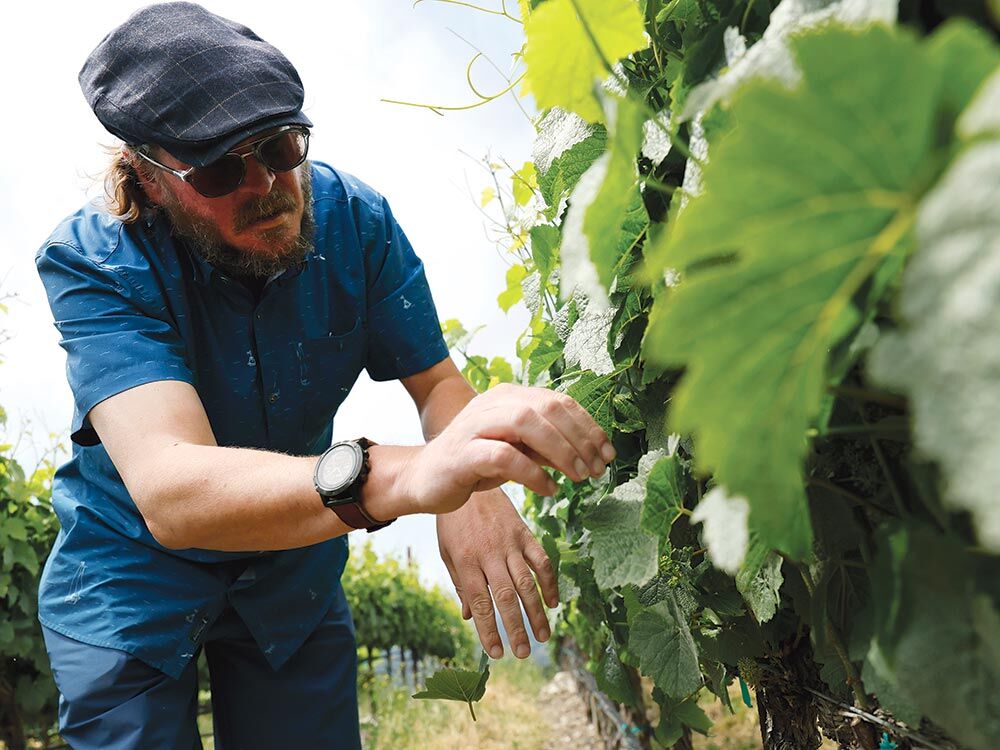
Albatross Ridge winemaker Garrett Bowlus checks the progress of vines midway through the growing season. While winemaking may seem glamorous to some, it is farming - and subject to the whims of nature and market forces.
“We” in this case refers to the global community of winemakers. Langhoff spent 20 years with Wine Enthusiast company before joining beverage industry veteran Jennifer Hord to form the San Francisco-based consulting firm A+J Partners. But she turns to the coffee industry – to ubiquitous brands such as Starbucks – as an example because wine is in something of a free fall.
According to the Silicon Valley Bank’s annual wine industry report, revenues for U.S. brands tumbled by 3.4 percent in 2024, the fourth consecutive year of plummeting sales. When vintners gathered in January at the Unified Wine & Grape Symposium in Sacramento, the president of a Fresno-area growers association, Jeff Bitter, urged wineries to tear out 50,000 acres of vineyards in California alone.
Closer to home, Pierce Ranch Vineyards shuttered its Monterey tasting room in 2023. Boekenoogen turned its tasting room in Carmel Valley over to McIntrye Vineyards, placing its planted acreage up for sale. Jouillian – its tasting room and vineyards – is on the market, and others have been recently listed, including significant plots such as Massa Estate and Bernardus’ Marinus vineyard.
And the situation is no better in wine regions across the world. The International Organization of Vine and Wine reports that when global consumption figures for 2024 were tallied, the result was the lowest since 1996.
The most obvious culprit in this decline is oversupply. Wine brands had been experiencing heady times. Beer consumption in the U.S. peaked in the early 1980s. Meanwhile – spurred by the famous “judgment in Paris,” where California wines beat the best of France in a blind tasting, the Hollywood hit Sideways and some prosperous years – interest in wine took off.
Garrett Bowlus of Albatross Ridge, with vineyards in the hills above Carmel Valley, recalls being in Oregon’s Willamette Valley in the early 2000s. He watched people arrive in private jets from places like Texas to load up on cases to fill their personal cellars. The number of vineyards in that region doubled in just a few years, thanks to low interest rates and corporate brands expanding.
“The big beverage companies went on a spending spree over the last 20-25 years,” he says. “They were thinking market share.”
In the early 2000s, the wave of young winemakers that established California vineyards in the early 1970s began to age out, or their families tired of the challenges of farming. In Napa County, few of the wineries from that original entrepreneurial rush remain under family ownership.
Seeing steady market growth, wine conglomerates and private equity firms began purchasing smaller operations. Talbott Vineyards, for example, sold to E&J Gallo in 2015. While Gallo maintains a diverse and balanced portfolio, many corporate owners sought quick expansion – not only of acreage, but also in the amount of wine distributed.
“That was not sustainable,” Bowlus says.
“We’ve had nonstop growth since 1991,” Heidi Scheid of Scheid Vineyards adds. “There was a lot of optimism.”
A correction between supply and demand was bound to happen, winemakers agree. And on that matter, there is little panic. The market has always experienced up-and-down trends.
Even with recent losses, wine consumption in the U.S. remains well above 2000 levels. Global production, meanwhile, plunged almost 5 percent in 2024.
“A lot of vineyards have been removed,” Scheid points out. “If we produce an average harvest, we’ll be closer to balance.”
There are, however, a slew of other factors at work. And those have been troubling many in the wine industry.
Decades may have erased Scheid’s embarrassment. She readily tells of her first encounter with wine, when not yet of legal drinking age.
“Mine was Boone’s Farm Tickle Pink,” Scheid says with a laugh.
While the fruity and overtly sweet Strawberry Hill was the label’s most popular bottle, Tickle Pink had a friendly cotton candy appeal. Others in the industry share similar stories, often chuckling with chagrin or even a regrettable memory – wine coolers, Cold Duck, Blue Nun, MD 20/20. The bottles were affordable, sugary and, with the wrenchingly notable exception of “Mad Dog,” relatively impotent.

Heidi Scheid of Scheid Vineyards with bottles of the winery’s low-alcohol label, Sunny with a Chance of Flowers. “Scheid is doing a good job,” says consultant Allison Langhoff of A+J Partners, who encourages wineries to reach new demographics.
While fine wine has always been something consumers aged into (“You’re not going to start by drinking Pinot [Noir],” Scheid notes), trends show young adults moving away from wine – and alcohol in general. And that has furrowed some brows.
Silicon Valley Bank’s analysis put the situation bluntly. If oversupply was the primary cause of the market imbalance, tearing out vineyards to reduce cut production would bring an easy correction. But the study highlights “an unprecedented change in consumer demographics and attitudes.”
Just 20 years ago, according to survey data from Gallup, young adults made up the segment most likely to drink on a regular basis. In 2023, only 38 percent of young adults reported drinking regularly, compared to almost half of middle-aged Americans.
In addition, while earlier generations learned that red wine in modest amounts had health benefits, many young people today fear that even drinking alcohol in moderation can be harmful. Gallup’s report found that as recently as five years ago, just 34 percent of Americans aged 18-34 considered a few drinks as unhealthy. That figure now stands at 52 percent.
Boone’s Farm and wine coolers were entry-level wine drinks in an era when American wines were still gaining traction. For many people – especially those with less disposable income – beer or spirits were the average day alcohols. Fine wine was more sophisticated, meant for occasions.
That one segment of the young adult market is spurning alcohol while the whole of the group is imbibing less frequently is to the wine industry like a war on two fronts. Despite the past appeal of novice wines as a gateway to the good bottles, the industry has in general been stubborn. Wine has a bottle, a cork, a mystique and a price point.
The global firm Tetra Pak introduced lightweight, portable containers for wine in the 1980s. These were easy to carry for cycling or other outdoor activities. Boxed wines also reached the market, and in 2003, Constellation Brands took a stab at revolutionizing this segment by introducing Black Box, a more premium wine with a handy pour spout.
But the fine wine labels – and wine aficionados themselves – scorned such innovations. Canned wine met resistance, as well.
Meanwhile younger generations are turning to pre-mixed cocktails, cannabis-infused drinks, spritzers, flavored waters and other drinks.
“There’s concern about the spritzer market, concern about the no-alcohol market, there are CBD-infused drinks,” observes Sabrine Rodems, winemaker for Wrath and Scratch. “There are a lot of options for young people.”
Wine scholar Mike Veseth of The Wine Economist newsletter summed up the industry’s fear of a sustained generational shift in a tone of resignation. He told NBC News in January that the Baby Boomers’ embrace of wine had convinced producers that other generations would follow suit. That it appears not to be happening is the cause of concern.
Winemaking is farming, and farming comes with risks – the whims of the weather, for instance – and costs. One cannot simply plant a vineyard and start making wine. It takes four to seven years before vines produce quality grapes. And that’s just a start when it comes to the upfront costs of producing wine.
Growers in any particular region are on similar schedules, meaning demand for labor and transportation are under pressure. Producing $4,000 worth of grapes might run between $3,000-$3,500, depending on circumstances. After all of that, a bottle of Cabernet Sauvignon, for example, will need to sit for a few years before a winemaker can even put it on shelves.
Simply put, making wine is expensive. Consumer prices reflect that.
But for Langhoff it’s not an insurmountable problem. “One of the things other industries do well is meet their demographic where they are,” she explains. Beverage companies taking advantage of market trends might offer a coffee drink, a spritzer, a “nontraditional” wine and a fine wine. “That hits all segments,” she continues. “[Wineries] do different tiers of the same wine. I don’t get it.”
Bowlus points to Napa wineries, where some labels wield their prestige from the tasting rooms to the wine clubs.
“You have to get on a waiting list, and then I have to buy four or five bottles at $600 a bottle,” he says. “Napa is smoke and mirrors. The younger generation sees through that.”
In the perceived crises – the tumbling sales, the no- or low-alcohol movement, the generation turning to other options – Langhoff sees potential.
“Downturns are opportunities to reinvent, but the wine industry has always pushed back on that,” she observes. “We’re traditionalists in the wine space. The wine industry would hate me for this, but I would create spritzers. If you have an entry-level wine, why not?”
THE YOUNGER GENERATIONS ARE NOT NECESSARILY SUCH AN ENIGMA. This time it is Scheid who makes the coffee analogy. With free-trade, different beans and roasts, milk alternatives and the array of drinks, she observes: “Nobody just orders coffee.”

Scheid partnered with Hoxie to produce wine-based spritzers for the young adult market.
Generation Z, she adds, has been able to stream music and shows on demand, to communicate readily on different platforms, to order favorite foods delivered: “That’s a tough thing for wine to overcome.”
And yet, as Langhoff has noted, it is not necessarily so. There are already wines for different occasions – sparkling for celebrations, Rosé for warm summer afternoons, table wines for an easy family meal.
Langhoff identifies Scheid as one of the area wineries doing a good job of breaking the rut of tradition. And Scheid recognizes the trends. But it was not a desire to introduce the young adult market to wine that led to the family winery’s lower-alcohol label, Sunny with a Chance of Flowers.
“I’m in my earliest 60s,” she says. Even older people spend a day at events or with friends, and the alcoholic weight of a typical wine can begin to tell. “I thought, ‘Wouldn’t it be nice if there was a great-tasting, low-alcohol wine.’ That was a big piece of it. The young people will love it, but a lot of other people will, as well.”
Sunny with a Chance of Flowers measures in around 9-percent alcohol, compared to the 14-percent range for traditional wines. The winery produces two Rosés, still and “bubbly” – their word – and four other varietals, including a Cabernet Sauvignon. All are made with no added sugars.
“The branding is positive, it’s not overly aspirational – this is a wine for the right moment,” Scheid says. “We talked so much about premiumization over the last 20 years. We need to have a spectrum.”
Scheid also recently introduced a house-poured spritzer at the winery’s Carmel tasting room. And in a move that further ripples traditional waters, they teamed with Josh Rosenstein, a New York chef, on the canned wine spritzer line, Hoxie.
In a signal that light, fizzy wine drinks might gain acceptance, Food & Wine wrote of Rosenstein, “Meet the guy making it OK to drink wine spritzers.”
Hoxie’s wine spritzer line includes flavors like lemon ginger Rosé, strawberry Rosé and peach blossom blush.
“Hoxie is flavor-driven,” Scheid notes. “Just because something is a trend, we also want to drink it.”
Lost in the concerns over the market correction that sent wine consumption into its slump and the swings of the younger generation are positives that Scheid has tapped into. People want options, they want sustainability, they want artisanal and they want a narrative.
“We’re not going to beat White Claw,” Scheid points out. But a chef-driven spritzer and sustainably farmed wine fits a niche.
Across Monterey County, wineries are filling those interests – dry farming methods, micro-terroirs, winemakers and land with stories to tell. The aspects of farming and making wine that set the price point also fit the interest in artisanal products with a narrative.
Perhaps that is why the hand-wringing among winemakers and distributors that expanded during the boom or beverage industry leaders tied to market share is not as apparent among the small wineries along the Central Coast.
The approach may be paying dividends. A Wine Market Council study reveals that despite the reduced interest in alcohol, those ages 21-34 still make up 29 percent of all Americans who report drinking wine.
Vintners in the county have cumulatively scaled back production, although a large part of that was due more to weather and wildfires than shifting market demand. Grape harvest peaked in 2014, with almost 46,000 acres bearing fruit. In the year after the 2020 fires, that figure had fallen to 41,972. According to the most recent Monterey County Crop and Livestock Report, 40,200 acres were harvested in 2023.
The value of winegrapes fluctuates year-to-year due to quality and demand. In 2015, for instance, with the market still surging, the county’s crop brought in just under $186 million. A year later, the amount jumped to almost $239 million.
In 2022, as the market hit full slide, local grapes were worth just $173.7 million, a low point in 10 years’ worth of annual crop reports. But in 2023, that figure rebounded to $194.6 million. (The 2024 crop report should be released in July.)
“We’re all struggling a little,” Rodems says. “But we all know consumers go through waves.”
WHILE LANGHOFF SAYS THE WINE INDUSTRY HAS “FUMBLED” when it comes to marketing toward the potential future consumers of fine wine, there is an equally important shortcoming.
“There is a time and place for every demographic to be addressed,” she says.
According to Gallup, the nation’s greater diversity may be in part responsible for the decline of interest in wine among young adults. In the early 2000s, less than one-third of 18- to 34-year-old Americans were Black, Latino, Asian or of another racial minority. Now they account for almost half.
Historically, the Gallup data suggests, non-white Americans have consumed less alcohol – 57 percent compared to 66 percent of white Americans ages 18-34 who drink. Winemakers, Langhoff suggests, have missed reaching out to all markets and instead focused on marketing to a more upscale consumer.
“Let’s be honest, if you want to attract a younger audience, you have to do something different,” she says.
The wine industry is at a crossroads. However, some are finding that it is possible to go in several directions at once.
For most Monterey County winemakers, there is an understanding of the many forces at play. Vineyard manager Matt Shea calls the listing of Bernardus’ Marinus property for $2.6 million a strategic move. It is planted with Cabernet Sauvignon, Cabernet Franc, Petit Verdot, Malbec, Petite Syrah and Merlot – apart from Cab, some of the grapes with less market appeal.
“[The owners] want to renew our focus on Chardonnay, Pinot Noir and Sauvignon Blanc,” he explains. “Those are our core wines.”
But it is almost a status quo approach. Marinus accounted for just 2 percent of Bernardus’ production, according to Shea, who believes the market dip will flatten out within a harvest or two. The winery will continue to purchase grapes from 14 suppliers and keep production levels the same.
The downturn and uncertainty rippling through the market has given corporate operations pause – and may be changing winemaking dynamics.
No longer are buyers on the vineyard real estate market so eager. Marinus Vineyard has been listed for six months without going under contract. Jouillian – with 30 planted acres and a tasting room on 655 acres in Carmel Valley – went on the market for $11.7 million in September 2024, and there it remains. Boekenoogen’s 333 acres, with 95 under vine, was listed at the end of December 2024 for $11.5 million. Almost six months later the price has been reduced to $7.7 million.
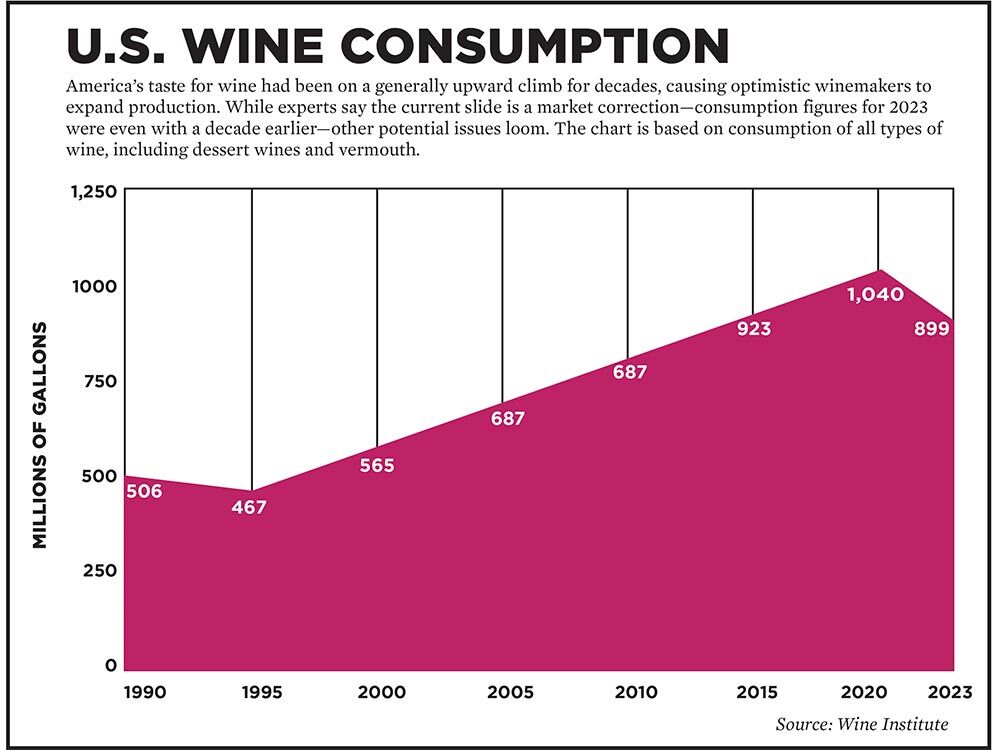
In 2023, Americans consumed 899 million gallons of wine, according to Wine Institute data. While that is down almost 100 million gallons from the previous year – a staggering figure – it remains well above consumption levels at the beginning of the millennium, when Americans drank 565 million gallons.
Spritzers and other introductory wines, along with low alcohol versions could easily achieve what wine coolers and Boone’s Farm did for other generations: turn them into wine aficionados – eventually.
Conglomerates have the capacity to produce and market both entry-level and fine wines on a national level. Under current circumstances, it is not additional acreage that proves attractive, but wineries with established distribution networks and sound financial metrics – in other words, mid-sized vineyards with a following.
Gallo purchased the Hahn label in 2023, despite the downturn. At the time, winebusiness.com ranked Hahn as the nation’s 40th largest winery, producing 450,000 cases annually (compared to some 100 million by Gallo).
According to IBIS World, Constellation Brands – which sold a number of its labels to Gallo – Treasury Wine Estates, The Wine Group, Gallo and a few other conglomerates account for 50 percent of U.S. wine revenue. Industry analysts say that in the current market, mid-sized wineries are most at risk of being “lost in the middle,” as Jenny Heinzen of Vineyard Professional Services told industry magazine Meininger’s International.
Mid-sized operations butt up against the corporate powers. Smaller producers – and Monterey County remains a haven of smaller winemakers – can create a market-favorable boutique niche, she added.
“People still love the personal experience,” Bowlus observes. “We have a good wine community. There’s a real authenticity, without the upselling.”
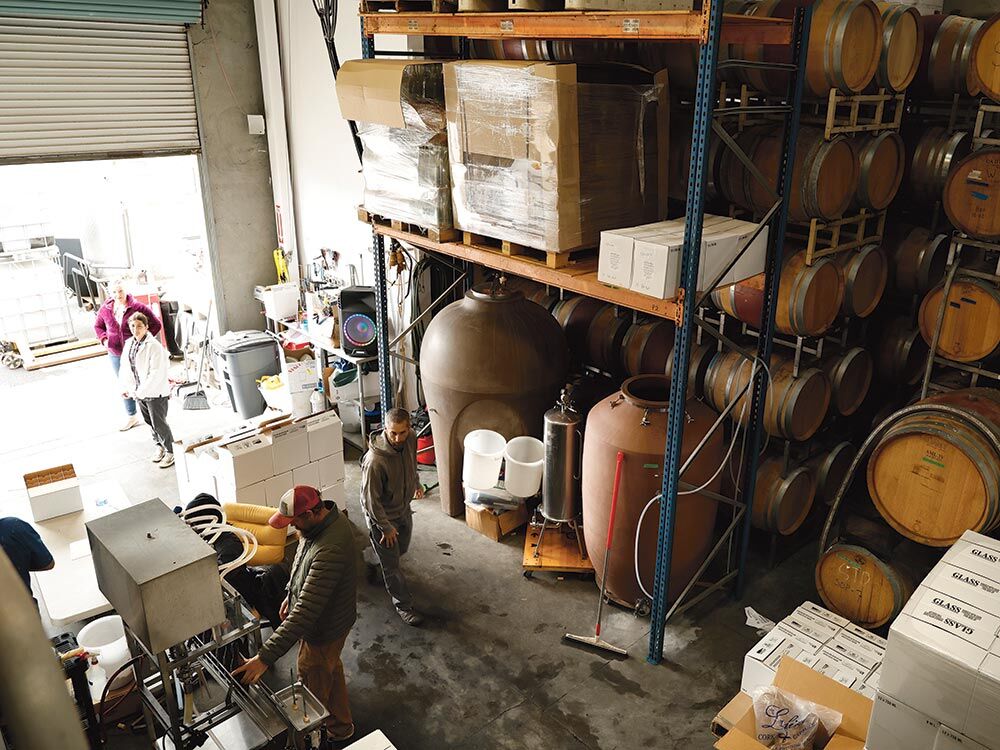
Bottling and packing cases at Albatross Ridge winery in the hills near Carmel. There are a lot of upfront costs before bottles hit the shelves.
Bowlus notes that he has not seen a drop in tasting room visits. But Albatross Ridge is considering more events to bring in foot traffic.
“Small producers, we’re still waiting and seeing,” Rodems says.
Amid all the turmoil, it remains farming and winemaking. And while demand draws some to addressing the growing breadth of demand – spritzers, low alcohol wines, cans and such, the fundamentals have yet to flinch.
“We keep turning out good wine,” Shea says. “That’s all we can do.”
(1) comment
Appreciate you sharing the piece—it echoes what I’ve observed. For many households, wine has quietly fallen off the grocery list. With essentials like housing, healthcare, and childcare demanding more of the budget, discretionary spending narrows. Wine becomes symbolic of a different time.
There’s also a perceptual shift. Where once a glass of red carried connotations of moderation and sophistication, many now view alcohol—even wine—as a health liability and, in some cases, a destabilizing force in family life.
I know vintners who’ve exited, some who survive through niche contracts insulated from market swings, and a few who still produce wines people seek out with intent. But the era of impulse buys over \$15 or boxed wine as a pantry staple seems behind us.
Much of that land has been repurposed for food crops—produce that feeds bodies, not just rituals. There’s something sobering, even clarifying, in that realignment of values.
Welcome to the discussion.
Log In
Keep it Clean. Please avoid obscene, vulgar, lewd, racist or sexually-oriented language.
PLEASE TURN OFF YOUR CAPS LOCK.
Don't Threaten. Threats of harming another person will not be tolerated.
Be Truthful. Don't knowingly lie about anyone or anything.
Be Nice. No racism, sexism or any sort of -ism that is degrading to another person.
Be Proactive. Use the 'Report' link on each comment to let us know of abusive posts.
Share with Us. We'd love to hear eyewitness accounts, the history behind an article.