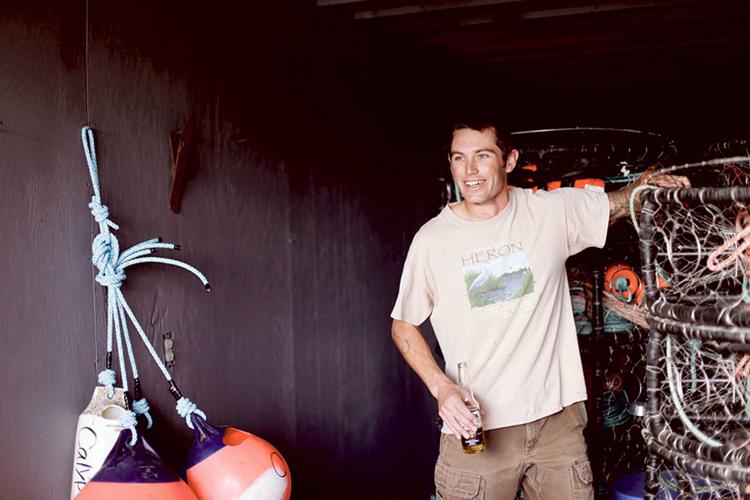

Calder Deyerle, a 30-year-old Moss Landing native and second-generation fisherman, has a lot on his mind.
It’s Nov. 9, six days before commercial Dungeness crab season opens, and the early intel is not looking good.
“Right now, I’m pretty scared,” Deyerle says. “It seems like it’s going to be a pretty slow season.”
Recreational crab season started Nov. 1, and Deyerle was out in Monterey Bay catching as many Dungeness as he could – up to the recreational limit of 10 per day – while taking stock of where the crabs were, and were not. He’s also in communication with other fishermen up and down the California coast, and has decided to start out the crab season in local waters, because nowhere else seems any more promising.
“All I know is I’ll do my best,” he says.
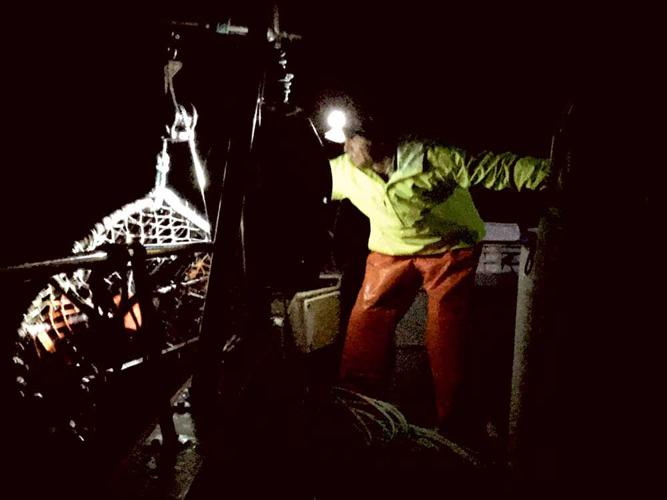
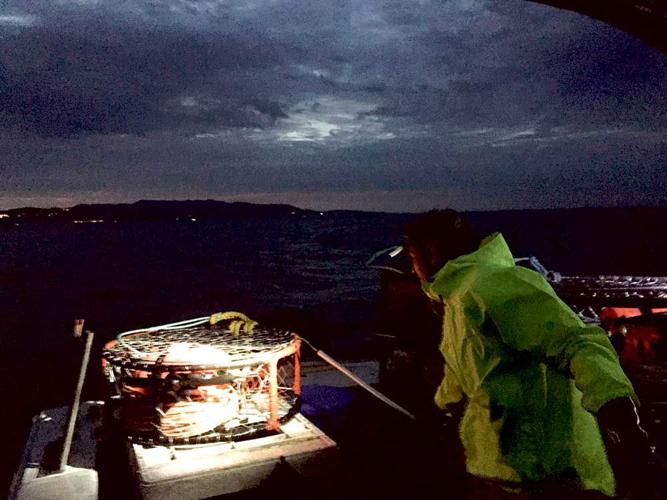
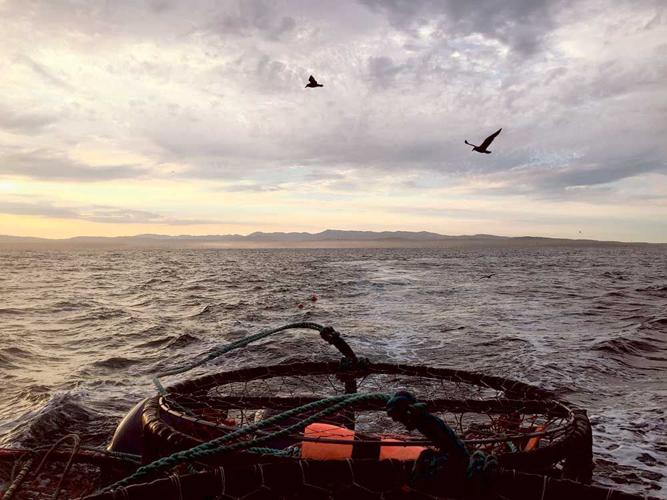
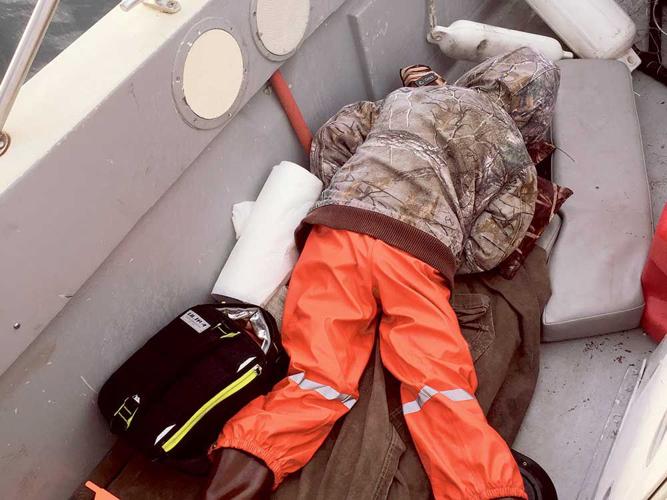
TIMELINE: Nov.15, Crab fishing on Monterey Bay
CrabTime-1
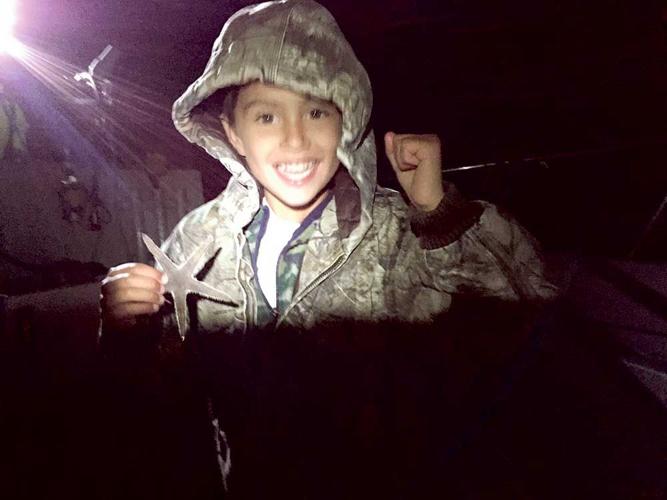
3:21am: Calder Deyerle’s 6-year-old son, Miles, shows off a starfish his dad pulled out of a crab pot.
~~ • ~~
For Deyerle, the stakes are high.
That becomes clear a day later, outside his home in Elkhorn that he shares with his wife, 6-year-old son and 8-month-old daughter.
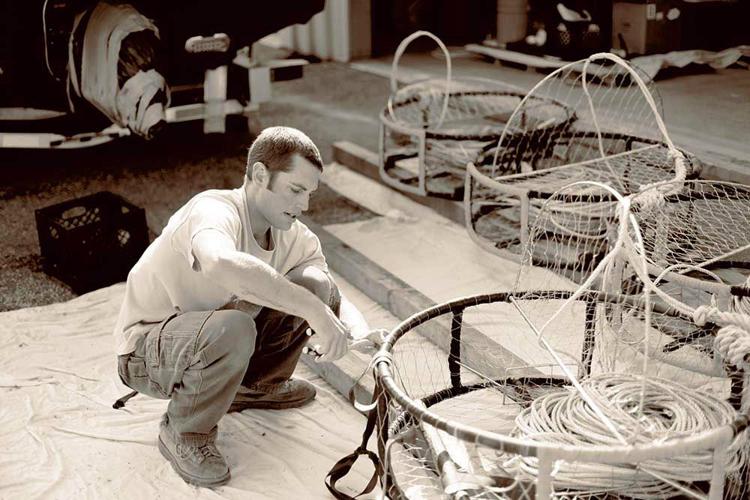
In front of an equipment shed on his property, just a stone’s throw from Elkhorn Slough, Deyerle is busy making minor repairs to crab pots he will soon transport to Moss Landing Harbor.
Next to those pots is a boat he recently purchased from Washington – which he named Sea Harvester, after the Sea Harvest Restaurant his family formerly owned in Moss Landing – but the boat is not yet outfitted with all the necessary fishing equipment.
He will be fishing this crab season on his other, smaller boat, Sea Harvest III, but his new boat is squarely on his mind: It, along with the house, which Deyerle bought in 2016, represent a daunting debt; he isn’t comfortable offering even ballpark numbers. He does offer, though, that he hopes to pay off the Sea Harvester in 10 years.
Deyerle is also sitting on 250 crab pots that, when outfitted with ropes, buoys and other accoutrements, cost about $300 each. There are still some upgrades he’d like to make to a few pots, but he’s out of money.
Nonetheless, he says, most of his traps are “ready to splash,” and good to go when the crab season opens at 12:01am, Nov. 15.
Typically, it’s Deyerle’s most profitable day of the year – some years he’s made more than $10,000 on opening day – but the big day of work is Nov. 14, when he’s allowed to drop pots in the water starting at 6am.
That day that will be filled with successive trips from the harbor to sea in which he stacks his boat with as many traps as safely possible – they weigh about 85 pounds each – and drops them on the ocean floor, hopefully in the best spots.
“That’s my most stressful day of the whole year,” Deyerle says.
As if on cue to lighten the mood, Deyerle’s son Miles strides onto the scene. He’s asked if he’s caught any crabs with his dad lately.
“Yeah!” Miles says, smiling widely.
“Not a lot though,” Deyerle says, smiling, yet pained. “The numbers are looking slim, that’s for sure, at least for what I need.”
But as Deyerle keeps talking, he also keeps psyching himself up.
“It’s a constant chess game,” he says. “These [pots] are your warriors who are out there with your heart and soul in them, so you want to put them somewhere where they’re going to be making money, and not wasting time and resources.
“That’s why I like to grind,” he says, referring to his work ethic. “I’m not going to end up with any more crabs than anyone else by going out earlier and coming in later, but I’ll have better intel, and that will lead to more crabs.”
Already, though, he is talking about shifting his fishing focus later this winter to sablefish and nearshore rockfish, as well as preparing for salmon season in the spring.
But right now, he remains focused on crabs – they’re his bread and butter – and will get after them the best way he knows how: keep grinding.
~~ • ~~
Crab season begins in darkness.
At 1:40am on Nov. 15, Deyerle pulls into a parking lot outside his family’s fish processing plant in Moss Landing Harbor. With him is Miles, who first went crab fishing with his dad when he was just 2 weeks old, and who’s excited to be along.
“Every second I hear I’m crab fishing, I’m going,” Miles says. “I sleep, but I don’t sleep forever.”
Deyerle’s boat is ready to go, and a few minutes later, he motors it out of the harbor while Miles dispenses local fishing wisdom from the front of the 27-foot-long boat.
“Never set gear on the edge of the [Monterey Submarine] Canyon, because it’s going to go bye-bye!” he says with a flourish, adding that his dad knows every fisherman in the harbor.
“Crabbing’s very cool,” Miles continues. “You get to see crabs.”
As Deyerle steers his boat out into Monterey Bay, he bears south, heading toward pots a few miles off the coast of Pacific Grove.
He says the prospects may not be good this season in terms of quantity, but he’s optimistic he’ll get a good price per pound, especially because the Dungeness crab fishery remains closed near the Northern California border – typically a crabbing hotspot – due to the crabs’ shells in that region being too soft. (That’s because the crabs are still recovering from molting, and putting their energy toward hardening their shells instead of filling their shells with meat.)
As Deyerle comes upon his first string of buoys at around 3am, the lights along the Monterey County coast, from Castroville to Pacific Grove, glow in the distance.
Deyerle fires up the generator that powers his boat’s mechanical hauler, and noise drowns out everything else.
Deyerle then grabs a long hook and uses it to reel in the first pot’s rope after the hook catches on a buoy. Once the rope is in his rubber-gloved hands, he threads it through a couple mechanical pulleys and flips a switch to start reeling the pot in.
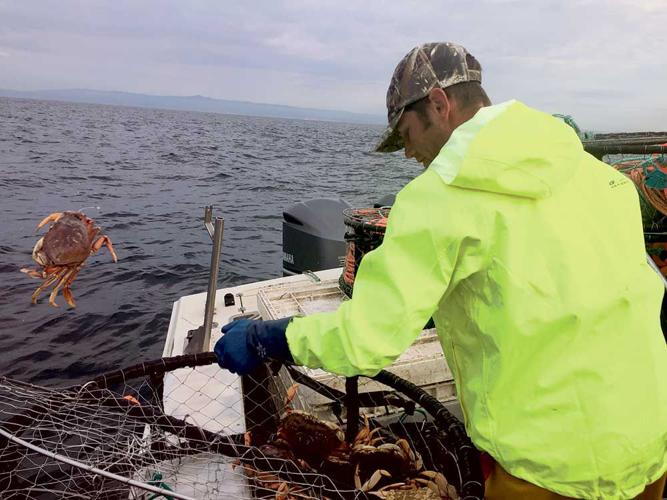
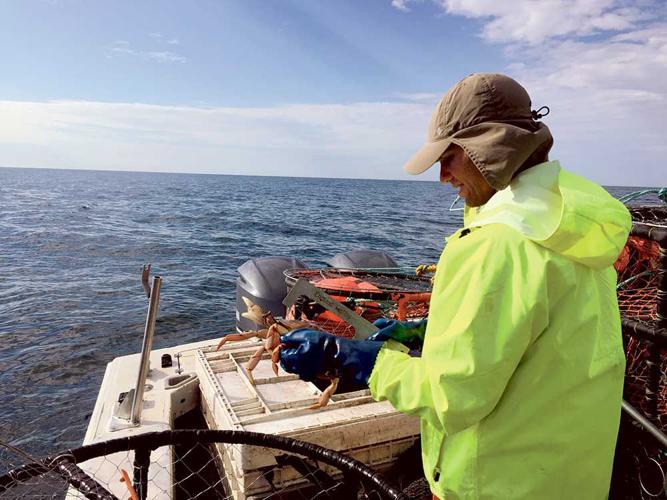
The process moves fast, about five minutes or less per pot. Deyerle lifts the pot onto the side of the boat and starts pulling crabs out. If they’re too soft or too small, he throws them back to sea; if not, he chucks them into his holding container. If any crabs are on the cusp size-wise – they’re required to be a minimum of 6.25 inches across the front edge of the shell – he measures them with a metal ruler that reads: “Englund Marine.”
He also takes the used bait from each trap – a sablefish head, and squid guts and heads – and throws them back to sea, and then restocks each pot with fresh bait. After bracing himself, he then hurls each 85-pound pot back into the water.
In the beginning, the returns are ominous: He averages only one crab per pot in the first five, an average that keeps dropping until his ninth pot, where he pulls zero.
“This is how it’s going to go this year,” he says. “This was a good sport-fishing spot. Zero doesn’t bode well. You’ve got to see signs of life.”
At 3:51am, Miles, who’s been sitting silently for the past several minutes, grabs some cheese puffs and starts popping them into his mouth as he lays on his back. Ten minutes later, he gets up and lies facedown on a pad his dad laid out and immediately goes to sleep.
As the morning gets faintly lighter, the returns on the crab pots are still troubling, with few if any keepers in each, so Deyerle starts stacking the pots on his boat instead of putting them back into the water.
“It’s like a ghost town,” he says.
His plan is to move the pots elsewhere. He’s never fished for crabs this far south in Monterey Bay, but his sport-fishing research this year indicated it was better than further north.
“I wish I had it all figured out,” he says. “I wasn’t positive there were crabs here. It was just my best educated guess, and I was really wrong.”
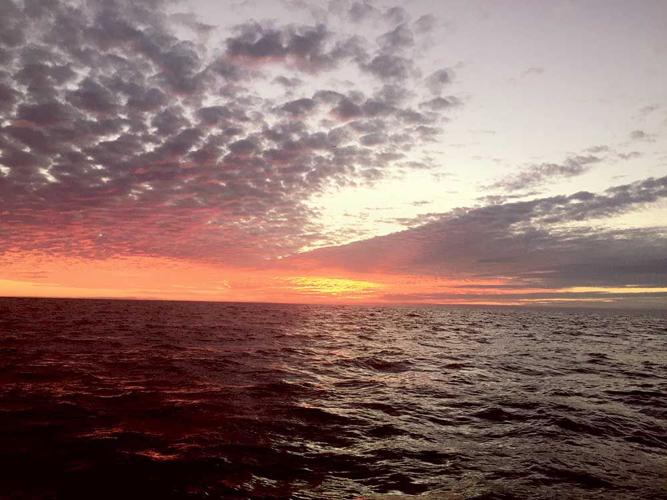
It’s a tough moment, and occurs as the sun starts rising beautifully in the southeast over the Santa Lucia Mountains, lighting up the clouds blanketing the bay. For a passive observer, it’s hard not to regain hope.

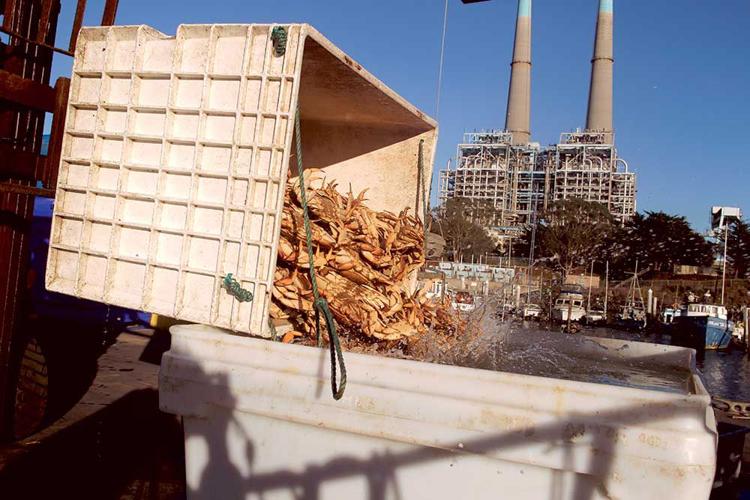
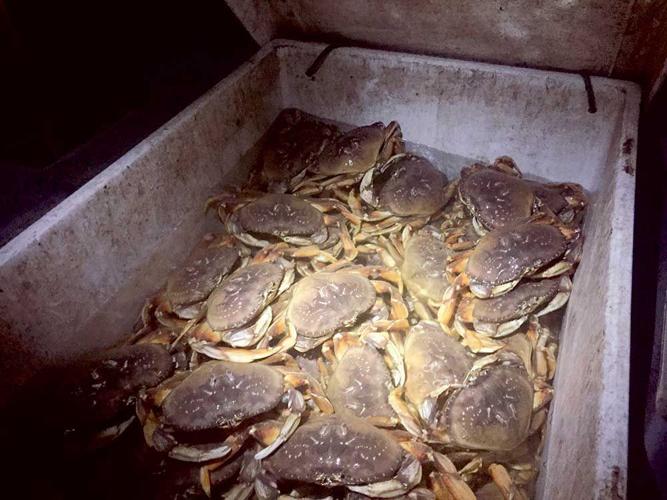
After being weighed, crabs are dumped into water to keep fresh.
But as Deyerle pilots his boat further north, hitting up other strings of crab pots – he usually lines them up in groups of about 10 – his luck barely improves, and he only gets a few crabs per pot, if that.
One pot in particular has no crabs, but holds a lingcod, which he throws back into the water. When you’re fishing for Dungeness crabs, you’re not legally allowed to fish any other species.
“Watching a fisherman return a fish to water is a beautiful thing,” Deyerle says, but adds it’s a bad sign he’s catching fish in a trap – crabs would keep them out.
Deyerle is explicitly a sustainable fisherman – it’s his niche – and he’s the Monterey Bay’s representative on the California Dungeness Crab Fishing Gear Working Group, which the California Department of Fish and Wildlife convened in 2015 to address the issue of whale entanglements. In his free time over the last summer, he and others combed the bay spotting and gathering lost crab pots, which can entangle whales.
It’s something Deyerle feels strongly about, and he firmly believes fishermen can healthily co-exist with a thriving marine ecosystem. In Monterey Bay, he knows that they must.
But this year, the crabs do not seem to be thriving: Just after 7:45am, he’s got 20 pots stacked on his boat, front to back and ready to be moved somewhere else. “I better try something way different,” he says, as a flock of cormorants fly overhead.
It’s then when Deyerle gets a call from his dad, who, along with other members of his family, owns fish markets in Monterey and Carmel, and who tells Deyerle not to sell his crabs to anyone else.
“At least I’ll make good money,” Deyerle says after hanging up.
But his luck stays bad – nine pots and only seven crabs – until he nears his younger brother Walter’s boat toward Moss Landing. Walter and his deckhand haven’t been out nearly as long, but have caught more crabs, and nine in one pot – but they’re “junk crabs,” Walter says, “skinny legs.”
Deyerle takes that in, and tells Walter that Miles, who’s awake again, would like to go home, and Walter says he’s planning to return to harbor soon.
They make a trade: Deyerle passes over a container of fuel to Walter, who needs it, and then very carefully hands off Miles.
When the two boats part, Deyerle calls his wife and informs her that Miles is on his way.
“I’ve got a boatload of traps, I’ve just got to find a spot to put them,” he says. After a short silence, he adds, “It’s a disaster, flat-out.”
~~ • ~~
Slowly, prospects seem to improve.
Deyerle beelines toward the spot his brother bagged nine crabs in a pot – “I’ve got to move all these pots over there,” he says – but the process is time-consuming, taking well over an hour, and he’s not fishing in the meantime.
Just before 11:30, after arriving to another string, he starts pulling more pots – which come up empty – and stacks them on his boat, disappointed. “I was slaying ’em in here last year!” he says.
When he’s done stacking the empty pots, he grabs a hose and starts wetting the crabs in his holding pen, which resembles an oversized plastic cooler, tall, plain white and rectangular.
Every time his boat is not moving, Deyerle never stops moving. Despite having been at it for more than 10 hours straight, he never appears to tire or lose focus.
Alan Lovewell, founder and CEO of Moss Landing-based Real Good Fish, has known Deyerle since Lovewell started his company in 2012.
Real Good Fish is a community-supported fishery that buys sustainably caught seafood and sells it to directly to consumers and schools, and Deyerle has helped supply the company with seafood from the beginning.
“He spends more time on the water than anyone else I know,” Lovewell says. “He’s a hard worker, he’s optimistic and he loves his job. We love working with him.”
That hard work, and optimism, begins to pay dividends as the day grows older.
Just after 1pm, Deyerle reaches a new string, a deeper one. “This is my last-ditch honey hole right here,” he says – and pulls up six nice ones in a single pot.
“We got some jumbos!”
Seagulls start trailing the boat, and fight after the used bait Deyerle throws back to sea.
But the consistency is still dicey, and he keeps stacking more pots.
“I’m pretty much going to reorganize everything,” he says. In a normal year, he says, “we’d probably be done, but the situation called for emergency moving.”
Things really start to pick up on a deeper string (the locations and depths of which are secret) when he reels in four crabs in the first pot.
“If it was like that all day long, we wouldn’t be doing too bad right now,” he says.
It’s just hit 3:30pm, 14 hours since he started fishing, and a rainbow forms over the hills east of Watsonville, arching over a radio tower. It’s a postcard you could only see from the water.
In Deyerle’s next pot, he pulls five crabs.
“This is the most life we’ve seen all day!” he exclaims. “That’s what we’ve been looking for, a nice, steady, three-to-four average.”
His pots keep hitting – four, three, six, three, seven – and Deyerle says, “Thank you rainbow, things are looking up. Now I’ve got a spot to move some gear to.”
~~ • ~~
As the sun begins to set after 5pm, the clouds over Monterey Bay come aglow like a veil of cotton candy.
When it’s finally dark, more than 15 hours after he set out, Deyerle calls it a day. He pulls out a few pieces of paper he’s been marking that show the number of crabs he caught per pot.
The numbers aren’t what he’d hope for, but they are useful.
“Tomorrow will be way better than today,” he says. “I’ve got very detailed info here.”
As for his stress throughout the day, he says, “I was just feeling anxious, now it’s just going to be gravy.”
But his words don’t ring entirely true, and belie a palpable anxiety.
“I’ve made over $10,000 on this day in years past,” he says. “This year, I’ll make a tenth of that, maybe a little more.
“Having gear in the water takes a part of your brain,” he continues, still reconciling the day’s events.
Then he shines a light on the crabs he caught – several dozens of them piled in a container – and his spirits lift.
“Those are beautiful crabs, each hand-squeezed by me,” he says. “This wasn’t like work today, this was fun. The stressful part is financial, and all the preparation involved.”
With all of his adrenaline, that may be true – even though he says he’s only slept two hours in the last 48 – and he continues to build the case a few seconds later, adding, “Being out on the ocean is just fine.”

Calder Deyerle fixes crab pots on Nov. 10 in last-minute preparations before the commercial fishing season opens.
~~ • ~~
A month later, Deyerle is still charging.
He says he started long-lining for black cod and laying traps for nearshore rockfish “right off the bat” after crab season began, but on other days, he’s still out there fishing for crabs.
“It’s improved, for sure, since the first day,” he says. “That was about as bad as it was, and it’s gotten better since.”
The price has also improved, rising from $4 to $6 per pound.
“It’s still relatively slow, but I’m catching enough to make it worthwhile at least,” Deyerle says.
The past weeks have been a blur, he adds; he can’t remember how many days in a row he’s been fishing.
(1) comment
Scab... kids dad and uncle are narcs to the fish n game, theyrat on other fisherman for minor shit. And they are strike breaking scabs.. you’ll never see them north of Monterey bay because the real fisherman would suitcase all their gear. Kid buys a new nice boat but won’t travel like the real fisherman do
Welcome to the discussion.
Log In
Keep it Clean. Please avoid obscene, vulgar, lewd, racist or sexually-oriented language.
PLEASE TURN OFF YOUR CAPS LOCK.
Don't Threaten. Threats of harming another person will not be tolerated.
Be Truthful. Don't knowingly lie about anyone or anything.
Be Nice. No racism, sexism or any sort of -ism that is degrading to another person.
Be Proactive. Use the 'Report' link on each comment to let us know of abusive posts.
Share with Us. We'd love to hear eyewitness accounts, the history behind an article.