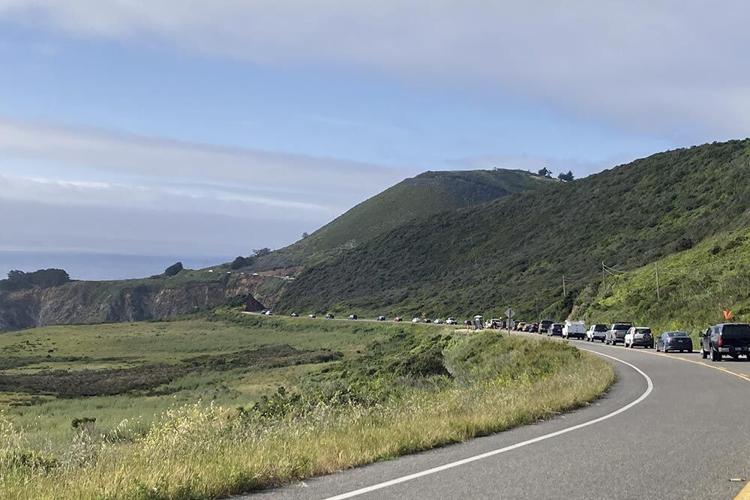

THERE IS PERHAPS NO MORE SCENIC PLACE to sit in a vehicle, idling in traffic, than on Highway 1 in Big Sur. Time the convoy just right and you can wait your turn at Hurricane Point, where there’s a pullout normally reserved for tourists with selfie sticks. Some people sit in their cars – a useful windbreak – reading books. Some do chores, like beating dirt out of their floor mats, or reshuffle the contents of their trunk. As drivers pass in the opposite direction, people honk and wave to say hello. The line of cars regularly backs up into the hundreds in either direction at 7am and 5pm daily, when California Highway Patrol allows vehicles to pass in a controlled convoy in the intact northbound lane – at other hours of the day, construction crews are working to stabilize the road at Rocky Creek.
For nearly two months this spring, this was the normal course of business for travel into and out of Big Sur to the north until traffic signals were installed, allowing 24/7 passage on May 17. (Forget travel from the south, which has been closed due to a slide since January of 2023 – and two new slides since then mean the timeline for restoring access there is an open question.)
The convoy system means “town” to the north is still accessible, but at a minimum, it’s an inconvenience. The sign at the Big Sur Deli indicates it opens at 7am, but the convoy schedule makes that impossible. That doesn’t stop a gaggle of construction workers from gathering out front around 7:40am, waiting for the door to open. When it does, around 7:55am as a man arrives to unload boxes of pastries acquired in town, the group rushes in while coffee is still brewing.

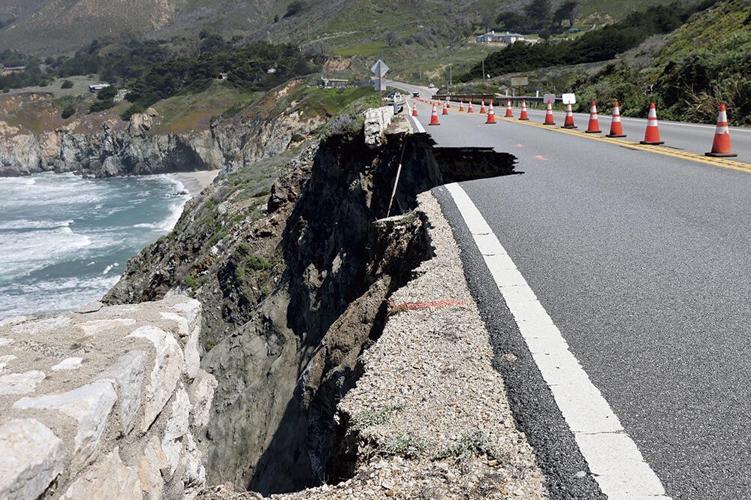
The southbound lane of Highway 1 slipped out, along with the earth underneath it, on March 30. The northbound lane has remained stable, meaning vehicles could get in and out of Big Sur to the north, while three slides have been blocking access to the south.
Mario Busch is waiting for coffee, then to meet a crew in the parking lot to go work on building a stone wall for a private home. Busch, who has lived in Big Sur since 1988, has seen his share of Highway 1 closures. In construction, it makes it difficult to get supplies, but it’s not the worst thing. “I’ve got plenty of work,” he says.
And besides, he’s seen this pattern play out before. The roads are overrun with crowds, and also lined with litter. “It might be a good thing for Big Sur, keeping people out a little bit,” he says. “Big Sur cleans itself up a little bit.” Then he pauses and notes: “It’s hard for the hospitality industry.”
Hospitality is the primary industry here, and it exists only because of Highway 1, the single paved artery that leads to and from Big Sur.
But the steady stream of tourists brings with it a host of challenges – traffic, trash, crowds. When Highway 1 is closed, life in Big Sur is different. Slower, uncrowded. Locals say they see more wildlife up close. They hear more birds. They bike on Highway 1, which takes on the feeling of a quaint country road, not a major international destination traveled by millions of vehicles per year.
The full or partial closure of the highway to visitors means construction crews are busy, but on the other side of the closure, life pauses.
There have been many Highway 1 closures, and there will be many more. Each one is its own unique disaster – people need to figure out how to get supplies, based on what level of access they will have to the outside world – but then comes a moment to pause.
“The idea that Big Sur is cleansing, it is a literal word, not just a figure of speech,” says Martha Diehl, a Monterey County planning commissioner and chair of the Big Sur Byway Organization. When the road is open, Diehl cleans up human waste almost daily. When the tourism pressure lifts, there’s a chance to plan for how to manage the return of millions of visitors, Diehl says. “People are saying: We are not dealing with the press of everyday emergency, so we can fuel up to deal with the incoming emergency, which appears to be the only way to keep our economy going.”
That paradox – of an economy reliant upon tourists, but an infrastructure that is not set up to support the volume – is just one of many underlying Highway 1 in Big Sur.
THE PEACEFULNESS that comes during a closure presents its own paradox. There’s no work, but the workforce gets a moment to enjoy Big Sur in a different way.
Kendra Morgenrath manages human resources at Nepenthe, meaning her job this season included furloughing about 100 employees.
But Morgenrath has also been enjoying the relative peace. She trained for the Big Sur International Marathon Relay by jogging on Highway 1. “I could hear the ocean and sea lions barking,” she says. “I have done hikes where I haven’t run into anyone.”
It’s a beautiful Sunday afternoon on May 12, sun streaming through the redwoods at Pfeiffer Big Sur State Park after the fog clears. Normally on a day like this, the campground would be packed. Instead, it’s still. The only sound in the Big Sur River gorge is the running water, and an owl hooting nearby. The short trail to Pfeiffer Falls is empty except for two hikers.
Matt Glazer is manager of Deetjen’s, which stayed open for breakfast daily but refunded close to $250,000 worth of room stays between March 30, when a chunk of Highway 1 collapsed at Rocky Creek, and mid-May, even after the convoy system was opened to the public. In the first week, he furloughed or laid off 36 of 42 employees. And yet – Glazer watched the partial solar eclipse from the popular destination Partington Cove, by himself. “I’m reminding myself why I live here,” he says.
This story repeats everywhere. “There are these really beautiful glimmers of magic that can only happen when it’s quiet like this,” says Diana Ballantyne, general manager of Fernwood Campground & Resort.
But there is pressure: She laid off 40 of 44 employees. She expected 1,500 campground nights in April. Instead, she sold just two campground nights.
“I am making sure as kind of the mother hen of this place that all of my chicks are warm and fed and taken care of, and all the ducklings are afloat,” she says.
One of those ducklings is Zeeek Kim, who lives in employee housing on the property. “In the beginning when I heard we were going to be furloughed and there was no definite timeline, that did make me worried,” he says. “But within a few weeks, I realized I was going to be OK.”
While he was not working, he got to soak up the quiet, riding his bike on Highway 1 and looking at wildflowers. “I was able to watch spring actually happen,” he says.
Jackson Kownchuck works the front of the house at the Big Sur Lodge, where he’s been furloughed for weeks. His busiest day in six weeks is Sunday, May 12, when he says one person came in to eat.
The job comes with housing, and work is easy. “I’ve been enjoying the privacy,” Kownchuck says.
He’s still waiting on an unemployment check, but qualified easily for $500 in relief from the nonprofit Community Association of Big Sur, which distributed cash relief to 542 of 600 applicants during the closure. “People have been looking out for one another,” Kownchuck says. “People are getting by and doing good.”
Kownchuck and Kim both say they’ve barely bought groceries thanks to The Big Share, another nonprofit. They’ve relied on a grassroots network of community support that exists to help people through times like these, so that hopefully, they get to appreciate some of the magic of the solitude instead of stressing.

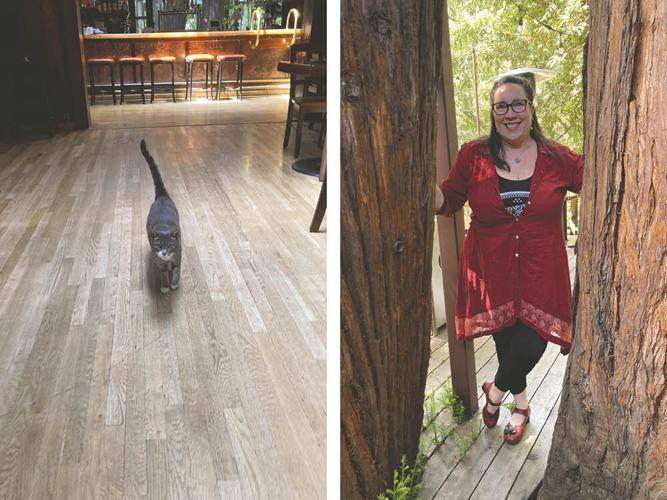
(Left) Coco, the bar cat at Fernwood, is the only customer on a recent afternoon when restaurant hours and the menu were limited during Highway 1 convoys. (Right) Fernwood Manager Diana Ballantyne, shown on the back deck, says there is a community infrastructure to help people during layoffs. “The Big Sur community is resilient and supportive of one another.”
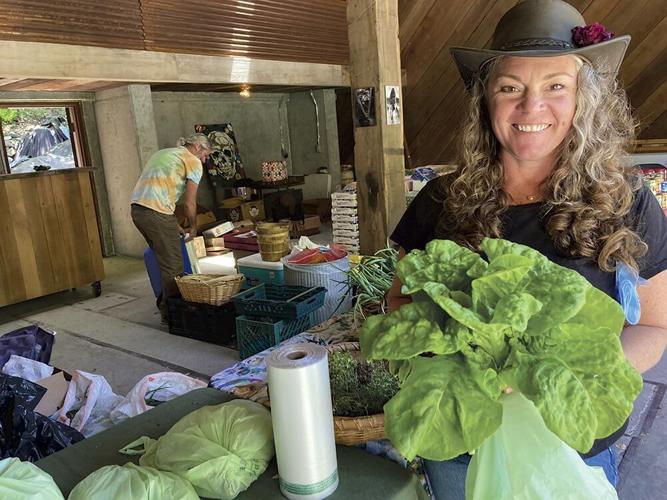
ON MONDAY AFTERNOON, May 13, kids are playing on a lush lawn. It looks and feels more like a community festival than a food bank distribution. But inside, there are piles of canned vegetables, bags of rice and jars of peanut butter that people are here for. There’s no eligibility criteria, no limit on what you can take – nothing to make it feel institutional. Jolinda Matthews has baked cupcakes to share to celebrate her 51st birthday; cut flowers are available in a jar of water. Stewart Gardner from MEarth (located at Carmel Middle School) harvested 125 heads of lettuce and armloads of scallions and Swiss chard on Sunday – what should be his day off – to deliver via the 7am convoy.
This is as much a gathering place as it is a food distribution site. The idea of The Big Share is simple: People in the community know what their neighbors need, and they can get it to them directly, a case study in mutual aid.
The group’s motto is “We believe there is plenty for everyone.”
“Our whole point is getting out of the scarcity mindset,” says Helen Handshy, one of the creators of The Big Share.
She farms on the five-acre Pfeiffer Ridge property where she moved to help care for her 94-year-old grandmother, Clovis Harrod. During the pandemic, the idea to launch something uniquely Big Sur originated. It is more than a food pantry, although it does distribute food from the Food Bank for Monterey County – it’s also an invitation to gather, and not just to take, but to offer.
“It’s evolved, but it’s always going to make sense to share food, whether it’s due to Covid or a disaster or just as a place in a remote community for people to gather,” Handshy says. “The way everyone supports each other here is phenomenal.”
With hospitality paychecks suddenly reduced or eliminated, there was a surge in participation. They added a second weekly site, and have been serving about 250 people per week. What was usually plenty of eggs – three cases – turned out not to be enough, and they were grabbed up quickly. So Handshy worked to get more (seven cases, of 150 eggs each). “That changed everything,” she says. No more rush.
Handshy has a dream of growing the Share with local food. She has calculated they’ll need 225 laying hens to meet the demand for eggs, that critical item. (The target is to have 225 hens by 2025.) She dreams of getting a grant for a walk-in of their own.
“If we have just eggs and produce, we could live on that for a couple of weeks,” she says.
That might sound like prepper type thinking. But in a remote place like Big Sur, it’s sensible. Highway 1 is the only paved artery that connects the coast to services to the north and south. Slides and slip-outs and flood and fires resulting in road closures are normal. They always have been.
A 2001 REPORT prepared by JRP Historical Consulting Services for Caltrans is titled, “A History of Road Closures Along Highway 1.” It reveals that ever since the highway opened in 1937, it’s been perilous to keep open. There were closures in 1938, 1940, 1941, 1952, 1955 and so on. The report documented more than 50 closures, some for as little as a few hours, some lasting many months.
Highway 1 in Big Sur is an attraction unto itself, a major tourist draw – but the same features that make the highway an attraction make it fundamentally unstable.
“The Big Sur coast is understood to be a geologically active area,” Caltrans spokesperson Kevin Drabinski says. “That has certainly been the case since the highway opened in the 1930s. You have a combination of steep cliffs leading down to the ocean, and steep cliffs leading up to the Santa Lucia Mountains. It poses a challenge for maintaining the roadway. Rain makes the dirt heavier and lubricated, and it wants to find the lowest level. That is one of the reasons we predictably see slide activity on the Big Sur coast.”
The slip-out just south of Rocky Creek occurred on March 30, when a chunk of pavement collapsed down the cliff after the earth below it gave way. Drabinski says it was due to a combination of rain (from above) and heavy swells and high tides (impacting the cliff below).
Meanwhile, Caltrans contractors continue to work on three slides on the South Coast. Work is underway at the northernmost of those slides at Dolan Point, which Caltrans recently reported was expected to be cleared by mid-May, a target that has come and gone. (The latest estimate is “early summer.”)
Two miles south of there, work at the steep and complex Regent’s Slide – which is still active – is also underway.
The southernmost slide is Paul’s Slide, where the highway has been closed for a year-and-a-half.
When Regent’s and Dolan slides happened in March, they trapped people for a 12-mile stretch between slides, so Caltrans started running a convoy (for local traffic only) to help people get out to the south – making access to the north through Rocky Creek especially important. (For residents south of the Dolan Point, who can travel in and out via convoy, a trip from Lucia to Monterey is now roughly four hours.)
Paul’s Slide is expected to reopen in late summer this year. But work at Regent’s Slide has just begun, and will take longer; in mid-May, construction crews had to take a five-day break as it was still moving.
Caltrans projects Regent’s Slide will be cleared and stabilized by late fall
That means the best-case scenario that Caltrans is now projecting is to reopen the dream Highway 1 road trip between Carmel and Cambria in late fall – close to two years since it’s been cut off. And that’s assuming no more incidents happen between now and then.
The 2001 report on closures is one of many reports produced over the years that echo the same thing: The highway is fundamentally unstable, and closures are to be expected.
“Neither the Big Sur coast, nor the Highway 1 corridor, nor its management context is static,” according to a 2004 management plan produced by Caltrans. “Just as geologic processes continue to shape the landscape, new information drives the regulatory environment. Changing demographics, the economy, and land use along the corridor all influence travel patterns. All of these are dynamic.”

Helen Handshy was grateful to find her own way of contributing to the community during the pandemic by launching The Big Share to distribute food and other essentials. The concept has grown and become permanent. “It is never going to not make sense to share food,” she says.
AS MUCH AS DYNAMICS CHANGE, they stay the same. A 1972 film narrated by actor Doug McClure and directed by Robert K. Blaisdell relies mostly on footage gathered in the 1960s, with testimony from local celebrities like Helmuth Deetjen and Henry Miller, as well as visiting hippies. Big Sur: The Way It Was reflects many of the same concerns of today through its own lens of 50 years ago. Next to a sticker reading “Keep Big Sur Beautiful,” McClure describes the growing “threat of overcrowding, the danger of the destruction of the backcountry, the scarring of the mountains, and fire.”
One speaker says, “As more people come in, the very thing people come for is being destroyed – freedom, privacy, beautiful country, nature in its pristine beauty.”
About three years ago, a group called Keep Big Sur Wild formed in order to be involved in the still-ongoing process of amending the Big Sur Coast Land Use Plan, first adopted in 1986.
For Marcus Foster, one of the founders of Keep Big Sur Wild, the primary goal is keeping that 1986 vision of limiting development intact.
“The land use plan is the heartbeat of what has protected this place,” he says.
An ad hoc committee comprising county planning commissioners Diehl and Kate Daniels (also supervisor-elect for District 5, which includes Big Sur) have spent years refining amendments to the 38-year-old document.
That means wrestling with questions about the appropriate number of lodging units, housing units and price points. But to Diehl, it is ultimately about Highway 1.
Protecting the road and the scenic experience of the drive is high on Diehl’s priority list, and in honoring the original spirit of the land use plan. “Big Sur was going to be designed as a place for people to drive through and experience the views,” she says. “Highway 1, the drive, that’s the thing.”
To protect the viewshed means limits on new buildings and on parking. Where drivers have created and expanded pullouts at Garrapata State Park are now routinely stacked with parked cars, which diminishes the quality of the drive, Diehl notes: “Now the experience is to look at parked cars, not the scenery.”
Bixby Bridge has similarly become a traffic jam chokepoint.
To Diehl, the 1986 plan was effective because it recognized the highway as the primary way for the public to experience Big Sur – they wouldn’t need to spend the night, go for a hike or even stop for lunch to experience the place. It could be experienced through the car window.
“In Big Sur uniquely, unlike anywhere else, public access is primarily visual access, and public access cannot be allowed to impinge upon that. Otherwise,” Diehl says, “it’s just for rich people.”
Of course, rich people have a way of enjoying the peacefulness of Big Sur even when the highway is closed. During the convoy era, Post Ranch Inn offered helicopter rides, about 15 minutes in duration, to and from Monterey Regional Airport so guests could still visit. (From co-owner Mike Freed’s perspective, that was a critical decision to support 200 employees. “We knew we were going to lose money, but we kept people working and that was the key,” he says.”)
Even after Caltrans and CHP agreed to allow the general public to use the convoy system starting on April 29, the public was slow to return.
At Nepenthe in mid-May, two big tables remain covered with partially completed jigsaw puzzles; there is so little business that they might as well keep them set aside.

About 500 vehicles a day traveled via convoy in April; that number grew to 700 after the general public was allowed. Signal lights enabled 24/7 traffic starting on May 17.
THE IDEA that Big Sur is the ultimate road trip obviously requires a road.
Caltrans hired Teichert Construction for initial stabilization work at Rocky Creek, which came in at $3.1 million. The estimate for a permanent repair (contractor TBD) is $21 million, just one of four current projects. (Papich Construction is the contractor for the three South Coast slides, with a $60 million project at Paul’s Slide, a $31 million contract at Regent’s and $1.8 million at Dolan Point.)
The conditions that lead to closures – fires, storm swells at high tide, heavy rain – are all likely to increase in frequency and severity with climate change. “Big Sur is poised to be better prepared, because we have already gone through this so much,” Ballantyne says.
For businesses, planning for a drop in visitors is increasingly part of the business plan.
“We have organically already started to make sure we are protected financially so we can get through these crises without closing the business,” Ballantyne says. “You have to have a chunk of money to get through a three-month closure for any period of time. This is a known factor – that the road will close, there will be a fire, there will be a flood. Knowing that is a good philosophy going forward for business in Big Sur. We already live it.”
At Deetjen’s, Glazer has learned to expect a slow return to normal visitor volume.
“We are looking at 12 to 18 months of recovery,” he says. “2011 taught us that, 2016 taught us that, 2017 taught us that. Getting the word out about being reopened is way more difficult because the news cycle talks about the disaster.”
He sees an opportunity to change the story about Big Sur and Highway 1 – that closures or travel difficulty is intrinsic, not a one-off. He wants visitors bureaus and marketing agencies to trumpet it, instead of pretending a free and clear road is normal: “We are beautiful because of our nature and nature is ever-changing. Those things are in tension.”
He hopes that can make visitors better prepared, as well.
And they need to be. Kim says it was a regular occurrence at Fernwood during the convoys that confused guests would show up, entirely unaware that they had to leave on a 5pm convoy, or that they would not be able to continue a drive to the south.
The hospitality industry workforce serves in many ways as the visitors’ center of Big Sur, answering phone calls from prospective guests about trails, poison oak and highway closures. “We all become ambassadors for this area,” Morgenrath says.
Residents have developed resilience and adaptability, taking care of each other. Maybe, with enough information, tourists can be too.
“What’s the difference between a good traveler or a bad traveler?” Glazer says. “It comes down to information. Most people coming to Big Sur don’t know what they’re coming for, other than three attractions and an Instagram picture.
“Really the attraction is the act of traveling the highway, and discovering and witnessing the engineering marvel of a highway system cut into a hillside along the edge of a continent. That is what we need to talk about.”
The idea that the highway is subject to disasters could, perhaps, be part of the draw. At least it already is for locals.
In Big Sur: The Way It Was, Henry Miller speaks very much about Big Sur the way it is. “That’s what I like about Big Sur,” he says. “It kills out the weak, and only the strong survive there… That’s another tribute to the community that lives in Big Sur. They survive everything – everything.”
Correction: This story has been updated to reflect that employees at Nepenthe this season were furloughed, not laid off.
(0) comments
Welcome to the discussion.
Log In
Keep it Clean. Please avoid obscene, vulgar, lewd, racist or sexually-oriented language.
PLEASE TURN OFF YOUR CAPS LOCK.
Don't Threaten. Threats of harming another person will not be tolerated.
Be Truthful. Don't knowingly lie about anyone or anything.
Be Nice. No racism, sexism or any sort of -ism that is degrading to another person.
Be Proactive. Use the 'Report' link on each comment to let us know of abusive posts.
Share with Us. We'd love to hear eyewitness accounts, the history behind an article.