





IT’S LUNCHTIME AT PACIFIC GROVE SENIOR LIVING, FORMERLY KNOWN AS FOREST HILL MANOR, and a group of residents are sitting around a table in the dining room, stumped by the bread that came with the tuna sandwiches. It was advertised on the menu as a croissant sandwich, but instead of a flaky, buttery pastry it’s some sort of muffin-shaped bread with a faux swirl design baked into the top.
“This is not a croissant,” one resident says, using the French pronunciation. “What is this thing?” She takes the top of the bread and taps it on her plate, making a clinking sound with each tap.
The residents agree the meal is barely edible, but the poor quality food is relatively minor compared to a list of additional vexing issues they have faced since for-profit Pacifica Senior Living purchased the P.G. location in 2022, along with another senior facility, Lake Park, in Oakland, for $34 million from the previous owner, nonprofit California-Nevada Methodist Homes. The nonprofit filed for Chapter 11 bankruptcy in 2021.
In recent months PGSL residents say they’ve contended with no heat for sometimes weeks in the main building and a malfunctioning elevator that stranded some residents, along with departures of longtime staff members and low staffing, poorly functioning washers and dryers, among other issues. Meanwhile, fees went up without explanation.
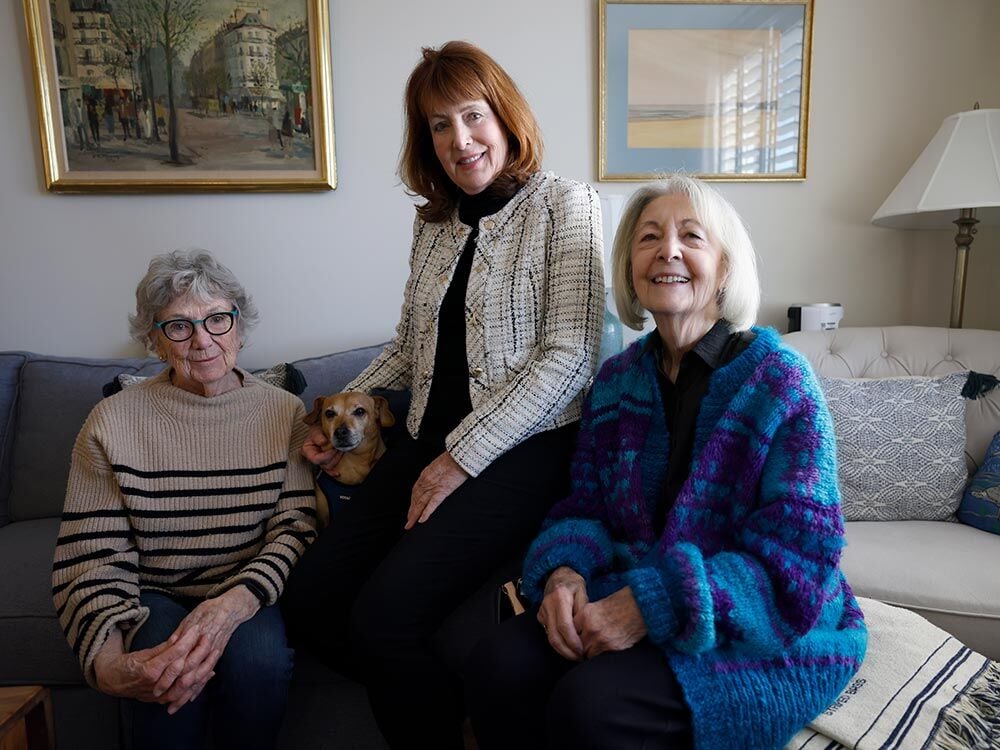
Nita Pettigrew (far left), vice president of the residents association, president Diana Northrop (center) , and Joanne Kelly, their neighbor, inside Northrop’s apartment. The association has been advocating for owner Pacifica Senior Living to fix persisting issues.
A neutral third-party monitor’s report completed for the California State Attorney General’s Office last March detailed how Pacifica cut costs while increasing fees and noted a higher than average number of state citations compared to other facilities. The monitor also noted problems like a lack of emergency lighting and safety issues due to staff cuts. (In California, the transfer of nonprofit-owned health care facilities to for-profit owners requires review by the Attorney General, and in this case, came with a set of conditions and monitoring for compliance.)
In August, Pacifica garnered worldwide attention after attempting to improperly evict a 96-year-old woman from PGSL. At a skilled nursing facility in Healdsburg owned by Pacifica, the company settled a wrongful death lawsuit for $2.5 million in the case of an 88-year-old woman who died after her stay there. The attending surgeon at the hospital where she died called it a case of “clear reckless neglect” in his deposition.
(Pacifica Senior Living management was contacted and asked to comment for this story. They did not respond.)
The senior population expected to grow over the next 45 years – the California Department of Finance projects that the number of people aged 65 and up in Monterey County, now just over 15 percent, will be 25 percent of the population by 2070. That fact is not lost on corporations and investors, who are jumping into the market to cash in on the senior wave.
For many seniors and their families, the options are limited, especially as more nonprofit and religious-based facilities are bought out by corporations and private equity firms. Nonprofit senior facilities tend to have better safety and care records than many for-profit facilities. One in Monterey County, Carmel Valley Manor, stands as an example of a well-run community for those that can afford it.
“For-profits, they’re out to squeeze every penny they can out of it for their investors and the human factor is going to twist in the wind,” says one P.G. Senior Living resident. (Residents asked to not be identified out of fear of retaliation.)
“The hard cold fact of it is that’s the way it’s coming for senior living across the country,” the resident says. “More and more are being taken over by for-profits, and seniors are getting hurt as a result of it.”
REAL ESTATE INVESTMENT WAS THE MAIN GOAL when Pacifica Companies was founded in 1978. Over the years, the San Diego-based company has compiled a large list of investment properties and hotels in the U.S., India and Mexico. Last year it broke ground in Chula Vista on a project encompassing 1,500 condominiums, a 250-room hotel and 400,000 square feet of commercial space.
Somewhere around 2006, company leaders saw a golden opportunity in the growing senior living marketplace and formed Pacifica Senior Living Management as well as other LLCs for a growing list of acquired senior assisted living facilities that total over 80 in seven states.
(The long background in hotels may hold the explanation for why Pacifica Senior Living management renovated the P.G. location common areas more like a hotel than for an accessible and safe facility for seniors. The third-party monitor noted in his report how dangerous the new, slick floors were. In addition, they create echoes that make it hard for senior residents to hear others, creating isolation.
“When they came in, they pulled up all the carpeting and all the furniture. Everything is plastic. The floors are plastic, furniture, everything,” one PGSL resident says.)
Deepak Israni, nephew to company founder Ash Israni, confirmed in a deposition in December 2023 that “the demographics were strong to justify us investing in that sector.”

The lobby of P.G. Senior Living was renovated after Pacifica Senior Living purchased the property. The company ripped out carpeting, creating a potential slipping danger for seniors, and residents say echoes make it difficult to hear. In a report by the residents association in January 2024, they noted major infrastructure repairs were going unaddressed “while superficial decor is changed in ways that defy common sense.”
“What is the purpose of that business?” attorney Lukas Pick asked Israni during the deposition.
“It’s to manage senior living assets,” Israni replied.
Asked if he had any health care training, Israni’s answer was “no.” Later when asked, he said he thought maybe a few others in the company did.
Pick was one of the lawyers representing the family of Phyllis Johnson, who sued Pacifica Senior Living for elder neglect and wrongful death after Johnson died in 2021. The active 88-year-old woman fell and broke two bones in her lower leg. She had surgery to repair the leg and was transferred to a temporary rehabilitation center, followed by transfer to Healdsburg Senior Living Community, owned by Pacifica, for skilled nursing.
Skilled nursing was not an area the company was familiar with. The Healdsburg facility was part of a package deal that included other senior facilities like assisted living and memory care, which had been the focus since it was first founded. At the time, Pacifica only operated two other nursing facilities, says Sanford Horowitz, who also represented the family.
“They were stuck with operating a [skilled nursing facility], so it was the hated step-child,” Horowitz says.
Skilled nursing requires a higher level of staffing, yet Healdsburg was treated like other facilities Pacifica has purchased – staffing and services were cut soon after the company took over.
Three weeks after Johnson was admitted to Healdsburg Senior Living Community, she was dead. She had been rushed back to the hospital where she died of septic shock, stemming from a pressure ulcer near the base of her spine.
In a draft report prepared by consultant Christopher Cherney for Johnson’s family, Cherney outlined what he called “a complete breakdown in HSLC systems of care provision,” blaming “violations of professional standards, as well as federal nursing home requirements.” He found nursing staffing levels to be 43-percent below state minimums on average during Johnson’s stay, including not hiring a director of nursing, as required by the state.
Johnson’s death was directly attributed to the failures of Pacifica Senior Living and its executives, including Israni, Cherney said.
His report was never heard in court. Pacifica settled the case last year for $2.5 million. The family returned to court recently over the company’s failure to pay in a timely manner.
SINCE JOHNSON’S DEATH, HSLC has been stripped of its state license, a rare step according to senior advocates, claiming that officials with the State Department of Social Services avoid taking away licenses, which would send families scrambling to find other locations that may not have enough beds or exist nearby.
In general, advocates are highly critical of state oversight, or the lack thereof.
Patricia McGinnis, an adviser to the nonprofit California Advocates for Nursing Home Reform (CANHR) who’s worked for the organization for decades, is critical of what she calls “substandard care” provided by most facilities in the state and the “shoddy work” done by state evaluators. She says they often do “brush-by” investigations when complaints are lodged, resulting in many labeled as unsubstantiated, possibly a byproduct of a system that’s been underfunded historically by legislators.
The California Department of Social Services manages over 72,000 licenses for a variety of facilities, according to McGinnis, including those for the elderly, like residential care facilities, continuing care retirement communities and memory care (see sidebar, p. 20). Many complaints filed by facilities are marked as unsubstantiated. Complaints that are substantiated come with required corrections, but McGinnis contends there is usually not enough follow-up.
Many years ago, the complaints CANHR received were about food, as well as theft and loss. In recent years the complaints are more serious, like residents not receiving medication, or medication mix-ups.
“Nobody seems to care,” McGinnis says. “That’s the problem.”
PGSL HAS A LICENSE IN CALIFORNIA for both what’s known as a residential care facility for the elderly and a continuing care retirement community, and as such is under the purview of the Department of Social Services (DSS). Since Pacifica took over in 2022, DSS evaluators have visited the site 20 times to investigate 40 complaints. Of those, 23 were considered unsubstantiated, 10 unfounded, and seven substantiated.
Pacifica was cited last October and July for not having hot water for residents, and received two citations in the case of the attempted eviction of 96-year-old Jean Jacques in August because management claimed she owed them $109,000 in back rent and fees. Jacques had a continuing care contract with the previous owners that guaranteed her care for the rest of her life even after she ran out of money, which Pacifica was ordered to abide by as a condition of the sale out of bankruptcy. After Jacques’ story went viral, Pacifica executives reversed their decision.
The company was also cited last fall for making a substantial change to its operations without prior approval, since it started advertising housing for independent living, apart from its approved plan for assisted living. Managers told the DSS evaluator they would talk to upper management about making a formal request to make the change.
By contrast, Canterbury Woods, located just a block away from PGSL and run by nonprofit Front Porch, had one substantiated complaint in 2023 for not providing enough hydration to an assisted living resident. Carmel Valley Manor has zero complaints on its recent DSS record.
In addition to PGSL, Pacifica also owns The Park Lane in Monterey, which has an assisted living license. Since 2020 that facility has been visited 19 times with nine citations issued. In all, 33 allegations were unsubstantiated, five unfounded and five substantiated. The citations included not seeking timely medical attention for a resident who fell, failing to refund money to a responsible party after a resident’s death and failure to administer medication.
Residents upset with Pacifica’s management have contacted other agencies for help. Last year, their persistence resulted in the City of Monterey investigating a roof leak that had been ongoing for about four years. The city issued a code violation to Pacifica for failing to repair the leak. At least two apartments had mold issues, resulting in one resident having to move out before the city’s visit. City officials tagged that apartment as unsafe in May. When Pacifica took too long to make repairs, the city threatened fines. The roof has since been repaired, according to a city building official.
A kitchen fire at The Park Lane last summer resulted in the discovery that the fire alarm system wasn’t working, possibly due to rodents chewing on wires. The Monterey Fire Department required Park Lane employees to patrol the building on fire watch until the system could be repaired.
Rats are suspects because they have been spotted by residents, and signs of their activity were seen on a regular basis last summer and fall in the dining area. The Monterey County Health Department has been monitoring the situation, which has improved, but they have not closed the case.
At one point last summer the kitchen was shut down by the health department for three days. Instead of the quality meals residents were once promised at what is advertised as “luxury senior living,” they were served pizza on paper plates.
County health inspectors have been out multiple times and Pacifica management has promised to follow up with rodent control. At a resident town hall meeting in August, the company’s Regional Director Aaron Windbigler detailed how they had a contractor coming out to inspect twice a week, as well as trimming trees away from buildings to deter roof rats.
Residents say the work to control rats is ongoing.
IT’S A QUINTESSENTIAL CLEAR FALL AFTERNOON at Carmel Valley Manor, nestled in the hillside on the south-facing side of the valley. The views of the Santa Lucia Mountains on the other side are stunning from the picture windows recently uncovered in a renovation of the sit-down dining room. On the other side of the kitchen area, a group of residents happily chat in a cafe of lighter fare that was created during the renovation, which continues in other areas of the facility.

Top: President and CEO Jay Zimmer at Carmel Valley Manor, which has apartments up to regular homes, plus an assisted living center and a skilled nursing facility.
Once known as Hollow Hill Farms, the 28 acres where CVM sits were purchased by the Northern California Congregational Churches in 1960. Board members formed Northern California Congregational Retirement Homes, Inc., a not-for-profit corporation, to build a retirement community and care facility on the property.
Ten years earlier, the churches had petitioned their national denomination “to give serious attention to the duty which Congregational Churches have toward elderly people,” according to CVM’s website.
CVM no longer has a relationship with the original churches, says President and CEO Jay Zimmer, but it continues to follow the original mission in the articles of incorporation, to provide housing and health care to seniors. Zimmer, who’s been in the position for over five years, comes from a background managing hospitals back East and transitioned to senior living facilities.
The facility is licensed as a Continuing Care Retirement Community. Its assisted living center, Hillcrest, is licensed as a residential care facility for the elderly. The Health Center is licensed as a skilled nursing facility. Zimmer says they also provide memory care, but don’t have a distinct memory care unit – CVM is working with the county on a master facility plan that will include such a unit in the future, in addition to 14 new housing units. Zimmer hopes to have approvals and entitlements within two to three years.
Currently there are about 240 residents, with 146 independent living units, 36 skilled nursing beds and 24 assisted living units. The youngest resident is 68, the oldest is 106. The housing units range from studios up to full homes.
The entry fee depends on the type of unit – the base entry fee is approximately $700,000 for a single person. There’s also a monthly service fee, which can range from $5,500 a month up to $12,000. All meals, care and activities are included.
“That entry fee covers their health costs for the rest of their lives,” Zimmer says. The Carmel Valley Manor Foundation pays residents’ fees if they run out of money, totaling around $350,000 a year.
There are a bevy of programs, events, hikes and other activities to keep residents involved, if they so choose. A residents’ council has a number of planning and advisory committees.
Unlike other senior facilities that seem to struggle finding and keeping employees, CVM offers competitive wages and benefits.
“We typically staff better than for-profits,” Zimmer says. “And the staffing makes a huge difference.”
HOROWITZ, THE ATTORNEY, is nearing retirement after a long career. He found his niche in practicing elder law after serving as the lead trial counsel and co-appellate counsel in a landmark elder abuse case, Delany v. Baker in 1999. The case established that the Elder Abuse and Dependent Adult Civil Protection Act applies to nursing homes as well as health care providers.
“The clients change, the bad guys change – it’s almost the same scenario, understaffing undertraining, profits over people,” he says.
“As I’m at the waning part of my career it’s a little depressing,” he adds. “It’s like a finger in the dyke, that’s all it’s been.” He acknowledges that he has helped families over the years seeking justice for their loved ones who received inadequate care.
Pacific Grove Senior Living residents haven’t given up on finding the leverage needed to force Pacifica to make changes.
It’s a momentum toward change that was in part started by Bob Sadler, a former resident who moved into P.G. Senior Living in April 2023 with his wife, Sharon. Sadler became an outspoken critic, dissatisfied with life there after having been promised a luxury living experience.
“You’re marketing this as a luxury resort place,” he said during a residents’ meeting last year when Pacifica Regional Vice President Beau Ayers visited. “State regulations are there trying to keep people from dying. We want a luxury resort, as advertised.” Ayers responded with a sarcastic edge: “So we should change the advertising to subpar, OK.”

Top: The grounds at Carmel Valley Manor are dotted with places for residents and visitors to gather.
Sadler worked diligently as a leader in the residents’ council during his time there. He developed surveys for residents to log their complaints about food quality. He publicly posted complaints on social media sites like Nextdoor. He came to Jacques’ defense and alerted the media to her plight. He followed up with multiple emails about her case, as well as sending emails about problems at Pacifica, and at The Park Lane.
His advocacy for residents was a thorn in the side of Pacifica officials. Residents say Windbigler went up to Sadler’s apartment and asked him to stop the bad publicity – it wasn’t going to help them attract new residents and bring in money to fix issues. Sadler told Windbigler if they fixed the problems the bad press would stop.
On Sept. 25, Sadler sent an email to his neighbors with the news that he and Sharon were reluctantly moving out.
“The pipe issue discussed at our last meeting was in our apartment. We have not filed a complaint; however, we have decided to move out of the community,” he wrote.
The lengthy email described how they had contended with leaky pipes in the walls for weeks, with maintenance people making access holes attempting to reach and patch the old pipes. No matter how many repairs were made, the pipes continued to leak, including in an upstairs apartment. A plumber told Sadler the pipes were part of a very old radiator system.
“The only real solution is to shut down this whole main building and replace the plumbing. Pacifica has said they won’t make that investment. They are going to replace the plumbing one emergency at a time,” he wrote.
“We were going to file a complaint with the state, but we knew it would get no more attention than the other complaints that are dropped after a lightweight investigation.”
They left in mid-October for a home in Del Mesa Carmel, an active 55-plus community in Carmel Valley.
Sadler died on Nov. 29 after a sudden medical episode. He was 80.
“I can’t believe Bob is gone,” a resident wrote to the Weekly after his passing. “When I told Jean Jacques, the first words she said were, ‘I will pray for him.’ She did not moan about the loss to her, but she thought of Bob first. I was touched.”
(0) comments
Welcome to the discussion.
Log In
Keep it Clean. Please avoid obscene, vulgar, lewd, racist or sexually-oriented language.
PLEASE TURN OFF YOUR CAPS LOCK.
Don't Threaten. Threats of harming another person will not be tolerated.
Be Truthful. Don't knowingly lie about anyone or anything.
Be Nice. No racism, sexism or any sort of -ism that is degrading to another person.
Be Proactive. Use the 'Report' link on each comment to let us know of abusive posts.
Share with Us. We'd love to hear eyewitness accounts, the history behind an article.