

“Where the hell did he go?” shouts an audience member. The shouter stands among a sea of 1,200 equally baffled concertgoers at The Fillmore in San Francisco. Moments before, The National lead singer Matt Berninger leaned dramatically over the edge of the stage, then ran down the stairs – mid-song – and disappeared into the darkness of the back of the theater.
The chaos and confusion builds briefly, then his voice cuts through the clamor with omnipotence.
“I won’t fuck us over, I’m Mr. November/ I won’t fuck us over, I’m Mr. November,” he erupts, still out of sight.
The audience sings every word along with him.
Berninger belts out the next line of the crowd-pleasing anthem with intensity: “I wish that I believed in fate, I wish I didn’t sleep so late.”
Then, the double doors to the main theater slam open, flooding the dark space with light from the lobby. The capacity crowd turns around as one to locate the singer, whose illuminated outline makes him look like an oversized lightsaber. Cheers thunder louder. The spotlight moves toward the back until it captures the frontman like a prisoner and guides him down the aisle and back to the stage and his bandmates, twin brothers Aaron (guitar, keys) and Bryce Dessner (guitar, keys) and brothers Scott (bass) and Bryan Devendorf (drums).
Berninger is easily over 6 feet, with intentionally tousled salt-and-ginger hair, an eight-o’clock shadow and black slim-fitting three-piece suit. His baritone voice hovers somewhere in between Ian Curtis and Leonard Cohen – and what he lacks in vocal range he makes up with restraint that demands listeners pay attention.
And he needs to be active while he performs. Not in a Mick Jagger stage-calisthenics, semi-choreographed way, but with the entire venue as his stage – the audience, the balcony, the theater lobby, the loudspeakers.
“We’ve always tried to put on great shows that we care about and are present for and passionate about,” Berninger says from Rome, Italy, in late July, while preparing for a performance. “We work really hard to put out good records and we work really hard to put on an awesome show every time we go out, whether it’s a little club or a big arena.”
Every band that’s made it big has said something along those lines. The difference in The National’s case: It’s true, and offers a window into their artistic DNA.
While the Cincinnati natives have enjoyed rave reviews from the likes of The New York Times and Rolling Stone since their start – they’ve been dubbed “critical darlings” – they remained marginalized, forced to swallow cringeworthy moments that could be outtakes from This Is Spinal Tap, like a Louisville show where the bartender was the only person they were playing for. Or the Orange County gig where another bartender offered to pay the band to stop playing so the employees could go home.
“Bloodbuzz Ohio” pounces on your ears with addictive rhythmic orchestration. Berninger’s baritone clashes against it, thumping like a metronome in an empty Spanish cathedral.
It’s one of those songs that you need to listen to more than once. As you do, the fragmented prose – “I’ll rest my eyes to the rivers in the sea” – begins to make sense.
Taken as a whole, the song is risky, authentic and dissonant, a powerful counterpoint to potable contemporary songs like Katy Perry’s “Firework,” Robyn’s “Dancing on My Own” and Cee Lo Green’s “Fuck You.” Its desolated expanse makes it hard for audiences to get immediately.
Like bassist Scott Devendorf told Consequence of Sound, “We were never a band that ‘arrived’ as many do today.”
As recently as 2007, the band wasn’t able to fill the landmark 250-seat Mercury Lounge in Manhattan.
So they went elsewhere – far away elsewhere. Like the Balkans.
“I WISH THAT I BELIEVED IN FATE, I WISH I DIDN’T SLEEP SO LATE.”
No, Croatia isn’t a hotbed for touring rock bands, but it became a regular stop for The National in the early days, thanks to an ambitious Croatian promoter who wouldn’t promise a huge venue or more than a couple of hundred Slavs, but always a packed house.
“We’d play everywhere,” Berninger says. “We didn’t say no to any offers. We would drive all night to play these little places.”
The marathon missions came as they were dealt deflating setbacks. One of the biggest indie labels, Matador, rejected their self-produced Sad Songs for Dirty Lovers. In Akron, Ohio, they played to an audience of one, who just happened to be Patrick Carney of the Black Keys, before that group hit it big.
The National faced a bitter choice: 1) Tweak their music to be less dissonant and dark, and more poppy and harmonious or 2) stay authentic but obscure, a Charles Bukowski of indie rock, struggling month to month, driving a crappy van, tempting the fate of being discovered very late in life or not at all.
They returned to a pact they made early on.
“We wouldn’t write a song that we weren’t really confident about musically,” Berninger told Consequence.
They didn’t want to perform what other people, however powerful, wanted. They didn’t want to look back and see a sugary phase or sell-out moment of creative weakness either.
“I hope we’re one of those bands that people can go back to any of our records and can connect with, and the songs have shelflife,” Berninger says.
That philosophy was reflected in Sad Songs For Dirty Lovers and Alligator – which yielded favorable reviews from tastemakers like Rolling Stone to Pitchfork, and swelling audiences in the U.K. and France, but the band was still playing to plenty of empty seats during their 2005 U.S. tour with opener Clap Your Hands Say Yeah.
“That was one of our darkest moments,” Berninger told Spin. “It quickly got to the point where [Clap Your Hands Say Yeah] would finish onstage and we would hurry to try to get out there and play our fastest, catchiest song to stop people from walking out.”
Even their fourth record, Boxer, which was their most successful album, at the time, debuted down at No. 68 on the charts.
The difference with the slow-building “Bloodbuzz Ohio,” the first single from the LP High Violet, the group’s fifth studio album, is that it was initially written to be very minimal. But it turned out to be one of their most epic tunes yet.
Suddenly, their vision had greater traction. The album sold more than 50,000 copies its first week. It reached No. 3 on the Billboard 200. It made No. 4 on Time’s list of Top 10 Albums of 2010 and No. 15 onRolling Stone’s Top 30 list.
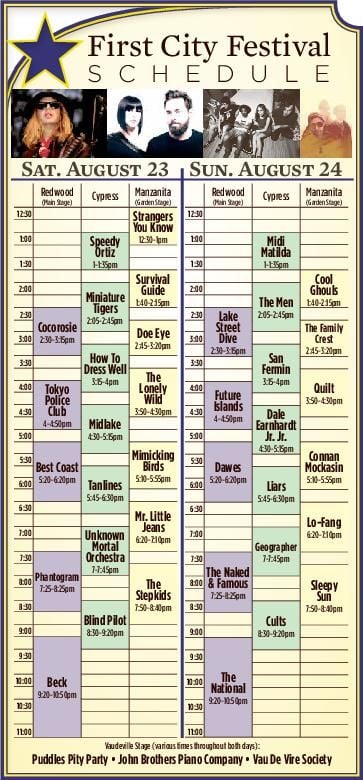
The fact that it happened without them abandoning that despondent, sometimes angsty sound – that they kept writing what they felt, not what pop charts dictated – makes them exactly the type of act festival organizers seek. When The National wrap things up at the Aug. 23-24 First City Festival, with a Sunday show (see schedule), they’ll be headlining arguably the hottest boutique music festival in the country.
But they’re not taking their burgeoning success for granted.
“Bands come and go and are forgotten,” Berninger says. “That might happen to us. It seems like our fans are pretty serious, but who knows?”
There are butterflies in your stomach, then there are California condors.
The group didn’t experience jitters at Obama’s 2008 campaign stop in their home town of Cincinnati. (The president used “Fake Empire” for his 2008 Vote for a Change campaign.) Or opening for R.E.M. in amphitheaters. Or playing for more than 18,000 at Brooklyn’s Barclays Center.
Not so much with Saturday Night Live.
“[SNL] was nerve-wracking,” says Scott Devendorf. “The reputation of the show and its place in our lives growing up amounted to a lot of pressure.”
The group’s widespread appeal grew in the three years in between High Violet and 2013’s Trouble Will Find Me, which also reached No. 3 on the Billboard Charts. The more dramatic signals of success were still to follow: both a Grammy nod and then Saturday Night Live.
The group was nominated for Best Alternative Album. Some 10 million viewers watched the SNL appearance, which included the morbidly romantic “I Need My Girl” and their homage to shotgunning cheap beer and shooting potato guns, “Graceless.”
But even as they’ve had their commercial breakthrough, they still do things their own way. They joined the Grateful Dead’s Bob Weir for a two-hour set at his TRI Studios in San Rafael, California (a typical National fan couldn’t be more different from a Deadhead). They’re performed their tune “Sorrow” 105 times in a row at a six-hour art installation in New York City.
The most surprising example of their uniqueness, though, came by way of cinema.
One of the best rock documentaries of the past decade isn’t really about rock.
Mistaken for Strangers, a title take from a song on the Boxer album, was released in March 2014. For many, a music movie surprisingly short on music was their introduction to The National. This writer felt compelled to watch it after seeing the prodigious buzz it received at the Tribeca Film Fest.
“Mistaken for Strangers is, like its maker, scruffy, undisciplined and eager to be loved,” writes New York Times film critic Jeannette Catsoulis. “The big surprise is how easy it is to comply.”
The risky, but ultimately authentic – and artistic – decision the group made with the film furnishes further proof of the group’s unique vision: It turns out to be more about Matt’s underachieving younger brother Tom than the nationally touring group.
“I had no interest in there being a documentary about our band on tour,” Matt says.
Mission accomplished. The movie follows Tom as he signs on as a stagehand, gets fired and decides to make a tour documentary of the band, without anyone’s permission. One catch: He’s never done much of anything with himself besides drink, and still lives with his parents, in his 30s.
If that sounds crazy, it is. But the end result is a revelation. Instead of navel gazing “what does your art mean?!” riffs – as Matt says, “when you interview a band about being a band, you learn a version of it that’s invented” – it’s artists navigating real life and revealing themselves more authentically as a result, even when it’s not pretty.
The semi first-person narrative leads into extended conversations with band members about everything from his fading relationship with Matt to his insecurities. The audience sees him get wasted by himself and pass out listening to heavy metal Christmas songs on the tour bus.
Matt has his share of unflattering temper tantrums and moments where he comes off as megalomaniac lead singer and controlling older brother, but doesn’t regret it.
“WE’D PLAY EVERYWHERE, WE DIDN’T SAY NO TO ANY OFFERS. WE WOULD DRIVE ALL NIGHT TO PLAY THESE LITTLE PLACES.”
“It’s such an honest portrayal of our relationship,” Matt says.
Devendorf adds, “We felt like having Tom around and documenting our experience would make for not the typical documentary. It gives [the movie] a narrative arc that shows who we are as a band and as people.”
The National have been on tour since May 2013, when they released Trouble Will Find Me and have shows scheduled until Thanksgiving. But Berninger’s already plotting the post-tour schedule: “After we finish touring, we’ll disappear into our own little caves for awhile and recalibrate into the world,” he says. “Then a [new] record will start to happen.”
After all the sudden twists and surprise turns across The National’s 15-year-career, the band has learned that nothing ever goes as planned or even deserved. They apply that sensibility to their creative process and let the songwriting happen organically. Lately, the group has been toying with the possibility of changing the way it makes records.
“Partly for fun, partly because we don’t want to make a record like any we’ve made in the past,” Berninger explains.
In other words, even if audiences may not know where Berninger dissapears to, and the group doesn’t know where the ride will take it, The National and its fans know one thing: The band isn’t heading anywhere predictable anytime soon.
(0) comments
Welcome to the discussion.
Log In
Keep it Clean. Please avoid obscene, vulgar, lewd, racist or sexually-oriented language.
PLEASE TURN OFF YOUR CAPS LOCK.
Don't Threaten. Threats of harming another person will not be tolerated.
Be Truthful. Don't knowingly lie about anyone or anything.
Be Nice. No racism, sexism or any sort of -ism that is degrading to another person.
Be Proactive. Use the 'Report' link on each comment to let us know of abusive posts.
Share with Us. We'd love to hear eyewitness accounts, the history behind an article.