
IT’S 7AM ON A SUNNY MID-JUNE MORNING IN CHUALAR. Madison Stagner, fresh off the school year and preparing to enter her final year at Salinas High School, wakes up and walks to the barn on her family’s property, where she is greeted noisily by seven pigs vying for her attention.
She consults a whiteboard in the center of the barn and a grid that is drawn on it. Each pig’s name is written across the top, and underneath them is every day of the week, with certain tasks organized in the grid.

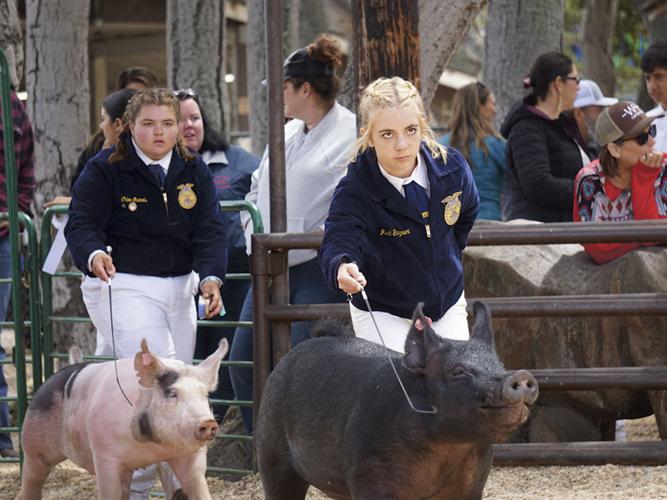
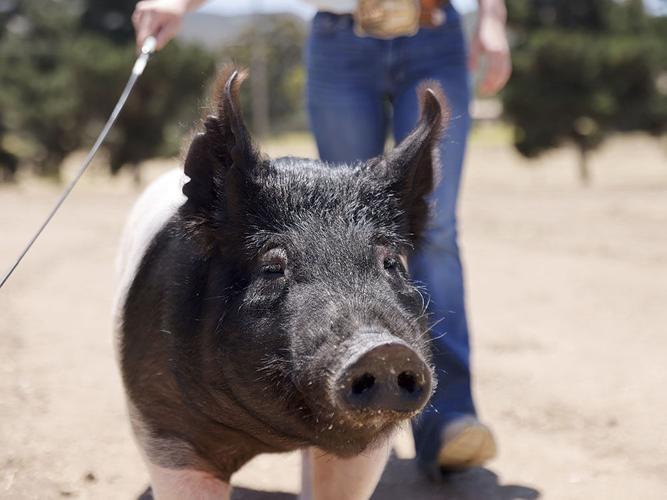
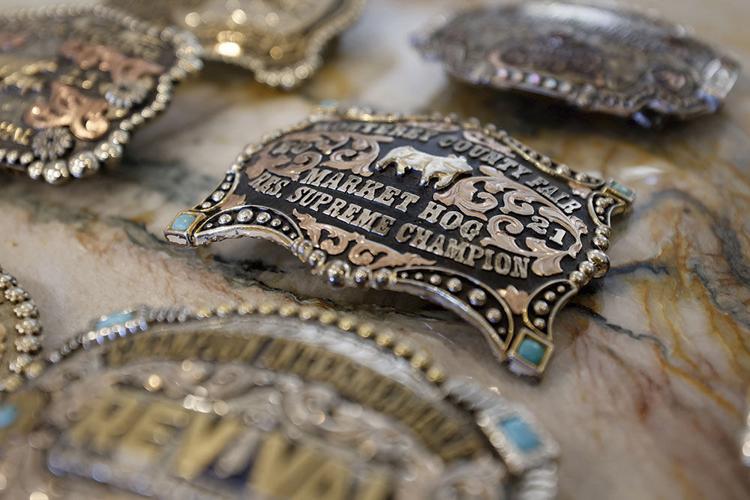
Madison Stagner competes in the showmanship competition with her pig at the 2023 Monterey County Fair. She says she must maintain focus in the intense judging ring while avoiding running into other competitors. Stagner’s work over the years has paid off with numerous belt buckles (shown at right) and other awards at various events.
Today is Thursday, which means Bandit, Cal and Poppy are due for a bath. Lenard, Maple, Dean and Rory, meanwhile, just need a brush, after being bathed the previous day. All are fed – it’s important that they not only maintain their weight, but increase it.
If this wasn’t summer break, Stagner would have to head off to school after completing these tasks, and after a long day of studying, go straight back to the barn to clean the pens, and of course, feed the pigs.
But these are the early days of summer, so Stagner is able to spend more time with the pigs, perhaps take them for a walk and further bond with them. While other students her age may be off on vacation or hanging out with friends, Stagner has work to do in perhaps the busiest time of her year.
She’s only a month removed from showing a pig at the Salinas Valley Fair in King City, and was only a few weeks away from making the trek to Sacramento for the California State Fair. After that, it’s non-stop through early fall: the Monterey County Fair runs Aug. 29-Sept. 2, the Santa Cruz County Fair from Sept. 11-15 and the San Benito County Fair from Oct. 4-6.
It’s a labor of love. Stagner, 17, is now the president of Salinas FFA (Future Farmers of America), and has lived the lifestyle since joining a 4-H group when she was 9. She estimates she’s raised more than 60 pigs in her lifetime.
As the Monterey County Fair kicks off for its 89th year, it marks the culmination of countless hours and immeasurable dedication from numerous students who have prepared for these days, hoping to not only earn money for college and other future dreams, but to share how important it is for everyone to know where their food comes from.
IT’S EARLY JULY DURING THIS MID-WEEK AFTERNOON. There’s some activity going on inside a barn on the outskirts of Salinas – Gina Lopez is blow-drying her goat, while FFA Adviser Rachel Dalton checks in with the handful of students, who are busy scraping out pens or feeding their pigs, who snort happily at the attention.
The students may be preparing for three more fairs by the end of the year – Monterey, Santa Cruz and San Benito – but the busiest time of the year has passed after the conclusion of the Salinas Valley Fair, where 30 Salinas FFA students and their 30 animals competed.

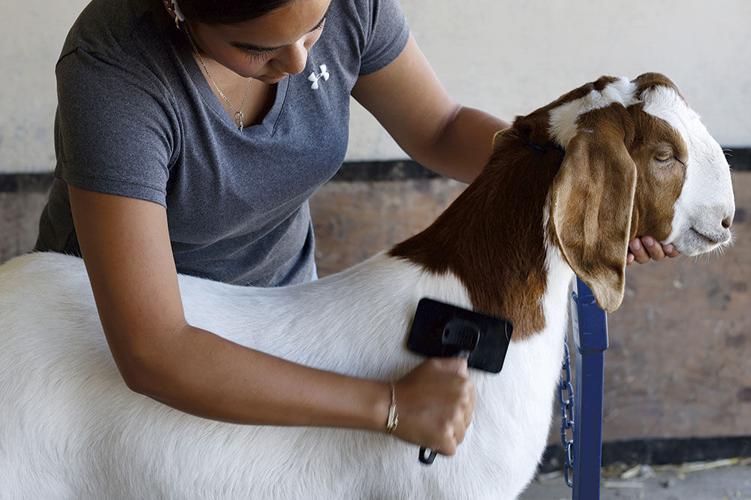
Lily Tenorio brushes Hank Jr. at the Salinas FFA barn on the outskirts of Salinas.
Now, the group is down to about half that size, before it doubles again in January to start the process all over again.
“It takes a really dedicated kid to raise an animal over the summer,” Dalton says. “You have to give up your vacation.”
Dalton adds the students must spend a minimum of 14 hours a week, or about two hours a day, at the barn completing the various tasks – feeding, cleaning, rinse and repeat. But most spend much more time than that, as just spending time with the animals is the key to success.
“In order to show them properly, they have to trust you and you have to form that bond,” she says. “It starts really early.
“These animals are the best cared for. These kids put everything into it.”
Ask any of the students if they feel it is too much work to care for the animals over the summer, especially when many of their peers are relaxing during this time, and they’ll say there’s no other place they’d rather be.
Senior Will Freshwater says he works on a ranch, and being a part of the FFA program throughout his high school career has taught him the responsibility that comes with caring for animals, as well as life skills.
“I love it,” he says. “It’s getting me prepared for life after school.”
THAT IS PRECISELY DALTON’S GOAL FOR THE PROGRAM – that students learn important skills, such as budgeting and time management, which will carry them through life. Other activities outside the barn, such as public speaking and learning the ins and outs of job interviews, are also pillars of FFA classes.
Students have to work out their schedules, showing up at the barn at 6am for feeding and cleaning before heading out to their summer jobs, returning to the barn in the afternoon and then again in the evening.

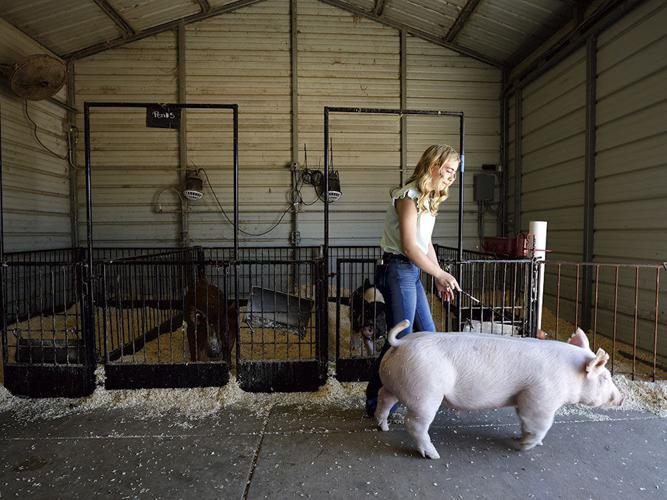
Madison Stagner tends to her pigs inside a barn at home on a June weekday, near the beginning of summer break.
“It’s really a labor of love,” Dalton says. “You have to love doing it.”
The students must keep records of everything, from the hours they spent doing certain tasks, to tracking their finances for food, equipment and whatever other unexpected expenses they will come across – like any other living being, the animals can get sick and injured.
It is a business, after all, and a big one at that: In 2023, livestock and poultry was valued at $115.5 million in Monterey County, ranking it in the top 10 in the county, according to the Crop and Livestock Report prepared annually by the Agricultural Commissioner.
In early summer, the 30 Salinas FFA students who showed animals in the Salinas Valley Fair got their checks from the auction, totaling a staggering $147,000, according to Dalton, which was the most in her tenure as adviser. One student earned $31,000 for her animal.
Many of the students save those funds for college, while others use them for other life necessities – Freshwater proudly points out that he was able to buy a truck from his earnings.
But Dalton is quick to point out that it’s not just for the money. Young people need to know where their food comes from, she says, as too many people think meat “appears out of nowhere” at the supermarket. A 2018 survey of more than 1,000 adult Americans, conducted by Michigan State University’s College of Agriculture and Natural Resources, found that 48 percent say they never or rarely seek information about where their food was grown.
“My students are the ones raising that meat,” she says. “It’s made with love. It’s critical that we can produce affordable protein sources. These kids are the future, and if they know where that food comes from, they can teach others.”
AS PRESIDENT OF SALINAS FFA, Stagner is tasked with teaching the next generation how to properly care and show their animals.
It’s a full-circle moment for her – Stagner was once a shy 9-year-old in 4-H who turned to the older students for help. She says her idol is Sierra Short, a Salinas-Rancho San Juan FFA Chapter graduate who is now vice president of the State FFA chapter, who took her to her first FFA jackpot show and taught her the ropes.

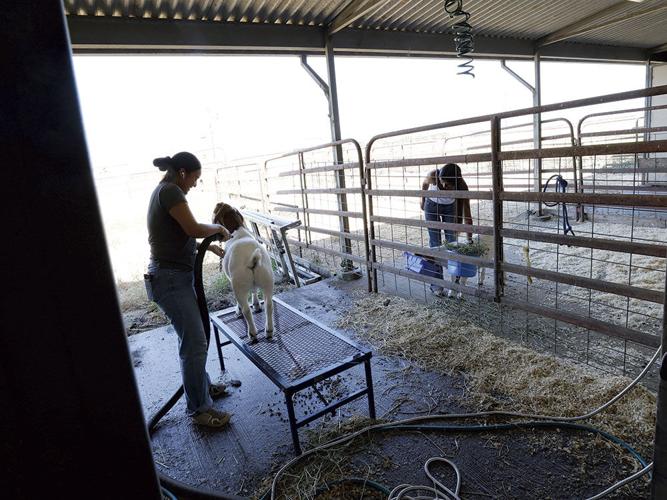
The barn is bustling with activity during the summer, as Lily Tenorio (left) blow-drys her goat and Regina Lopez feeds hers, named Speedy Gonzales.
Stagner says she not only helps out students from her FFA chapter, but also those from other chapters. Teaching the students how to help their pigs gain weight is a crucial part of showing in the competitions, where the animals must hit a certain target.
Bandit, Stagner’s Monterey County Fair pig, weighed in at 175 pounds in mid-June, well on his way to the goal of 275 for the fair, she says, adding that the pigs gain 2 pounds a day. Dalton says the students need to learn the right combination of proteins and fats in the pigs’ feed, and adjust accordingly. There’s a science to it, and the goal is to find the right mix of muscle and chubbiness.
Consistency in washing and brushing is key to making the pigs presentable for competition, Stagner notes. White shavings in their pens are also important to keep their hair clean, while yellow shavings tend to stain their coats.
During the competition in the ring, Stagner says it’s critical to keep the pigs in control with their heads up, so she likes to train them by walking them in a figure-8. The thrill of the competition is like no other, she notes.
“It’s a whole different feeling when you’re in the ring,” she says. “You’re super intense and you’re so focused on the judge. It’s hard to focus on what’s going on around you.”
The Monterey County Fair will be senior Riley Mauras’ second fair, after having shown for the first time in the Salinas Valley Fair in May. Mauras encourages younger students interested in the program to “definitely go for it,” as raising the animals only gets easier with experience.
“It has its ups and downs,” she says. “When you first get the animals, it’s really hard and stressful. I was reconsidering what I was doing. But it gets easier, and now I’ve got it down.”
“Don’t be shy to ask questions, there will always be someone there to help,” Stagner says. “Just keep working hard, and don’t give up even when it’s really hard.”
ON TUESDAY, AUG. 27, Bandit the pig joined about 125 swine during a large-scale move-in to the fairgrounds. He was joined by nearly 160 sheep and goats, close to 30 cattle and numerous rabbits and chickens, the result of the hard work over the summer by students in the 22 4-H and eight FFA chapters participating in the fair.

Bandit the pig gets some exercise at Madison Stagner’s Chualar home.
After months of dedication raising their animals, the work is still far from over. The weigh-in period begins – for pigs, they must strictly be between 210-280 pounds to qualify. Those that don’t make weight can try again at the Santa Cruz or San Benito county fairs.
Tayler Baldwin, public relations coordinator for the fair, says the number of entries are up slightly compared to recent years. For the first time since the Covid-19 era, the junior livestock auction will take place at the same time as the fair, after being held the week before.
Students will then compete in the market and showmanship divisions. In the market, judges will examine the animal for how well it will produce a meat product. In showmanship, students must demonstrate how well they’ve trained their animal through a variety of techniques – which vary by animal – including keeping their animal between themselves and the judges at all times.
“It’s the little things that make the show really interesting,” Baldwin says. “You have to work with your animal a lot to prepare for these fairs.”
That amount of training means the students spend countless hours with their animals. That also means it’s hard to say goodbye once the fair ends. Tears will be shed.
At the conclusion of the fair, buyers of the animals at the auction can choose to have them slaughtered and processed at a butcher of their choice, or resell them to a processor. Or, they can choose to donate the meat to the Food Bank for Monterey County or Salvation Army.
With experience, Dalton says she knows how to emotionally separate herself from the fair animals and her own pets. But it’s difficult for many students, especially the first-timers.
“They will sit in their pens, say their goodbyes and they will cry,” she says. “To these kids, they are like family. They are spending so much time with them.
“It’s hard, but they’ll do it again.”
FOR THE HIGH SCHOOL SENIORS, this will be the last time they show an animal at the Monterey County Fair.
Everett Alvarez FFA member Aleena Chavez, a senior at Everett Alvarez High School in Salinas, was chosen as the Monterey County Fair Heritage Foundation’s $2,500 scholarship recipient and exhibitor.
The pig she is raising will be auctioned during the fair’s junior livestock auction on Saturday, Aug. 31. All proceeds from the sale of the animal will benefit the foundation’s programs for youth, including scholarship opportunities and agricultural awareness, while helping with improvements to the barns, grounds and other event center venues at the Monterey County Fair.

Numerous belt buckles and other awards at various events.
Chavez, who earned a California FFA State degree, plans to study for a career as a veterinarian or agriculture teacher after she graduates from high school. She said she wants to encourage more women to pursue “non-traditional” roles in the agricultural industry, including as mechanics.
Stagner says her dream is to attend a four-year university, with her sights set on Texas A&M University, studying animal science. She still has another year, as well as three more fairs and other competitions to go before she graduates, so the daily grind of caring for her pigs continues.
As Stagner walks Bandit in a figure-8 outside of their Chualar barn, her mother Tami Carriger looks on. She notes that while she does join Stagner in the barn as she completes her various tasks, the work is all done by her daughter. Besides, while Stagner’s father Tom is allowed to wash the pigs, they are not permitted to walk them – “She says we do it wrong,” Tami Carriger says.
“We’re really proud of her,” she says. “It’s hard work. She has to be dedicated, but she feels a real good sense of accomplishment.”
Monterey County Fair runs from noon-11pm Thursday-Sunday, Aug. 29-Sept. 1 and noon-10pm Monday, Sept. 2 (the junior livestock auction takes place at 10am Saturday, Aug. 31). Monterey County Fair and Event Center, 2004 Fairground Road, Monterey. $7-$14. montereycountyfair.com.
(0) comments
Welcome to the discussion.
Log In
Keep it Clean. Please avoid obscene, vulgar, lewd, racist or sexually-oriented language.
PLEASE TURN OFF YOUR CAPS LOCK.
Don't Threaten. Threats of harming another person will not be tolerated.
Be Truthful. Don't knowingly lie about anyone or anything.
Be Nice. No racism, sexism or any sort of -ism that is degrading to another person.
Be Proactive. Use the 'Report' link on each comment to let us know of abusive posts.
Share with Us. We'd love to hear eyewitness accounts, the history behind an article.