


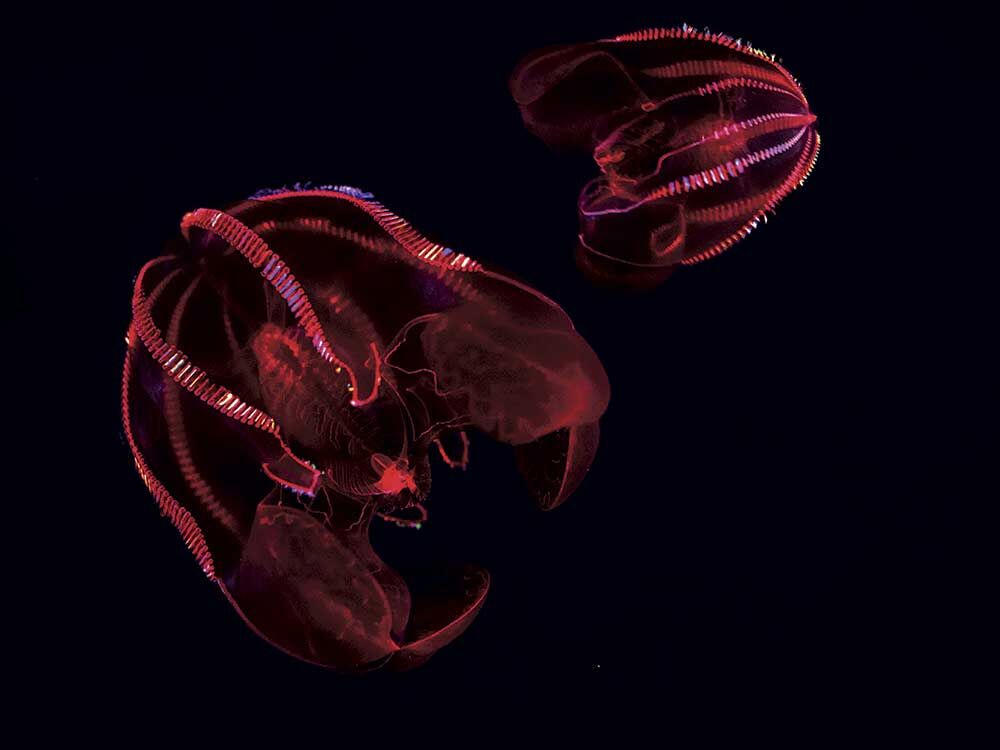
The bloody-belly comb jelly is one of the exhibition’s marquee animals. Its blood-red hue makes it invisible in the deep sea, a predatory advantage.
Six glowing red orbs drift along in a dark tank that appears as boundless as the night sky. A musical composition hums from the speakers above, scoring a mood of wonder and discovery.
Faceless and translucent, these irregularly shaped gelatinous creatures range in size from lime to grapefruit. They are propelled to and fro by shimmering ribs of cilia that refract a full range of color against the light. In motion, these creatures appear stitched with vibrating DNA helices. Yet, the animal, whose existence was only formally acknowledged in the 21st century, is just one dimension of the wonder here. Until now, even the world’s leading marine scientists thought its live display in an aquarium tank was impossible.
George Matsumoto is one of those scientists, but now he stands face-to-face with it, stunned. Arms folded, he leans his shoulder against the other side of the glass and examines the achievement before him. He is as mystified as the moment he first encountered one of these creatures as a graduate student on a deep sea cruise more than 25 years ago.
“As soon as we saw it, we knew immediately it was something no one had ever seen before,” says Matsumoto, a senior research specialist with the Monterey Bay Aquarium Research Institute. In the Monterey Bay, they are found at depths between 1,200 and 3,300 feet, in low-oxygen waters at a frigid 39 degrees Fahrenheit. Yet, the greatest obstacle to observing these deep sea jellies is their fragility: after capture and arrival on the research boat, Matsumoto’s team would only have 10 minutes before the animal melted into red soup.
Matsumoto would eventually help arrive at a scientific name for the ctenophore: lampocteis cruentiventer; common name: bloody-belly comb jelly. To accurately categorize it in the animal kingdom required photographs, deep sea video, a scientific illustrator and a lot of red soup. Now, Matsumoto, firmly on land inside the Monterey Bay Aquarium, watches this animal he helped bring to science drift along in a display tank – an animal he’s only ever had 10-minute increments with.
“Now, someone could just sit right here and describe it,” Matsumoto muses. “It’s stunning.”
Although few humans have ever stood next to a live bloody-belly comb jelly, they are not rare. Neither are Japanese porcupine and spider crabs, giant isopods, deep sea corals or any of the other alien-looking lifeforms the Monterey Bay Aquarium is preparing to debut to the public through “Into the Deep,” its most ambitious exhibition to date. The animals featured exist in extreme ocean depths, the last areas of our planet that remain largely untouched and undiscovered by humanity.
Five years in development, “Into the Deep” is by all accounts a marine science achievement of the highest degree. Rooted in public education, it combines MBARI’s decades of deep sea research and discovery with the Aquarium’s tradition of storytelling and its peerless ability to recreate environments that allow the most elusive marine animals, from some of the planet’s harshest conditions, to live on display.
“There are people all over the world, research organizations included, who will stream a full 12-hour dive just for the chance to see these animals live on video,” Matsumoto says. “Now, they’re going to be able to come to Monterey Bay Aquarium and see these animals with their own eyes. It’s remarkable.”

MBARI’s George Matsumoto says he has colleagues coming from as far as Europe for a chance to finally see some of the deep sea creatures with their own eyes.
HUMAN HISTORY HAS BEEN A STORY OF DISCOVERY, from migration across continents on foot and circumnavigation on sea, to lunar expeditions by space shuttle. Yet, somewhere along the way, between NASA’s mid-20th century space program, Star Trek dubbing space the “final frontier” and the rich and famous shelling out $55 million for a seat on Jeff Bezos’s Blue Origin rocket, we largely forgot about the most spacious room in our own home: the deep sea, Earth’s true final frontier and one that, unlike space, we now know is teeming with life.
The deep sea, which begins at a depth of 200 meters, or about 660 feet, accounts for between 90 and 95 percent of Earth’s habitable space and much of it remains a mystery. It’s often said we know more about the surface of the moon and Mars than we do about our own first floor.
A reasonable excuse is the difficulty in getting there. Light and radio waves – the main tools of communication in space – do not travel well in water. Every 10 meters of depth adds another 14 pounds of pressure, which means the animals found at 4,000 meters move with the weight of two compact cars pressing down on every square inch of their bodies. The saltwater is corrosive to manmade equipment and the seafloor is almost entirely unmapped.
“The deep sea, for most people, is out of sight, out of mind. Yet it is a really important part of the Earth we all share,” says Julie Packard, who has been the Aquarium’s executive director since she helped found it in 1984. “This exhibition will expand people’s definition of the ocean and show them they’ve had an incomplete picture of this planet.”
In developing the direction for “Into the Deep,” Aquarium staff asked focus groups what they expected to see in such an exhibition. Many responses came back with some version of, “The fish with the lantern thing hanging off its forehead,” which revealed the significant gap in the public’s understanding of the deep sea, and solidified the mandate to design the exhibition in a way that builds empathy among visitors for the ecosystem and its residents.
“Into the Deep” is not simply a vain debut of uniquely evolved animals, it’s a plea for protection of and attention to the deep sea. It asks visitors to marvel at illuminated jellyfish and giant spider crabs with eight-foot wingspans, but also understand the pressure human activity places on this ecosystem – think plastic pollution, CO2 saturation, or deep sea mining – and how that pressure can reciprocate on the surface.
“If people are able to see what’s down there, they can start to talk about what’s happening down there; how are we affecting it? What do we need to worry about so we don’t wipe out places like this?” says marine ecologist Jim Barry, a 30-year veteran of MBARI whose work focuses on deep sea corals and the impacts of climate change. “The ocean seems so vast, but so did the atmosphere at one point and we thought we could never change the atmosphere. We really have to be pretty cautious.”
ABSENT THE RIGHT CONTEXT, IT’S DIFFICULT TO DECIPHER WHETHER THE LOUNGEY COCKPIT OF THE WESTERN FLYER, MBARI’s deep sea research vessel, is a place of high science or high entertainment. In fact, it might be both. A virtual reality headset hangs off the joystick arm of one of three leather chairs facing a wall of flatscreen monitors. With the leather couch in the back and the litany of buttons and touch screens, this den would be a cozy place for video games if it wasn’t where the MBARI team remotely operates its 11,000-pound deep sea rover that gives scientists a front-row seat to the unknown.
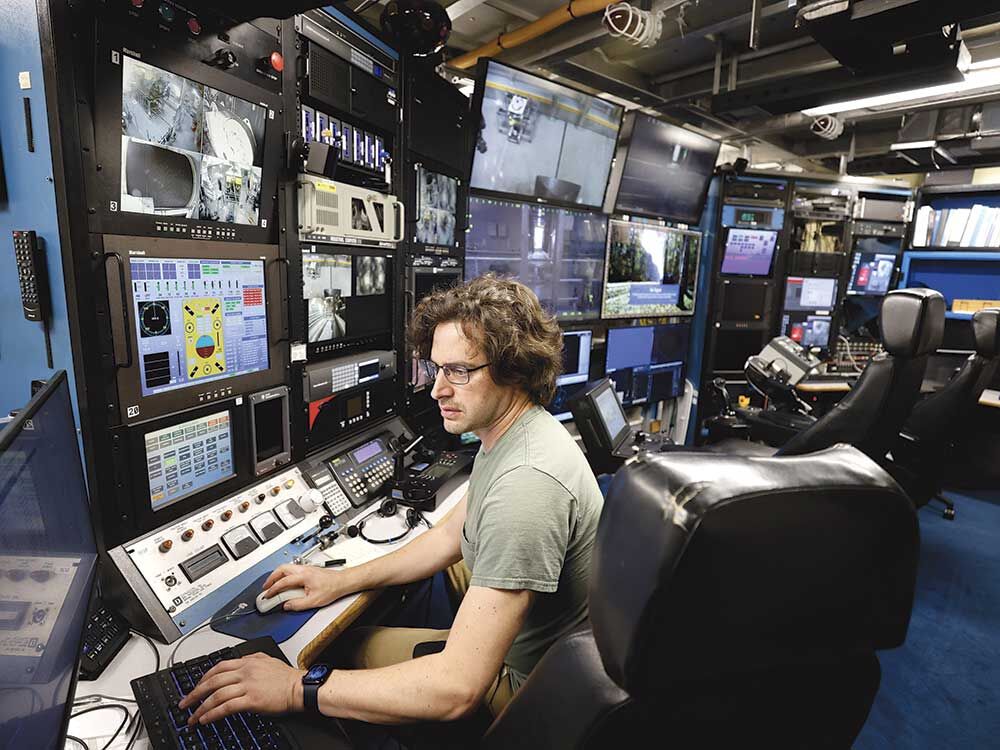
From the cockpit of the Monterey Bay Aquarium Research Institute’s Western Flyer research vessel, pilot Drew Bewley readies the ROV Doc Ricketts for another deep sea dive.

MBARI’s 11,000-pound deep-sea rover, ROV Doc Ricketts, is one of the many reasons MBARI has remained on the cutting edge of deep sea discovery.
The rover, known as the ROV Doc Ricketts – named after the father of marine biology – is a feat of mechanical engineering that can roam at depths down to 4,000 meters. It’s outfitted with the world’s only deep sea camera at 4K resolution, a virtual reality camera that offers a 3D view and essentially puts scientists on the front bench of the rover, as well as a set of mechanical arms that allow for the delicate collection of newly discovered marine life. All of this, including the elevator that shuttles collected animals by cable up to the research boat, was designed or built by MBARI engineers.
Founded in 1987, MBARI is the Aquarium’s sister organization that focuses on deep sea research and discovery. With technology such as the ROV Doc Ricketts and a team of top-tier engineers and scientists, MBARI has remained at the cutting edge of its field and a global leader in unraveling the mysteries of the deep sea.
“The deep sea has had this almost impenetrable curtain over it that we’re now able to pull back,” MBARI scientist Steven Haddock says from the cockpit couch. For example, each increase in camera resolution MBARI achieves reveals more detail and allows better distinction of new species.
Over two decades with MBARI, Haddock has advanced scientific knowledge around jellyfish and ctenophores, and helped marine biologists gain a better understanding of bioluminescence, the chemical reaction that allows certain deep sea animals to create light in their dark worlds. His work has featured prominently in peer-reviewed journals and helped rewrite textbooks. However, “Into the Deep” offers a new opportunity for Haddock: the chance to raise his work from the esoteric depths of science publications into the hearts and minds of the general public.
Haddock acknowledges that curiosity and interest often hinge on personal impact – the thought of, “What can we get out of this work?” He’s excited that the exhibition includes messaging on the importance of deep sea research to understanding climate change and the pressures of pollution, and how they might come back to hurt us. However, he sternly clarifies that his interest in the deep sea transcends those issues and he hopes the exhibition will inspire a similarly unconditional curiosity in the ecosystem.
“Even if climate change wasn’t a problem, I still want to care about the deep sea. Over several hundred million years of evolutionary history has resulted in these unique lineages, these unique organisms that have adapted to live in this really challenging environment, and I feel we should respect it,” Haddock says. “Understanding life in the deep sea is essential to understanding life on Earth, and to be able to see it firsthand is really a privilege.”
Before the “Into the Deep” exhibition opens to the public on Saturday, April 9, only a few people have ever been afforded that first-hand privilege of interacting with the deep sea. Even fewer thought it possible to eventually bring that privilege to the public.
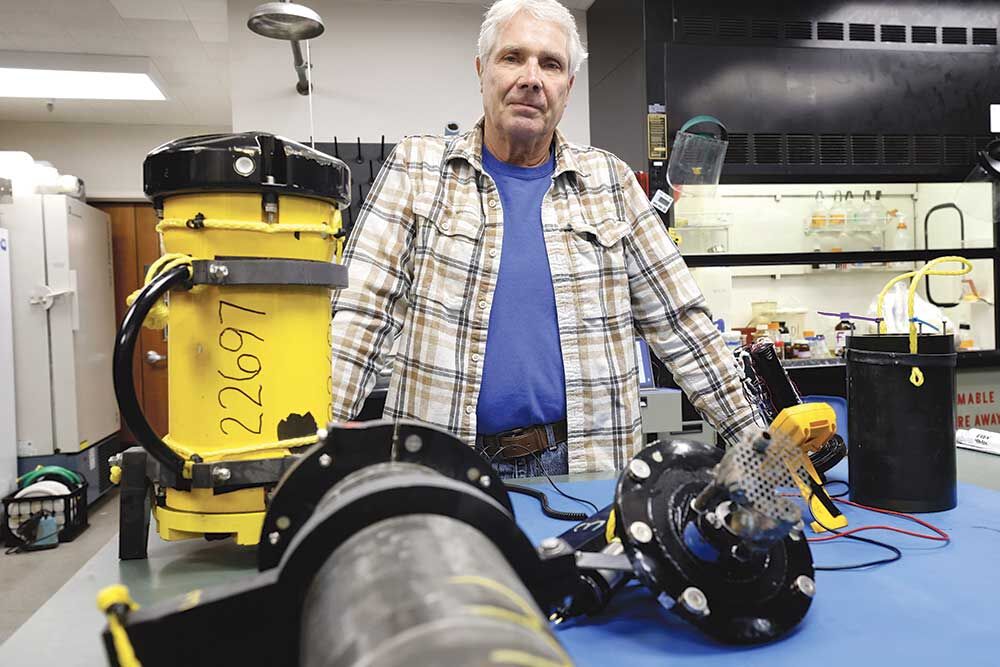
Marine ecologist Jim Barry, a 30-year veteran of MBARI, says the organization’s support from the Packard Foundation is critical to perform long-term deep sea research.
WHEN PACKARD REFLECTS ON THE AQUARIUM’S GREATEST ACHIEVEMENTS, the historic great white shark exhibition jumps to the top of the list. In 2004, the Aquarium was able to keep a juvenile great white shark – the ocean’s largest predatory fish – alive and on display for 198 days before releasing it back into the wild. Prior to the Aquarium’s feat, the captivity record for a great white shark was 16 days. No aquarium has matched the achievement since.
“That took years of research and development,” Packard says, as the Aquarium had to custom-build transport tanks, and develop a carefully planned system to keep it alive. The most critical aspects of any great achievement are often those which go unseen. “Into the Deep” is no different.
A few steps beyond the dimly lit entrance, Kyle Harrigan swings open an otherwise unnoticeable door and steps behind the exhibition’s walls. A bright fluorescent light illuminates a den lined with a complex web of labeled PVC piping, orange levers, gauges, electrical wiring and water tanks. Like any proper central nervous system, that of “Into the Deep” is both invisible to the viewing public and crucial to its operation.
From here, the Aquarium dictates the acidity, levels of oxygen, nitrogen and carbon, temperature and flow of each tank displayed in the exhibition. Harrigan, the water systems engineer and the exhibition’s proverbial Oz, drives the system, which was designed and developed in-house over the last five years for “Into the Deep.”
“We need to recreate the environment for these animals. The ocean we see is much different than what deep sea creatures experience,” Harrigan says. “They are worried less about what they see and more about what they feel, things like pH and oxygen and temperature.”
Too much oxygen or acidity can spell an ugly death for deep sea creatures. When other aquariums have done short-term deep sea shows, they use systems that push oxygen out of the water by bubbling in nitrogen; however, the bubbles can harm some of the more delicate animals on display.

The Aquarium’s custom-built water treatment system controls variables such as temperature, acidity and oxygen in each tank, which allows a range of habitat conditions.
“In order to show the greatest number of animals and give them the greatest quality of life, we needed to get away from that idea,” Harrigan says. So the Aquarium built a system that pulls oxygen and other gasses out by filtering the water through membranes. Harrigan says this more closely aligns with natural conditions and raises the animals’ quality of life, which is important in an exhibition that is planned to run for the next eight years.
The ability to adjust the chemical parameters of any tank in the exhibition is only useful after figuring out what each animal needs, which was its own messy challenge, says Evan Firl, an aquarist who leads the animal care team for the exhibition. Firl points to a cylindrical tank across from the bloody-belly comb jelly, displaying a siphonophore, which, to the untrained eye, appears to be an autonomous string of silk with the head of a miniature jellyfish and a body adorned with tiny red charms.
“With this one, if you even waft water towards it, it might explode,” Firl says. “It took a lot of groundwork and engineering to figure how we could keep these animals that aren’t supposed to touch anything, ever, in an encapsulated space.”
The ocean where many of these animals live is a still, dark place, untouched by sunlight or tidal currents with temperatures that sit just above freezing. How, then, do engineers design a tank that recycles water, receives food, and stays illuminated to display an animal fatally sensitive to all of those factors?
“It’s been a lot of trial and error. It’s very different from anything we’ve ever done before,” says Firl, who has worked exclusively on the exhibition for nearly three years. “Each of these animals come from different depths, which means they have their own parameters. Each tank runs on its own system and if you increase the pH even by 0.1 for the wrong animal it can be very problematic.”
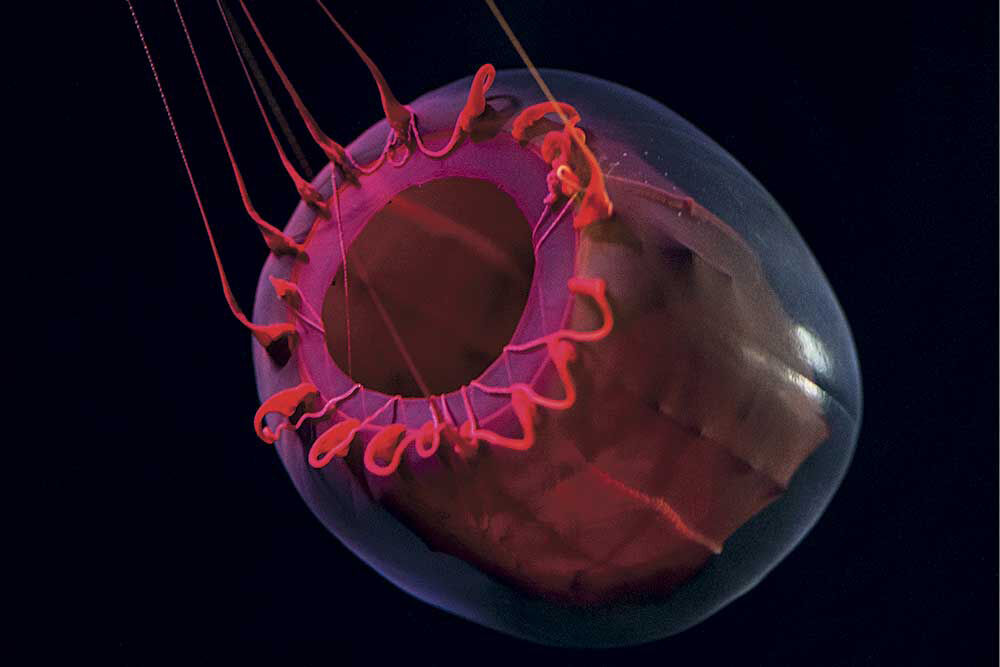
A delicate drifter, the snowglobe jelly is found worldwide between 100 and 10,000 feet deep. Its red stomach allows it to remain invisible and avoid predators.
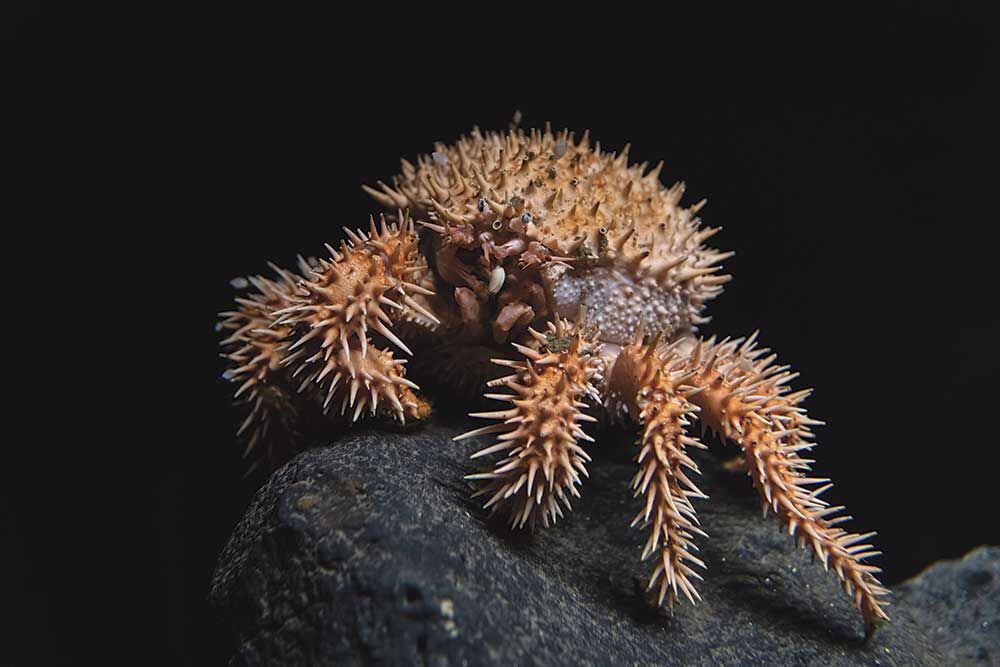
Into the Deep, crustaceans, Japanese porcupine crabs, Paralomis histrix, crabs A Japanese porcupine crab (Paralomis histrix) stakes claim to her favorite rock in the new Into the Deep exhibit.
MATSUMOTO WALKS FROM THE BLOODY-BELLY COMB JELLIES to a display of smaller, similarly red gelatinous orbs that swim spritely around their tank. Matsumoto recently oversaw the collection of this species, which was only just discovered and remains nameless. The scientific process of describing it is underway but, for now, Matsumoto uses “red X jelly” as a placeholder.
“It’s always stunning to discover something but it’s not that unusual because, unfortunately, we don’t know very much about the deep sea or what lives inside it,” Matsumoto says. “Monterey Bay is probably one of the best studied bodies of water in the world and we’re still finding new species here.”
Therein lies the crux and achievement of “Into the Deep.” The exhibition will not be a time capsule of what is known about the deep sea as of spring 2022. Rather, it will be a living, evolving experience, a space for the public to be brought along at the pace of deep sea discovery. The massive, five-year undertaking to engineer a customizable water system is at once a private acknowledgment by the Aquarium that neither they nor MBARI know what they will discover next, and a commitment to the public that as long as “Into the Deep” exists, the sense of wonder and discovery that characterizes a true frontier will not be hidden behind the exclusive gates of white coat labs or science journals; it will be available and on display for the price of an Aquarium ticket.
(0) comments
Welcome to the discussion.
Log In
Keep it Clean. Please avoid obscene, vulgar, lewd, racist or sexually-oriented language.
PLEASE TURN OFF YOUR CAPS LOCK.
Don't Threaten. Threats of harming another person will not be tolerated.
Be Truthful. Don't knowingly lie about anyone or anything.
Be Nice. No racism, sexism or any sort of -ism that is degrading to another person.
Be Proactive. Use the 'Report' link on each comment to let us know of abusive posts.
Share with Us. We'd love to hear eyewitness accounts, the history behind an article.