

Two on, two out, bottom of the ninth. With the score knotted at 2-2, Paul Garcia digs in at the plate.
It’s the Friday night home opener for the Monterey Amberjacks. Maybe a hundred fans remain and now many of them lean toward the edge of their seats with interest in the game’s outcome renewed. The team pushed across runs in the fifth and sixth innings to even the score, but had offered little threat since. Now, without hitting a ball out of the infield, the Amberjacks have an opportunity to win. Batting ahead of Garcia, Chuck Rocker reached second on an infield error. The potential game-winning run stands on third, in the form of a player named Caldwell – G. Caldwell according to the box score – a pinch hitter who waited out a 3-2 count and drew a walk, advancing on the error.
Caldwell is a new addition to the team. His name does not appear on the Amberjacks roster. A search of his name through the league website comes up blank.
It’s like that on the lowest rung of minor league baseball. Teams often share ballfields, some ill-suited to professional play. Players catch rides with teammates to and from road games. When at home, they flop in spare bedrooms in the houses or apartments of volunteer host families – if they are lucky. (If they’re not, guys must double or triple up in hotel rooms or a hostel.) Players come and go, through trades, dismissal or frustration. And contracts, which in the past guaranteed barely $250 to $300 a month during the season, are now in question.
The Amberjacks are part of the Pecos League, an independent minor league for players ages 25 and under who are not signed by a major league organization. It sits below the systems affiliated with the big clubs – AAA, AA and A ball, which is itself subdivided into full season and short season play. It even sits below the four “premier” independent leagues, looking up at the Frontier, Can-Am and Atlantic leagues, as well as the American Association.

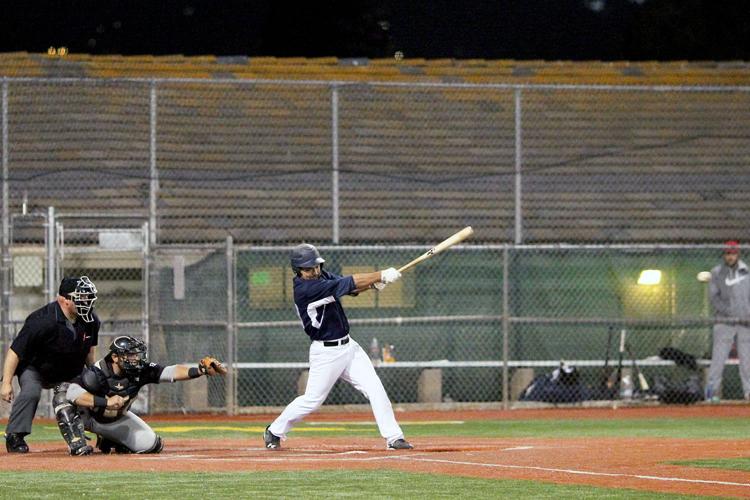
Paul Garcia swings at the last pitch of the night during the Amberjacks’ home opener, June 1. His single drove in the winning run.
SINCE ITS INCEPTION IN 2010, THE PECOS LEAGUE HAS BEEN THROUGH UPS AND DOWNS. Last year, however, the league expanded, adding the Monterey squad and experiencing perhaps its most stable season, and headed into 2018 with a sense of security. But everything changed in March, when Congress passed a federal budget that included an obscure item – known as the Save America’s Pastime Act – at the behest of major league owners.
Minor leaguers playing for affiliated teams in the major league system earn salaries that often fall below minimum wage, particularly when overtime – travel, pregame workouts, team meetings – is accounted for. Average monthly income in the lower reaches of Class A ball was at $1,100 last year, rising to $2,150 at the AAA level. The budget line item came in response to a challenge, calling for minor league players to earn overtime. It allows the major league teams to continue the existing wage scale with one new provision: Salaries must equal the Fair Labor Standards Act section 6(a) minimum wage for a 40-hour week.
That’s not a problem for major league organizations. It is also doable for the top four independent leagues. But in the Pecos League, where athletes signed contracts with the league rather than individual clubs, salaries were limited to around $300 a month. And that’s for full days that may include games, meetings, practice, visits to the trainer, public outreach programs and travel.
“It’s a major issue in our league,” Pecos League Commissioner Andrew Dunn says.
He adds that some of the independents still believe the federal budget measure does not apply in their cases. As news of the Save America’s Pastime inclusion trickled out, there was some suggestion that independent leagues might be covered by an FLSA clause that exempts seasonal employers. But, Dunn says, “I would be cautious – it’s federal law.”
The league voided contracts and quickly worked out a new pay scheme.
“We spent $900,000 on salaries,” Dunn explains. “All of a sudden we can’t do that.”
Now the players are considered independent agents, assigned to a Pecos League team which then must figure out a way to raise funds to compensate the players. In the Amberjacks’ case, youth baseball camps scheduled on Fridays and coached by the players will account for much of the pay.
Dunn does not believe the congressional decision will affect the league’s four California teams. The Amberjacks are off to a respectable 5-7 start after the weekend games, and the commissioner refers to them as one of the strongest. But Pecos teams entered the season with three divisions and squads scattered from Santa Fe, New Mexico and Garden City, Kansas, to Bakersfield, High Desert and Monterey. Dunn worries that teams in smaller markets with poor records at mid-season may not be able to draw fans and, therefore, be unable to pay the players.
Uncertainty has always been a part of independent baseball. Since the premier Frontier League was founded in 1993, 25 independent organizations have started and folded. The Pecos League began as a small group of teams in north Texas known as the Continental League.
“It was a disaster,” Dunn recalls.

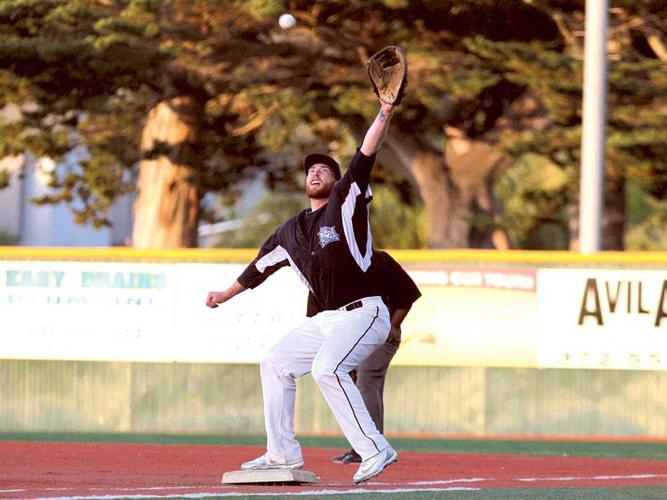
First baseman Matt Kuhl stretches for a high throw. Kuhl played his college ball at Culver-Stockton.
Brought in to set up a team in Las Cruces, New Mexico, Dunn soon found himself in charge of a league of teams based in the southwestern desert.
“That’s a miracle of God that we got it going,” he says. “We got lucky.”
Since its inception, at least 20 Pecos League players have been picked up by other leagues, independent or affiliated. Only two – Jon Edwards and Chris Smith – appeared on major league rosters. Edwards pitched 25 innings over two seasons for the Texas Rangers and San Diego Padres. Smith pitched a mere five innings for the Toronto Blue Jays.
Some observers on social media have ridiculed the league for this. Only two players made it, and just for a sip of coffee in the bigs. But to the Amberjacks, it shows that two players made it. And another 20 or so moved up in the minor league system.
And that’s why they are here, sharing a field, sleeping in guest rooms, packing themselves into cars for road trips and now dealing with uncertain pay.
“This was the first league to give me a chance,” explains center fielder Chuck Rocker, who was injured during his junior year playing for Cornell College in Iowa. “It’s a last chance opportunity.”

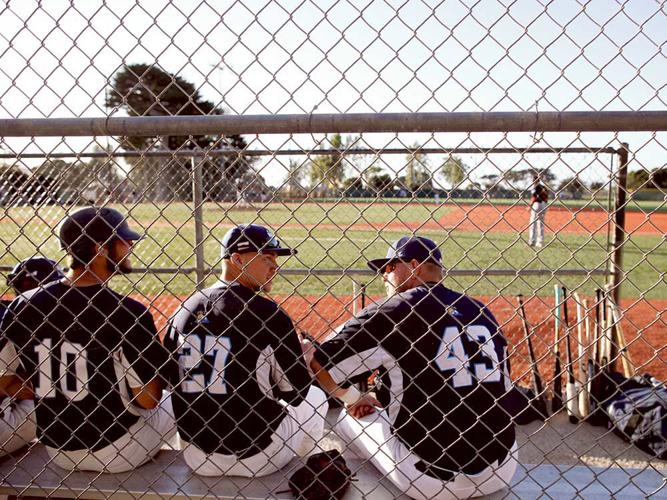
During a lull in the action, Jordan Gray of Edinburgh, Texas, and Tom McKenna from Queens, New York, introduce themselves to a new player, the one who would eventually score the game winner.
THE PLAYERS DID NOT SIGN FOR THE MONEY. And they know the odds. Of college athletes in all sports, only 2 percent make it to the professional level. According to some tallies, of the roughly 475,000 kids involved in high school baseball each year, about 2,375 play pro ball – at any level.
“There are a lot of players out there,” observes Edilson Alvarez, a pitcher and manager for the Amberjacks. “Baseball is a big sport. You have to be in the right place. When you have an opportunity, you don’t miss it.”
Alvarez came out of the Dominican Republic. Selected by the Minnesota Twins, he spent five years in Class A ball, then played in Mexico, the Can-Am League and Dominican winter ball. He switched to the coaching side this season, hoping to find a new path to the majors.
He appreciates what independent leagues offer.
“All these guys have a lot of talent,” Alvarez says. “They are motivated. They are hungry. They are hustling. They want to show their talent.”
Outfielder Tom McKenna starts his third season in the Pecos League. He played college ball for St. Joseph’s College in Brooklyn and, like many of the players, holds down an off-season job. He decided to return after hitting .394 for the Tucson Saguaros.
“There’s always work,” McKenna says. “It’s tough to leave your family, but you don’t want regrets.”
Besides, it can happen. Boston Red Sox scouts noticed outfielder Daniel Nava – now in his seventh MLB season – after he filed a .371 average with an independent league club. David Peralta played with three independent teams before being picked up by the Arizona Diamondbacks, where he hit over .300. Just moving up to the premier independents is worthy of note. Unsigned out of Tennessee Tech, Michael Morris toiled for three seasons in the Pecos League. He now plays for Florence in the Frontier League, considered one of the top independents. Eric Yardley has been advancing through the San Diego Padres organization after a stint in the Pecos – a rocky stretch, certainly (his first team folded shortly after his arrival), but it worked.
“A Padres scout saw me,” Yardley told the San Diego Union-Tribune in 2015. “He asked if I could get to Phoenix and report to the Arizona Rookie League. I got to the airport and hopped on a flight.”
And shortly after the Pecos League season began on May 24, McKenna, Alvarez, shortstop William Salas and second baseman Brian Luebcke all were added to the league’s show team in the Can-Am League, according to Dunn. It’s an unusual arrangement: The Salina Stockade play a traveling schedule out of their home base in Kansas, playing against each of the Can-Am teams – games that count on the Can-Am teams’ record, though the Stockade cannot challenge in the league’s pennant race. The crew from Monterey will return to play their Pecos League contests, as well.
“It can be done,” McKenna says, echoing the reason why players are willing to start at the bottom. “You gotta want it. You also gotta know when it becomes a chore, but it’s not a chore.”
Again, life on this level is tenuous. On a Monday morning, May 21, when the Amberjacks gather for two days of spring training at Sollecito ballpark, the scene is full of the same hope and uncertainty. Tim Cusick strolls toward a number of cargo bags, tossed randomly on the ground. He is cradling a bat, protecting it from damp skies.
“That was better,” he says to himself with a slight grin.
The St. Louis native has just finished his second turn at batting practice. With an easy swing he drove several balls on a tight line into left center – base hits in any game. As Cusick tucks his bat away into a bag and grabs his glove, another player heads toward the plate, head covered against the weather, complaining that he forgot to bring anything but a hoodie. There is no uniformity: One player dons a Chicago Cubs hat. A second runs past wearing his Oral Roberts University T-shirt. Most of the players arrived in Monterey shortly after midnight, grabbing a few hours of sleep before hitting the field.
As practice continues, a chain-link gate in centerfield swings open and a private landscaping company semi hauling garden mulch turns onto Sollecito ballpark’s warning track. It rumbles along slowly, parking in the leftfield corner. A crew dismounts, fires up their equipment and begin to spray ground cover on landscaping associated with the playground adjacent to the multi-use stadium – a routine groundskeeping chore taking place on a soggy spring morning.
That the Amberjacks are also on the field taking batting practice seems of little concern to the crew.
Baseball at this level is precarious. Earlier in the spring, Cusick had survived a series of tryouts that led to this moment. Overlooked by major league clubs after college, he went to work with a San Francisco startup – Birdman Bats – crafting baseball bats, of all things. “I realized I could still play,” he says. “I decided I owed it to myself.”
After signing his first professional contract to join the Amberjacks, he naturally called his mother. Now that contract has been voided in the wake of a congressional vote. And according to the Amberjacks’ manager, Cusick ran afoul of the Pecos League’s age limit. Teams can only keep one “veteran” – that is, player over 25 – and Cusick’s three years away from the game after college, working for Birdman Bats, put him over the limit.
“We love him, but – league rules,” says Alvarez, the team’s remaining veteran.

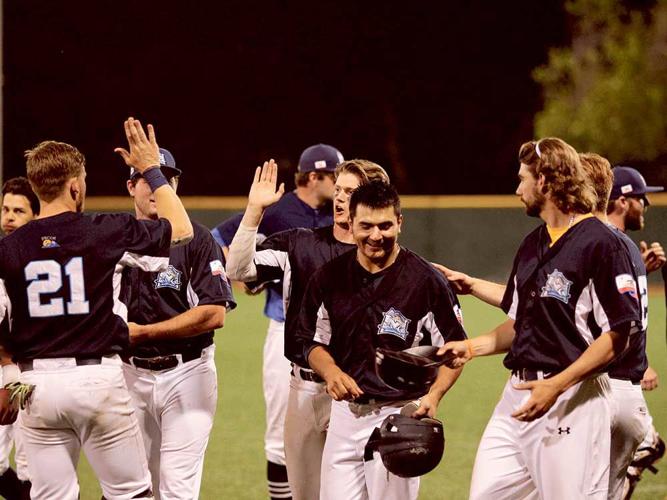
players congratulate Paul Garcia and Chuck Rocker moments after the dramatic finish to Friday night’s game
THE AMBERJACKS STARTED IN A PRECARIOUS SITUATION. Monterey city officials had been approached in the past by both minor league and college summer league amateur teams, but the ballpark availability always became a sticking point. Sollecito Park is used for adult softball, youth leagues, soccer and other events throughout the summer.
“It has baseball lines, but we play everything on it,” says Kyle Susic, sports coordinator for the city of Monterey. “There’s a lack of green grass in Monterey. There’s a lack of facilities, so there’s always creative scheduling.”
Dunn and the Pecos League agreed to work around this. He met with city officials at the beginning of 2017 and Monterey City Council agreed in a spring meeting to bring the team in, with a Saturday-Sunday home schedule as all other dates were booked.
It was short notice, but it worked. More than 400 fans turned out on opening night and the team drew an average of over 100 spectators a night the rest of the season, despite playing most of their “home” games on the road or at a neutral site. Last year it was Hollister, this time around they will play in Tehachapi.
“Last year was an amazing experience,” Rocker says of the Monterey games. “The crowd was rowdy, they were on our side.”
That encouraged the city for a second year. The league was able to secure Friday nights, as well – although the players must still travel four-plus hours to Tehachapi for Thursday night “home” games. They also added youth camps each Friday during the regular season coached by Amberjacks players. And they’ve added beer sales.
In 2017, there was no time to complete the permitting process for alcohol sales before the season started. This season, beer and a fixed schedule have given Dunn and the city a sense of confidence, despite the Save America’s Pastime Act.
“We have three days and we have beer,” Dunn explains. “It’s going to be good.”
None of this matters with two down in the bottom of the ninth, with the potential game winning run perched on third base on the first day of June – the home opener for the Amberjacks.
Paul Garcia waits on a delivery from High Desert Yardbirds’ hurler Gregg Gausden, letting it ride past his hands then knocking it low and hard into right for a base hit. Caldwell scores and the celebration begins.
“He was throwing curves – I just took it the other way,” Garcia says moments later. “That felt great.”
With a smile still wrapping around his face, the star of the game headed off to meet his host family for the first time. During the game, a notice from the public address announcer that the team was still in need of host families drew a cheer from the Amberjacks’ bench – including one loud call of “chocolate chip pancakes” from a player. One family is providing beds for five Amberjacks, some of whom sleep on air mattresses.
“They’re not picky,” says host Camille Gingrich.

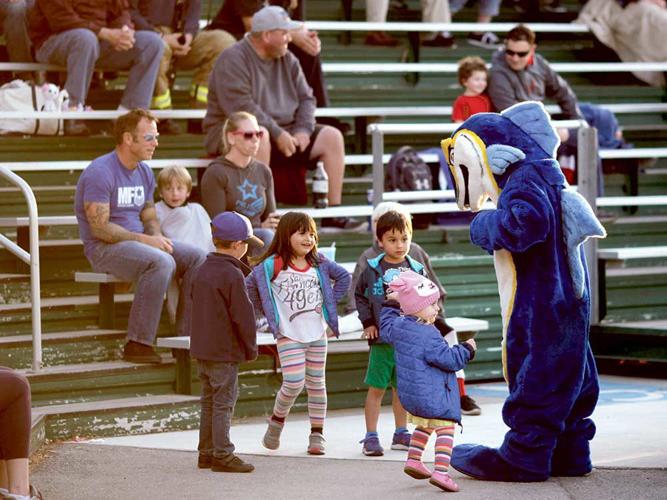
Young fans dance with the Amberjacks’ mascot, known as Jack.
The players and the Pecos League are used to the game’s precarious nature. It is a place for those who take chances, after all – who are willing to bunk in unfamiliar homes, to cash uncertain paychecks and have no regrets. It’s a season of opportunity, and that’s all that matters on a damp morning in May, with contracts voided, the centerfield gate yawning wide open and a machine tossing mulch on a playground droning monotonously in the background. It’s all that matters on a glorious night for baseball, in front of a few fans, when the kind of dramatic moment kids dream of plays out in real life.
“It was great to be back home,” says Rocker, a native of the Quad Cities in Illinois who sleeps on an unfamiliar bed in Monterey.
“We’re here because we love baseball,” he adds, “but I couldn’t do it without my host family.”
(0) comments
Welcome to the discussion.
Log In
Keep it Clean. Please avoid obscene, vulgar, lewd, racist or sexually-oriented language.
PLEASE TURN OFF YOUR CAPS LOCK.
Don't Threaten. Threats of harming another person will not be tolerated.
Be Truthful. Don't knowingly lie about anyone or anything.
Be Nice. No racism, sexism or any sort of -ism that is degrading to another person.
Be Proactive. Use the 'Report' link on each comment to let us know of abusive posts.
Share with Us. We'd love to hear eyewitness accounts, the history behind an article.