



THE MAINSTREAM AMERICAN READER STILL DOESN’T KNOW HENRY MILLER, and there are many reasons for that. First, everybody has heard of Henry Miller – the scandalous writer, “the king of smut,” as he suspected he would be called – and this taint of supposed dirt makes for an impression one knows all that there is to know.
Secondly, in terms of literary and culture studies, Miller (1891-1980) died only recently. When it comes to the arts, 45 years is very little to establish anything in terms of significance or serious studies. It will take some time before the audience at large gets deeper than the surface of his writing and will have space to embrace the Miller who loved riding a bike and playing pingpong, and who wouldn’t do anything before consulting an astrologer.
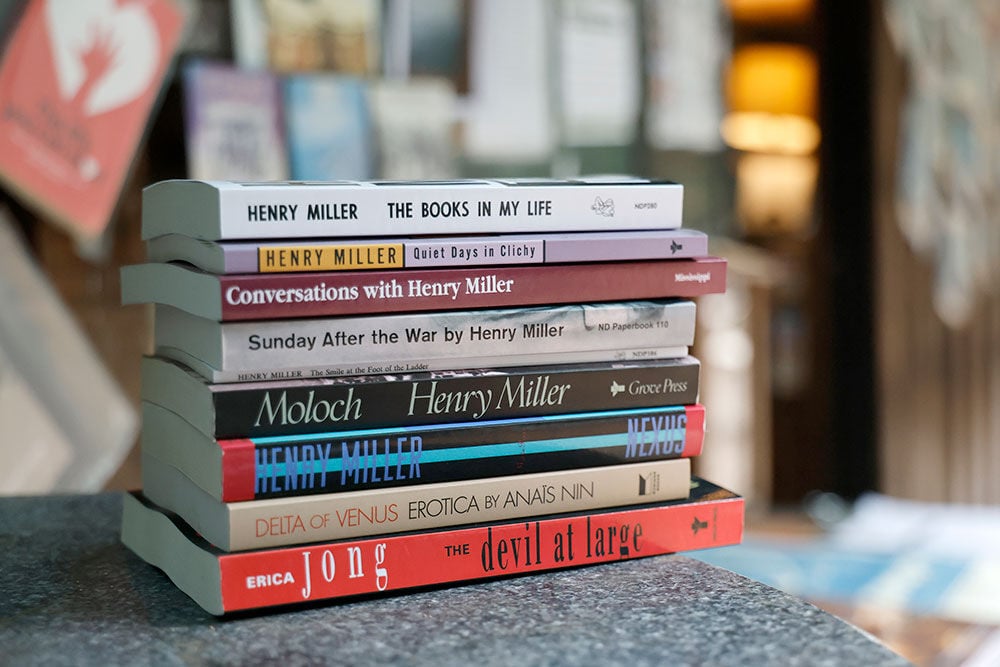
The Henry Miller Memorial Library in Big Sur carries many titles by Miller, among other books.
While Tropic of Cancer is a universally recognized title, followed by other “dirty books” – Tropic of Capricorn, Black Spring and The Rosy Crucifixion – other works of Miller’s are barely mentioned in the mainstream literary culture. Those omitted titles include important works such as Big Sur and the Oranges of Hieronymus Bosch or The Smile at the Foot of the Ladder. They show a completely different Henry Miller: lyrical, idealistic, philosophical, bordering on mysticism. (That said, Tropic of Cancer remains on reader-curated lists of the best American novels of the 20th century.)
Browsing through the catalogue of Ohio University’s Rare Books collection, one can find over 250 volumes by Henry Miller, some of them written miniatures of 20-30 pages, some author’s copies. His works still are not gathered in one place, as Canadian scholar and archivist Michael Paduano observed in a 2023 conversation with Magnus Torén, executive director of the Henry Miller Memorial Library in Big Sur, on A Big Sur Podcast. Paduano marveled over a recent resurfacing of a lost Miller manuscript, The Book of Conversation with David Edgar, which he had the pleasure to prepare for publishing in 2023.
There’s still so much to do in terms of discovering Henry Miller. It doesn’t help that, as writer Arthur Hoyle wrote in 2014 in The Unknown Henry Miller: A Seeker in Big Sur, that in the 21st century, Miller continues to be shunned by academia, excluded from the American literary pantheon and omitted from anthologies of the era.
A symposium from Oct. 16-19 in Pacific Grove, “Henry Miller in the 21st Century,” seeks to change that, offering a burst of scholarly and artistic energy to move forward with and celebrate Miller. Torén, Hoyle and Paduano will be joined by leading and emerging scholars of Miller, 30 speakers total, many coming from abroad.
In parallel but independently, audiences will be treated to Smile: A Clown’s Ascension, a play based on Miller’s story The Smile at the Foot of the Ladder. The production offers a mode of interpretation regarding Henry Miller and the role he plays in his readers’ lives – that of a jester (yes, a provocateur), but mainly the “holy fool,” a role often chosen by a sage who puts on a fool’s hat to be able to speak the truth.
Additionally, Gary Koeppel, Henry Miller’s art dealer and art publisher, is producing an exhibition of Henry Miller’s artwork titled The Art of Play at Asilomar Conference Center from Oct. 16-19. It features over 60 framed artworks, exhibition catalogs, posters and unique collectibles.
For the time between Oct. 16 and 19, let us all become Miller scholars. As Torén says on behalf of the Henry Miller Library – which is, along with the Nexus: The International Henry Miller Journal, the organizer of the symposium – this is a meeting of “scholars and fans.” Its goal is to examine Miller in light of today’s thinking, asking the question: Is Henry Miller relevant today?
In the culture wars of today, Torén speculates, when people walk on eggshells, Miller’s work “might have an interesting counterbalance or counterweight to many readers because of that sense of casting off the shackles – of censorship, or propriety, or convention – because that’s kind of what Henry’s message oftentimes was.
“In that sense, maybe the 21st century is welcoming Henry, and we’ll find out from all the academics at the symposium whether they agree.”

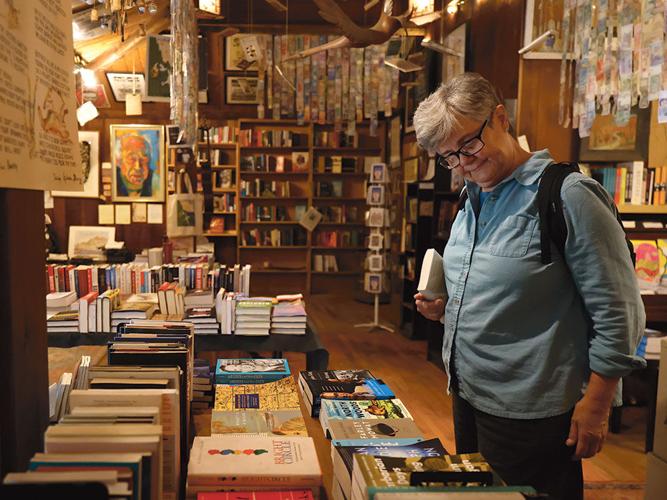
A visitor browses in the Henry Miller Library.
IN A SMALL, BARE REHEARSAL ROOM IN NEW YORK CITY, just a few blocks from Broadway, actor Dennis Leroy Kangalee and poet Magus Magnus are deep in the artistic process, rehearsing for Smile: A Clown’s Ascension for performances that start in less than two weeks on the other side of the continent. They co-wrote the play based on the 20-page text, written in 1948, about which Henry Miller wrote: “Of all the stories I’ve written this is perhaps the most singular.”
It’s nighttime already and when they turn on and off the lights in the room, marking scenes and light changes in the play, it is only their excited voices that can be heard in darkness.
“À votre service!” exclaims Kangalee, who embodies Auguste, a world-celebrated clown who struggles with his drive to make the public ecstatic, even if at the cost of his sanity or even life. He is able to jump into and out of the role within seconds; within the splits of a second his sweet smile can melt into Auguste’s profound sadness. He takes a seat at the dressing room, he looks into an imaginary mirror, feeds an imaginary horse a lump of sugar and reaches out toward the imaginary moon.
Smile: A Clown’s Ascension is a complex story where a plot is a pretext to show a drama of an artistic life and the price of doing art. Miller wrote it inspired by clown drawings of French painter and sculptor Fernard Léger (1881-1955), but also “Rouault, Miro, Chagall, Max Jacob, Seurat,” as he explains in the epilogue for the story, listing the whole bunch of modern European artists of the era. Léger, who commissioned the work, didn’t use Miller’s text after all, but The Smile took a life on its own and Miller soon equipped it with his own clown drawings.
There was something about the idea of the clown that clearly attracted him deeply; when reading the story it’s hard not to take some of the sentences as Miller’s own confessions, perhaps even more authentic than those he so keenly offers to us in his first-person autobiographical works, such as Tropic of Cancer, The Rosy Crucifixion, etc.
“Nothing could diminish the lustre of that extraordinary smile which was engraved on Auguste’s sad countenance,” we read about the hero of the story, the clown in crisis. He “wanted to endow his spectators with a joy that would prove imperishable… Each night the laughter became more jarring to his ears. Finally it became unbearable.”
These words make readers think about what’s behind an artist’s presentation to the world. How does it feel to be “the king of smut,” to be a jester, who tells his critic over and over again that he doesn’t care what they think? To quote from The Smile again: “The real Auguste no one knew, not even his friends, for with fame he had become a solitary.
“Very friendly and social. Usually reserved unless he has the floor. Then, he speaks enthusiastically, with a marvelous sense of humor, accentuating his remarks with gestures and grimaces. Often he claims, ‘I should have been a clown.’” These words were put down to paper by June Lancaster, Miller’s brief but observant romantic interest who lived with him in the summer of 1944.
Now, it’s been adapted for the stage by Kangalee of Kangalee Arts Ensemble, co-written and directed by Magus Magnus, and produced by Justine Stock of J. Stock Productions and the Henry Miller Memorial Library. It premiered on Oct. 15 and performances are scheduled at various local venues through Sunday, Oct. 19.
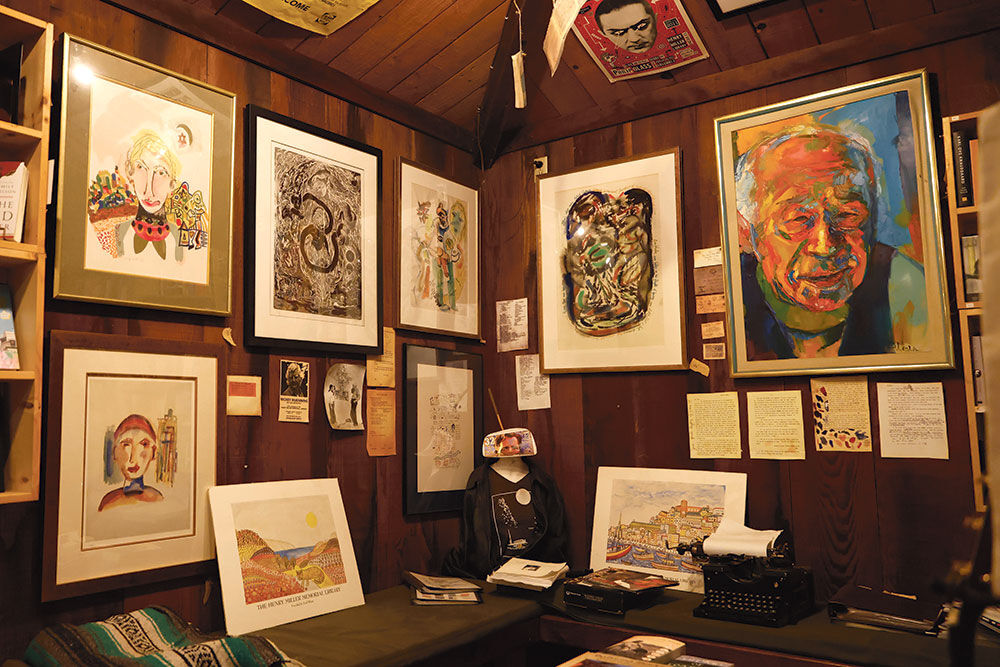
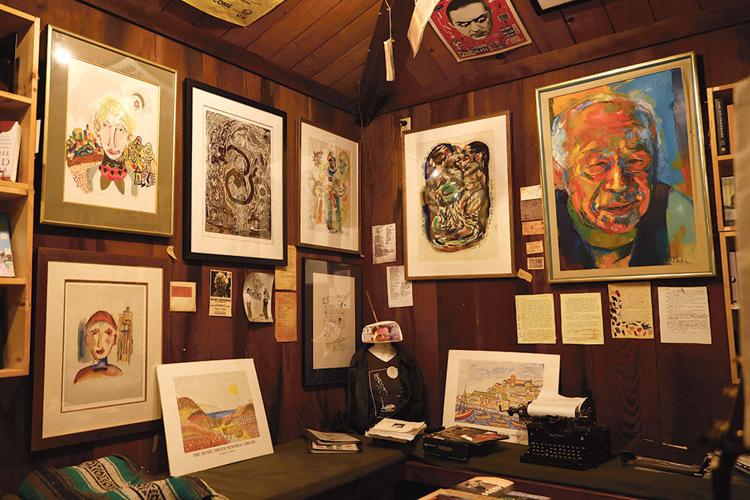
Henry Miller was not only a writer, but also a painter who worked in watercolor. Some of his works can be found at the Henry Miller Library in Big Sur .
KANGALEE AND MAGNUS are not the first people moved by The Smile at the Foot of the Ladder as a parable of an artistic life. Miller published and sold rights for the film years before Tropic of Cancer was published in the U.S. in 1961, Italian-Norwegian composer Antonio Bibalo made his breakthrough thanks to The Smile at the Foot of the Ladder opera, and in 1973 the famous French mime Marcel Marceau desperately inquired about the rights for the movie based on the story, thinking of Auguste’s story as his own.
“It’s been very spiritual,” Kangalee said, describing his experience with Miller’s text in a conversation with Torén (on A Big Sur Podcast in 2023). “It’s very strange; I’m not religious at all.”
The exact same words could be said by Henry Miller himself, who was not religious either but felt religiously about his quest of self-liberation he was determined to share with his readers. This sense of metaphysical, almost mystical mission is present whenever he defends the liberties he takes in his writing, obscenities being at the top of the list.
Not unlike Miller, Kangalee – who is based in New York but has performed locally at the Carl Cherry Center for the Arts in January 2025 in Krapp’s Last Tape by Samuel Beckett – gave up the mainstream for more ambitious art. He started his own company, the Kangalee Arts Ensemble, and risks – like Miller, like all ambitious artists – artistic obscurity.
Kangalee says reading The Smile at the Foot of the Ladder changed his life because he had read it in times when he considered giving up acting.
“There are people I know that are huge, huge movie stars, but they have absolutely no moral compass,” Kangalee said in the same interview. “Integrity is very important for me… And that’s something I’ve learned from Henry Miller, the idea that to be an artist you have to be really tough.”
In 2025, he shared the story with his friend, the poet Magus Magnus, who is based in the Washington, D.C. area. “We are honoring Henry Miller with this piece,” Magnus says during a break from a rehearsal that the Weekly attends via a video call.
Magnus adds they both admire in Miller his rebelliousness, but also his poetic drive, so palpable on the pages of The Smile. Who would have thought that the king of smut, the nonchalant jester could be so lyrical?
EXCEPT FOR A FEW CLICHES, Henry Miller barely exists in mainstream American culture.
Maybe the best proof of that is his absence from film and TV, mediums that stubbornly avoid Miller. That applies to his works – 1970 was the only time Tropic of Cancer was put on screen – but also to his own story. The last serious attempt to show Miller as a character was the 1990 movie Henry and June, largely forgotten by now and based on Anais Nin’s recollection, not Miller’s own.
(The literary and erotic relationship between Miller and Nin, who became famous thanks to her journals, was crucial to his development as a writer. Miller credited Nin for help with publishing Tropic of Cancer in 1934 and remained grateful to her until his death.)
In the 35 years since then, the only time Miller was portrayed on screen was in 2015 in Mara with Juliette Binoche, a short film based on his Quiet Days in Clichy, and then episodically, as a companion to Lawrence Durrell in the third season of British TV series The Durrells in Corfu that cannot be described other than as a family show.
In many ways, Miller experiences the same silence he did after he published Tropic of Cancer in 1934 in Paris; the curse continues. He always was and remains – taking out a brief experience with fame – unrecognized, at best disfigured in the popular imagination.
“As far as Henry’s notoriety and fame, that really didn’t start across America until the book [Tropic of Cancer] was published with this intense attention due to prosecutors charging the book with obscenity,” Torén says. “The attention was entirely focused on sex.” Only with passing decades, the atmosphere of the scandal around Miller’s work had simmered down.
Tropic of Cancer was the first of her father’s books that Miller’s daughter, Valentine Miller, read, at the age of 12. They were in Paris, she shares, with her brother and Miller’s fourth wife, Eve McClure, visiting writer Alfred Perles. “I asked Fred [Perles] what all the fuss was over the Tropic of Cancer, and he gave me a copy to read,” she writes by email. “I didn’t understand most of it, being a naive girl.”
These days, upon reading all her father’s books and essays, she points to The Books in My Life and Big Sur and the Oranges of Hieronymus Bosch as her favorites.
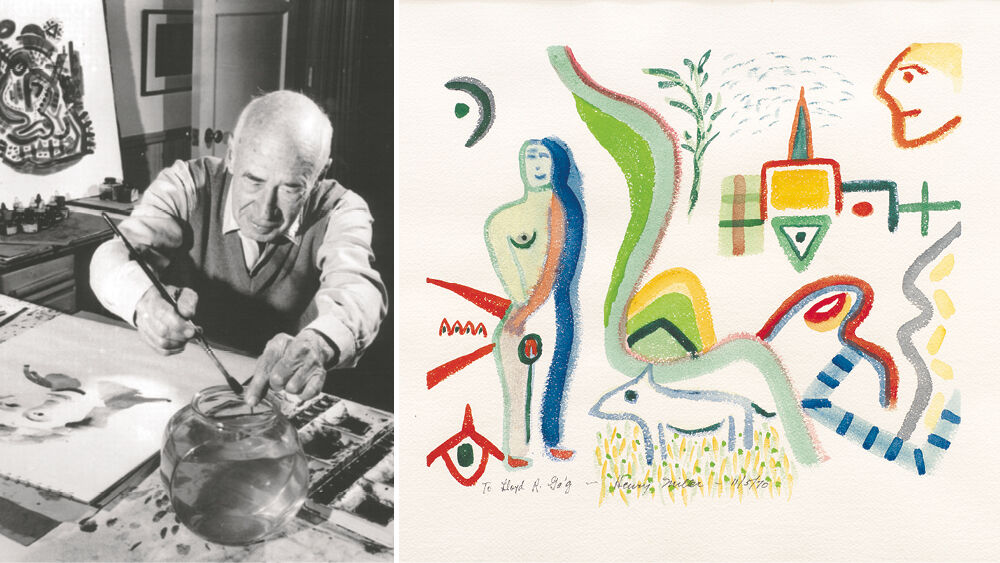
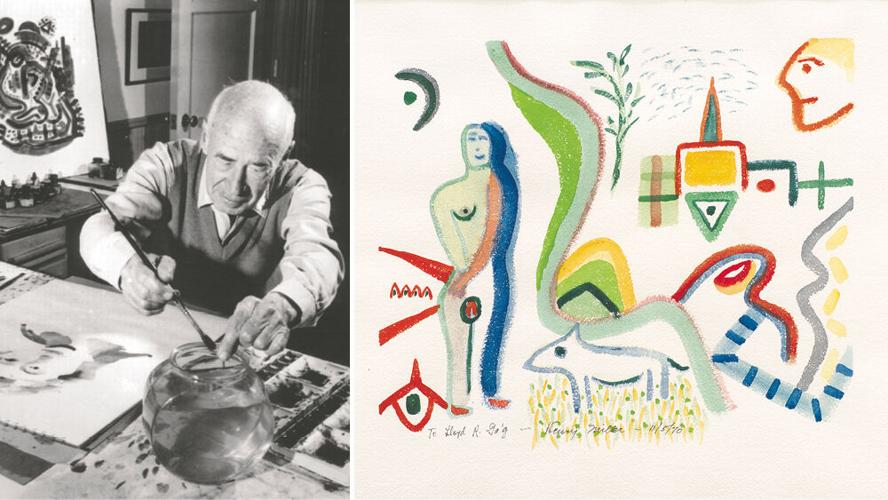
(left) The photo of Miller painting was taken by Gail Mezey at Miller’s home in Pacific Palisades, where he spent the last two decades of his life. (right) An untitled work of Miller’s.
AS IN THE CASE OF AUGUSTE, the world-famous clown, Miller’s story is a tragic one. Born in 1891 in Brooklyn, a son of a tailor, he left some traces in Paris (to an extent, popular imagination left him there), and he returned to the U.S. poor and unknown. He continued to be poor and rather unknown – international fame came first but wouldn’t really reach him during his 19 years in Big Sur, which he left only a couple of years after Tropic of Cancer was published. He became a writer late and even when he finally published, in Paris, he was already in his 40s. Add to this another 30 years of his books being banned during the “air-conditioned nightmare” of conservative post-war America; when Tropic of Cancer was published in the U.S. in 1961, Miller was 70 years old. That left him only 20 years to curate his stuff and enjoy being famous. And that leaves only a bit over 60 years, so far, for Henry Miller’s American scholars to start digesting his vast and multifaceted oeuvre.
The main Henry Miller biographies were released only in 1991. (Miller rejected the first attempt at his biography by Jay Martin, published in 1980 as Always Merry and Bright: The Life of Henry Miller: an Unauthorized Biography).
The more recent biographical takes are Robert Ferguson’s Henry Miller: A Life and The Happiest Man Alive: A Biography of Henry Miller by Mary V. Dearborn, who is the keynote speaker at the symposium in Pacific Grove, with a presentation titled “Nirvana Needed: Toward a New Henry Miller. What does Henry Miller have to say to us in the 21st century?”
Dearborn is in a great company. The “Henry Miller in the 21st Century” symposium gathers most important Henry Miller scholars, from above-mentioned Arthur Hoyle and David Stephen Calonne, author of the 2014 critical biography Henry Miller, to Roger Jackson – who compiled and in 1993 published Henry Miller: A Bibliography of Primary Sources – and Finn Jensen, who in 2017 wrote Henry Miller and Modernism: The years in Paris, 1930-1939.
Jackson and James Decker of Nexus: The International Henry Miller Journal will be present, as well as filmmaker Joe Kishton who made three Miller films: Henry Miller is Not Dead in 1991, The Genius and Mister Nobody in 2010 and this year’s American Venus et Le Guide Bleu: A Surrealist Journey with Henry & Brenda. A younger generation of scholars is well represented among the speakers, starting with Katy Masuga, the author of two Henry Miller monographs: Henry Miller and How He Got That Way and The Secret Violence of Henry Miller.
In other words, the whole Henry Miller universe, “all these Miller geeks from around the world,” to quote Torén, will gather in one place and at one time.
The scope of presentations is stunning. Henry Miller’s archival materials will be discussed, along with how to make them more accessible, plans for future Miller publishings and Miller’s reception in various countries, including Japan and India. Studies in comparative literature are included in discussions on how Miller influenced particular writers, such as Vietnamese poet-thinker Pham Cong Thien. The author of Tropic of Cancer will be discussed in the context of his watercolors, his trip to Greece, his time in Big Sur, as will larger concepts, such as anarchism or existentialism. All that will be combined with excursions to the Henry Miller Library and other relevant locations in Big Sur.
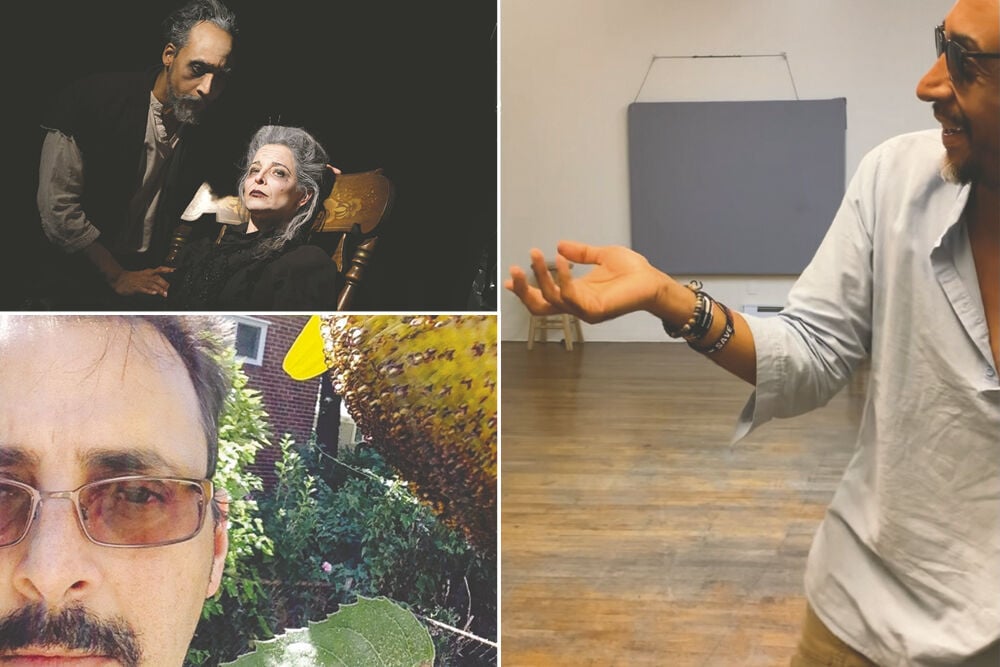
(top) Kangalee and Justine Stock (a producer for Smile) during their previous project together in January in Carmel. (right) Dennis Leroy Kangalee during rehearsal for Smile: A Clown’s Ascension in New York City. (bottom) Poet and Smile director Magus Magnus in a selfie. The play premiered on Oct. 15.
DURING FOUR DAYS OF PRESENTATIONS AND DISCUSSIONS, attendees will all witness Miller’s “most singular” story presented on stage. Smile: A Clown’s Ascension is not part of the official program of the symposium, “but obviously everyone who comes to the symposium is very aware of it,” Torén says, “and many of them are very excited about it happening.”
While Torén can only speculate about how much of himself Miller saw in the character of Auguste, the world-famous clown, he says he’s sure “Henry had had those subjective thoughts when he put the character on the page. I guess there are so many aspects to the role of the artist, such as the role of the artist in relationship to his audience. Henry Miller was always, of course, battling with this, in a sense that he was torn between writing just subjectively to try to figure out what it is that he was doing, and writing for an audience to tell something that he felt strongly about. And, as a character, Auguste is doing exactly that.”
(0) comments
Welcome to the discussion.
Log In
Keep it Clean. Please avoid obscene, vulgar, lewd, racist or sexually-oriented language.
PLEASE TURN OFF YOUR CAPS LOCK.
Don't Threaten. Threats of harming another person will not be tolerated.
Be Truthful. Don't knowingly lie about anyone or anything.
Be Nice. No racism, sexism or any sort of -ism that is degrading to another person.
Be Proactive. Use the 'Report' link on each comment to let us know of abusive posts.
Share with Us. We'd love to hear eyewitness accounts, the history behind an article.