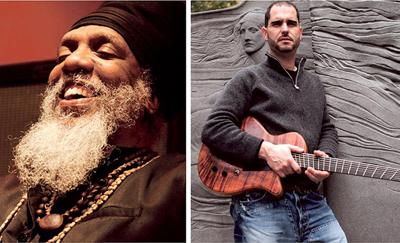

Even if you never step foot inside the main stage arena this weekend, you’ll be thoroughly inundated with jazz greats all three days of the Monterey Jazz Festival – from up-and-coming Grammy-nominated jazz/soul vocalist Gregory Porter(10:30pm Friday; Dizzy’s Den) and sax-master son of jazz genius pedigree Ravi Coltrane (8pm Saturday; Dizzy’s Den) to rising roots jam band California Honeydrops (1:30pm Saturday; Garden Stage) to the legendary sax-man behind Alligator Bogaloo Lou Donaldson (2pm Sunday; Dizzy’s Den and 7pm Sunday; Night Club).
In addition to being masters at their craft, many of these musicians represent some of the hardest-working forces in the jazz game. Seven-string guitarist Charlie Hunter and drummer Scott Amendola (9:30pm Saturday; Dizzy’s Den) can’t even remember the last time they weren’t on the road. So, they decided to use that as the central motif of their 2012 record, Not Getting Behind is the New Getting Ahead.
“Traveling around takes a lot,” Hunter says. “We’ve been on tour for a long time, so that’s pretty much what we’re dealing with on a daily basis.”
Hunter plays custom-made seven – and eight-string guitars that enable him to simultaneously rock the rhythm, bassline and lead; he’s released more than 20 records and is considered by jazz critics to be one of the most technically fluent modern-day jazz guitarists working. Amendola, meanwhile, has scored a Grammy nod and is one of the Bay Area’s most touted jazz musicians.
But making a living is still an arduous endeavor for the pair, and dedication is the key tool implemented to ensure their survival.
“Persevering is important for the small guys like us,” Hunter explains. “Some years are going to be better than others, and you just always work at your craft, no matter what.”
Not Getting Behind is the New Getting Ahead – featuring funk-driven blues derivatives like “Rust Belt” – was recorded without any “mixing, fixing” or headphones; Hunter has always prefered recording without using any overdubs.
“Generally we play live, that’s what we do, and we just decided it made sense to [record] that way,” he says. “It was mixed by Dave McNair while we were recording right to tape, like the old way of doing things. Recording without headphones for me is really a key way to record just ‘cause it’s what we do. I like that more natural sound, but some people like it much more when you’re able to tailor and manipulate things in a mix. But I like to just do it and be done with it, like the old guys did it.”
Last July, the duo managed to record another LP, Pucker (it will be on sale at MJF), featuring eight new tracks penned by Amendola and one by Amendola’s grandfather.
“I wrote music specifically with Charlie in mind, and we recorded it similarly to the last album with engineer Dave McNair and live mixing,” Amendola says. “It’s very hard to write specifically for someone. I’ll work on a melody or a bassline and put it down on paper and send [Charlie] a bunch of charts, since we don’t live near each other. Then I just let him do his thing with it. Ultimately, I’m working with him because I want his voice and I want his interpretation of my music. That’s how the music is going to be the best it could be.”
Hunter says their sets are a mix of music from both recent albums along with a whole onslaught of covers, from Bessie Smith to The Impressions, ensuring every night is different from the last.
Hammond B3 organist Dr. Lonnie Smith (9pm Sunday; Dizzy’s Den) is another example of one of the jazz world’s hardest workers – in his case, he’s been doing it for half a century. Smith, who was named Organ Keyboardist of the Year in 2003, 2004, 2005, 2008, and 2009 by the Jazz Journalist Association, still enjoys reflecting on the early days when his love affair with the organ began.
“I used to hear it a lot from folks like Wild Bill Davis and in churches, and I thought the organ was just a beautiful instrument,” he says. “Not only did it sound good, it looked beautiful. But I never really thought I’d be playing something like the organ because I was a singer.”
Smith remembers a music store in his hometown of Buffalo, N.Y., where he’d hang out for hours just gazing at all the shiny instruments he couldn’t afford. One day after closing time, the store owner took Smith into the back room, where he revealed a brand new B3 organ.
“My eyes lit up,” Smith recalls. “The [store owner] said that if I could get it out of the shop, it was mine. I got it into my house and pushed all the buttons and pulled all the stops, and I did everything possible, and it didn’t say one thing bitchin’, it just made a lot of sounds.”
Smith called on a buddy who played organ to show him how everything worked.
“That was it,” he recollects. “That’s all I needed, just a little help from my friends. Once I learned how to work the stops, I taught myself how to play it by ear.”
From that point on, Smith began scoring gigs around Buffalo and beyond, and hooking up with then-unknowns like George Benson, Jack McDuff and Lou Donaldson, who enlisted Smith to play on his now-classic Alligator Bogaloo.
“I didn’t realize that this was the beginning of something that was going to get bigger,” he says. “I was just enjoying myself.”
Following Smith’s 1966 debut Finger-lickin’ Good came his 1968 Blue Note debut Think!, arguably one of the greatest B3 organ jazz records ever made. Smith, along with Lee Morgan (trumpet), David Newman (tenor saxophone and flute) and Herman Henry and Melvin Sparks (guitar), generated a slow, funky groove that rocks with the meticulousness of a pendulum throughout all five tracks, including a soulful take on the traditional “Three Blind Mice.”
“I had no idea that [Think!] would really take off,” Smith says laughingly. “The rhythm felt good, the music felt good and I still had no idea that this album was so big until I started headlining concerts with a lot of Motown groups. I had no idea. I played those songs because I always liked those kinds of songs. I didn’t realize I was going to be stuck with those songs for the rest of my life.”
Smith went on to record more than 20 albums and even a few cover records, like Purple Haze: A Tribute to Jimi Hendrix andBogaloo to Beck: A Tribute.
At 71 years old, Smith is eager to bring his soulful organ touch to several tunes, but “Phantom of the Opera” sits at the top of his list.
“I think all music is important,” he says. “If I don’t feel music, I don’t really want to play it. It has to say something to me. I believe that all music has a venue: classic, rock, country is all valid. I don’t play something because I want to make a hit; I play it because I like that song. If I play a song I don’t like, how are people going to feel me?”
THE MONTEREY JAZZ FESTIVAL happens 6pm-midnight Friday, 11:30am-midnight Saturday and 11am-11:30pm Sunday at the Monterey County Fairgrounds, 2004 Fairgrounds Rd., Monterey. $225-$335 three-day arena; $66 Friday arena; $132 Saturday or Sunday arena; $125/three-day grounds; $50/military or student three-day grounds; $40 Friday grounds; $50 Saturday or Sunday grounds. 394-8432.www.montereyjazzfestival.org/2013.
(0) comments
Welcome to the discussion.
Log In
Keep it Clean. Please avoid obscene, vulgar, lewd, racist or sexually-oriented language.
PLEASE TURN OFF YOUR CAPS LOCK.
Don't Threaten. Threats of harming another person will not be tolerated.
Be Truthful. Don't knowingly lie about anyone or anything.
Be Nice. No racism, sexism or any sort of -ism that is degrading to another person.
Be Proactive. Use the 'Report' link on each comment to let us know of abusive posts.
Share with Us. We'd love to hear eyewitness accounts, the history behind an article.