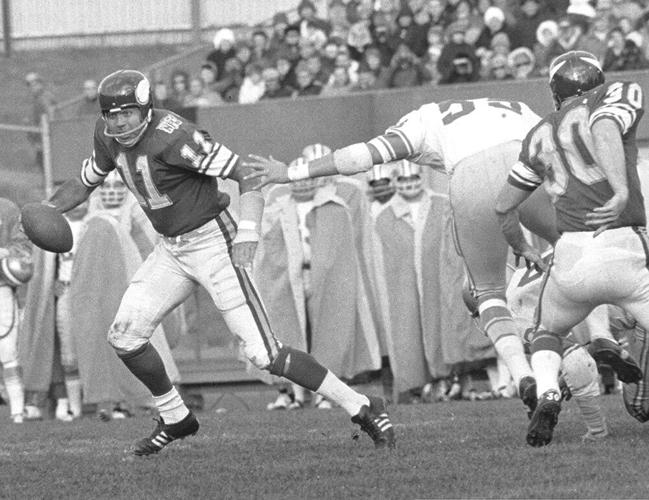
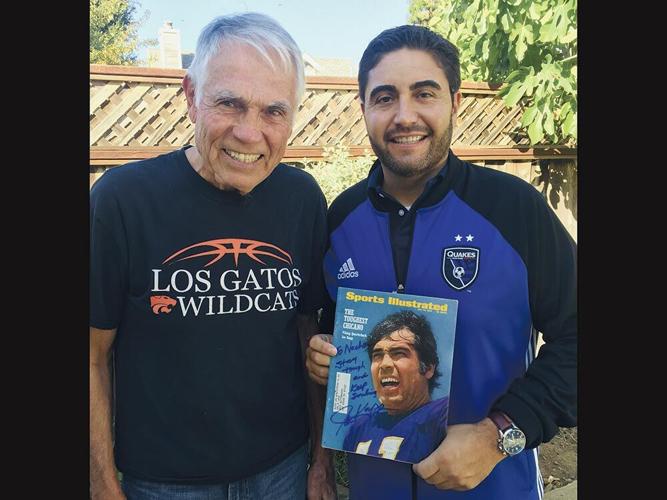

Joe Kapp was born in Santa Fe, but he was made in Salinas.
A football player who Sports Illustrated once dubbed “The Toughest Chicano,” Kapp was a man of many facets: a husband, a father, an older brother and son. And, an athlete. But none of those things are what set him apart.
What made Kapp special is that he was a leader, and above all, a fighter, both on the field and in the world.
Kapp was never inducted into the NFL Hall of Fame – he played most of his professional career in Canada – but he left a lasting impact on the sport that resonates to this day. In 1972, he sued the league over a contract dispute with the New England Patriots that ended his football career.
This came after Kapp had lent his weight to La Causa, the yearslong fight Cesar Chavez led on behalf of farmworkers’ rights. Kapp told a group of protesters in L.A. in 1970 – the peak year of his fame – that he’d picked grapes and lettuce himself. “I’ve seen their agony… Steinbeck didn’t describe half the scene.”

While Kapp’s size is the current prototype for a modern NFL quarterback, he was big in his day. He was also a bruiser.
In 1974, Kapp prevailed in his lawsuit against the NFL, although he was never awarded monetary damages.
But to this day, the NFL players making millions have Kapp to thank, at least in part – he was the first athlete to poke the bear, to stand up for what he thought was right.
He reportedly told a crowd of 15,000 at a farmworkers’ protest in 1970, “Get off your knees; unite!… Fight!… Fight the bastards!”
That was Joe Kapp, a singular man, someone who could be at home both in Hollywood – he appeared in several films and TV shows – or in the barrio, the word he used to describe the neighborhoods of his youth.
Kapp’s eldest son, J.J., absorbed that spirit, and went on to become a public defender in Santa Clara County. In retirement, he helped his dad, who’d long suffered from dementia brought on at least in part by head injuries he suffered playing football, complete his memoir, Joe Kapp – “The Toughest Chicano,” which first printed in 2019. The heart of the book was written in 1988 and ’89 by Joe Kapp and Ned Averbuck, but J.J. and his friend Robert Phelps brought it to the finish line. Most of the book is about football and details chapters of his career, but all throughout, it’s sprinkled with his wisdom – Kapp may have been a fighter, but he was also studious, as a great quarterback must be. In a game of X’s and O’s and ever-changing formations, to be good at playing quarterback – the most singular position in sports – you have to be smart.
There is now a second edition of that book with an afterword written by Jim Rainey, a journalist with the Los Angeles Times who is also a UC Berkeley alum, that delves deeper into what is arguably the most incredible play in football history. It happened in 1982 in a game between Stanford and Cal when Kapp, who’d played quarterback at Cal in the late ’50s, was in his first season as Cal’s coach decades later. To this day, it’s still known as “The Play.”
The National Steinbeck Center in Salinas is hosting an author’s talk on Saturday, May 18 with J.J. Kapp and coauthor Phelps, along with Rainey. Ignacio Ornelas Rodriguez, a Salinas native and a historian at Stanford who focuses on civil rights and social movements, will moderate a panel discussion, and sale proceeds from the book will go toward two one-time yearly scholarships of $2,500 that go to college-bound seniors at Alisal High.
Kapp died on May 8, 2023 – just over a year ago – at the age of 85 at his home in Los Gatos, and per his wishes, his brain was sent to UCSF for study.
On Feb. 29, UCSF doctors reported back to Kapp’s family that he had suffered the most advanced form of chronic traumatic encephalopathy, aka CTE, a condition affecting the brain that’s impacted many former professional football players. It’s because of CTE that the rules of football keep changing – the league is at least making a show of trying to protect its players.
CTE’s symptoms can manifest in myriad ways, with depression and memory loss among them.
But would Kapp still have played today, as a kid in Salinas, knowing all we know now?
There is no doubt the answer is yes.
“There are many good things about football,” Kapp wrote at the end of his memoir, “most importantly, providing an outlet for the violence that exists in the souls of men. Men are born for games.”
And Kapp was a gamer with the best of them, and now, just over a year after his passing, the second edition of his memoir provides an opportunity to look back on the life of a man who spent his formative years in Salinas, proving his toughness, and who later became a national celebrity.
Kapp lived a fascinating life, but unlike Chavez, he’s not widely celebrated locally. And while he wasn’t born in Salinas and didn’t attend high school there past the 10th grade, in every other way, he was a native son.
KAPP WAS BORN IN SANTA FE, NEW MEXICO, IN 1938. He was the first-born. The heating source in an adobe house he was born in was a pot-bellied stove fueled by coal, or sometimes 2-by-4s his dad would steal from construction sites and then saw into pieces.
In his memoir, Kapp describes his dad Robert Douglas, aka R.D., the son of German immigrants, as a “charming alcoholic” and a “natural-born salesman who loved to gamble.”
His mom, Florence, a Mexican-American, was 17 when Kapp was born, and she proved to be the rock in the family – he calls her “the Toughest Chicana.”
R.D. moved the family to San Fernando in Southern California when Kapp was 2, and his years living there would prove to have a lasting impact. “As a small boy I did not really appreciate the significance of living in a neighborhood without sidewalks,” Kapp wrote. “Eventually, I learned that meant we lived in the barrio section of town.”
Kapp’s parents spoke Spanish at home, but his mom discouraged him from speaking it in public – “She knew that English was the language to compete in the world.”
It was in those early years that Kapp got his first taste of competition: “As a little kid in San Fernando, I liked school, and I liked sports even more.”
A family friend in the neighborhood who was a fan of horse racing took Kapp to watch the races in Santa Anita one day, and it left an impression that stuck. “It was at Santa Anita that I first heard that unmistakable and exhilarating roar of the crowd,” Kapp wrote. “I knew then that the roar of the crowd was something special. It was a calling.”
Kapp’s dad, after spending time in the military during World War II, got a job in Salinas in 1947 selling cookware and equipment for the Wearever Company. The family lived in a three-bedroom unit in a GI housing Quonset hut just across the street from El Sausal Middle School, which Kapp would attend.
“We had no organized sports, so we chose up sides and created our own games, and we had to be resourceful because we couldn’t afford sporting equipment,” Kapp wrote. “Sometimes we used lettuce heads instead of footballs.”

Kapp and Ignacio Ornelas Rodriguez, a Salinas native and Stanford historian who’s moderating a panel discussion among the authors at the May 18 event at the Steinbeck Center.
In that environment, Kapp also helped take care of his younger siblings while his parents were working, and invented games for them to play together. He also got into some scraps, including one in grade school with a “bigger kid” who called Kapp “a dirty Mexican.” (Kapp describes the population of his neighborhood at that time as “two distinct groups – Okies and Latinos.”
Not long after that, a boy who later became Kapp’s friend and teammate, Bob Sartwell – the biggest kid at the time – rolled Kapp’s basketball down a hill. Kapp cried on his mom’s shoulder, but got no sympathy. “She told me to go right back out and settle it. I did, but without a fight.”
But it was his time in Salinas that instilled in Kapp the need to stand up for himself, and guided him through the rest of his life.
“Growing up in this competitive town was good for me,” Kapp wrote. “I learned early in life that if you don’t stand up for yourself, you get squashed.”
It was also in Salinas, while in the seventh grade, that one of his teachers at El Sausal took their class on a field trip to visit UC Berkeley. “Walking through Sather Gate onto campus and past Memorial Stadium was like walking into the center of the universe,” Kapp wrote. “Prior to this, all I knew were barrios, lettuce fields, and Quonset huts.”
Cal would remain central in the rest of Kapp’s life, as would Everett Alvarez, his classmate at El Sausal who joined him on that trip, and whose life is a legend in its own right. (Everett Alvarez High School in Salinas is named for him.)
Kapp’s family moved back to southern California when he was in the 10th grade, and it was there, for Hart High in Santa Clarita, that he finally got a chance to prove himself on the field as a quarterback. He was offered a scholarship to play at Cal, but the school was out of football scholarships, so they offered him a basketball scholarship, which he took – he was a two-sport collegiate athlete. But it was the gridiron that was his calling.
Kapp excelled on the football field and led Cal to the Rose Bowl in 1958, a feat the team hasn’t achieved since. He was also named an All-American.
The Washington Redskins (now called the Commanders) drafted him in 1959, but they never called him up, something that would be unheard of in today’s NFL.
So Kapp packed his bags for Canada, where he played in the Canadian Football League for the next eight years before finally landing in the NFL with the Minnesota Vikings in 1967.
Two years later, he led them to the Super Bowl.
WILL KAPP, Kapp’s youngest son, says growing up with his father “was like growing up around a superhero.”
And despite the brain damage his dad suffered as a result of playing the sport, Will, who also played football at Cal, is sure his dad wouldn’t have changed a thing, even knowing the outcome.
“He called it ‘the call of the ball,’” Will says. “Smashing people, throwing the ball and scoring.”
That tracks with a statement Kapp made in 1970, fresh off a season in which he led the Minnesota Vikings to the Super Bowl, when he told a journalist from True magazine, “It’s an animal game. I’m an animal. Any guy good at it is an animal.”
In his memoir, Kapp also includes a quote from Cormac McCarthy’s novel Blood Meridian – arguably one of the greatest novels ever written, but which is also among the most violent. It reads: “‘Men are born for games. Nothing else. Every child knows that play is nobler than work. He knows too that the worth of the game is not inherent to the game itself but rather in the value of that which is put at hazard.”’
The character who said that was Judge Holden, a murderous sociopath who was the story’s charismatic, well-educated villain. Literature critic Harold Bloom wrote that Holden’s character in the book was, “short of Moby Dick, the most monstrous apparition in all of American literature.”
But Kapp wasn’t a sociopath, he was channeling Holden as a graduate of the school of hard knocks, of which Kapp took plenty.
The first line of Kapp’s memoir reads, “I’ve never liked bullies,” which leads into a description of a dustup he had with a fellow football player in the CFL, Angelo Mosca. They were both invited onstage at a banquet in Vancouver in 2011, celebrating retired CFL players, and Kapp saw fit to settle a score about what he believed to be a late, dirty hit from a Grey Cup game in 1963. (The Grey Cup is the CFL’s Super Bowl.) Mosca didn’t hit Kapp, he hit star running back Willie Fleming, putting him out of the game.
So Kapp, at age 73, waved some flowers in Mosca’s face in a provocative peace-making gesture, and Mosca – who required a cane to get around – whipped his cane at Kapp’s head.
Kapp reflexively punched Mosca in the jaw, knocking him down.
It may not have been a good look for anyone involved, but that’s who Joe Kapp was – he had no tolerance for bullies.
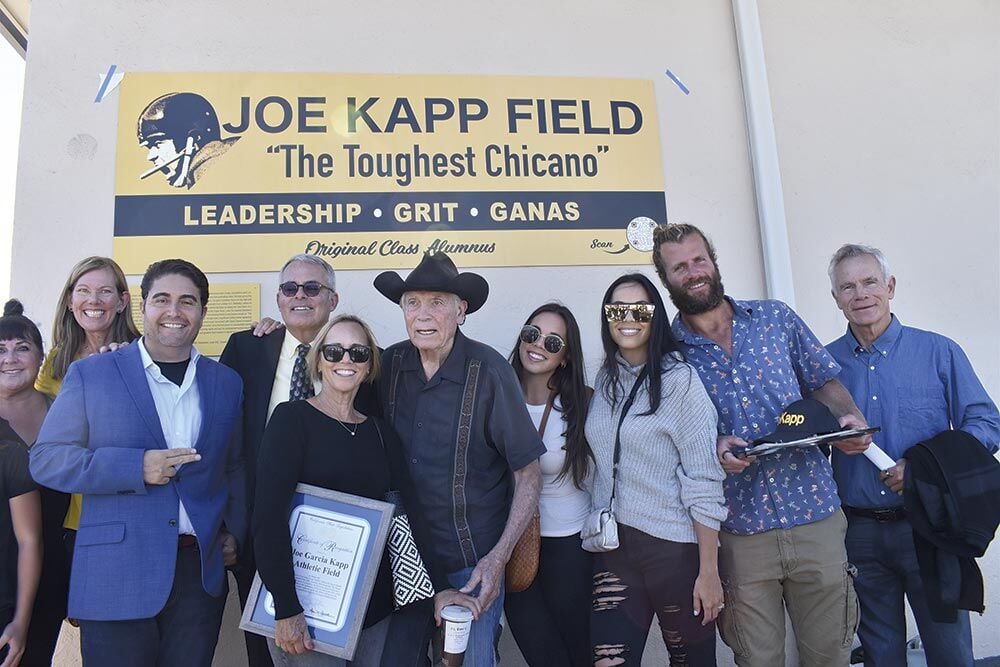
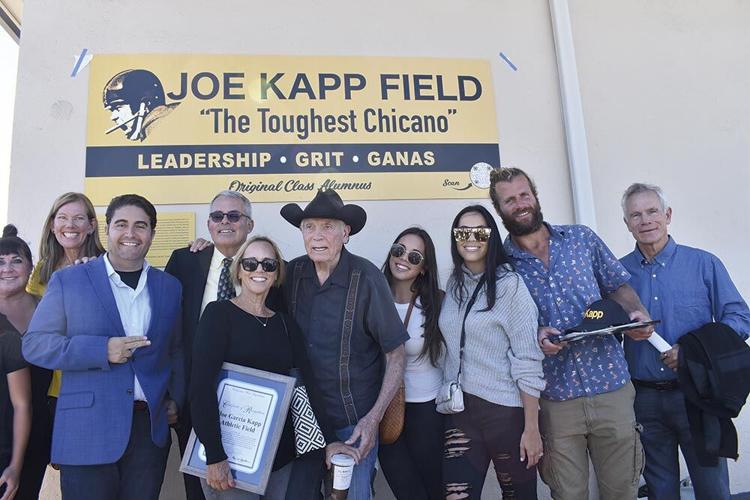
Kapp, wearing a cowboy hat, surrounded by his friends and family when El Sausal’s athletic field was named after him in 2022.
THE NFL WAS A BULLY IN KAPP’S MIND. In a time of civil rights ferment, and galvanized by the work Chavez was doing on behalf of farmworkers, Kapp fought the league in an antitrust lawsuit over player contracts, and in 1974, he won.
The lawsuit called into question the power that teams, and the league, had over players’ contracts – in a free market, players would be free to play where they wanted and not be forced to sign a contract they felt was unfair.
While he never got any money out of it – a federal court jury in 1976 decided he wasn’t financially hindered by the contract rules, as they existed at the time – his lawsuit helped pave the way for modern-day free agency, in which players have more control over where they play, and in turn, how much money they make.
“He was tough enough to give up his career to do the right thing. That’s unique, that’s unusual,” his son J.J. says. “No one else was able to take that fight… he decided enough was enough.”
Kapp was vilified by some in the sports world during that lawsuit but, J.J. says, “He wasn’t afraid to fight for a cause that was just.”
J.J., like Will, says nothing could have kept his dad from playing football – Kapp proudly played through injuries throughout his career – even though Kapp encouraged other parents to have their kids take piano lessons instead.
“He loved doing it,” J.J. says. “He made a good living for his family, and that was his number-one priority.” Or as Will says, he was called to the ball.
As Kapp aged, dementia set in, and his memory and faculties started slipping over a decade before he died last year. But he lived long enough to see the athletic field at El Sausal Middle School named after him in 2022 with a sign that reads: “Joe Kapp Field – ‘The Toughest Chicano’ – Leadership – Grit – Ganas.”
The latter word roughly translates from Spanish to “a desire to win,” and that was always Kapp’s primary drive. And it was in Salinas where that drive was instilled in him, in a community that helped shape him into a competitor.
Ornelas Rodriguez, who spearheaded the effort to name El Sausal’s field after Kapp, thinks there should also be a local school – not just a field – named after him, like Kapp’s middle school friend Everett Alvarez, who became a lifelong friend.
At the very least, though, it seems Kapp should have a greater stature in local lore, and in hearts and minds.
When he was addressing a crowd of 15,000 in L.A. in 1970, he urged protesters to “fight… fight the bastards!” Al Stump, the journalist who wrote the profile of him for True magazine that year, wrote, “You could feel the building shake before Kapp finished.”
That was the power of Joe Kapp.
His former teammate on the Minnesota Vikings, Alan Page, who would later serve more than two decades as a justice on the Minnesota Supreme Court, told J.J. in an interview that’s the foreword to Kapp’s memoir, “Who he was and what he did as a football player made us better than the sum of our parts… His spirit and focus were magic.”
That’s the magic being celebrated at the Steinbeck Center on May 18 to honor a singular man.
The lessons Kapp learned playing football – and that he taught to players he coached – are timeless, and he exuded them.
“What you looked like didn’t matter to me,” Kapp wrote. “I cared about what kind of person you were. Did you pull your weight? Did you give your all for your team? Did you help others to do their best? Playing football, I wasn’t concerned with the skin color of a lineman or what side of the tracks he grew up on. I was more concerned about whether he could stop a defensive end from throwing me into the cheap seats. Growing up in Salinas did help me appreciate people from the inside out.”
That said, no one was going to try to throw Kapp, who stood at 6-foot-2 and weighed 215 pounds, into the cheap seats, not unless they wanted their jaw to collide with his fist.
MEET THE CO-AUTHORS of the second edition of Joe Kapp – “The Toughest Chicano” in an event 5:30pm-7pm on Saturday, May 18 at the National Steinbeck Center, 1 Main St., Salinas. Free. steinbeck.org/event.
----
Corrections (5/16/24): This story has been corrected from its printed version to reflect that the two scholarships being offered in Kapp's name, as it relates to his memoir sales, both go to college-bound Alisal seniors (instead of one going to a Latino student entering their first year at Cal—that's a separate Kapp-related scholarship).
Additionally, the name of Kapp's high school has been corrected from Newhall to Hart. (Newhall was the name of the high school's town, which is now part of Santa Clarita.)
The Weekly regrets the errors.
(1) comment
I wish I'd had the chance to meet him. I unknowingly followed in his footsteps, growing up on the other side of the tracks from Alisal (South Salinas). I followed him into the fields, harvesting lettuce, and later growing crops. I followed him to Cal (Class of 1972). And I despise bullies. A truly remarkable man forged from our wonderful Salinas Valley. Thanks for a wonderful romp down memory lane.
Welcome to the discussion.
Log In
Keep it Clean. Please avoid obscene, vulgar, lewd, racist or sexually-oriented language.
PLEASE TURN OFF YOUR CAPS LOCK.
Don't Threaten. Threats of harming another person will not be tolerated.
Be Truthful. Don't knowingly lie about anyone or anything.
Be Nice. No racism, sexism or any sort of -ism that is degrading to another person.
Be Proactive. Use the 'Report' link on each comment to let us know of abusive posts.
Share with Us. We'd love to hear eyewitness accounts, the history behind an article.